
- PromptQuorum : Dispatch vers 25+ modèles — idéal pour comparer plusieurs LLM
- Braintrust : Évaluation + observabilité (juges LLM, feedback humain, tracing production, contrôles CI/CD) — Gratuit / 249 $/mois Pro
- Confident AI : Évaluation automatisée avec 50+ métriques intégrées et red teaming — 19,99 $/utilisateur/mois Starter
- Vellum : Déploiement en production avec monitoring et tests A/B — 200–500$/mois
- Promptfoo : Tests open-source gratuits pour les pipelines CI/CD
- PromptHub : Versioning style Git avec collaboration en équipe — 50–300$/mois
- LangSmith : Observabilité et tracing pour LangChain — gratuit avec options premium
- Stratégie : Commencez avec PromptQuorum + Promptfoo (gratuits), ajoutez le versioning tôt, l'évaluation seulement si nécessaire
Quel problème résout chaque outil ?
Les équipes de prompt engineering font face à cinq goulots classiques : (1) évaluer la qualité (précision, ton, factualité), (2) tester automatiquement en CI/CD, (3) versionner et revenir à une version antérieure, (4) déployer en production avec monitoring, (5) comparer et dispatcher vers plusieurs modèles. Chaque outil se spécialise sur un ou deux. L'appairage correct économise des mois et prévient les défaillances coûteuses.

Où s'inscrit PromptQuorum ?
PromptQuorum résout le problème central que les cinq autres ne résolvent pas : comparer et dispatcher vers plusieurs modèles. Avant d'évaluer ou tester, vous devez choisir quel modèle (GPT-4o, Claude 4.6 Sonnet, Gemini 2.5 Pro, Llama 3.1, etc.) fonctionne le mieux. PromptQuorum envoie le même prompt à 25+ modèles simultanément, affiche les différences en qualité, vitesse et coût, et facilite le choix avant d'investir dans Braintrust, Promptfoo ou Vellum.
- Dispatch multi-modèle : Envoyez un prompt à 25+ modèles en parallèle
- Comparaison directe : Qualité, latence, coût par token — tout sur un écran
- Gratuit : Testez toutes les fonctionnalités sans carte de crédit
- Décision rapide : Trouvez le modèle optimal avant d'acheter des outils d'évaluation
Qu'est-ce que Braintrust ? Évaluation, observabilité et ground truth
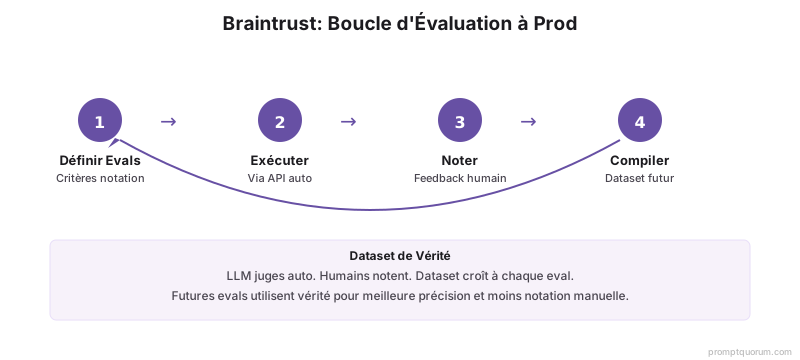
Braintrust est devenu une plateforme complète d'observabilité et d'évaluation suite à sa levée de fonds Series B (80 M$, fév. 2026, valorisation 800 M$). En plus de la boucle d'évaluation principale (juges LLM, feedback humain, gestion de datasets), il couvre désormais : le tracing en production (spans, latence, coûts), les contrôles qualité CI/CD, l'intégration serveur MCP et un Playground pour la comparaison de modèles côte à côte.
- Boucle d'évaluation : Quatre étapes de définition à dataset de vérité
- Juges LLM + humains : Combine automatisation et jugement manuel
- Effet dataset : L'accumulation devient signal d'entraînement pour de meilleures evals
- Tarifs : Gratuit (1M traces, 10 k scores, utilisateurs illimités) ; Pro 249 $/mois ; Enterprise sur devis
- Tracing en production : enregistre chaque span, latence et coût aux côtés des résultats d'évaluation
Qu'est-ce que Vellum ? Déploiement, workflow builder et monitoring
Vellum a évolué bien au-delà du déploiement en production pour devenir une plateforme LLM complète. Fonctions principales : tests A/B, canary rollouts, fallback chains, tableau de bord de monitoring pour latence et coût. Nouveautés : workflow builder visuel drag-and-drop, SDK Python pour des pipelines définis par code, intégration RAG pour la récupération de documents, LLM Leaderboard pour le benchmarking de modèles, et référencement sur AWS Marketplace pour les achats enterprise.
- Monitoring de prompts : Enregistre texte, réponse, coûts, latence par request
- Tests A/B : Comparez différents prompts en production sur le trafic réel
- Observabilité IA : Pas des métriques infra génériques, mais des signaux spécifiques
- Tarifs : Tier gratuit disponible ; Pro 500 $/mois ; Enterprise sur devis
- Workflow builder visuel : construction d'agents par drag-and-drop sans code de pipeline
Promptfoo : Tests open-source
Promptfoo est la colonne vertébrale des tests en CI/CD. Gratuit, open-source (GitHub), local ou pipeline. Vous écrivez des cas de test en YAML (entrée + sortie attendue), Promptfoo les exécute, évalue et affiche les taux de réussite. Avantage : vous attrapez les régressions avant la production. Inconvénient : vous devez définir des tests binaires — Promptfoo ne mesure pas "comment c'était la réponse", juste "correspond-elle ?".
- Gratuit : Repository GitHub, exécutable localement
- Intégration CI/CD : Teste les prompts automatiquement à chaque commit
- Config YAML : Les cas sont versionnable comme du code
PromptHub : Versioning style Git
PromptHub est Git pour les prompts. Comme le code, le versioning doit commencer le jour 1 — pas seulement quand une régression force la main. PromptHub offre versioning, branches, merges, collaboration. Modifiez, testez en branche, collectez du feedback, mergez. Cela empêche les équipes d'écraser accidentellement un prompt ancien et facilite le rollback si une modification casse la production.
- Versioning : Chaque changement comme un commit code
- Branches & merges : Testez avant production
- Accès équipe : Prompts partagés avec workflows d'approbation
- Tarifs : Gratuit (prompts publics) ; Pro 12 $/mois (solo, prompts privés) ; Team 20 $/utilisateur/mois
LangSmith : Tracing pour LangChain
LangSmith est l'observabilité dédiée aux systèmes LangChain (chains, agents, RAG). Il enregistre chaque étape (retrieval, transformation, appel LLM, parsing), visualise l'historique d'exécution et permet de déboguer chaque étape. Si vous n'utilisez pas LangChain, LangSmith ne s'applique pas. Mais pour les chains ou agents, LangSmith est essentiel pour voir où ils échouent.
- Chain tracing : Visualise chaque étape d'une chaîne LangChain
- Débogage : Voit exactement quelle étape échoue et pourquoi
- Gratuit : Tracing basique gratuit, features avancées optionnelles
- Tarifs : Developer 0 $/siège/mois (5 000 traces/mois) ; Plus 39 $/siège/mois ; Enterprise sur devis
Qu'est-ce que Confident AI ? Évaluation automatisée et red teaming LLM
Confident AI (plateforme basée sur le framework open-source DeepEval) est la principale alternative à Braintrust pour l'évaluation automatisée. Là où Braintrust mise sur le feedback humain et l'accumulation de datasets, Confident AI met l'accent sur des métriques prédéfinies : 50+ scorers intégrés (factualité, pertinence, hallucination, toxicité, G-Eval, etc.) sans configuration manuelle requise. Utilisé par Panasonic, Amazon et BCG. Tracing à 1 $/Go-mois (vs 3 $/Go en plan Pro Braintrust).
- 50+ métriques d'évaluation prêtes à l'emploi — aucune configuration de scorer requise
- Simulation multi-tours et tests de pipeline HTTP de bout en bout
- Red teaming intégré : OWASP Top 10 pour LLM, alignement NIST AI RMF, détection de jailbreak
- Tarifs : Gratuit (5 exécutions de test/semaine, 2 sièges) ; Starter 19,99 $/utilisateur/mois ; Premium 49 $/utilisateur/mois ; Enterprise sur devis
Comparaison directe
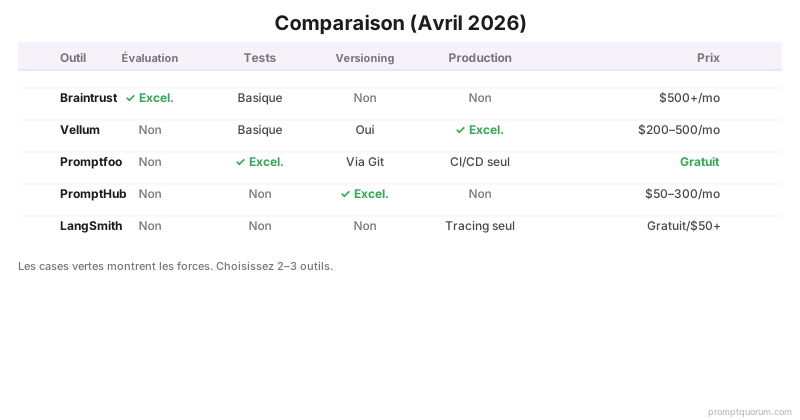
Ce tableau montre comment les six outils se comparent sur rapidité, évaluation, versioning, monitoring, tarifs :
| Outil | Rapidité | Évaluation | Versioning | Monitoring production | Tarifs |
|---|---|---|---|---|---|
| PromptQuorum | ✓ Rapide (Parallèle) | ✓ Comparaison modèles | ✓ Intégré | ✓ Métriques dispatch | Varies |
| Braintrust | ⊙ Lent (Éval) | ✓✓ Spécialiste (LLM+Humain) | ⊙ Partiel | ⊙ Basique | Gratuit / 249 $/mois |
| Confident AI | ✓ Rapide | ✓✓ Excellent (50+ métriques) | Basique | ✗ Absent | 19,99 $/utilisateur/mois |
| Vellum | ✓ Rapide | ⊙ Basique | ✓ Intégré | ✓✓ Spécialiste | Gratuit / 500 $/mois |
| Promptfoo | ✓ Rapide | ⊙ Binaire (Oui/Non) | ✓ Git-based | ✗ Absent | Gratuit (Open-Source) |
| PromptHub | ✓ Rapide | ✗ Absent | ✓✓ Spécialiste | ✗ Absent | Gratuit / 20 $/utilisateur/mois |
| LangSmith | ✓ Rapide | ✗ Absent | ✗ Absent | ✓ Fokus LangChain | Gratuit / 39 $/siège/mois |
Choix par cas d'usage
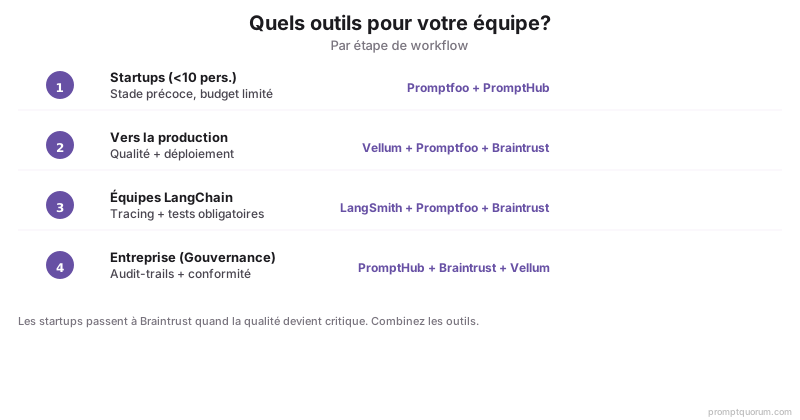
L'appairage dépend de votre taille d'équipe, étape et budget :
- Startups (1–3 devs) : PromptQuorum (gratuit) + Promptfoo (gratuit) + PromptHub (plus tard). Pas besoin d'évaluation ou monitoring encore.
- Croissance (3–10 devs) : Ajoutez Vellum quand votre prompt entre en production. Braintrust ensuite.
- Production + LangChain : Braintrust + LangSmith + PromptHub. LangSmith essentiel pour les chains.
- Enterprise : PromptHub (gouvernance) + Braintrust (qualité) + Vellum (monitoring). PromptQuorum pour tester les modèles avant évaluation.
- Règle : Commencez gratuit avec PromptQuorum. Puis Promptfoo en CI/CD. Puis versioning. Puis évaluation. Ne prioriez pas le monitoring tant que vous n'avez pas de stratégie de test.
Construire votre stack d'outils
- 1Identifiez votre goulot. Où perdez-vous du temps ou argent ? Tests ? Évaluation ? Versioning ? Monitoring ? Commencez là.
- 2Lancez-vous avec PromptQuorum gratuit. Comparez les modèles avant écrire des suites de tests. Économise des mois.
- 3Ajoutez les tests Promptfoo en CI/CD. Automatisez les régressions. Tout gratuit, local.
- 4Ajoutez le versioning tôt. Traitez chaque prompt comme du code : review, merge, rollback. PromptHub ou Vellum.
- 5Évaluation seulement si critique. Braintrust pour noter les dimensions. Seulement si vos tests ne trouvent pas les régressions.
- 6Monitoring en dernier. Vellum ou LangSmith. Seulement quand vous savez ce à monitorer.
Erreurs courantes
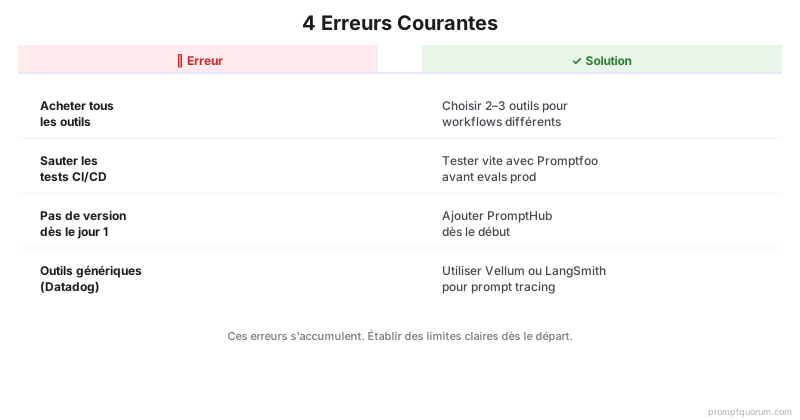
❌ Acheter les cinq outils parce qu'ils semblent utiles
Why it hurts: Braintrust et Promptfoo se chevauchent — les deux créent des workflows dupliqués et gaspillent le budget.
Fix: Commencez avec Promptfoo (gratuit) pour CI/CD. Braintrust seulement si vous avez besoin d'évaluations humaines avec datasets.
❌ Sauter les tests CI/CD et passer directement aux evals production
Why it hurts: Les evals manuelles manquent les cas limites. Les erreurs production coûtent cher.
Fix: Mettez Promptfoo en CI/CD d'abord — attrape les changements cassants. Braintrust pour mesurer la qualité offline.
❌ Ne pas ajouter le versioning avant qu'une régression ne force
Why it hurts: Sans versioning, vous ne savez pas quel changement a causé la régression ni comment revenir à une bonne version.
Fix: Ajoutez PromptHub ou Vellum dès le jour 1. Traitez chaque changement comme un commit : review avant merge.
❌ Utiliser l'observabilité générique (Datadog, New Relic) pour monitorer les prompts IA
Why it hurts: Les outils génériques voient latence et erreurs mais pas le texte du prompt, les réponses ou les coûts — les signaux pour déboguer.
Fix: Utilisez Vellum ou LangSmith. Tous deux enregistrent le pair prompt–réponse complet avec coûts.
Considérations pour les utilisateurs francophones
Pour les équipes basées en France, Belgique ou Suisse francophone, quelques points importants :
- CNIL et RGPD : Si vos prompts contiennent des données sensibles (informations client, contrats, données financières), la CNIL recommande l'utilisation d'IA locale ou self-hosted pour respecter la souveraineté des données. Les outils SaaS américains nécessitent des garanties contractuelles supplémentaires.
- Conformité données : Les outils d'évaluation comme Braintrust stockent vos datasets. S'ils contiennent des données personnelles, vous avez besoin du consentement explicite des personnes ou d'une base légale sous la RGPD.
- Alternatives locales : Ollama + PromptQuorum (local) + PromptHub (self-hosted ou EU) sont des options conformes. Demandez toujours les DPA (Data Processing Agreements) aux fournisseurs américains.
Lectures complémentaires
- Meilleures plateformes de gestion de prompts — Versionner, partager et gouverner les prompts en équipe
- Évaluation vs. test en prompt engineering — Différence entre tests automatisés et évaluations dimensionnelles
- Tester et déboguer les pipelines RAG — Stratégies spécifiques pour Retrieval-Augmented-Generation
- LangChain pour les agents production — Construire et monitorer des chaînes LLM
- Versioning de prompts et workflows Git — Traiter les prompts comme du code
- LLM locaux pour la conformité RGPD — Modèles self-hosted pour le prompt engineering conforme
Questions fréquemment posées
Quels sont les 5 meilleurs outils de prompt engineering en 2026 ?
Braintrust (évaluation), Vellum (production), Promptfoo (tests), PromptHub (versioning) et LangSmith (tracing). PromptQuorum est le sixième pour le dispatch multi-modèle. La plupart des équipes n'en ont besoin que de 2–3.
Quel est le meilleur outil pour tester les prompts ?
Promptfoo pour l'automatisation CI/CD (gratuit, open-source). Braintrust si vous avez besoin de scores dimensionnels (juges LLM, feedback humain).
Braintrust vs Promptfoo — quelle est la différence ?
Promptfoo teste si les prompts correspondent aux sorties attendues — binaire. Braintrust évalue la qualité sur des dimensions (ton, précision, factualité) avec juges ou humains. Promptfoo est rapide et gratuit. Braintrust est plus lent, cher, mais nuancé.
Ai-je vraiment besoin du versioning ?
Oui. Sans versioning, vous ne pouvez pas identifier quel changement a causé une régression ou revenir à une bonne version. Traitez le versioning comme du versioning code dès le jour 1.
Les modèles locaux (Ollama, LM Studio) fonctionnent-ils avec ces outils ?
PromptQuorum oui (25+ modèles locaux + cloud). Promptfoo oui. Braintrust oui. Vellum et PromptHub oui. LangSmith oui avec LangChain. Tous supportent les LLM self-hosted.
Puis-je utiliser plusieurs outils ensemble ?
Oui. Setup typique : PromptQuorum (comparaison) + Promptfoo (CI/CD) + PromptHub (versioning). Vellum plus tard pour production. Braintrust si critique.
Combien coûtent ces outils au total ?
Promptfoo gratuit. PromptQuorum gratuit. Braintrust gratuit (1M traces, 10 k scores) / Pro 249 $/mois. Vellum gratuit / Pro 500 $/mois. PromptHub gratuit / Team 20 $/utilisateur/mois. LangSmith Developer 0 $/siège (5 000 traces/mois) / Plus 39 $/siège/mois. Confident AI gratuit (5 tests/semaine) / Starter 19,99 $/utilisateur/mois.
Y a-t-il un tier gratuit pour tous les outils ?
Promptfoo oui (complètement gratuit, open-source). PromptQuorum oui. LangSmith oui. Braintrust a un tier gratuit permanent (1M traces, 10 k scores, utilisateurs illimités). Confident AI a un tier gratuit (5 exécutions de test/semaine, 2 sièges). Vellum et PromptHub ont des tiers d'entrée gratuits.
Quelle est la différence entre tester et évaluer les prompts ?
Tester (Promptfoo) vérifie si un prompt produit la sortie attendue — automatisé en CI/CD, attrape les régressions. Évaluer (Braintrust) mesure la qualité (précision, ton, factualité) avec des juges ou humains. Le test est rapide et automatisé; l'évaluation est plus lente et nuancée. La plupart des équipes ont besoin des deux.
Comment sais-je que j'ai outgrown Promptfoo et que je dois basculer vers Braintrust ?
Basculez vers Braintrust quand vous avez besoin de noter la qualité au-delà du binaire — par exemple, ton, précision ou respect de la marque. Promptfoo excelle aux tests corrects en CI/CD. Braintrust ajoute le scoring humain, les juges LLM et un dataset accumulé qui s'améliore. La plupart des équipes atteignent ce point quand 3–5 personnes itèrent sur les prompts quotidiennement.
Sources
- Documentation Braintrust — Boucle d'eval officielle et documentation feedback
- Plateforme Vellum — Page produit Vellum avec déploiement, A/B tests et monitoring
- Promptfoo GitHub — Repository open-source avec docs YAML et red teaming
- PromptHub — Plateforme de versioning et collaboration
- Documentation LangSmith — Tracing officiel et observabilité pour LangChain
- Confident AI — Plateforme d'évaluation et red teaming basée sur DeepEval avec 50+ métriques intégrées