
关键要点
- LoRA = 向预训练模型添加小型可训练层。仅 1-5% 的模型权重可训练,大幅降低 VRAM 和时间。
- 微调需求:500-1000 个高质量示例,8-16GB VRAM,1-4 小时训练时间。
- 最佳工具:unsloth(最快),Hugging Face TRL,Axolotl(最灵活)。
- LoRA 秩(r): 较低(r=8)更小更快;较高(r=64)表现力更强。默认:r=16-32。
- 截至 2026 年 4 月,LoRA 已生产就绪,在推理引擎中广泛支持。
LoRA 如何工作?
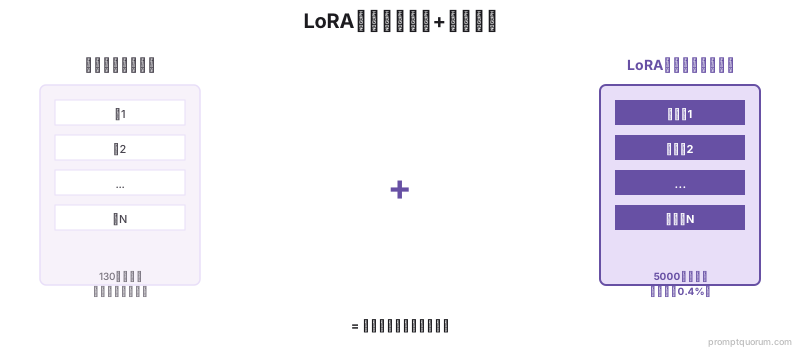
LoRA 在原始模型权重旁边添加小型"适配器"矩阵。 在训练期间,仅更新适配器。原始权重冻结。
示例:13B 模型有 130 亿个权重。LoRA 仅添加 5000 万个可训练参数(原始的约 0.4%)。训练快 100 倍。
在推理时,适配器输出通过矩阵乘法与主模型输出合并。最小速度损失(约 5%)。
结果:一个在你的任务上表现更好的特定领域模型,只需 8GB VRAM 而不是 26GB。
什么是 QLoRA(4 位量化 LoRA)?
QLoRA 结合 LoRA 和 4 位量化——基础模型以 4 位(QLoRA)加载,仅适配器以 16 位训练。 这将 VRAM 需求减半:
截至 2026 年 4 月,QLoRA 是消费级硬件的默认选择。 上面代码示例中的 Unsloth `load_in_4bit=True` 标志会自动启用 QLoRA。与完全 LoRA 的 2% 质量差异对大多数领域自适应任务可以忽略不计。
何时使用 LoRA(16 位)而非 QLoRA(4 位):
• 需要最大精度的任务(医学、法律合同分析)
• 你有 16+ GB VRAM 可用
• 微调 3B 或更小的模型(QLoRA 节省在小尺寸时最小)
| 方法 | 7B 模型 VRAM | 13B 模型 VRAM | 质量 vs 完全 |
|---|---|---|---|
| 完全微调 | 28 GB | 52 GB | 100%(基准) |
| LoRA(16 位基础) | 16 GB | 30 GB | 约 97% |
| QLoRA(4 位基础) | 8 GB | 14 GB | 约 95% |

微调还是 RAG?
决策矩阵:
在投资LoRA微调之前,请先确认更好的提示词工程是否无法解决问题——提示词工程更快速、可逆且与模型无关。完整的决策框架请参阅提示词工程 vs 微调:如何决定。
微调是让编码工作流在离线环境下保持生产力的途径之一。要了解涵盖模型、IDE、包缓存、文档镜像的更完整离线方案,请参阅无需联网的本地编码 LLM。
| 标准 | 微调 | RAG |
|---|---|---|
| 文档变化频率 | 每年或更少 | 每周或更多 |
| 知识需求 | 模型需要深度理解 | 检索即可 |
| 训练数据可用 | 需要 500+ 高质量示例 | 任何文档都可用 |
| 成本(长期) | 一次性($50-200) | 持续嵌入成本 |
| 延迟 | 更快(无检索) | 更慢(检索 + LLM) |
| 最适合 | 代码、创意写作、领域风格 | 知识库、问答 |
如何准备训练数据?
训练数据质量决定微调成功。 差数据 = 差模型。
最少: 500 个示例。每个示例 = 输入 + 预期输出。
最优: 1000-5000 个示例。更多数据 = 更好的准确性。
格式: JSON 或 JSONL。每行 = 一个训练示例。
[\n {"instruction": "翻译为中文", "input": "Hello world", "output": "你好世界"},\n {"instruction": "总结", "input": "很长的文本...", "output": "摘要..."},\n {"instruction": "代码审查", "input": "Python 代码...", "output": "审查意见..."}\n]\n\n# 或仅指令格式:\n[\n {"text": "<|user|>翻译为中文\nHello<|assistant|>你好"},\n {"text": "<|user|>总结\n文本<|assistant|>摘要"}\n]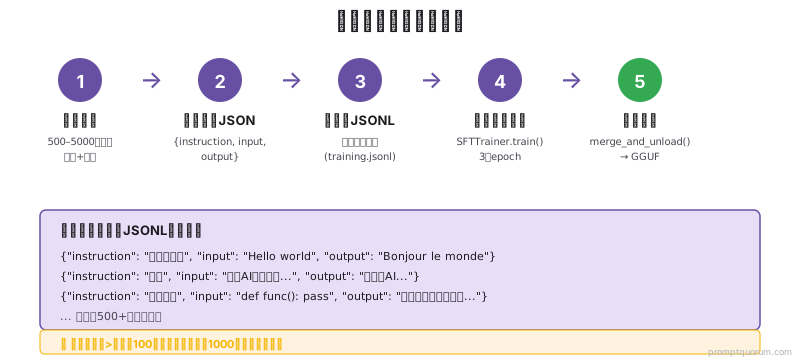
Unsloth 微调设置
Unsloth 是最快的 LoRA 框架(相比标准训练快 4 倍):
# 安装 unsloth\npip install unsloth[colab-new] xformers bitsandbytes\n\nfrom unsloth import FastLanguageModel\nfrom datasets import load_dataset\n\n# 用 LoRA 加载基础模型\nmodel, tokenizer = FastLanguageModel.from_pretrained(\n model_name="unsloth/llama-3.1-8b-bnb-4bit",\n max_seq_length=2048,\n load_in_4bit=True,\n lora_r=16, lora_alpha=32,\n lora_dropout=0.05\n)\n\n# 加载训练数据\ndataset = load_dataset("json", data_files="training.jsonl")\n\n# 配置训练器\nfrom trl import SFTTrainer\ntrainer = SFTTrainer(\n model=model,\n tokenizer=tokenizer,\n train_dataset=dataset["train"],\n dataset_text_field="text",\n max_seq_length=2048,\n args=TrainingArguments(\n per_device_train_batch_size=4,\n num_train_epochs=3,\n learning_rate=2e-4,\n output_dir="output"\n )\n)\n\n# 训练\ntrainer.train()LoRA 微调的关键超参数
| 超参数 | 推荐值 | 典型范围 | 效果 |
|---|---|---|---|
| learning_rate | 2e-4 | 1e-5 至 1e-3 | 更低 = 稳定,收敛更慢 |
| lora_r(秩) | 16 | 4 至 64 | 更高 = 表现力更强,速度更慢 |
| lora_alpha | 32 | 8 至 256 | 更高 = LoRA 效果更强 |
| num_train_epochs | 3 | 1 至 10 | 更多轮次 = 过拟合风险 |
| batch_size | 4 | 1 至 32 | 更大 = 训练更快,VRAM 更多 |
| warmup_steps | 100 | 0 至 1000 | 学习率逐步增加,稳定训练 |
如何评估微调模型?
训练损失: 应该随着 epochs 下降。如果平坦,学习率可能太低。
验证损失: 应该下降但保持在训练损失之上(正常)。如果上升,则过拟合。
手动测试: 在测试示例上运行微调模型,将输出与预期结果进行比较。
基准任务: 使用标准基准(MMLU、HumanEval)来衡量改进。
最常见的微调错误有哪些?
- 训练示例太少。 <200 个示例通常导致过拟合。至少收集 500 个。
- 训练轮次太多。 模型记住数据而不是学习可泛化的模式。最多 3-5 个轮次。
- 不在未见数据上验证。 始终将数据分为训练/验证(80/20)。频繁验证以捕获过拟合。
- 对微调和评估使用相同数据。 如果在训练数据上评估,报告的准确性无意义。
- 不保存检查点。 训练可能需要数小时。每个 epoch 保存,这样可以从崩溃中恢复。
LoRA 微调的常见问题
需要多少训练数据?
最少 500 个示例,最优 1000-5000 个。质量比数量更重要。100 个高质量示例 > 1000 个低质量示例。
我可以在笔记本电脑上微调吗?
可以。使用 4 位量化和 LoRA。7B 模型需要 8GB VRAM,训练在 CPU 上需要 1-2 小时(慢),在 GPU 上需要 10-15 分钟。
如何将 LoRA 适配器合并到基础模型?
使用 unsloth 或 HF transformers:`model.merge_and_unload()`。创建单个模型文件(7B 约 3-4 GB),准备好推理。
我可以组合多个 LoRA 适配器吗?
可以,但有限制。堆叠适配器进行顺序应用,或使用适配器组合技术(例如 DoRA)。
微调模型质量比 RAG 更好吗?
对于大多数任务,是的。微调模型深入理解领域概念。当文档庞大且经常变化时,RAG 更好。
LoRA 和 QLoRA 有什么区别?
LoRA 以 16 位加载基础模型,训练小适配器。QLoRA 以 4 位加载基础模型,以 16 位训练适配器。QLoRA 使用大约一半的 VRAM:7B 的 8GB vs 16GB。质量差异约 2%——对大多数任务可以忽略不计。Unsloth 使用 `load_in_4bit=True` 启用 QLoRA。
如何在 Ollama 中使用微调的 LoRA 模型?
训练后,将适配器合并到基础模型:`model.merge_and_unload()`。使用 llama.cpp 的 `convert.py` 转换为 GGUF。创建指向 GGUF 文件的 Ollama Modelfile:`FROM ./my-finetuned-model.gguf` 然后:`ollama create my-model -f Modelfile` 和 `ollama run my-model`。微调模型的运行方式与任何 Ollama 模型相同。
我可以在消费级硬件上用 LoRA 微调 Llama 3.3 70B 吗?
可以,使用 QLoRA。Llama 3.3 70B 在 4 位时需要约 40GB VRAM——适合双 RTX 4090(2×24 GB)或单个 A100 80GB。训练时间:1000 个示例需 4-8 小时。对于大多数用户,微调 7B 或 13B 模型更实用,能获得 90%+ 的 70B 质量提升。
LoRA 适配器权重使用什么文件格式?
LoRA 适配器作为 safetensors 文件保存(例如 adapter_model.safetensors),以及 adapter_config.json。总适配器大小通常为 50-500MB,取决于秩(lora_r)和适配的层数。
我可以分发微调的 LoRA 模型吗?
你可以将 LoRA 适配器权重与基础模型分开分发。用户必须已下载基础模型。检查基础模型的许可(Meta Llama 对大多数用途都很宽松;某些模型限制商业重新分发)。
来源
- Hu, E. et al. (2021). "LoRA: Low-Rank Adaptation of Large Language Models." https://arxiv.org/abs/2106.09685 — 原始 LoRA 论文,展示 0.4% 可训练参数与完整微调质量相匹配。
- Dettmers, T. et al. (2023). "QLoRA: Efficient Finetuning of Quantized LLMs." https://arxiv.org/abs/2305.14314 — QLoRA 论文:4 位量化基础模型 + 16 位 LoRA 适配器将 VRAM 需求减半。
- Unsloth. (2026). "Unsloth: 4× Faster LoRA Training." https://github.com/unslothai/unsloth — 最快的 LoRA 框架,支持 Llama 3.x、Qwen2.5、Mistral,速度快 4 倍。
- Hugging Face. (2025). "TRL: Transformer Reinforcement Learning." https://github.com/huggingface/trl — 用于监督微调的 SFTTrainer,支持 LoRA 适配器。