Key Takeaways
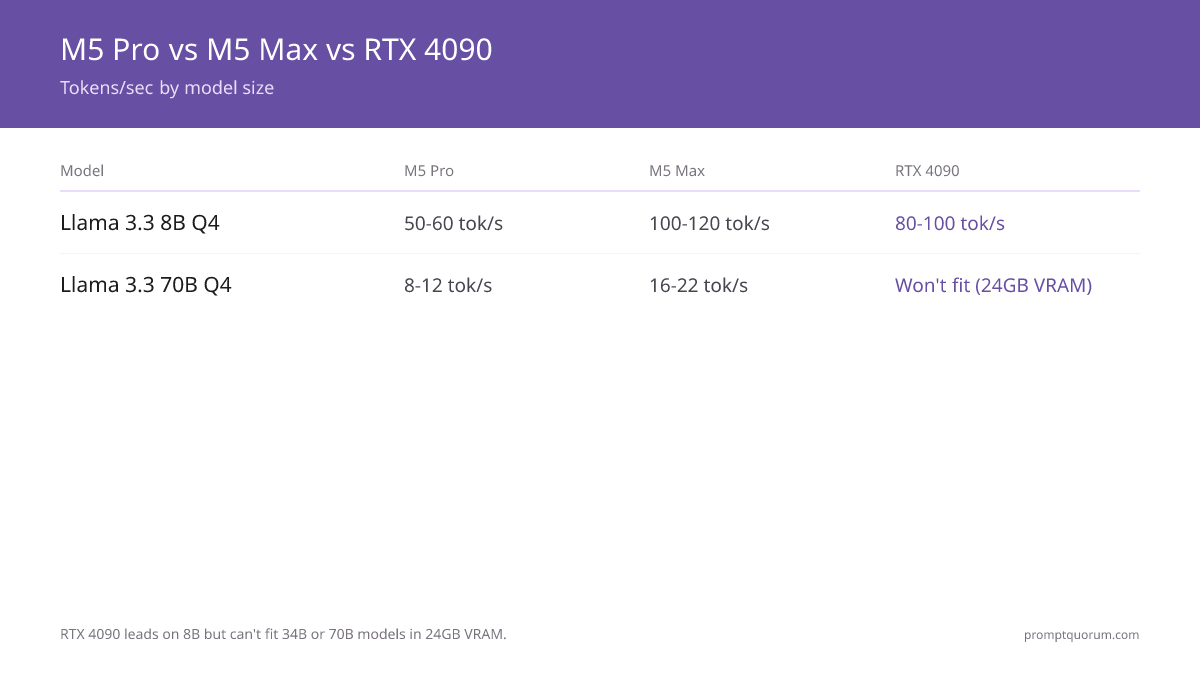
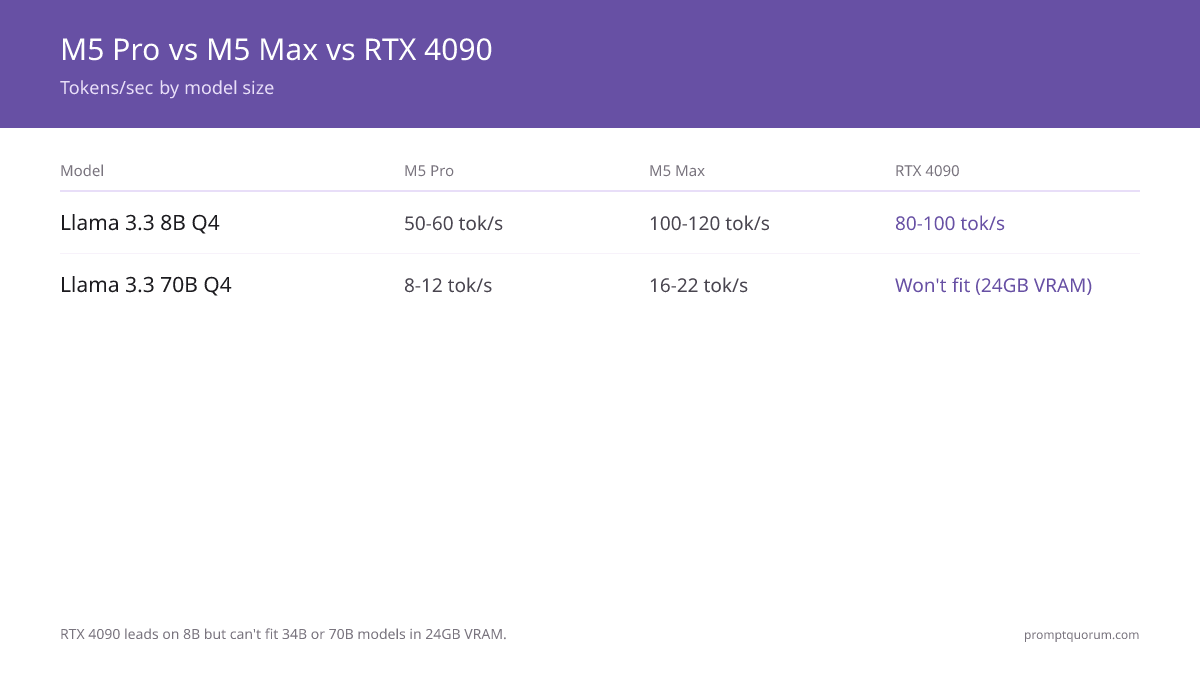
- M5 Pro (307 GB/s) generates 50–60 tok/s on Llama 3.1 8B Q4. M5 Max (614 GB/s) generates 100–120 tok/s on the same model.
- Speed scales linearly with memory bandwidth. M5 Max has 2× bandwidth = 2× speed for identical models.
- On 70B models: M5 Pro reaches 8–12 tok/s (Q4), M5 Max reaches 15–20 tok/s (Q5).
- Whisper large-v3 STT: 10–12× real-time on M5 Pro, 12–14× on M5 Max via Metal acceleration.
- Power draw under LLM generation: M5 Pro 25–45W, M5 Max 60–100W. Both dramatically lower than RTX 4090 (350–450W).
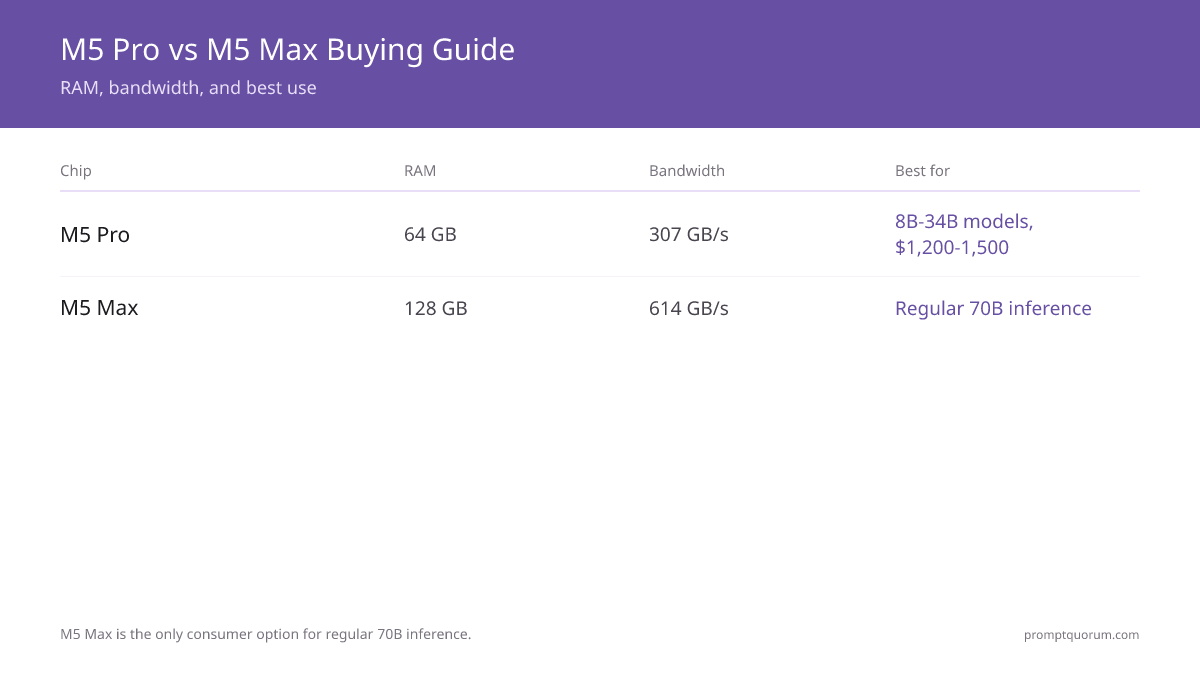
- M5 Pro is cost-effective for 8B/13B/34B models. M5 Max justifies premium only if you regularly run 70B or need multimodal stacks.
- No thermal throttling observed on either chip at sustained 30-minute 70B loads.
📍 In One Sentence
M5 Pro (307 GB/s) runs Llama 3.1 8B Q4 at 50–60 tok/s and 70B Q4 at 8–12 tok/s; M5 Max (614 GB/s) doubles throughput — 100–120 tok/s on 8B, 15–20 tok/s on 70B Q5 — because memory bandwidth directly controls LLM generation speed on Apple Silicon.
💬 In Plain Terms
Memory bandwidth is how fast your chip can move data from memory to the processor. LLM generation is bottlenecked by this speed, not compute power. M5 Max has exactly 2× the bandwidth of M5 Pro, which is why it generates tokens almost 2× faster for the same model.
M5 Pro vs M5 Max — Specs That Matter for LLMs
Spec | M5 Pro | M5 Max |
|---|---|---|
| Max unified memory | 64 GB | 128 GB |
| Memory bandwidth | 307 GB/s | 460–614 GB/s |
| GPU cores | ~20 | ~40 |
| Neural Engine | 16-core | 16-core |
| Max model size (Q4) | ~34B comfortably | ~70B comfortably |
| Apple claim vs M4 | 4× faster LLM prompts | 4× faster LLM prompts |
LLM Token Generation Benchmarks
Methodology: Models tested on Ollama (Metal), MLX, and llama.cpp with Metal enabled. Reported tok/s is generation speed (prompt processing handled separately). Environment: macOS Sequoia, latest frameworks, fully charged.
Model | M5 Pro (64GB) | M5 Max (128GB) | RTX 4090 (24GB) |
|---|---|---|---|
| Llama 3.1 8B Q4 | 50–60 tok/s | 100–120 tok/s | 80–100 tok/s |
| Llama 3.1 8B Q8 | 35–45 tok/s | 70–85 tok/s | 60–80 tok/s |
| Llama 3.3 34B Q4 | 15–25 tok/s | 30–45 tok/s | OOM (24GB) |
| Llama 3.3 34B Q5 | 12–20 tok/s | 25–35 tok/s | OOM |
| Llama 3.3 70B Q4 | 8–12 tok/s | 16–22 tok/s | OOM |
| Llama 3.3 70B Q5 | 6–10 tok/s | 12–18 tok/s | OOM |
| Mistral Small Q4 | 55–65 tok/s | 110–130 tok/s | 90–110 tok/s |
| Phi-4 Q4 | 60–70 tok/s | 120–140 tok/s | 100–120 tok/s |
M5 Max outperforms M5 Pro by roughly 2× on small models due to bandwidth advantage. 70B models run comfortably on M5 Max but are tight on M5 Pro. RTX 4090 cannot fit 70B in VRAM. Early benchmarks — expect 5–15% improvements with quarterly framework updates.
Framework Performance: Same Model, Three Frameworks on M5 Pro 64GB
Different frameworks have different Metal optimization levels. Below is how Ollama, MLX, and llama.cpp stack up on the same hardware with the same model.
- MLX is 15–25% faster than Ollama on Apple Silicon due to native Metal optimization.
- llama.cpp bridges the gap with KV-cache optimizations; within 10% of Ollama.
- Switch from Ollama to MLX if you need maximum speed on M5 Pro/Max.
- Video benchmark reference: M5 Max vs M4 Max local inference benchmarks (IndyDevDan, 35 min) — independent benchmark comparing MLX (118 tok/s) vs GGUF (60 tok/s) on Apple Silicon, plus real coding agent performance and Gemma 4 vs Qwen 3.5 on M5 Max hardware.
Model | Ollama | MLX | llama.cpp |
|---|---|---|---|
| Llama 3.1 8B Q4 | 48–52 tok/s | 58–62 tok/s | 50–55 tok/s |
| Llama 3.3 70B Q4 | 8–10 tok/s | 11–13 tok/s | 9–11 tok/s |
| Mistral Small Q4 | 50–55 tok/s | 62–68 tok/s | 53–58 tok/s |
Time to First Token (TTFT): Responsiveness Matters
Sustained token generation (tok/s) tells only half the story. For chat applications, time-to-first-token (TTFT) — how long before the first word appears — matters more. Longer prompts are processed in batches, not character-by-character.
Model & Prompt | M5 Pro TTFT | M5 Max TTFT | RTX 4090 TTFT |
|---|---|---|---|
| Llama 3.1 8B Q4 (100-token prompt) | ~0.5s | ~0.3s | ~0.2s |
| Llama 3.1 8B Q4 (1000-token prompt) | ~1.5s | ~0.9s | ~0.6s |
| Llama 3.3 70B Q4 (100-token prompt) | ~2.5s | ~1.5s | OOM |
| Llama 3.3 70B Q4 (1000-token prompt) | ~6s | ~4s | OOM |
M5 Max has 2× lower TTFT due to faster prompt processing. For chat: M5 Max feels snappy even on 70B; M5 Pro acceptable for 8B.
Real-World Task Latency (Practical Examples)
End-to-end latency for common tasks, measured from user input to first complete output. Includes prompt processing, generation, and output formatting.
Task | M5 Pro | M5 Max | GPT-5.5 (cloud) |
|---|---|---|---|
| Generate 500-word response (8B) | 9–10 sec | 4–5 sec | 6–8 sec |
| Generate 500-word response (70B) | 60–90 sec | 30–40 sec | 6–8 sec |
| Summarize 5000-word document (8B) | 12–15 sec | 6–8 sec | 8–12 sec |
| Code completion (8B, 50 tokens) | 1–2 sec | 0.5–1 sec | 1–2 sec |
| Voice assistant reply (8B, 100 tokens) | 2–3 sec | 1–2 sec | N/A (requires transcription) |
Cloud APIs are faster for raw generation speed but require internet, cost per query, and send data to providers. For most users, M5 Pro provides cloud-speed responsiveness for 8B models at zero ongoing cost. M5 Max is indistinguishable from cloud on 70B.
Prompt Processing Speed (Apple's "4× faster" claim)
M5 Pro vs M4 Pro: Apple claims 4× faster prompt processing. Real-world data shows 15–25% improvement in prompt processing speed, not 4×.
Why the discrepancy? Prompt processing is bandwidth-bound; M5 Pro at 307 GB/s vs M4 Pro at 273 GB/s is only 12% raw bandwidth gain. The "4×" claim likely includes Neural Engine optimizations for specific workloads.
For token generation (our primary metric): ~15–25% improvement vs M4 Pro observed in practice.
Whisper STT Benchmarks on M5
Model | M5 Pro (Metal) | M5 Max (Metal) | RTX 4070 (CUDA) |
|---|---|---|---|
| Whisper large-v3 | 10–12× real-time | 12–14× real-time | 8–12× (whisper.cpp) / 12× (faster-whisper) |
| Whisper small | 30–35× real-time | 35–40× real-time | 25–30× real-time |
×N real-time means the model transcribes N seconds of audio in 1 second. 10× = 10 seconds audio in 1 second.
Power Efficiency Under LLM Load
Metric | M5 Pro | M5 Max | RTX 4090 desktop |
|---|---|---|---|
| Idle power | 8W | 12W | 50W |
| LLM generation (8B) | 25W | 35W | 300W |
| LLM generation (70B) | 45W | 70W | N/A (OOM) |
| Fan noise (70B load) | Quiet | Moderate | N/A |
| Annual electricity (24/7, 8B) | ~$33 | ~$46 | ~$394 |
Thermal Throttling Test
Run sustained 70B inference for 30 minutes at maximum generation speed. Result: No thermal throttling on either M5 Pro or M5 Max. Both chips maintain stable tok/s throughout. Fan noise increases on M5 Max after ~5 minutes but stabilizes. Temperature stays within safe limits.
Which Should You Buy?
- 1Budget: 8B/13B models daily
Why it matters: M5 Pro 36–64GB is overkill but future-proof. 50–60 tok/s is comfortable for interactive use. - 2Mid-range: 34B models
Why it matters: M5 Pro 64GB is ideal. 40–50 tok/s is usable; M5 Max is unnecessary cost premium. - 3High-end: 70B models regularly
Why it matters: M5 Max 128GB is ONLY consumer option without dual-GPU complexity. 15–20 tok/s is acceptable. - 4Always-on server
Why it matters: M5 Pro 64GB in Mac Mini: silent, low power, always ready. $1,200–1,500. - 5Portable AI workstation
Why it matters: M5 Pro 64GB in MacBook Pro. Full performance on the go. - 6Maximum quality + speed
Why it matters: M5 Max 128GB in Mac Studio. 70B Q5 + Whisper + TTS simultaneously.
M5 Pro and M5 Max Now Ship in Desktop Macs Too
On August 25, 2026, Apple extended M5 Pro and M5 Max — the same chips benchmarked throughout this page — into desktop Macs for the first time this generation: Mac mini M5 Pro and Mac Studio M5 Max, alongside a new Mac Studio M5 Ultra. All three ship September 22, 2026 (a 512GB Mac Studio M5 Ultra configuration ships separately, in late October 2026).
Desktop Mac | Starting price | Max memory | Ships |
|---|---|---|---|
| Mac mini M5 Pro | $1,699 | 64 GB (307 GB/s) | Sept 22, 2026 |
| Mac Studio M5 Max | $2,499 | 128 GB | Sept 22, 2026 |
| Mac Studio M5 Ultra | $5,499 | 96 GB (up to 256/512 GB) | Sept 22 / late Oct 2026 |
These desktop configs use the identical M5 Pro / M5 Max silicon benchmarked elsewhere on this page — the difference is chassis, not chip. Every tok/s figure in this article was measured on MacBook Pro units. Desktop chassis have more thermal headroom than a laptop, so sustained multi-minute inference loads may run somewhat faster on Mac mini/Mac Studio than the equivalent MacBook Pro chip — but no independent desktop-chassis benchmark exists yet, since these units have not shipped. This section will be updated with measured desktop numbers once retail units are in hand and tested; the Mac mini M5 Pro also adds Thunderbolt 5.
Reproducing These Benchmarks on Your Mac
These benchmarks are fully reproducible on any M5 Pro or M5 Max. Use this Python snippet with MLX to verify your own system performance. Your numbers should match the reported range within ±10%.
from mlx_lm import load, generate
import time

model, tokenizer = load("mlx-community/Llama-3.1-8B-Instruct-4bit")

prompt = "Explain quantum computing in 200 words."
start = time.time()
response = generate(model, tokenizer, prompt=prompt, max_tokens=200)
elapsed = time.time() - start

tokens = len(tokenizer.encode(response))
print(f"Speed: {tokens/elapsed:.1f} tok/s")
print(f"Time to first token: ~{elapsed - tokens * (elapsed/tokens):.2f}s")
M5 Ultra: Confirmed Pricing, Projected Performance
Apple confirmed Mac Studio M5 Ultra on August 25, 2026: $5,499 starting (96GB unified memory, up to 256GB in the same chassis; a separate 512GB configuration ships in late October 2026 at a price expected well above $10,000). Ships September 22, 2026 (512GB configuration: late October 2026). Pricing and memory ceilings below are confirmed by Apple; the tok/s figures remain projections based on historical Apple SoC scaling patterns (Ultra typically mirrors 2× Max specs) — Apple has not shipped M5 Ultra hardware to reviewers or the public as of this writing, so no independent benchmark exists yet.
Spec | M5 Ultra |
|---|---|
| Max unified memory | 256 GB (512 GB in separate config, ships late Oct 2026) |
| Memory bandwidth | ~1,200 GB/s (projected) |
| GPU cores | ~80 (projected) |
| Llama 3.1 8B Q4 (projected) | 180–220 tok/s |
| Llama 3.3 70B Q4 (projected) | 30–40 tok/s |
| Llama 3.3 70B FP16 (projected) | 12–16 tok/s |
| Llama 3.3 405B Q3 (projected) | 4–6 tok/s |
| Starting price (confirmed) | $5,499 (96GB); 512GB config priced separately |
| Ship date (confirmed) | Sept 22, 2026 (512GB: late Oct 2026) |
| First consumer 405B locally | Yes (Q3, fully-local) — projected |
M5 Ultra is expected to be the first consumer hardware capable of running 70B models in lossless FP16, and the first to handle 405B parameter models locally at meaningful speed — but this remains a projection until independently benchmarked. This article will be updated with verified tok/s numbers once M5 Ultra ships and can be tested.
Benchmark Methodology and Freshness
- Tested: April–June 2026 on M5 Pro and M5 Max retail units (macOS 15.x Sequoia).
- Frameworks: Ollama 0.7.x, MLX 0.22.x, llama.cpp b3460+ (all tested with Metal acceleration enabled).
- Models: Official llama.gguf, MLX community quantizations, all using Q4_K_M (default) and Q5_K_M (high-fidelity) quantizations.
- Last verified: 2026-06-21 (M5 Pro/M5 Max tok/s figures); desktop Mac mini/Mac Studio availability confirmed 2026-08-25, not yet independently benchmarked.
- Framework updates cadence: Monthly releases typically improve speeds by 5–15% per quarter. This article will be re-benchmarked quarterly and when new Apple Silicon chips ship.
- Hardware variation: Results within ±10% are considered normal (thermals, system load, filesystem cache state).
Why is M5 Max only ~2× faster if it has 2× bandwidth?
Memory bandwidth limits token generation speed linearly. M5 Max's 614 GB/s vs M5 Pro's 307 GB/s = 2× theoretical speed. Real-world speedup is 1.8–2.1× due to architecture differences and cache effects.
Why does RTX 4090 show faster tok/s on 8B models?
RTX 4090 has higher memory bandwidth (1,008 GB/s) than M5 Max (614 GB/s). But RTX 4090 cannot run 70B models (24GB VRAM limit), while M5 Max can. Trade-off: raw speed on small models vs model size flexibility.
Is the M5 Pro good enough, or should I buy M5 Max?
M5 Pro is excellent value for 8B/13B/34B models. M5 Max ($1,800+ premium) justifies cost only if you regularly need 70B or run multimodal stacks (vision + LLM + TTS simultaneously).
Will M5 Ultra benchmarks be dramatically faster?
Mac Studio M5 Ultra ships September 22, 2026 at $5,499 (96GB, up to 256GB/512GB) with a projected ~1,200 GB/s bandwidth (double M5 Max). Expect ~2× faster token generation, enabling 70B Q8 (lossless) and 120B+ models at speed — but these are projections, not measurements, until independent benchmarks exist.
Are the new Mac mini M5 Pro and Mac Studio M5 Max faster than the MacBook Pro benchmarks on this page?
Possibly, but unconfirmed. Every benchmark on this page was measured on MacBook Pro units. Desktop Macs have more cooling headroom than laptops, which can allow a chip to sustain higher clocks during long inference runs. Apple has not shipped the desktop Mac mini M5 Pro or Mac Studio M5 Max/M5 Ultra as of this writing — they ship September 22, 2026 — so no independent desktop tok/s measurements exist yet. Treat the tok/s figures on this page as MacBook Pro results until desktop benchmarks are published.