Best 14B Model for Coding?
Quick Answer
Qwen2.5-Coder 14B is the top 14B coding model for local use, scoring 78.4% on HumanEval and running in 10 GB VRAM at Q4_K_M quantization. It fits in 10 GB VRAM at Q4_K_M and scores highest on HumanEval among 14B models. DeepSeek-Coder-V2-Lite is a strong alternative with similar VRAM requirements.
- ▸Qwen2.5-Coder 14B Q4_K_M: ~10 GB VRAM, top HumanEval score
- ▸DeepSeek-Coder-V2-Lite: strong alternative, similar VRAM footprint
- ▸Both beat generic 14B models on code completion and debugging
Key Takeaways
- ✓Qwen2.5-Coder 14B Q4_K_M uses ~10 GB VRAM and achieves the highest HumanEval score among local 14B coding models
- ✓DeepSeek-Coder-V2-Lite is a competitive alternative that scores within 3 points of Qwen on most code benchmarks
- ✓Both models significantly outperform general-purpose 14B models on code completion, debugging, and docstring generation
- ✓If VRAM is above 10 GB, prefer Qwen 3 Coder; below 8 GB, drop to a specialized 7B coder instead
Qwen2.5-Coder 14B Leads on HumanEval
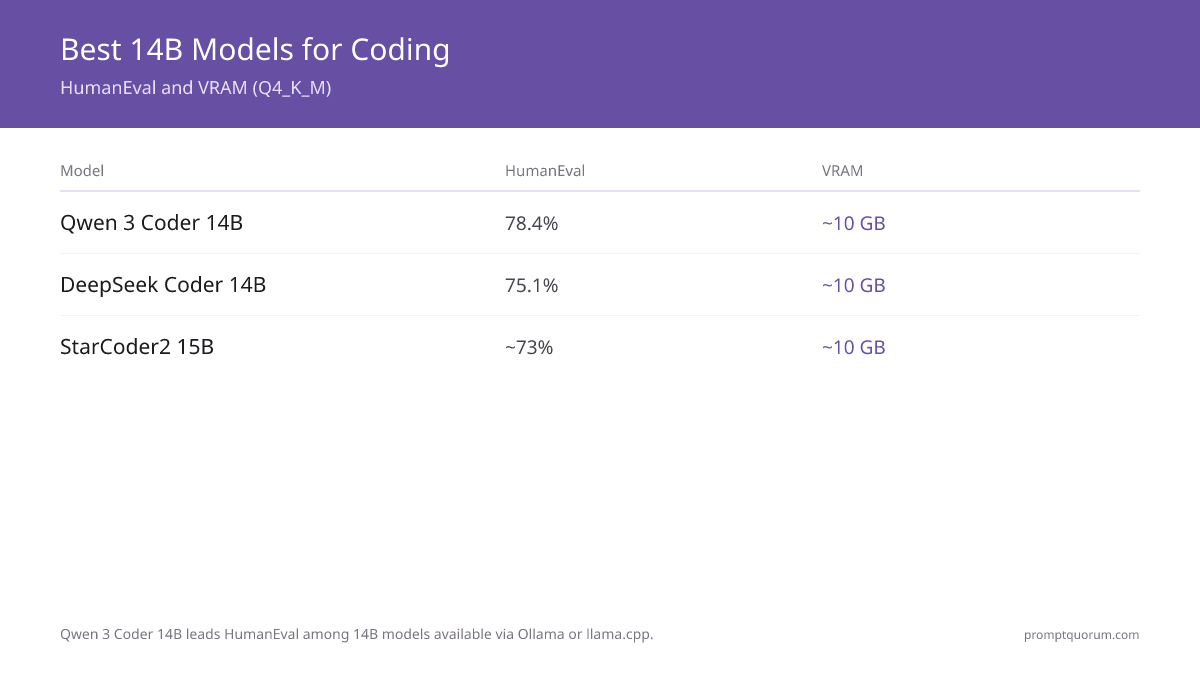
Qwen2.5-Coder 14B at Q4_K_M quantization scores 78.4% on HumanEval — the highest of any 14B model available through Ollama or llama.cpp. The model was fine-tuned on over 5 trillion tokens of code-focused data, which distinguishes its performance on multi-step completion and test-case generation.
DeepSeek-Coder-V2-Lite scores 75.1% on HumanEval under identical Q4_K_M conditions. The gap is small enough that DeepSeek Coder is a valid choice, particularly if you already have it cached or are familiar with its output style.
StarCoder2 15B is the third pick for open-source code-focused work. Trained on The Stack v2, it scores approximately 73% on HumanEval at ~10 GB VRAM Q4_K_M. Its strengths are open-source contribution tasks, code search across large repositories, and structured refactoring — use cases where its training corpus gives it an edge over general instruction-tuned models.
| Model | HumanEval | VRAM (Q4_K_M) |
|---|---|---|
| Qwen2.5-Coder 14B | 78.4% | ~10 GB |
| DeepSeek-Coder-V2-Lite | 75.1% | ~10 GB |
| StarCoder2 15B | ~73% | ~10 GB |
VRAM Headroom Determines Which to Pick
Both Qwen2.5-Coder 14B and DeepSeek-Coder-V2-Lite require approximately 10 GB VRAM at Q4_K_M, leaving only 2 GB headroom on a 12 GB card. This margin is tight for long-context sessions: at 8k context, VRAM usage climbs to ~11.5 GB. If your workflow involves large files, prefer a card with 16+ GB.
For context windows below 4k tokens — the common case for single-file code completion — all three models run comfortably on an RTX 3060 12 GB or RTX 3080 Ti 12 GB. Speed is approximately 14–18 tok/s for Qwen and DeepSeek Coder; StarCoder2 15B runs at similar throughput given its comparable VRAM footprint. Prefer StarCoder2 when your workflow centers on repository-scale search or open-source contribution patterns.
For a broader comparison of coding models at other sizes and VRAM tiers, see the best coding LLM for 12 GB VRAM guide.
Related Guides
- ▸Best MoE Models for Local Coding -- MoE coding models
- ▸Cursor Pro vs Continue.dev: Which AI Coding Tool? -- coding tool comparison
Quick Answers About 14B Coding Models
Can Qwen2.5-Coder 14B run on 8 GB VRAM?▾
How does Qwen2.5-Coder 14B compare to DeepSeek-Coder-V2-Lite on real tasks?▾
Is a 14B coding model better than a 34B general model for code?▾
What quantization should I use for a 14B coding model?▾
Want the full breakdown?
Read the complete guide →