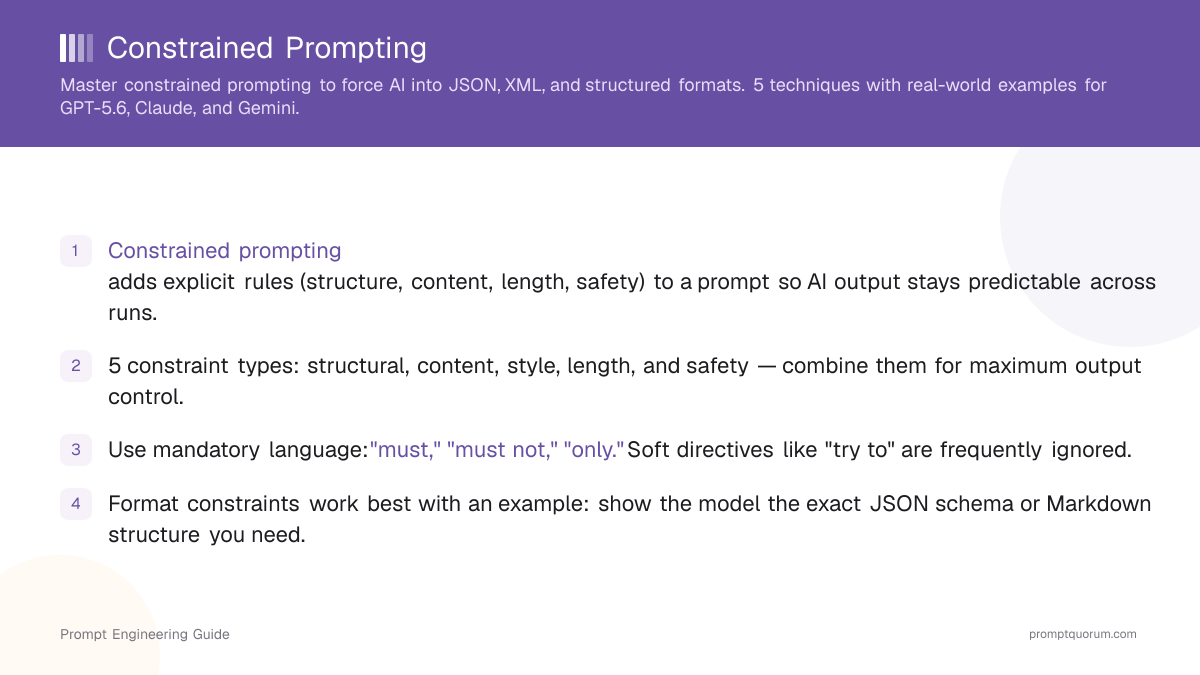
Quick Facts
- 5 constraint types: Structural, Content, Style, Length, Safety
- Model adherence: GPT-5.6 and Claude Opus 5 follow hard constraints at ~95% on well-formed prompts
- Optimal stacking: 3–5 constraints work well; beyond 5–6, models drop lower-priority constraints silently
- JSON output consistency: Without a schema example, models produce inconsistent key names across runs
- Test methodology: Generate 10 outputs to verify all respect length, format, and content boundaries
- Setup time: First-run constraint validation adds 10–15 minutes; reusable templates save 30+ minutes per task
What Is Constrained Prompting?
📍 In One Sentence
Constrained prompting is the practice of adding explicit rules — format, length, content, and safety boundaries — directly into a prompt to make AI output predictable.
💬 In Plain Terms
Instead of asking AI to "write a summary," you tell it: maximum 150 words, use bullet points, do not mention competitors, always include a call-to-action. The more specific the rules, the more consistent the output.
Constrained prompting means adding explicit rules about content, structure, length, and behavior directly into your prompt. Instead of a loose instruction like "summarize this," you specify allowed formats, required fields, banned topics, and validation rules. This is a core prompt engineering technique.
Constraints can include output schemas (such as JSON with fixed keys), word limits, tone requirements, and safety restrictions like "do not provide medical diagnoses." By making these rules part of the prompt, you reduce ambiguity and make the model easier to integrate into production workflows.
🔍 Definition
Constrained prompting is not a separate API feature — it is a prompting technique. You apply constraints in plain text within the prompt itself. No special syntax or API flags required.
Why Does Constrained Prompting Matter?
Constrained prompting matters whenever model output feeds into people, processes, or other systems that depend on predictable behavior. Without constraints, the same prompt may produce different structures or levels of detail across runs.
Clear constraints help you:
- Prevent unexpected content or formatting that breaks downstream tools.
- Enforce brand, legal, or safety guidelines directly at the prompt level.
- Reduce review time because outputs already match your required structure.
💡 Key Point
Unconstrained outputs vary widely: same prompt, different structures, different lengths, different tone. Constraints eliminate that variance and make output production-ready.
Which Constraint Types Can You Use?
You can constrain prompts along several dimensions: structure, content, style, length, and safety. The more precise you are, the more consistent the outputs become. Learn how these fit into structured prompts.
Common constraint types include:
- Structural constraints: Required headings, bullet lists, tables, or JSON with specific keys.
- Content constraints: Required sections (such as "Risks" or "Next steps") and banned topics or phrases.
- Style constraints: Tone ("formal," "neutral," "conversational"), reading level, or terminology rules.
- Length constraints: Word or character limits, or a fixed number of bullets or sections.
- Safety constraints: Instructions to avoid personal data, medical advice, legal conclusions, or disallowed content categories.
Constraint Type | Example | When to Use |
|---|---|---|
| Structural | "Return as JSON: {key: value}" | API integrations, data pipelines |
| Content | "Must include risks section; must not mention competitors" | Reports, customer comms |
| Style | "Formal tone, no contractions, Grade 8 reading level" | Brand-controlled outputs |
| Length | "≤150 words, exactly 5 bullet points" | Templated content, summaries |
| Safety | "Must not provide medical diagnoses or legal advice" | Regulated industries, public-facing |
💡 Pro Tip
For JSON output, always provide the exact key names and value types in the prompt. "Return JSON" without a schema produces inconsistent key naming across models.
📌 Model Adherence Rates
Prompt-level constraint adherence varies by model and constraint type: GPT-5.6 achieves ~95% on JSON schema, ~90% on word limits, ~95% on content inclusion. Claude Sonnet 5 scores ~97% on JSON, ~92% on word limits, ~96% on inclusion. Gemini 3.1 Pro: ~92% JSON, ~85% word limits, ~93% inclusion. API-level Structured Outputs achieve near 100% JSON schema compliance across all models, but only handle schema — not content, tone, or safety constraints.
Unconstrained vs Constrained Prompt: An Example
The impact of constrained prompting is easiest to see when you compare an unconstrained prompt with a constrained one for the same task. Here we draft a short product summary.
Unconstrained prompt (produces variable length, structure, and tone on every run):
"Write a summary of our new analytics feature."
Constrained version (defines length, structure, style, and required content):
"You are a B2B product marketer. Task: Write a summary of our new analytics feature for a product page. Constraints: Length: 120–160 words. Structure: 1 short intro paragraph, then 3 bullet points, then 1 closing sentence. Style: Clear, neutral-professional tone. No hype words like 'revolutionary' or 'game-changing'. Content: Mention the main benefit (faster insight into customer behavior) and one concrete example use case. Output format: Valid Markdown with bullet points using `-`."
The constrained version defines length, structure, style, and required content. Output becomes predictable and reusable — suitable for templating across team workflows.
Advanced Example: Constrained Data Extraction from Legal Documents
For more complex tasks, combine multiple constraint types with a structured output schema:
Prompt:
"You are a contract analysis assistant. Task: Extract key terms from the provided contract clause. Constraints: (1) Return ONLY valid JSON matching this exact schema: { \"parties\": \"string\", \"obligation_type\": \"payment|delivery|confidentiality|termination\", \"deadline\": \"ISO 8601 date or null\", \"penalty_clause\": true|false, \"summary\": \"max 50 words\" } (2) If a field cannot be found, use null. (3) Do not infer information not explicitly stated. (4) Output ONLY the JSON — no preamble, no markdown code fences, no explanation. (5) Verify your JSON is valid before returning."
This advanced example shows how to layer constraints for production use: schema enforcement (format constraint), field requirements (content constraint), no inference rule (content constraint), and JSON validity (safety constraint).
🛠️ Rule
Every constraint you add reduces the variance in model output. Start with 1–2 constraints, test, then add more. Stacking 5+ constraints at once increases the risk of the model violating one silently. For production use, test on edge cases (ambiguous clauses, missing fields, boundary conditions).
When Should You Use Constrained Prompting?
You should use constrained prompting whenever correctness and consistency are more important than maximum creativity. This is particularly true in operational, analytical, and regulated contexts. Paired with few-shot examples, constraints become even more powerful.
Typical use cases include:
- Generating JSON or table outputs that other systems will parse.
- Creating standardized reports, summaries, or status updates across teams.
- Drafting customer communications that must follow brand or legal guidelines.
- Extracting structured data (issues, entities, metrics) from unstructured text.
⚠️ Avoid
Do not apply length or structural constraints to open-ended creative tasks (brainstorming, ideation). Over-constraining creative prompts produces generic, box-checking outputs rather than genuinely useful ideas.
How Does PromptQuorum Support Constrained Prompting?
PromptQuorum is a multi-model AI dispatch tool that is designed to work well with constrained prompting by letting you define, save, and reuse structured prompt frameworks. You can combine constraints with frameworks like SPECS, RTF, or Google's Prompting Guide and send them to several models at once.
In PromptQuorum, you can:
- Encode structural and content constraints directly into frameworks so every run follows the same rules.
- Test constrained prompts across multiple models side by side to see which provider adheres best to your specifications. For example, dispatch the same JSON extraction constraint to GPT-5.6, Claude Sonnet 5, and Gemini 3.1 Pro simultaneously — then compare which model most reliably respects your schema, word limits, and content restrictions.
- Save constrained prompts as templates for recurring tasks, ensuring your team always uses the same validated patterns.
- Identify which model works best for your use case — then route production traffic to the winner.
🛠️ Best Practice
Always test your constrained prompt against at least 2 models before deploying. Different models (GPT-5.6 vs Claude vs Gemini) interpret constraints differently. A 95% adherence rate on GPT-5.6 may drop to 80% on Gemini.
How to Use Constrained Prompting
- 1Identify output constraints relevant to your task: length, format, vocabulary, scope, safety. Example: 'Response must be ≤100 words, JSON format, use only technical terms, cover only recent developments (2024+), must not mention competitors.'
- 2State constraints explicitly using 'must,' 'must not,' and 'only' language. Avoid soft directives like 'try to' or 'aim to.' Hard constraints are more reliable.
- 3For format constraints, provide an example of the exact format you want. Show the model: 'Return as JSON: { "finding": "...", "confidence": "high|medium|low", "sources": ... }'
- 4For content constraints, list what to include and exclude explicitly. Example: 'Include: technical details, performance metrics. Exclude: marketing language, competitor names, pricing.'
- 5Test constrained prompts on edge cases to ensure the model respects all constraints. Generate 10 outputs. Check: Do all respect the length limit? Do all use the correct format? Are there any violations?
📌 Insight
GPT-5.6 and Claude Sonnet 5 follow hard format constraints (JSON, tables, word limits) at ~95% adherence on well-formed prompts. Gemini 3.1 Pro scores similarly. All three support API-level Structured Outputs for near 100% JSON schema compliance. For production use, combine API-level enforcement with prompt-level constraints for maximum reliability.
API-Level Constraint Enforcement (Beyond Prompt Text)
In 2026, all major AI providers offer API-level constraint enforcement — a more reliable alternative to prompt-text constraints. Instead of hoping the model respects your rules, you enforce constraints at the token-generation level via API parameters. This guarantees outputs match your schema.
Major providers now support structured outputs:
OpenAI Structured Outputs (GPT-5.6): Set `response_format: { type: "json_schema", json_schema: {...} }` at the API level. Guarantees valid JSON matching your exact schema — ~100% reliability. The model cannot produce invalid JSON.
Anthropic Structured Outputs (Claude Sonnet 5): Use the `output_config.format` parameter to enforce JSON schema server-side. All outputs strictly match the schema you define.
Google Gemini 3.1 Pro: Set `response_mime_type: "application/json"` with `response_schema` to enforce structured output. Native JSON constraint with high reliability.
Key advantage: API-level enforcement operates at the token-generation level, not as a prompt instruction. Models cannot violate the constraint — it is enforced by the API before output is returned.
Use this strategy: Combine API-level enforcement (for format) with prompt-level constraints (for content). Example: Use API-level JSON schema to guarantee valid output structure, then use prompts to constrain content ("only include data from the provided context").
📌 Best Practice
When available, prefer API-level constraint enforcement over prompt-text constraints. API-level is more reliable (near 100% adherence) and ensures schema correctness. Reserve prompt-level constraints for nuanced content, tone, and safety rules that the API level does not handle.
Constrained Prompting in Regulated Environments
In regulated industries, constrained prompting is not optional — it is a compliance requirement. Healthcare providers, financial institutions, and law firms depend on constraints to prevent outputs that violate HIPAA, GDPR, SOX, or other regulatory frameworks.
Regional and industry considerations:
- EU (GDPR): Safety constraints that exclude personal data, financial information, and medical history are mandatory. Prompts must explicitly state: "Do not include personal data, financial details, or health information."
- US (SOX/HIPAA): Regulated firms in finance and healthcare require audit trails and signed agreements. Constrained prompts lock output format to make audit logs complete and verifiable.
- Japan (APPI): Data residency and consent constraints are critical. Prompts must specify: "Process only Japanese-resident user data" and "Do not transfer data outside Japan."
- China (Data Security Law): Constrained output to structured tables (no free-form text) and format restrictions ensure outputs stay within approved data handling pathways.
⚠️ Compliance
In regulated industries, always pair constrained prompting with documentation. Write down every constraint, test all constraint combinations, and log results. Regulators expect to see proof that constraints were validated.
Common Mistakes
❌ Using soft constraint language ("try to", "aim for")
Why it hurts: Models treat soft directives as suggestions, not rules. "Try to keep it under 200 words" produces outputs ranging from 80 to 400 words.
Fix: Use absolute language: "Response must be 150–200 words. No exceptions."
❌ Stacking too many constraints without priority order
Why it hurts: When 6+ constraints conflict, the model silently drops lower-priority ones without warning.
Fix: List constraints in priority order. Add: "If constraints conflict, prioritize in this order: (1) safety, (2) format, (3) length."
❌ Not providing a format example for JSON/structured output
Why it hurts: "Return as JSON" produces inconsistent key names and nesting across models and runs.
Fix: Show the exact schema inline: "Return JSON exactly matching this structure: { \"finding\": \"...\" }"
❌ Applying structural constraints to creative generation tasks
Why it hurts: Strict structure on open-ended tasks produces formulaic, low-quality creative output.
Fix: Reserve structural constraints for operational tasks. Use tone/style constraints only for creative tasks.
❌ Not testing constraints across models
Why it hurts: GPT-5.6, Claude Sonnet 5, and Gemini 3.1 Pro all interpret the same constraint differently. A prompt that works on one may fail on another.
Fix: Test your constrained prompt on at least 2 models before deploying. Use PromptQuorum to run parallel comparisons.
❌ Not providing an example alongside the constraint
Why it hurts: "Return valid JSON" without a schema example produces inconsistent keys and structures across models and runs. Models frequently guess at field names.
Fix: Always show the exact schema or format inline: "Return JSON exactly matching this structure: { \"finding\": \"...\" , \"confidence\": \"high|medium|low\" }"
Frequently Asked Questions
What is constrained prompting?
Constrained prompting is the practice of adding explicit rules — format, length, content, and safety boundaries — directly into a prompt to make AI output predictable and reusable. Instead of "write a summary," you specify: 150 words, JSON format, no competitor names, must include a call-to-action.
What are the five types of constraints?
The five main constraint types are: (1) Structural — required headings, tables, JSON with specific keys. (2) Content — required sections, banned topics. (3) Style — tone, reading level, terminology. (4) Length — word or character limits. (5) Safety — avoid medical advice, personal data, legal conclusions.
How do you force a model to output valid JSON?
Provide the exact JSON schema in the prompt: "Return JSON exactly matching: { \"finding\": \"...\" }". Combine this with "Output only JSON, no other text." GPT-5.6 also supports a JSON mode via API that enforces valid JSON at the API level.
Does constrained prompting work on GPT-5.6, Claude, and Gemini?
Yes — all three support constrained prompting. GPT-5.6 and Claude Opus 5 follow hard format constraints (JSON, tables, word limits) at approximately 95% adherence on well-formed prompts. Gemini 3.1 Pro scores similarly but may interpret ambiguous constraints differently. Always test across models.
What is the difference between constrained prompting and few-shot prompting?
Constrained prompting adds explicit rules in text form (format, length, content restrictions). Few-shot prompting provides worked examples that implicitly show the model what to produce. The two work well together: use a few-shot example to demonstrate the output pattern, then add constraints for stricter enforcement.
When should you NOT use constrained prompting?
Avoid structural constraints on open-ended creative tasks (brainstorming, ideation, fiction). Over-constraining creative prompts produces formulaic, low-quality output. Use tone and style constraints for creative tasks but allow structural freedom.
How many constraints can you stack in one prompt?
Practically, 3–5 constraints work well. Beyond 5–6, models start silently dropping lower-priority constraints without warning. If you need more than 5, list them in priority order and state explicitly: "If constraints conflict, apply them in this order: (1) safety, (2) format, (3) length."
Sources
- OpenAI. (2026). "Structured Outputs — JSON Mode and Responses API." platform.openai.com/docs/guides/structured-outputs — Server-side JSON schema enforcement for GPT-5.6 with 100% schema adherence.
- Anthropic. (2026). "Claude Structured Outputs — output_config.format." docs.anthropic.com/en/docs/build-with-claude — API-level constraint enforcement for Claude Sonnet 5 and Opus 5.
- Google. (2026). "Gemini API: Controlled Generation with response_schema." ai.google.dev/gemini-api/docs/controlled-generation — Native JSON mode and structured output enforcement for Gemini 3.1 Pro.
- White et al. (2023). "A Prompt Pattern Catalog to Enhance Prompt Engineering with ChatGPT." arxiv.org/abs/2302.11382 — Academic taxonomy of prompt patterns including constraint-based prompting techniques.
- Zhou et al. (2022). "Large Language Models Are Human-Level Prompt Engineers." arXiv:2211.01910 — Research on automated constraint optimization and prompt refinement.