Prompt Engineering: Definition and Core Principles
📍 In One Sentence
Prompt engineering is the practice of designing and refining the instructions given to a language model so it produces a specific, repeatable output rather than a plausible guess.
💬 In Plain Terms
It is learning to brief well. The model is a fast, literal colleague with no memory of your project: say who it should be, what you want, and what the answer should look like, and most of the frustration disappears.
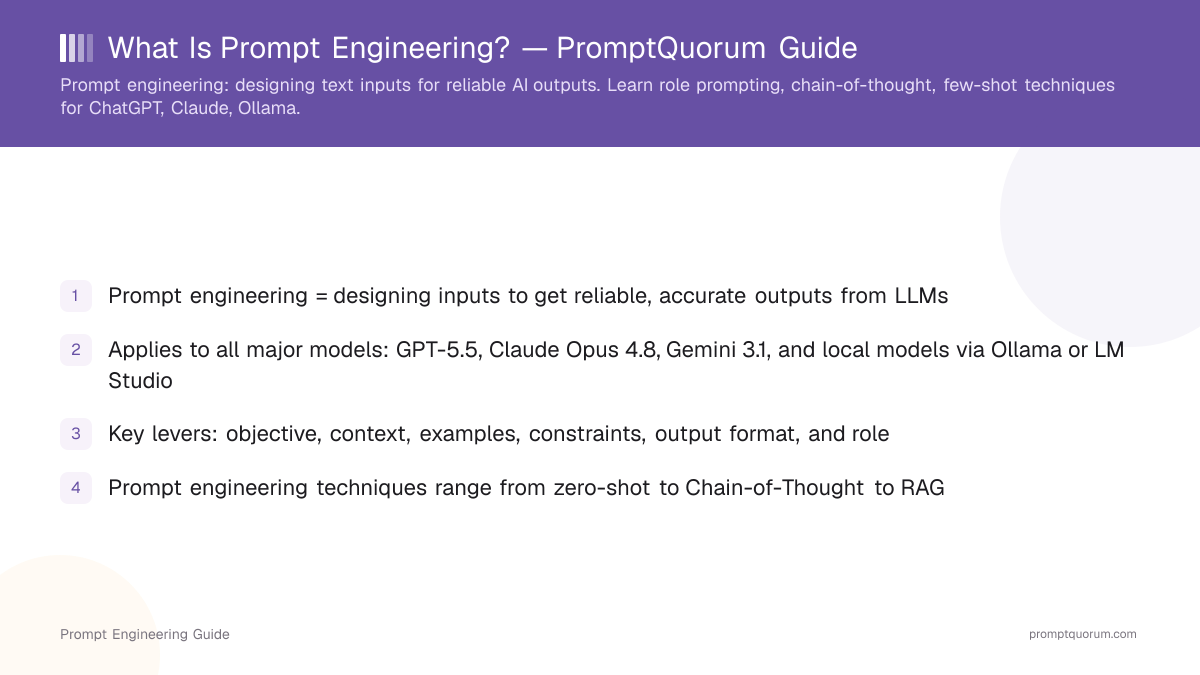
Prompt engineering is the practice of designing and structuring text inputs — called prompts — to get accurate, useful, and repeatable outputs from large language models (LLMs). It applies to GPT-5.6, Claude Opus 5, Gemini 3.1, and locally-run models via Ollama or LM Studio. The difference between prompt engineering and "just asking AI a question" is the difference between a vague request and a precise instruction with a defined objective, context, and output format.
Today, prompt engineering is a structured discipline with named techniques, reusable frameworks, and measurable outcomes. It is not about tricking AI systems or finding hidden commands — it is about giving a probabilistic model the clearest possible signal of what you need. A well-engineered prompt consistently produces usable output on the first attempt.
Prompt engineering basics start with understanding that LLMs are pattern-completion engines. They generate output based on the statistical likelihood of what should follow your input. The more precisely you specify the task, context, constraints, and desired format, the less the model has to guess — and the better the result.
🔍 Works with local models
Every technique in this guide works with Ollama, LM Studio, and other local LLMs. No API key required.
Why Prompt Engineering Matters
The same AI model produces dramatically different outputs depending on how a question is framed. A vague prompt returns a vague answer. A structured prompt with a clear objective, relevant context, explicit constraints, and a specified output format produces a result that requires no editing.
These are the key benefits of prompt engineering basics applied consistently:
⚠️ Vague Prompts Are Expensive
Every failed output on the first attempt consumes tokens and requires retries. A structured prompt eliminates back-and-forth clarification and reduces wasted API costs by 40–60% on average.
- Reliability: Structured prompts produce consistent outputs across runs and across models — the same prompt works on Monday and Friday
- Higher output quality: Explicit instructions reduce model ambiguity and eliminate guessing about intent
- Speed: Well-framed prompts eliminate back-and-forth clarification cycles → Faster AI Answers: How to Prompt for Speed
- Cost control: Precise prompts use fewer tokens per task and reduce retries → Tokens, Costs & Limits: The Economics of AI Prompting
- Hallucination reduction: Clear grounding, source constraints, and scoped questions reduce fabricated facts → AI Hallucinations: Why AI Makes Things Up — and How to Stop Them
- Multi-model compatibility: The same well-structured prompt works across GPT-5.6, Claude Opus 5, Gemini 3.1, and local LLMs — reducing vendor lock-in
- Repeatability: A well-designed prompt is a reusable asset. Teams can share, version, and improve prompts over time
Core Building Blocks of a Prompt
Every effective prompt is assembled from some combination of these seven elements. You rarely need all seven at once — the skill is knowing which ones to include for a given task.
A 2024 survey of prompting techniques (Schulhoff et al., "The Prompt Report", arXiv:2406.06608) catalogued over 58 discrete techniques used in production AI systems — all are structured variations of these seven building blocks applied in different combinations.
For a deeper breakdown with examples of each element in action, see The 5 Building Blocks Every Prompt Needs.
- Objective: The task or question, stated precisely — what you want the model to produce
- Context: Background information the model needs to answer correctly — who is asking, what the output is for, what constraints apply
- Instructions: Specific steps or rules the model should follow — "list in order of importance", "write in second person", "use only the provided data"
- Examples: 1–3 sample input/output pairs that demonstrate the exact format or style you want (few-shot prompting)
- Constraints: Explicit limits on what the model should NOT do — forbidden topics, banned phrases, length caps, style restrictions
- Output format: How the answer should be structured — bullet list, JSON object, Markdown table, numbered steps, plain paragraph
- Role / persona: A defined expertise or perspective for the model to adopt — "Act as a senior data analyst" or "You are a concise technical writer"
💡 You Don't Need All Seven
Simple tasks often need just 2–3 building blocks (objective + context + format). Complex multi-step reasoning needs all seven. Start minimal and add only what the task requires.
PromptQuorum Consensus Test: Prompt Structure Impact
Tested in PromptQuorum — 40 summarisation prompts dispatched to GPT-5.6, Claude Opus 5, and Gemini 3.1: Unstructured prompts produced inconsistent length and structure across all three models in 37 of 40 cases. After rewriting with the five building blocks above, all three models produced consistent, on-format responses on the first attempt in 40 of 40 cases.
This consensus effect — where structured prompts produce identical behavior across different models — is the core insight behind prompt engineering. The five building blocks work because they exploit how all major LLMs process instructions identically.
🔍 Did You Know? The Consensus Effect
92.5% consistency improvement (37→40 of 40) comes from structure alone, not from tuning model-specific parameters. This means one well-designed prompt works across vendors without modification.
Prompt Structure in Practice
Bad Prompt "Summarize this article."
Good Prompt "You are a research analyst. Summarize this article in 3 bullet points. Focus on findings, not methodology. Each bullet ≤ 25 words."
Common Prompt Engineering Techniques
Technique | Best For | Example |
|---|---|---|
| Few-shot prompting | Teaching through examples | Providing 2–3 sample input/output pairs |
| Chain-of-thought | Logic and multi-step tasks | "Think step-by-step before answering" |
| Role-prompting | Domain-specific expertise | "Act as a marketing copywriter" |
| Constraint-based | Limiting output style | "Write in exactly 150 words, no technical jargon" |
| Negative prompting | Avoiding specific behaviors | "Do not use buzzwords or clichés" |
| Self-consistency | Improving reliability | "Generate 5 answers and return the most common" |
| Structured output | Machine-readable results | "Respond in JSON format with these fields..." |
| Prompt chaining | Multi-step workflows | Breaking one complex task into 3–4 sequential prompts |
| Tree-of-thought | Exploring multiple paths | "Consider 3 different approaches before choosing" |
| RAG (Retrieval-Augmented Generation) | Grounding in facts | Attaching recent documents before prompting |
| Persona-based | Different communication styles | "Explain like I am a 10-year-old" |
💡 Best Practice: Combine Techniques
Most effective prompts use 2–3 techniques together. Example: role (persona) + chain-of-thought (technique) + constraint-based (format). Start with one technique, add others if the output lacks quality.
Prompt Engineering Frameworks
A prompt engineering framework is a named template that specifies which building blocks to include and in what order. Frameworks turn prompt engineering from an ad hoc skill into a repeatable process. They are easier to teach, easier to share across a team, and faster to apply under time pressure than building a prompt from scratch.
The table below shows five widely used prompt engineering frameworks and the situations each is best suited for:
Framework | Best for |
|---|---|
| Single-Line | Quick one-line tasks where speed matters more than precision |
| CRAFT | Marketing, copywriting, and creative content with a defined voice |
| SPECS | Research, analysis, and structured fact-based outputs |
| CO-STAR | Complex tasks that need full context, a defined audience, and step-by-step instructions |
| RISEN | Instructional writing, training material, and educational content |
🔍 Key Point: Framework vs Technique
A framework is the structure (which blocks to fill and in what order). A technique is a method for filling those blocks. Use a framework to organize your prompt; use techniques to refine each section.
There are ten documented frameworks on this site — each with its own guide covering when to use it, how to structure the prompt, and worked examples. Start with Which Prompt Framework Should You Use? for a decision guide. Then explore CRAFT Framework, CO-STAR Framework, SPECS Framework, and RISEN Framework individually.
PromptQuorum includes 9 built-in frameworks and two custom framework slots. You can apply any framework directly inside the app, compare the structured prompt against your original, and save your own templates — see Build Your Own Prompt Framework.
Where Prompt Engineering Fits in the AI Workflow
Prompt engineering does not operate in isolation. Every prompt exists within a broader technical context — the model you choose, the token budget you have, and the architecture of your AI system all affect what a prompt can achieve.
These are the key technical decisions that interact with prompt engineering:
- Model selection: GPT-5.6, Claude Opus 5, and Gemini 3.1 respond differently to the same prompt. Choosing the right model for the task is part of the engineering process. Mistral AI (Europe) and Qwen (China) follow the same prompting principles but may require adjusted output format specifications due to differences in instruction-following behavior. The same structured prompt works globally across all major model families → GPT, Claude or Gemini? How to Pick the Right Model
- System vs. user prompts: The system prompt sets persistent instructions for an entire session; the user prompt is the per-request input. Getting this split right determines consistency at scale → System Prompt vs. User Prompt: What's the Difference?
- Context windows: Every model has a maximum token limit for input + output combined. Long prompts reduce the available space for the model's answer — and models start to ignore earlier content as the window fills → Context Windows Explained: Why Your AI Forgets
- Token limits and cost: Precise, concise prompts use fewer tokens per call, reduce latency, and stay within rate limits — directly affecting cost at scale → Tokens, Costs & Limits: The Economics of AI Prompting
- Multimodal prompting: Modern LLMs like GPT-5.6 and Gemini 3.1 accept images as well as text. Prompt engineering principles apply equally to image inputs → Beyond Text: How to Prompt with Images
- Local vs. cloud models: Prompt engineering techniques apply equally to cloud APIs and locally-run models via Ollama or LM Studio — though local models may require adjusted formatting due to smaller context windows and different instruction-following behaviour. PromptQuorum supports both local models (Ollama, LM Studio, vLLM) and cloud APIs (OpenAI, Anthropic, Google Gemini 3.1) through a single interface — letting you switch between providers without rewriting prompts, or compare the same prompt across multiple models simultaneously.
Prompt Engineering Limits: What It Can and Cannot Do
What prompt engineering reliably improves:
- Output consistency — the same structured prompt produces similar results across runs and team members
- Hallucination reduction — grounding, source constraints, and explicit scoping reduce fabricated facts. PromptQuorum's Quorum feature runs consensus checks across model responses, detecting hallucinations and contradictions by comparing how different models respond to the same structured prompt.
- Format control — specifying output format means results arrive ready to use, not ready to edit
- Iteration speed — fewer clarification rounds, more first-attempt successes
- Cross-model portability — a well-structured prompt works on GPT-5.6, Claude Opus 5, and Gemini 3.1 without rewriting
What still requires other approaches:
- Private or real-time data access: When the model needs documents, databases, or live information that cannot fit in a prompt — use RAG → RAG Explained: How to Ground AI Answers in Real Data
- Deep domain specialisation: When a model needs to reliably adopt a specific vocabulary or style across all sessions — use fine-tuning, not prompts
- Missing knowledge: Prompt engineering cannot give a model knowledge it was not trained on. If the base model does not know a topic, no prompt will teach it
- Systematic quality evaluation: Checking AI output quality at scale across thousands of runs requires evaluation pipelines and tooling beyond manual prompting
Prompt engineering is the fastest, most accessible lever for improving AI output quality — it requires no infrastructure changes and no retraining. For the problems it cannot solve, it points clearly to the right next tool.
How to Start Learning Prompt Engineering
These six steps take a smart beginner from zero to productive in the shortest path through the material on this site:
- 1Read the Fundamentals. Before writing complex prompts, understand how LLMs process text, what tokens are, what a context window means, and why models hallucinate. The Fundamentals section covers all of this in dedicated articles — start with The 5 Building Blocks Every Prompt Needs and From GPT-2 to Today: How Prompt Engineering Evolved.
- 2Start with single-line prompts. Write one clear sentence describing your task exactly. Observe what the model returns before adding structure. This establishes a baseline — you need to know what a bare prompt produces before you can improve it.
- 3Apply one framework to a real task. Pick CRAFT for a writing task or CO-STAR for a complex instruction. Frameworks force you to think through all the elements a prompt needs. The Frameworks section covers each framework with examples → start with Which Prompt Framework Should You Use?.
- 4Add one technique at a time. Try few-shot examples on one task. Add a constraint to another. Test Chain-of-Thought on a reasoning problem. Isolating changes lets you see which technique actually improved the output. The Techniques section covers each technique in depth.
- 5Test across multiple models. The same prompt produces different results on GPT-5.6, Claude Opus 5, and Gemini 3.1. Use PromptQuorum to dispatch one prompt to multiple models simultaneously and compare responses side by side — this is the fastest way to find which model and formulation works best for a specific task.
- 6Build a prompt library for your use cases. Save prompts that work. Refine them over time. A library of tested prompts for your specific domain is a durable asset. See Build a Prompt Library That Saves Hours for a guide on how to structure and maintain one.
FAQ: Prompt Engineering Basics
Is prompt engineering still useful with newer AI models?
Yes — and more so. More capable models are better at following precise instructions, which means the return on well-structured prompts increases as models improve. Even today, the most capable models produce inconsistent or vague output when given vague input. Structured prompts remain the most reliable way to get professional-grade output on the first attempt.
Do I need to know how to code to learn prompt engineering?
No. Prompt engineering is primarily a language and logic skill — the ability to state a task precisely, anticipate failure modes, and specify what you want. Coding helps when building automated pipelines or parsing structured output, but the vast majority of prompt engineering work requires no programming at all.
What is the difference between prompt engineering and traditional programming?
Traditional programming gives a computer deterministic instructions that produce the same output every time, given the same input. Prompt engineering gives a probabilistic model structured guidance that increases the likelihood of a useful output — but cannot guarantee it. The skill is in designing prompts that produce reliable results despite that underlying uncertainty.
What is the difference between a prompt engineering technique and a framework?
A technique is a specific pattern applied to achieve a particular output quality — for example, Chain-of-Thought prompting improves reasoning accuracy. A framework is a structural template that organises all the elements of a prompt — for example, CO-STAR defines the order in which to specify context, objective, style, tone, audience, and response format. Frameworks help you build the prompt; techniques help you refine what the model does with it.
Will prompt engineering still matter long-term?
All available evidence points to yes. LLMs are not yet capable of reliably producing professional-grade output from unstructured natural language alone. Even as AI interfaces become more conversational, the underlying principles of good prompts — clear objective, relevant context, explicit constraints, specified output format — remain the difference between a useful and a useless AI response.
What is the difference between prompt engineering and fine-tuning?
Prompt engineering shapes the output of an existing model without changing the model itself — it works at inference time and requires no training. Fine-tuning modifies a model's weights by training it on a new dataset, changing its default behaviour permanently. Prompt engineering is faster, cheaper, and requires no ML expertise; fine-tuning is better when you need deep, consistent specialisation that prompts alone cannot achieve.
How does prompt engineering relate to a tool like PromptQuorum?
PromptQuorum is a multi-model AI dispatch tool built around prompt engineering principles. It includes 9 built-in prompt frameworks, an AI-powered prompt optimiser, and the ability to dispatch one prompt to multiple models simultaneously — GPT-5.6, Claude Opus 5, Gemini 3.1, and local models — and compare results side by side. It makes prompt engineering repeatable and removes the friction of testing across models manually.
Is prompt engineering still relevant now that AI agents exist?
Yes. AI agents — autonomous systems that plan and execute multi-step tasks — are built on top of prompt engineering. Every agent has a system prompt defining its role, constraints, and available tools. Every tool call is triggered by structured instructions. Prompt engineering is the foundation that makes agents controllable and predictable. As agents become more common, the skill becomes more important, not less.
How does a user prompt differ from a system prompt?
A system prompt is a persistent instruction set that applies to the entire session — it defines the model's role, constraints, and default behaviour before the user says anything. A user prompt is the per-request input — the specific task or question for that interaction. In most AI products, developers write the system prompt; end users write the user prompt. Both benefit from prompt engineering, but they serve different functions and require different design approaches. → System Prompt vs. User Prompt: What's the Difference?
Sources & Further Reading
- Wei, J., Wang, X., Schuurmans, D., et al. (2022). "Chain-of-Thought Prompting Elicits Reasoning in Large Language Models" — the foundational paper demonstrating that step-by-step reasoning reduces hallucinations in math and logic tasks.
- Maynez, J., Narayan, S., Hashimoto, B., & Hardt, D. (2021). "On Faithfulness and Factuality in Abstractive Summarization" — empirical study of hallucination rates and mechanisms in neural text generation.
- Anthropic (2024). "Constitutional AI" — Anthropic's approach to reducing harmful outputs and hallucinations through principles-based training.