What Are the Hard Limits of Large Language Models?
📍 In One Sentence
Some LLM failures are structural rather than temporary: a model predicts text from patterns, so it cannot verify a fact, know what happened after training, or reliably count and calculate without external tools.
💬 In Plain Terms
These are not bugs waiting for the next release. A model that generates plausible text has no way to check whether the text is true — so the fix is never a better prompt, it is giving the model a tool that can actually look things up or do the arithmetic.
LLMs have eight structural limitations that no prompt, fine-tune, or model size increase can fully overcome — they require architectural additions to work around. These limits emerge from the transformer architecture and training process itself, not from poor implementation.
The distinction matters for prompt engineering: limitations require *system design changes* (retrieval tools, memory layers, verification steps), while poor prompt quality is a separate, fixable problem. Conflating the two leads to over-engineering prompts when the real constraint is architectural.
The eight limits are: knowledge cutoffs, hallucination, weak multi-step reasoning, context window caps, no persistent memory, no real-world action, training data bias, and inability to self-verify outputs.
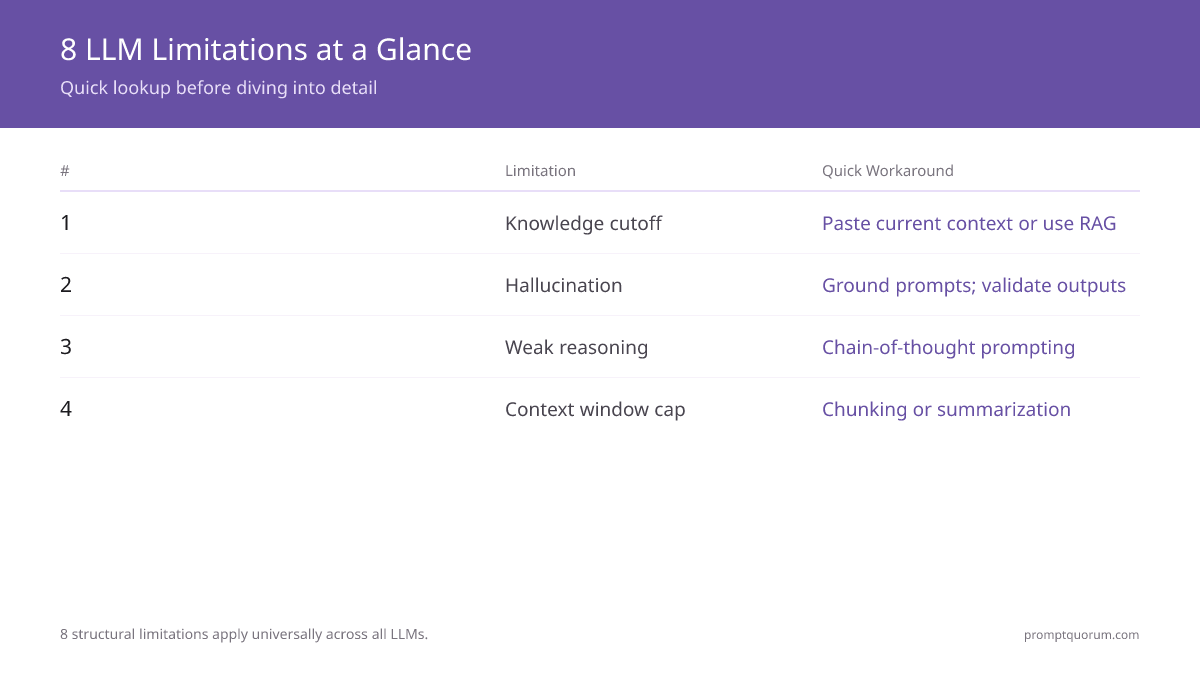
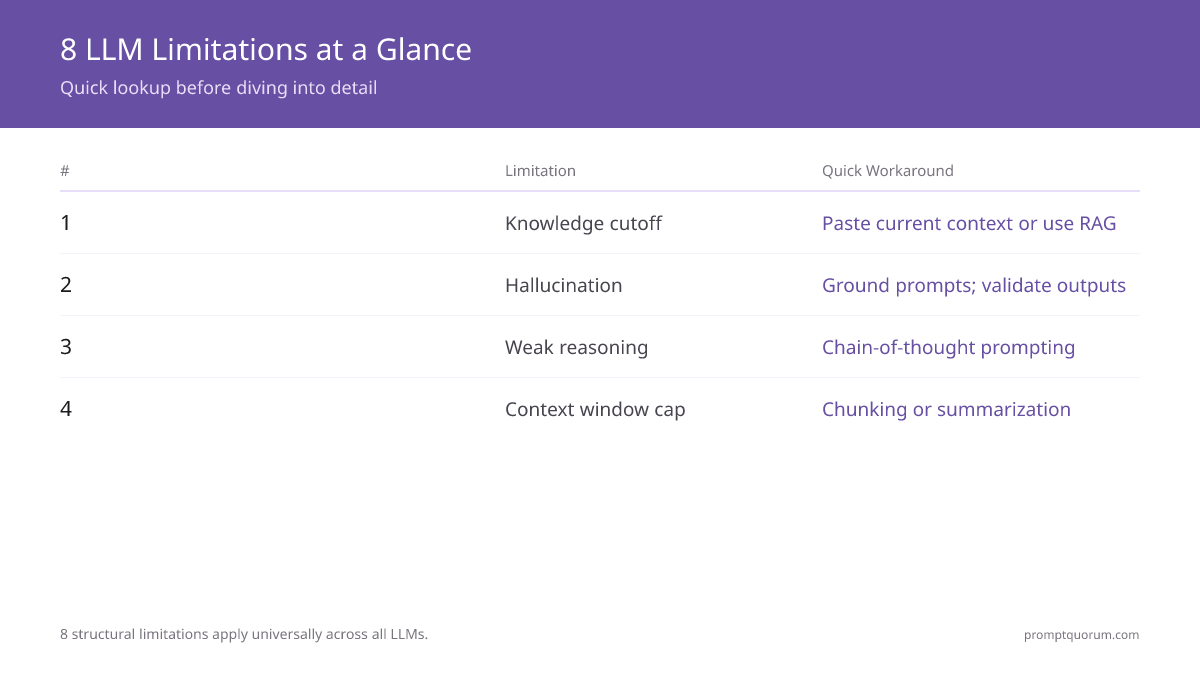
The 8 Limitations at a Glance
Quick lookup table before diving into detail.
# | Limitation | Quick Workaround |
|---|---|---|
| 1 | Knowledge cutoff | Paste current context or use RAG |
| 2 | Hallucination | Ground prompts; validate outputs |
| 3 | Weak reasoning | Chain-of-thought prompting |
| 4 | Context window cap | Chunking or summarization |
| 5 | No memory | Store state in app layer |
| 6 | No real-world action | Tool use / function calling |
| 7 | Training bias | Provide domain context |
| 8 | Cannot self-verify | Validate against primary sources |
Can LLMs Do X? — Quick Answers
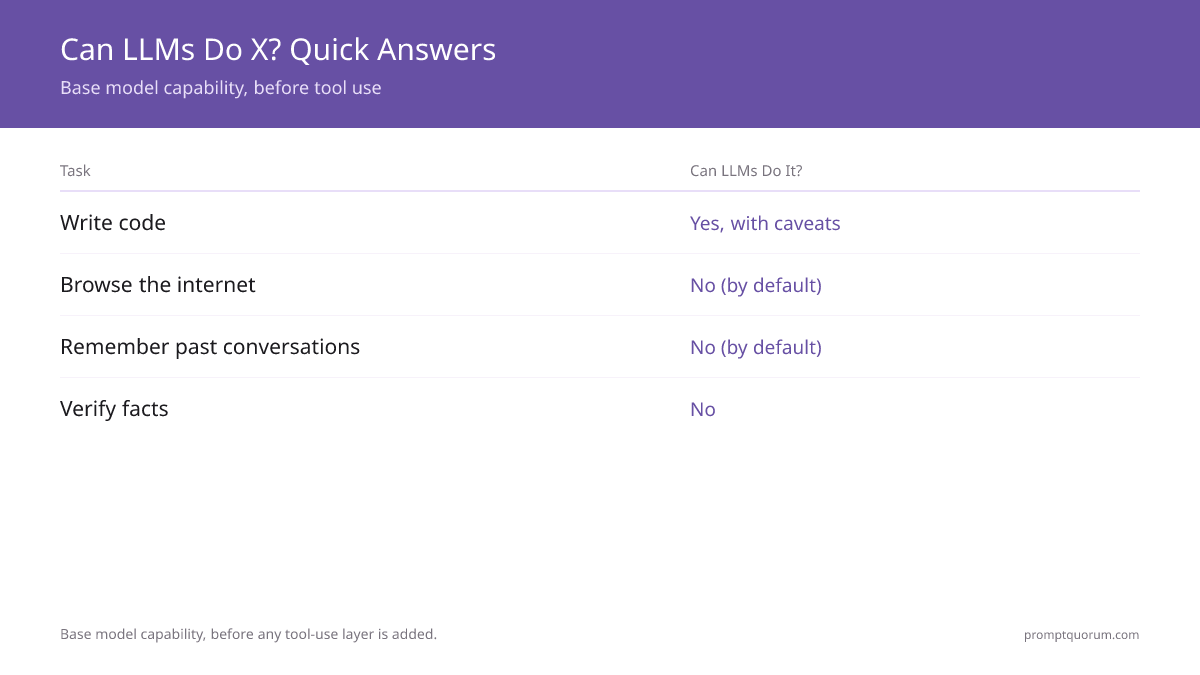
Common tasks people ask LLMs to perform — and whether the current architecture can actually handle them.
Task | Can LLMs Do It? | Why / Why Not |
|---|---|---|
| Write code | Yes, with caveats | Generates plausible code but cannot test or debug it without tool use |
| Browse the internet | No (by default) | Requires tool-use layer; base model API has no network access |
| Remember past conversations | No (by default) | Stateless architecture; requires application-layer memory injection |
| Do math reliably | Partially | Simple arithmetic: yes. Multi-step: requires chain-of-thought or code interpreter |
| Verify facts | No | No ground-truth access; assesses pattern consistency only, not factual accuracy |
| Generate images | No (text models) | Separate multimodal models (DALL-E 4, Midjourney) required |
| Understand sarcasm | Partially | Detects obvious sarcasm; misses nuanced, cultural, or highly contextual forms |
| Replace a domain expert | No | Lacks real-world experience, legal accountability, and access to verified knowledge |
How Limitations Differ by Model (2026)
The eight structural limits apply universally — but severity and available partial workarounds vary by model.
Limitation | GPT-5.6 | Claude Opus 5 | Gemini 3.1 Pro | Open-Source (LLaMA 3.1) |
|---|---|---|---|---|
| Knowledge cutoff | Feb 2026 | May 2026 | Jan 2025 | Varies by release |
| Context window | 128K tokens | 200K tokens | 2M tokens | 8K–128K tokens |
| Tool use quality | Excellent | Excellent | Good | Varies |
| Hallucination handling | Moderate | Strong (flags uncertainty) | Moderate | Weak |
| Reasoning (extended) | Sol tier (extended reasoning) | Extended thinking available | Flash Thinking available | Limited |
Limitation 1 — Knowledge Cutoffs and No Real-Time Data
Every LLM has a training cutoff date, and the model has no knowledge of events, prices, papers, or product versions released after that date unless external retrieval is added. OpenAI GPT-5.6 has a cutoff of February 2026. Anthropic Claude Opus 5 has a reliable knowledge cutoff of May 2026. Google Gemini 3.1 Pro has a cutoff of January 2025.
Models also have sparse knowledge of events *close to* their cutoff, because training data collection and processing takes weeks to months after events occur. A model trained through February 2026 may have thin coverage of December 2025–February 2026 events.
The primary workaround is retrieval-augmented generation (RAG), which injects live or recent documents into the prompt at query time. A secondary workaround is prompt grounding: pasting the relevant current facts directly into the prompt and instructing the model to answer only from that context.
Limitation 2 — Hallucination Is Structural, Not a Bug
LLMs generate statistically plausible tokens, not verified facts — when the training signal for a specific fact is thin, the model produces a confident-sounding fabrication. This applies to every model including GPT-5.6, Claude Opus 5, and Gemini 3.1 Pro. For a deep dive, see AI Hallucinations — Why AI Makes Things Up.
Hallucination occurs most frequently on: specific numeric figures (prices, dates, statistics), citations and paper references, niche technical specifications, and events close to or after the training cutoff. Models rarely signal when they are hallucinating.
Workarounds: provide the source material in the prompt and instruct the model to answer only from it; ask the model to flag any claim it cannot confirm from provided context; use RAG to anchor answers to verified documents; validate all key figures against primary sources before publishing.
"The model does not know what it does not know. It fills gaps with patterns, not silence."
Limitation 3 — No Reliable Multi-Step Reasoning
LLMs perform poorly on multi-step logical or mathematical reasoning tasks without explicit chain-of-thought prompting or external calculator tools. A model asked to solve a 10-step arithmetic problem in a single response will frequently produce a confident but incorrect answer.
The root cause: LLMs are trained to generate likely next tokens, not to maintain state across a reasoning chain. Each generated token is conditioned on prior tokens, but there is no working memory or scratchpad that persists the intermediate results of a calculation.
Chain-of-thought prompting ("Think step by step" or numbered stages) forces the model to write out intermediate reasoning, which significantly improves accuracy on multi-step tasks. For precise arithmetic, route the task to a code interpreter tool rather than relying on model output.
Limitation 4 — Context Window Caps
Every LLM session has a hard token limit — GPT-5.6 at 128,000 tokens, Claude Opus 5 at 200,000 tokens, Gemini 3.1 Pro at 2,000,000 tokens — and performance on earlier content degrades as the window fills. See Context Windows Explained for a full breakdown.
The "lost in the middle" problem: multiple studies show LLM accuracy on retrieving information from the middle of a long context is significantly lower than from the beginning or end. A 1M token window does not mean uniform attention across all 1M tokens.
Workarounds: structure important information at the start or end of the prompt; use RAG to retrieve only relevant chunks rather than dumping full documents; break long documents into chunked sessions with summarization steps.
Performance is often highest when relevant information occurs at the beginning or end of the input context, and significantly degrades when models must reason over information in the middle of long contexts, even for explicitly long-context models.
Limitation 5 — No Persistent Memory Across Conversations
By default, every LLM conversation starts with a blank context — the model has no memory of previous sessions, past instructions, or prior user preferences. This is not a feature gap; it is the base architecture.
Application layers (like OpenAI's Memory feature in ChatGPT, or custom memory systems built with vector databases) can inject prior conversation summaries into the prompt, creating the *appearance* of memory. But this is application-level state management, not the model itself remembering.
For prompt engineering: always include any relevant prior context explicitly in your prompt. Do not assume the model remembers a preference, format, or constraint you set in a previous session.
Limitation 6 — LLMs Cannot Take Real-World Actions
LLMs generate text — they cannot browse the web, run code, send emails, modify files, or interact with external systems unless a tool-use layer explicitly enables these actions. The model produces a text description of what it would do; the scaffolding layer executes it.
Tool use (also called function calling) — available in GPT-5.6, Claude Opus 5, and Gemini 3.1 Pro — lets a model output structured function calls that an application intercepts and executes. The model still cannot take action on its own; it can only emit structured text that triggers external execution.
Autonomous agents wrap multiple tool calls in an orchestration loop, creating the appearance of independent action. Prompt injection and security vulnerabilities are significant concerns in these architectures — see Prompt Injection and Security.
Limitation 7 — Training Data Bias and Coverage Gaps
LLMs inherit the biases, gaps, and skews of their training data — primarily English-language, Western, and pre-2025 internet content. Performance on non-English queries, non-Western cultural contexts, and minority-language topics is structurally weaker.
This is relevant for international teams: GPT-5.6, Claude Opus 5, and Gemini 3.1 Pro all produce stronger outputs in English than in lower-resource languages. Technical terminology in niche domains (specific industries, local legal systems, regional dialects) may be poorly represented in training data.
Workaround: provide domain-specific context, terminology definitions, or examples in the prompt. Do not assume the model has accurate knowledge of your specific industry, region, or institution.
Limitation 8 — LLMs Cannot Verify Their Own Outputs
LLMs have no access to ground truth and cannot check whether their answers are factually correct — they can only assess whether an answer is consistent with patterns in their training data. Asking a model "Is this correct?" produces a pattern-match assessment, not a verification.
Self-consistency prompting (generating multiple answers and checking agreement) improves reliability but does not guarantee accuracy. A model can be consistently wrong on facts that were underrepresented or misrepresented in training data.
The practical implication: treat LLM output as a draft, not a final source. All factual claims — especially numeric figures, dates, citations, and technical specifications — require verification against authoritative primary sources before publication.
LLM Limitations at a Glance
The eight structural limits summarized by root cause, severity, and primary workaround.
Limitation | Root Cause | Severity | Primary Workaround |
|---|---|---|---|
| Knowledge cutoff | Static training data | High for current events | RAG / paste context in prompt |
| Hallucination | Token prediction, not truth lookup | High for specific facts | Ground prompts, validate outputs |
| Weak multi-step reasoning | No working memory / state | Medium (improves with CoT) | Chain-of-thought prompting, code tools |
| Context window cap | Transformer attention limit | Medium for long documents | RAG, chunking, summarization |
| No persistent memory | Stateless architecture | Medium for multi-session work | Application-layer memory injection |
| No real-world action | Text-output only by default | High for autonomous tasks | Tool use / function calling |
| Training bias | Non-representative training corpus | Medium (language/domain dependent) | Provide domain context explicitly |
| Cannot self-verify | No ground-truth access | High for factual accuracy | External validation, primary sources |
When the Limitations Don't Apply — Edge Cases and Experimental Workarounds
The eight structural limitations are real, but each has at least one scenario where the conventional warning overstates the problem — or where 2025–2026 research has partially closed the gap. Knowing the exceptions is as important as knowing the rule.
- Knowledge cutoff is irrelevant for stable-domain questions. The cutoff matters for current events, recent releases, and changing prices. For physics, mathematics, established software APIs (pre-2024), classical literature, and foundational legal frameworks, GPT-5.6's February 2026 cutoff carries almost no practical penalty. Routing stable-domain queries to unaugmented models is often faster and cheaper than RAG.
- Hallucination is a feature for generative tasks. The same token-prediction mechanism that fabricates citations also generates novel metaphors, product names, and creative variations that no retrieval system could produce. Designers, copywriters, and product teams often want LLM "confabulation" — the problem arises only when treating generated content as factual. Separating generation tasks from fact-lookup tasks eliminates most hallucination risk without suppressing creativity.
- Extended-thinking models have substantially narrowed the reasoning gap. the GPT-5.6 Sol tier from OpenAI and Anthropic's extended thinking in Claude Opus 5 use inference-time compute scaling — generating chains of reasoning tokens before answering — and achieve near-human accuracy on graduate-level math and formal logic benchmarks (AIME, MMLU-Pro) as of 2026. The "LLMs can't reason" claim is accurate for standard-mode inference; it is increasingly inaccurate for extended-thinking modes on well-defined tasks.
- The "lost in the middle" context problem is position-dependent, not universal. Liu et al. (2023) showed degradation specifically when critical information is placed in the middle of very long contexts. For prompts under ~20,000 tokens, or when critical facts are placed at the start or end of the prompt, the degradation is minimal. The 2M-token Gemini 3.1 Pro window does not suffer the same magnitude of middle-degradation as earlier 4K or 8K models.
- Self-consistency prompting partially addresses the self-verification gap. Generating three independent answers to the same question and selecting the majority response (Wang et al., 2023, "Self-Consistency Improves Chain of Thought Reasoning in Language Models," arXiv:2203.11171) improves factual accuracy on closed-domain tasks by 10–20 percentage points compared to greedy decoding. It does not substitute for external validation, but it does reduce the rate of confident errors on questions with retrievable answers.
Prompting Around Limitations — Bad and Good Examples
These examples show how the same underlying request fails when it ignores LLM limitations and succeeds when it accounts for them.
Bad Prompt "What's the current pricing for GPT-5.6?"
- This prompt ignores the knowledge cutoff limitation. GPT-5.6's training data ends February 2026 — pricing may have changed since then. The model will generate an answer that sounds authoritative but may be months out of date.
- A better approach explicitly accounts for the limitation:
- Good Prompt "Explain the typical pricing structure OpenAI uses for GPT-5.6 (input tokens, output tokens, batching). Note: I know your training data may not reflect the latest rates — I'll verify the exact current numbers at platform.openai.com after reading your explanation."
How to Design Prompts That Account for LLM Limitations
Two of the most effective techniques for compensating for these limitations are chain-of-thought prompting — which externalises reasoning steps and reduces errors — and RAG, which compensates for knowledge cutoffs by retrieving fresh context. See chain-of-thought prompting and RAG explained.
- 1Identify which limitation applies to your task before writing the prompt. Factual lookups → knowledge cutoff and hallucination. Multi-step problems → reasoning limitation. Long documents → context window. Cross-session work → memory limitation.
- 2Provide grounding context explicitly. Paste in the relevant facts, documents, or data the model needs. Never assume the model has current, accurate, or domain-specific knowledge.
- 3Use chain-of-thought prompting for reasoning tasks. Add "Think step by step" or number the reasoning stages when your task involves multi-step logic, arithmetic, or sequential decisions.
- 4Instruct the model to signal uncertainty. Add a line like: "If you are not certain about a specific fact, say so explicitly rather than guessing." Models comply with this instruction at a higher rate than they hallucinate spontaneously.
- 5Validate outputs before publishing. Check all key figures, dates, citations, and technical specifications against authoritative primary sources. LLM output is a high-quality draft, not a primary source.
Key Terms
Definitions for the core concepts used throughout this article. Each term links to the full entry in the Prompt Engineering Glossary.
- Knowledge Cutoff — The date beyond which a model has no training data. Any event, pricing change, or release after this date is invisible to the model unless you paste it into the prompt. GPT-5.6: February 2026; Claude Opus 5: May 2026; Gemini 3.1 Pro: January 2025.
- Hallucination — Confident-sounding but factually incorrect or fabricated output. Caused by statistical token prediction rather than truth lookup. Grounding prompts with source material reduces but does not eliminate it.
- Context Window — The maximum number of tokens (words + punctuation) the model can process at once, including system prompt, conversation history, and retrieved documents. GPT-5.6: 128K tokens; Claude Opus 5: 200K; Gemini 3.1 Pro: 2M.
- Tool Use / Function Calling — A capability that lets the model invoke external functions (web search, code execution, database queries) instead of generating text answers. Required to work around the no-real-world-action limitation.
- Chain-of-Thought (CoT) — A prompting technique where you ask the model to reason step by step before giving a final answer. Significantly improves accuracy on multi-step arithmetic, logic, and planning tasks.
- RAG (Retrieval-Augmented Generation) — Architecture where relevant documents are retrieved from an external knowledge base and injected into the prompt at query time. The primary workaround for knowledge cutoffs.
- Training Bias — Systematic skew in model outputs caused by imbalances in training data — primarily English-language, Western, and pre-2025 internet content. Non-English and niche-domain tasks are structurally weaker across all major models.
How LLM Limitations Vary by Region
LLM limitations are universal in structure but vary in severity by language, region, and regulatory environment. EU organizations operating under the EU AI Act (2024) must document AI limitations in risk assessments for high-risk use cases — making the eight limits here a compliance requirement, not just a technical concern.
In China, Baidu ERNIE 4.0 and Alibaba Qwen 3 share the same structural limitations but have training data weighted toward Mandarin-language sources. This improves performance on Chinese-language topics but the same knowledge cutoff, hallucination, and reasoning constraints apply.
In Japan, Fujitsu Takane and Line HyperCLOVA X exhibit stronger performance on Japanese-language tasks than general multilingual models, but all structural limitations — cutoff dates, hallucination, context windows, no real-world action — apply identically.
Frequently Asked Questions
What are the main things LLMs can't do?
LLMs cannot access real-time data, verify their own outputs, retain memory across sessions, take real-world actions without tool scaffolding, or reason reliably through multi-step logic without chain-of-thought prompting. These are structural limits applying to every model — GPT-5.6, Claude Opus 5, Gemini 3.1 Pro, and open-source alternatives alike.
Why do LLMs hallucinate?
Hallucination is structural: LLMs predict the most statistically likely next token based on training data, not verified truth. When training signal for a specific fact is thin — niche figures, recent events, obscure citations — the model generates a plausible-sounding fabrication without flagging uncertainty. Grounding prompts with explicit source material reduces but does not eliminate hallucination.
Can GPT-5.6 access the internet?
GPT-5.6 in the standard API cannot access the internet. ChatGPT's consumer interface uses live Bing search by default, but the base model API has a training cutoff of February 2026 and no live retrieval unless a tool-use layer is explicitly wired in. Always confirm whether that layer is active in your specific integration before assuming the model has current data.
How do knowledge cutoffs differ between GPT-5.6, Claude, and Gemini?
As of 2026: OpenAI GPT-5.6 has a training cutoff of February 2026; Anthropic Claude Opus 5 has a reliable knowledge cutoff of May 2026; Google Gemini 3.1 Pro has a cutoff of January 2025. All three models may have imprecise knowledge of events close to their cutoffs due to sparse training coverage of the most recent months.
Can I fix LLM limitations with better prompting?
Prompting reduces the impact of limitations but does not eliminate them. Chain-of-thought prompting improves reasoning accuracy. Providing facts in the prompt mitigates knowledge cutoffs. Explicit uncertainty instructions reduce hallucination confidence. But prompting cannot give a model real-time data access, genuine memory, or the ability to take real-world actions.
Do fine-tuned models have the same limitations?
Yes. Fine-tuning adjusts style, domain focus, or instruction-following behavior — it does not add real-time data access, true reasoning, or persistent memory. A fine-tuned GPT-5.6 retains the same knowledge cutoff and hallucination risk as the base model.
What's the difference between an LLM limitation and a bug?
A bug is an unintended error fixable with a software update. A limitation is a structural property of how the model works. Hallucination, knowledge cutoffs, and context window caps are limitations — they emerge from the transformer architecture and training process and cannot be patched away, only worked around with system design.
Which LLM has the fewest limitations?
No model eliminates any of the eight structural limitations — they are universal to transformer architecture. Gemini 3.1 Pro has the largest context window (2 million tokens), best mitigating limitation 4. Claude Opus 5 hedges uncertainty and acknowledges knowledge cutoffs most reliably, mitigating hallucination risk. GPT-5.6 excels at tool use (limitation 6 workaround). Choose based on your specific limitation bottleneck, not on which model is "least limited."
How do limitations differ between open-source and proprietary models in 2026?
Open-source models (LLaMA 3.1, Mistral Large, Qwen 3) and proprietary models (GPT-5.6, Claude Opus 5, Gemini 3.1 Pro) face identical structural limitations — knowledge cutoffs, hallucination, context windows, reasoning constraints. The differences are in severity and cost: proprietary models typically have larger contexts (Gemini 3.1 Pro: 2M tokens vs. Mistral: 128K), better instruction-following, and more frequent training updates. Open-source models trade capabilities for cost and deployment control. Neither category eliminates any of the eight limitations.
Sources & Further Reading
- Ji, Z. et al. (2023). "Survey of Hallucination in Natural Language Generation." ACM Computing Surveys. — comprehensive taxonomy of LLM hallucination types and mitigation strategies
- Bubeck, S. et al. (2023). "Sparks of Artificial General Intelligence: Early experiments with GPT-4." arXiv:2303.12528. — systematic evaluation of GPT-4 capabilities and limitations
- Liu, N. et al. (2023). "Lost in the Middle: How Language Models Use Long Contexts." arXiv:2307.03172. — evidence for performance degradation in middle-of-context retrieval