This glossary covers 100+ of the most important terms in prompt engineering, from foundational concepts to agent orchestration and evaluation frameworks. Each entry includes a concise practical definition written for developers and AI practitioners, plus a primary reference link for deeper reading.
Terms are organized into six groups: Core Prompting Concepts, Agents & Orchestration, Safety & Alignment, Evaluation & Testing, Advanced Techniques, and Metrics & Production. Use the searchable tables as a quick reference or follow the links for implementation details.
Core Prompting Concepts
Prompt
Prompt engineering
PromptingGuide Overview, LearnPrompting Definition, IBM Techniques
LLM (Large Language Model)
Token
OpenAI Tokenizer, PromptingGuide Settings, KeepMyPrompts 2026
Context window
Wikipedia, Firecrawl Context Engineering, PromptingGuide Settings
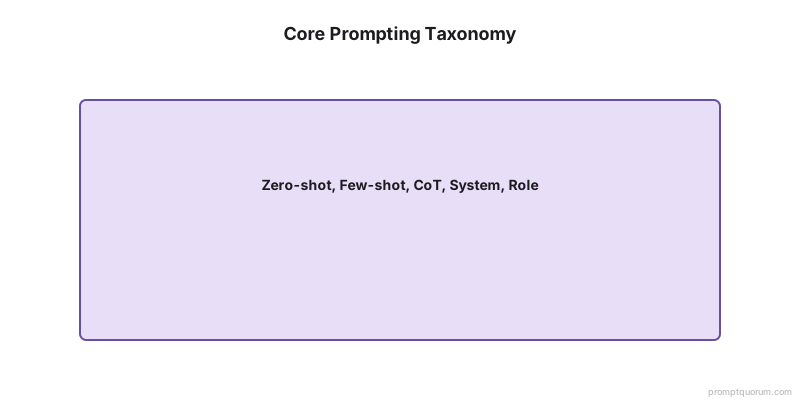
System prompt
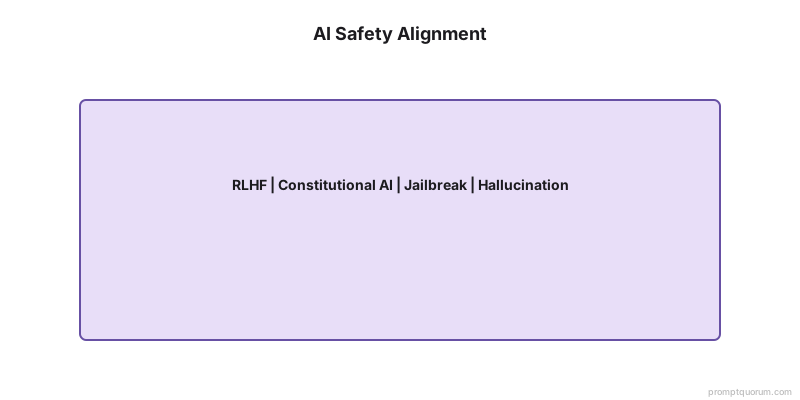
Hallucination
Grounding
Zero-shot prompting
PromptingGuide Zero-shot, Codecademy Shot Prompting, Lakera 2026
Few-shot prompting
Chain-of-Thought (CoT)
Zero-shot CoT
Role prompting
LearnPrompting Roles, PromptingGuide Basics, DecodeTheFuture 2026
Prompt chaining
Anthropic Chain Prompts, PromptingGuide Chaining, Lakera Orchestration
ReAct prompting
PromptingGuide ReAct, Zignuts Agent Orchestration, IBM Techniques
Tree-of-Thought (ToT)
PromptingGuide ToT, LearnPrompting Tree of Thought, ClipboardAI Glossary
Temperature
PromptingGuide Settings, Tetrate Guide, PromptEngineering.org
Top-p (nucleus sampling)
PromptEngineering.org Temperature & Top-p, PromptingGuide Settings, Infomineo Best Practices
RAG (Retrieval-Augmented Generation)
Open Weights
Meta – LLaMA Community License, Mistral AI – License, Wikipedia – Open-weights models
Fine-tuning
Anthropic – Fine-tuning guide, OpenAI – Fine-tuning API, IBM – RAG vs fine-tuning
LoRA
Hu et al. – LoRA paper, Dettmers et al. – QLoRA paper, PromptingGuide – Advanced techniques
VRAM
NVIDIA – GPU memory, Ollama – Hardware guide, HuggingFace – Model cards
Context engineering
Agents & Orchestration
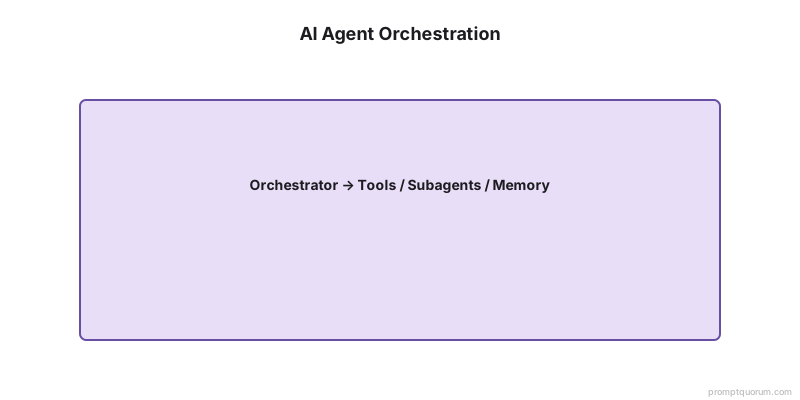
Agent
OpenAI Agents – Orchestration, Genesys – LLM agent orchestration, GetStream – AI agent orchestration
Tool
IBM – What is tool calling?, LLMBase – Tool call, OpenAI – Tools & function calling
Tool call
Tool schema
OpenAI – Tool specification, IBM – Tool calling guide, OpenAI Agents SDK
Agent orchestration
OpenAI – Agent orchestration, Genesys – LLM agent orchestration, IBM – Orchestration tutorial
Multi-agent system
Eonsr – Orchestration frameworks 2025, Zylos – Multi-agent patterns 2025, GetStream – AI agent orchestration
Planner agent
OpenAI Agents – Planning, IBM – Orchestration tutorial, Zylos – Multi-agent patterns
Executor agent
OpenAI Agents SDK, Genesys – Agent orchestration, GetStream – Orchestration
Router agent
OpenAI – Routing patterns, Eonsr – Orchestration frameworks, Zylos – Multi-agent patterns
Guardrail
Lakera – Prompt engineering & safety, Zendesk – AI glossary (guardrails), GetStream – Orchestration best practices
Observation
IBM – Tool calling, OpenAI Agents – Tools, Genesys – Orchestration flows
State (agent state)
OpenAI – Agent orchestration, IBM – Orchestration tutorial, Zylos – Production considerations
Memory (short-term)
PromptingGuide – Context & history, OpenAI – Conversation design, CoherePath – Glossary
Memory (long-term)
Firecrawl – Context engineering, Zylos – Multi-agent production, PromptingGuide – RAG & memory
Vector store
PromptingGuide – RAG, AWS – Vector databases overview, Eonsr – Orchestration frameworks
Action space
OpenAI Agents – Actions & tools, IBM – Agent orchestration guide, GetStream – Orchestration best practices
Termination condition
OpenAI – Agent orchestration, Zylos – Production considerations, Multi-agent patterns video
Sequential orchestration
Multi-agent patterns video, OpenAI – Orchestration patterns, Genesys – Orchestration
Parallel orchestration
Zylos – Multi-agent orchestration 2025, Multi-agent patterns video, Eonsr – Orchestration frameworks
Producer-reviewer loop
Multi-agent patterns video, GetStream – Orchestration, IBM – Orchestration tutorial
Safety & Alignment
Safety policy
OpenAI – Safety best practices, Anthropic – Safety overview, Lakera – Safety & guardrails
Guardrails
Anthropic – Safety & guardrails, OpenAI – Safety best practices, Zendesk – Generative AI glossary
Prompt injection
OWASP – LLM prompt injection, Lakera – Prompt injection, Microsoft – Prompt injection guidance
Jailbreak
OWASP – LLM jailbreaks, Lakera – Jailbreak examples, Anthropic – Safety FAQ
Red-teaming
Anthropic – Red-teaming AI systems, OpenAI – Safety & red teaming, OWASP – Testing LLM apps
Toxicity
Google – Perspective API, Zendesk – AI glossary, OpenAI – Safety best practices
Bias
OpenAI – Addressing bias, IBM – Bias in AI, Anthropic – Responsible scaling
Alignment
Anthropic – Constitutional AI, OpenAI – Alignment & safety, DeepMind – Alignment research
RLHF
OpenAI – RLHF paper, Anthropic – RL from AI feedback, DeepMind – RLHF overview
Constitutional AI
Anthropic – Constitutional AI, Anthropic – Research paper, Zendesk – AI glossary
Evaluation & Testing
Evals (evaluation suite)
OpenAI – Evals framework, Anthropic – Model evaluations, ClipboardAI – AI glossary
Golden set
OpenAI – Evals docs, Microsoft – Evaluation guidance, Anthropic – Evaluating Claude
A/B prompt test
OpenAI – Prompt best practices, KeepMyPrompts – Testing prompts, Lakera – Prompt optimization
Win rate
OpenAI – Evals & comparison, Anthropic – Model evals, Microsoft – Evaluation patterns
Regression test
OpenAI – Evals, Microsoft – Regression evaluation, OWASP – LLM application testing
Human-in-the-loop (HITL)
Microsoft – Responsible AI, OpenAI – Safety best practices, Anthropic – Human feedback
Monitoring
Datadog – LLM observability posts, Microsoft – Monitoring guidance, OWASP – LLM security
Drift
Google – ML data drift, OpenAI – Monitoring, Eonsr – Orchestration in production
Prompt versioning
KeepMyPrompts – Prompt management, Lakera – Prompt lifecycle, OpenAI – Prompting best practices
Prompt repository
OpenAI – Prompt library examples, CoherePath – Prompting glossary, ClipboardAI – AI glossary
Advanced Techniques
Self-Consistency
PromptingGuide – Self-Consistency, IBM – Prompt techniques, Lakera – Prompt engineering guide
Meta-Prompting
PromptingGuide – Meta Prompting, IBM – Prompt engineering techniques, DigitalApplied – Advanced techniques 2026
Automatic Prompt Engineer (APE)
PromptingGuide – Automatic Prompt Engineer, PromptingGuide – Techniques, K2View – Prompt techniques 2026
Reflexion
PromptingGuide – Reflexion, PromptingGuide – LLM Agents, Lakera – Advanced guide
Multimodal Prompting
Promptitude – Prompt engineering 2026, PromptingGuide – Multimodal CoT, Promnest – Best practices 2026
Graph-of-Thoughts (GoT)
PromptingGuide – Techniques, Promnest – Cognitive architectures 2026
Chain-of-Table
GetMaxim – Advanced techniques 2025/2026, PromptingGuide – Advanced techniques
Active-Prompt
Directional Stimulus Prompting
PromptingGuide – Directional Stimulus Prompting, PromptingGuide – Techniques overview
Program-Aided Language Models (PAL)
PromptingGuide – Program-Aided Language Models, PromptingGuide – Advanced
Agentic RAG
LinkedIn – Agentic AI terms, K2View – Agentic RAG, Reddit – Agentic terms
Handoff (agent handoff)
OpenAI Agents SDK – Handoffs, Zylos – Multi-agent patterns, Genesys – Orchestration
Orchestrator agent
OpenAI – Agent orchestration, Eonsr – Orchestration frameworks 2025, Zignuts – Prompt engineering guide
Critic / Reviewer agent
Multi-agent patterns, IBM – Orchestration tutorial, GetStream – Best practices
GraphRAG
Prompt Tuning
Zendesk – Generative AI glossary, IBM – RAG vs fine-tuning vs prompting
Context Compression
Adaptive Prompting
Promptitude – Trends 2026, RefonteLearning – Optimizing interactions 2026
G-Eval
Microsoft – Evaluation guidance, Confident AI – LLM evaluation metrics
Metrics & Production
BERTScore
ROUGE
BLEU
Perplexity
Answer Relevancy
Task Completion Rate
Prompt Injection (indirect)
OWASP – LLM top 10, Penligent – Agent hacking 2026, Microsoft – Guidance
Agent Hijacking
Human-in-the-Loop (HITL) Evaluation
LLM-as-a-Judge
Prompt Repository (enterprise)
OpenAI – Examples, Braintrust – Prompt tools 2026, KeepMyPrompts – Management
Prompt Optimizer
Dev.to – Automatic prompt optimization, Braintrust – Tools 2026
Multi-Modal Orchestration
Shadow AI
Constitutional AI (extended)
Drift Detection (prompt/model)
Google – ML drift, Eonsr – Production, Datadog – Observability
Win Rate (pairwise)
OpenAI – Evals, Anthropic – Model evaluations, Microsoft – Evaluation
Context Engineering (advanced)
Firecrawl – Context engineering, AIPromptLibrary – Advanced 2026, KeepMyPrompts – Guide
Swarm / Collective Intelligence
Zignuts – Prompt engineering guide, Promnest – Orchestration
Prompt Versioning & Rollback
KeepMyPrompts – Prompt management, Lakera – Prompt lifecycle, Braintrust – Tools
Frequently Asked Questions
What is prompt engineering in simple terms?
Prompt engineering is the discipline of designing and iterating prompts so language models produce useful, predictable, and safe outputs. It involves structuring instructions, adding context, and choosing techniques like few-shot or chain-of-thought to improve reliability and quality.
What is the difference between zero-shot and few-shot prompting?
Zero-shot prompting asks the model to perform a task using only instructions, without any examples—best for common tasks where the model's prior training already covers the pattern. Few-shot prompting includes a small number of input-output examples in the prompt so the model can infer the desired pattern, format, or style before handling the real query. Few-shot typically produces higher quality on complex or uncommon tasks.
What does RAG stand for in AI?
RAG stands for Retrieval-Augmented Generation. It's an architecture where relevant documents are retrieved from a knowledge base and injected into the prompt so the model answers based on current, grounded data rather than relying on training data alone. This reduces hallucinations and ensures answers are based on real, up-to-date information.
What is the difference between prompt engineering and fine-tuning?
Prompt engineering is the discipline of designing and iterating prompts to steer model outputs without changing the model itself. Fine-tuning, by contrast, modifies the model's weights by training it on task-specific data. Prompt engineering is faster, cheaper, and easier to iterate on, while fine-tuning can achieve better results on specialized tasks but requires more data and computational resources.
What is a context window in AI?
A context window is the maximum number of tokens the model can consider at once, including system prompt, conversation history, and retrieved documents. When context limits are exceeded, older or middle parts of the context are truncated or ignored. Understanding context window size is crucial for managing costs and latencies, as longer contexts are more expensive and slower to process.