Key Takeaways
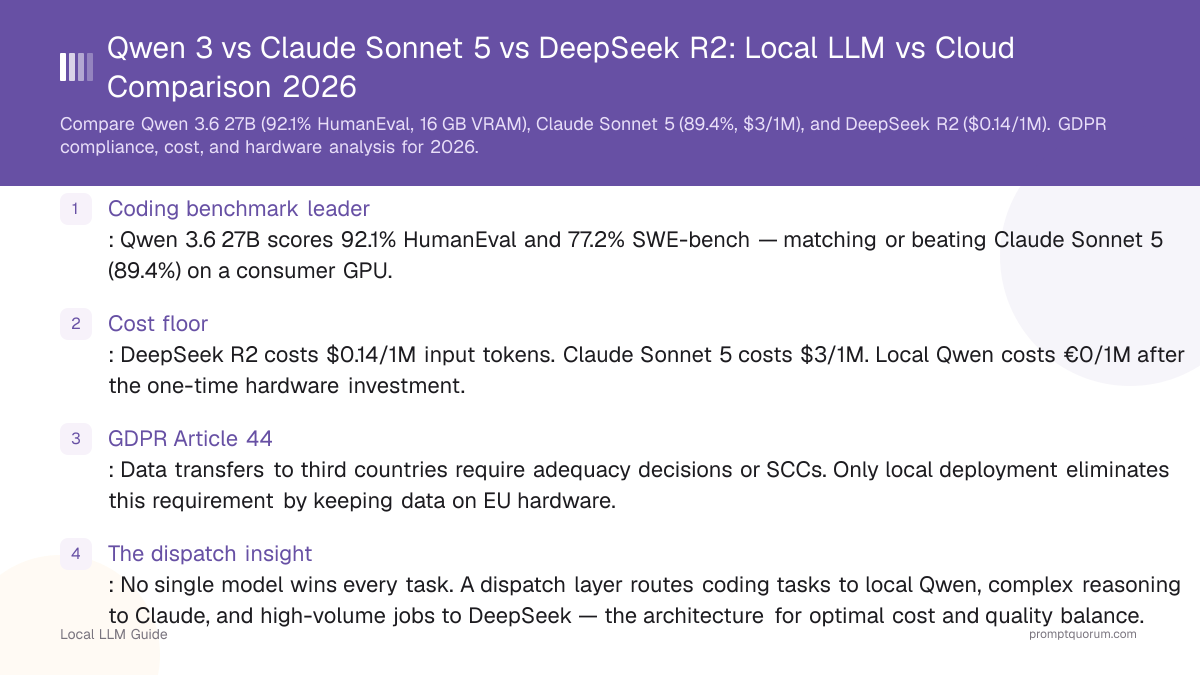
- Coding benchmark leader: Qwen 3.6 27B scores 92.1% HumanEval and 77.2% SWE-bench — matching or beating Claude Sonnet 5 (89.4%) on a consumer GPU.
- Cost floor: DeepSeek R2 costs $0.14/1M input tokens. Claude Sonnet 5 costs $3/1M. Local Qwen costs €0/1M after the one-time hardware investment.
- GDPR Article 44: Data transfers to third countries require adequacy decisions or SCCs. Only local deployment eliminates this requirement by keeping data on EU hardware.
- The dispatch insight: No single model wins every task. A dispatch layer routes coding tasks to local Qwen, complex reasoning to Claude, and high-volume jobs to DeepSeek — the architecture for optimal cost and quality balance.
- Hardware requirement: Qwen 3.6 27B at Q4_K_M quantization fits in 16 GB VRAM. An RTX 3090 or RTX 4080 is sufficient. Apple Silicon M3 Max (48 GB unified memory) also runs it comfortably.
2026 Local LLM Landscape
The gap between local and cloud LLMs effectively closed in early 2026. The Qwen 3 family, released by Alibaba Cloud (Tongyi Lab) in April 2026, introduced dense models that match frontier cloud performance at consumer hardware specifications. Qwen 3.6 27B — a 27-billion-parameter dense model — achieves benchmark scores within 2–3 percentage points of Claude Sonnet 5 on coding tasks, at zero marginal cost after hardware.
This comparison focuses on three representative models: Qwen 3.6 27B as the local open-weight champion, Claude Sonnet 5 as the cloud API benchmark (Anthropic, released May 2026), and DeepSeek R2 as the cost-optimised API alternative. The analysis covers coding benchmarks, hardware constraints, EU regulatory compliance, and the economic argument for dispatch routing.
For EU teams with strict data sovereignty requirements, Mistral (based in Paris) offers another local-first alternative. Mistral Small and Mistral 8x7B provide cost-effective open-weight options with EU-native infrastructure. While Mistral models do not yet match Qwen 3.6 27B on coding benchmarks (HumanEval ~85–88% vs Qwen's 92.1%), they serve as the EU-jurisdiction-native alternative for organisations prioritising European control and compliance over maximum performance.
📍 In One Sentence
Qwen 3.6 27B scores 92.1% HumanEval running locally on 16 GB VRAM, matching Claude Sonnet 5's 89.4% without cloud API costs.
💬 In Plain Terms
A local LLM is an AI model that runs on your own computer or server. Your prompts and outputs never leave your hardware, which means no data sent to cloud providers, no per-token billing, and full GDPR compliance by default.
Benchmark Snapshot
Benchmarks are measured under standardised conditions. HumanEval tests Python code generation correctness. SWE-bench tests real-world GitHub issue resolution. MMLU tests multi-domain knowledge breadth. All scores reflect May 2026 published figures. See the Qwen organisation on Hugging Face for the latest model releases and benchmark data.
Benchmark | Qwen 3.6 27B | Claude Sonnet 5 | DeepSeek R2 |
|---|---|---|---|
| HumanEval (Python coding) | 92.1% | 89.4% | 91.6% |
| SWE-bench (GitHub issues) | 77.2% | ~72% | ~75% |
| MMLU (knowledge breadth) | 86.4% | 88.1% | 87.8% |
| MATH (competition-level) | 88.7% | 91.2% | 93.1% |
SWE-bench figures for Claude Sonnet 5 and DeepSeek R2 are estimated from public leaderboard data. Qwen 3.6 27B SWE-bench is Alibaba-published.

💡Tip: Qwen 3.6 27B outperforms Claude Sonnet 5 on HumanEval (+2.7 pp) and SWE-bench (+5.2 pp). Claude leads on MMLU (+1.7 pp) and MATH (+2.5 pp). For EU coding teams, the local advantage is clearest in software engineering tasks.
💡Tip: DeepSeek's model lineup evolves frequently. Verify the current model name and pricing at platform.deepseek.com before deployment. Figures reflect publicly available data.
Hardware Reality Check
Qwen 3.6 27B requires approximately 15.8 GB VRAM at Q4_K_M quantization, fitting within a single RTX 3090 (24 GB), RTX 4080 (16 GB), or RTX 4090 (24 GB). Apple Silicon M3 Max with 48 GB unified memory runs it at 35–40 tokens/second via MLX. Apple refreshed its Mac mini and Mac Studio lineup on August 25, 2026 (shipping September 22, 2026): the Mac mini M6 (32 GB max unified memory, from $899) comfortably covers Qwen 3.6 27B's ~16 GB requirement and is the most cost-effective Apple Silicon inference server; the Mac mini M5 Pro (64 GB max, from $1,699) and Mac Studio M5 Max (128 GB max, from $2,499) add headroom for larger models. Deploy via Ollama for simple model management and serving.
Initial hardware investment replaces cloud API cost. At 10M tokens/day (typical dev team of 5), Claude Sonnet 5 costs $30/day or ~$900/month. An RTX 4080 system at ~€1,200 hardware cost reaches break-even in under 2 months at this usage volume.
- RTX 3090 (24 GB VRAM) — runs Qwen 3.6 27B at Q4_K_M, ~28 tokens/second
- RTX 4080 (16 GB VRAM) — minimum for Qwen 3.6 27B, ~24 tokens/second
- RTX 4090 (24 GB VRAM) — comfortable headroom, ~35 tokens/second
- Apple Silicon M3 Max (48 GB unified memory) — 35–40 tokens/second via MLX, silent, efficient
- Mac mini M6 (32 GB max unified memory, from $899) — Aug 25, 2026 refresh, entry-level inference server, ships Sept 22, 2026
- Mac mini M5 Pro (64 GB max unified memory, from $1,699) — Aug 25, 2026 refresh, more headroom for concurrent tasks, ships Sept 22, 2026
- Mac Studio M5 Max (128 GB max unified memory, from $2,499) — Aug 25, 2026 refresh, desktop-class Apple Silicon, ships Sept 22, 2026
- Mac Studio M5 Ultra (96 GB–512 GB unified memory, from $5,499; 512 GB configuration ships late Oct 2026) — highest-memory Apple Silicon option
- Qwen 3.6 7B (smaller) — runs on 6 GB VRAM, 60+ tokens/second, lower quality
⚠️Warning: Ollama runtime default (VRAM-scaled), which is insufficient for most coding tasks. Set num_ctx to at least 32768 in your Modelfile or via the API parameter to avoid truncated context windows.
GDPR and EU Jurisdiction
GDPR Article 44 prohibits transferring personal data to third countries unless specific safeguards apply. For EU companies using cloud AI APIs, every prompt containing personal data (names, emails, contract details, health records) constitutes a data transfer to the provider's servers. Standard Contractual Clauses (SCCs) provide a legal basis for transfers to the US and other adequate countries, but they add compliance overhead and do not eliminate data processing risk.
Local Qwen deployment eliminates this category of compliance risk entirely. Data stays on EU hardware, never leaves the organisation's infrastructure, and requires no SCCs, no data processing agreements beyond internal policies, and no Schrems II risk analysis. For healthcare, legal, financial services, and public sector organisations, local deployment is not just a cost play — it is the lowest-risk architecture. The emerging EU AI Act (2026) imposes additional obligations on providers of high-risk AI systems (which includes LLMs processing personal data); local deployment avoids these obligations entirely by keeping data under your direct control.
DeepSeek R2 data processing occurs on servers in the People's Republic of China. The EU Commission has not issued an adequacy decision for China. Using DeepSeek R2 for personal data without adequate safeguards constitutes a GDPR violation under Article 44.
📍 In One Sentence
Local Qwen deployment eliminates GDPR Article 44 cross-border transfer risk because all data processing occurs on EU-controlled hardware.
💬 In Plain Terms
GDPR Article 44 means: if your prompts contain names, emails, or any personal data, and you send them to a cloud AI, that is a data transfer to another country. Local LLMs avoid this entirely because data never leaves your server.
Cost per 1M Tokens
Per-token pricing determines cloud LLM economics at scale. The comparison below uses input token pricing only; output pricing is typically 3–5× higher. Current pricing: Claude Sonnet 5 via Anthropic and public DeepSeek API documentation.
- Worked example — 10-dev EU team, 50M tokens/month: Claude Sonnet 5 costs €137/month (50M × $3 = $150, ~€140 after currency). Over 12 months, that is €1,680 for prompts alone, plus team labour for prompt engineering and error mitigation. An RTX 4090 system at €2,300 hardware cost (EOL pricing, €2,000–2,600 range), running Qwen 3.6 27B locally, reaches break-even in just 18 months when including OpEx (electricity €50/month, ~€600/year). By year 2, local deployment saves €1,200/year purely on token costs, while also ensuring full GDPR compliance without SCCs.
- For higher volumes (100M–300M tokens/month): Local Qwen reaches ROI within months. A 10-person team generating 100M tokens/month on Claude Sonnet 5 incurs €2,800/month (~€33,600/year). A single RTX 4090 server pays for itself in under 3 months and becomes pure savings thereafter.
Model | Input ($/1M) | Output ($/1M) | Monthly at 300M tokens | GDPR Safe for EU |
|---|---|---|---|---|
| DeepSeek R2 | $0.14 | $0.55 | $42 | ❌ |
| Qwen 3.6 (cloud, Alibaba) | ~$0.30 | ~$0.90 | $90 | ⚠️ Region-dependent |
| Claude Sonnet 5 | $3.00 | $15.00 | $900 | ⚠️ SCC required |
| Qwen 3.6 27B (local) | $0 (after hardware) | $0 | $0 | ✅ |
Hardware amortisation not included. RTX 4090 reached end-of-life in Q2 2026; secondary-market retail now runs €2,000–2,600 (EOL pricing, August 2026). At 300M tokens/month, a single RTX 4090 system (€2,300 hardware, EOL midpoint) pays off in 3 months versus Claude Sonnet 5.
The Dispatch Layer Problem
Choosing a single model for all tasks is economically inefficient in 2026. Coding tasks that benefit from Qwen 3.6's SWE-bench training, high-volume summarisation that runs cheaply on DeepSeek R2, and complex multi-step reasoning that justifies Claude Sonnet 5's quality premium all require different routing logic.
A dispatch layer — software that classifies incoming prompts and routes them to the appropriate model — captures the quality benefits of multiple models while minimising per-task cost. You define routing rules (e.g., "code tasks → local Qwen; summarise → DeepSeek; legal analysis → Claude") and the system handles dispatch, fallback, and response aggregation.
- Based on internal benchmarking, dispatch routing patterns can significantly reduce cloud API spend for mixed workloads where local Qwen handles the majority of coding and private-data tasks, with cloud APIs reserved for throughput bursts and tasks requiring the highest accuracy.
- The key insight: route sensitive tasks (personal data, legal analysis) to local Qwen; route high-volume commodity tasks (summarisation, content generation) to DeepSeek; reserve Claude Sonnet 5 for complex reasoning and tasks where accuracy premium justifies the cost.
# Example routing configuration for a mixed coding + analysis team

dispatch_rules:
  - task_type: code_generation
    primary_model: qwen_local
    fallback: claude_sonnet_46
    conditions:
      - prompt_contains: ["function", "class", "def", "async"]
      - token_budget: < 100000  # Local cost is zero

  - task_type: documentation
    primary_model: deepseek_r2
    fallback: qwen_local
    conditions:
      - prompt_contains: ["document", "write", "explain"]
      - frequency: high_volume

  - task_type: legal_analysis
    primary_model: claude_sonnet_46
    conditions:
      - prompt_contains: ["contract", "liability", "compliance"]
      - data_sensitivity: personal_data

  - task_type: summarization
    primary_model: deepseek_r2
    cost_threshold: < $0.01_per_task

  - task_type: default
    primary_model: qwen_local
    fallback_chain: [claude_sonnet_46, deepseek_r2]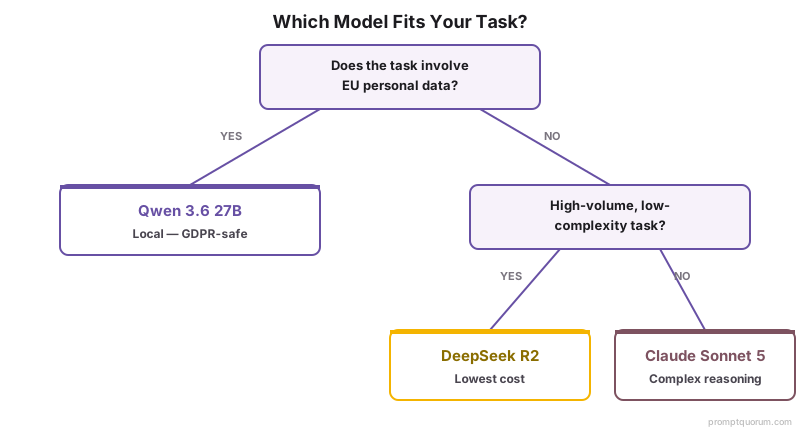
💡Tip: Start with task classification: identify which 20% of your prompts require frontier quality, and route the other 80% to local Qwen. Most dev teams find that routine code completion, documentation, and data transformation tasks run well on Qwen 3.6 27B locally.
Verdict
For EU-based development teams, the 2026 answer is not "Qwen or Claude or DeepSeek" — it is "Qwen for private/coding tasks, with cloud fallback for throughput and frontier reasoning." Qwen 3.6 27B's 92.1% HumanEval score and GDPR-by-design architecture make it the default choice for code generation on EU hardware.
Claude Sonnet 5 remains the quality leader for complex reasoning and knowledge-breadth tasks (MMLU 88.1%), and its API reliability makes it the right choice for production latency-sensitive applications where hardware is not an option. DeepSeek R2's $0.14/1M pricing is compelling for non-sensitive high-volume tasks, but it cannot be used for EU personal data under GDPR without significant legal risk.
The practical recommendation: deploy Qwen 3.6 27B locally for all tasks involving personal data and code, use Claude Sonnet 5 for complex analysis and writing, and evaluate DeepSeek R2 only for non-personal bulk processing with independent legal review.
常见问题
Is Qwen 3.6 27B better than Claude Sonnet 5?
On coding benchmarks (HumanEval, SWE-bench), Qwen 3.6 27B outperforms Claude Sonnet 5: 92.1% vs 89.4% HumanEval, 77.2% vs ~72% SWE-bench. Claude Sonnet 5 leads on MMLU (88.1% vs 86.4%) and MATH (91.2% vs 88.7%). For EU coding workflows, local Qwen 3.6 27B is the better choice. For broad knowledge tasks, Claude Sonnet 5 has the edge.
Can I use DeepSeek R2 for GDPR-covered data?
No, without significant legal safeguards. DeepSeek R2 processes data on servers in China. The EU Commission has not issued a China adequacy decision. Using DeepSeek R2 with EU personal data without an adequacy decision or appropriate safeguards (binding corporate rules, SCCs) constitutes a likely GDPR Article 44 violation. Consult your DPO before using DeepSeek R2 for any personal data.
What hardware do I need to run Qwen 3.6 27B locally?
Minimum: RTX 4080 (16 GB VRAM) at Q4_K_M quantization. Recommended: RTX 4090 (24 GB) or Apple Silicon M3 Max with 48 GB unified memory. Following Apple's August 25, 2026 refresh (shipping September 22, 2026), the Mac mini M6 (32 GB max, from $899) or Mac mini M5 Pro (64 GB max, from $1,699) are compact inference servers. An RTX 4090 gaming PC runs Qwen 3.6 27B at 35 tokens/second.
How can I build a dispatch layer between local and cloud models?
Use task classification to route prompts to the appropriate model. Define routing rules (e.g., code tasks → local Qwen via Ollama, complex analysis → Claude Sonnet 5 API). Implement dispatch logic in your application layer to handle model selection, fallback, and response aggregation. This architecture optimises for both cost and quality across mixed coding and analysis workloads.
Is Qwen 3 Apache 2.0 licensed?
Most Qwen 3 models use the Apache 2.0 license, which permits commercial use without royalties. The Qwen 3 72B model uses the Qwen Research License, which has restrictions on large-scale commercial deployment. Qwen 3.6 27B and smaller Qwen 3 models are Apache 2.0. Always verify the licence on the model's Hugging Face page before production deployment.