Key Takeaways
- Best overall coding model: Kimi K2.6 — 58.6 SWE-Bench Pro, MoE architecture (32B active / 1T total), Modified MIT license. Best dense model: Qwen 3.6 27B — 77.2% SWE-bench.
- Newest agentic-coding challenger: Laguna XS 2.1 (Poolside) — SWE-bench Verified 70.9%, 256K context, OpenMDW-1.1 license. Also new: Kimi K2.7 Code (Moonshot AI), a coding-focused evolution of K2.6 for long-horizon sessions.
- Best for 8 GB RAM: Qwen3 8B — 5 GB VRAM used, best quality-speed tradeoff at this tier.
- Best for agentic coding at 24B (multi-file edits, debugging): Devstral Small 24B — purpose-built for tool calling and multi-step workflows.
- Best for IDE autocomplete: Codestral 22B (Mistral AI) — FIM-optimized, replaces Starcoder2 as recommended model.
- SWE-bench replaces HumanEval as primary benchmark in 2026 — tests real-world GitHub issue resolution, not just single-function Python generation.
- For AI coding assistant workflows (VS Code, Cursor), see Local LLMs for Coding Workflows.
📍 In One Sentence
The best local coding LLMs in July 2026 are Kimi K2.6 (58.6 SWE-Bench Pro, MoE, Modified MIT) for maximum quality and Qwen 3.6 27B (77.2% SWE-bench) for balanced performance on consumer hardware.
💬 In Plain Terms
SWE-bench measures how well an AI fixes real GitHub bugs — higher is better. Kimi K2.6 is a large "mixture-of-experts" model that activates only 32B of its 1T parameters per query, giving top accuracy at manageable GPU cost.
Quick Facts — Local Coding LLMs at a Glance
- Best overall (max quality): Kimi K2.6 — 58.6 SWE-Bench Pro, MoE (32B active), Modified MIT license. Needs quantization for consumer hardware.
- Newest agentic challenger: Laguna XS 2.1 (Poolside) — SWE-bench Verified 70.9%, SWE-bench Multilingual 63.1%, 256K context, 33B total / 3B active MoE, OpenMDW-1.1 license.
- Newest coding-focused variant: Kimi K2.7 Code (Moonshot AI) — built on Kimi K2.6, tuned specifically for long-horizon agentic coding sessions.
- Best dense model: Qwen 3.6 27B — 77.2% SWE-bench, 22 GB VRAM, no MoE overhead.
- Best for agentic coding at 24B: Devstral Small 24B — multi-file edits, debugging workflows, 16 GB RAM, Mistral AI (France).
- Best for IDE autocomplete: Codestral 22B (Mistral) — FIM-optimized, Continue.dev integration, ~14 GB RAM.
- Best for 8 GB RAM: Qwen3 8B — 5 GB VRAM used, best quality-speed tradeoff.
- Benchmark shift: SWE-bench (real GitHub issues) now primary metric for practical coding. HumanEval (single Python functions) still useful for comparison.
- Recommended setup: 16 GB RAM or more (handles Qwen 3.6 27B or Devstral Small with headroom).
- High-end setup: 20+ GB (runs Kimi K2.6 quantized, Laguna XS 2.1, or Qwen2.5-Coder 32B for maximum quality).
🏆 Best Local LLMs for Coding (Quick Picks)
- Best overall: Kimi K2.6 (quantized) — 58.6 SWE-Bench Pro, MoE architecture, Modified MIT license. `ollama run kimi-k2.6`
- Newest agentic challenger: Laguna XS 2.1 — SWE-bench Verified 70.9%, long-horizon agentic coding, 256K context. `ollama run laguna-xs-2.1`
- Newest coding-focused variant: Kimi K2.7 Code — built on K2.6, tuned for long-horizon coding sessions. `ollama run kimi-k2.7-code`
- Best dense model: Qwen 3.6 27B — 77.2% SWE-bench, best non-MoE option. `ollama run qwen3.6:27b`
- Best for agentic coding at 24B: Devstral Small 24B — multi-file edits, debugging, 16 GB RAM. `ollama run devstral-small:24b`
- Best for IDE autocomplete: Codestral 22B — FIM-optimized for Continue.dev. `ollama run codestral:22b`
- Best for 8 GB RAM: Qwen3 8B — improved coding performance, 5 GB VRAM. `ollama run qwen3:8b`
- 👉 If unsure: use Qwen3 8B — best quality-speed trade-off on consumer laptops (8–16 GB).
- 👉 If you have 16+ GB: upgrade to Qwen 3.6 27B for SWE-bench performance.
- 👉 If you need long-horizon agentic coding: try Laguna XS 2.1 or Devstral Small 24B.
- 👉 If you need IDE completion: use Codestral 22B with Continue.dev.
- 👉 For maximum quality (20+ GB): use Kimi K2.6 quantized or Qwen2.5-Coder 32B for offline capability.
🛠️Practice: Match model size to your hardware first. If you have 8 GB, use Qwen3 8B. If you have 16+ GB, use Qwen 3.6 27B or Devstral Small 24B. If you have 20+ GB, use Kimi K2.6 (quantized) for best real-world performance. Do not waste time downloading larger models that will run out of memory.
In One Sentence
The best local coding models in July 2026 are Kimi K2.6 (58.6 SWE-Bench Pro, MoE) for maximum quality, Qwen 3.6 27B (77.2% SWE-bench) as best dense model, Laguna XS 2.1 (SWE-bench Verified 70.9%) as the newest agentic-coding challenger, and Qwen3 8B for 8 GB RAM.
In Plain Terms
Running a coding model locally is like installing an AI coding assistant on your laptop — it keeps your code private, works offline, but is slower than cloud APIs like GitHub Copilot.
What Makes a Local LLM Good for Coding?
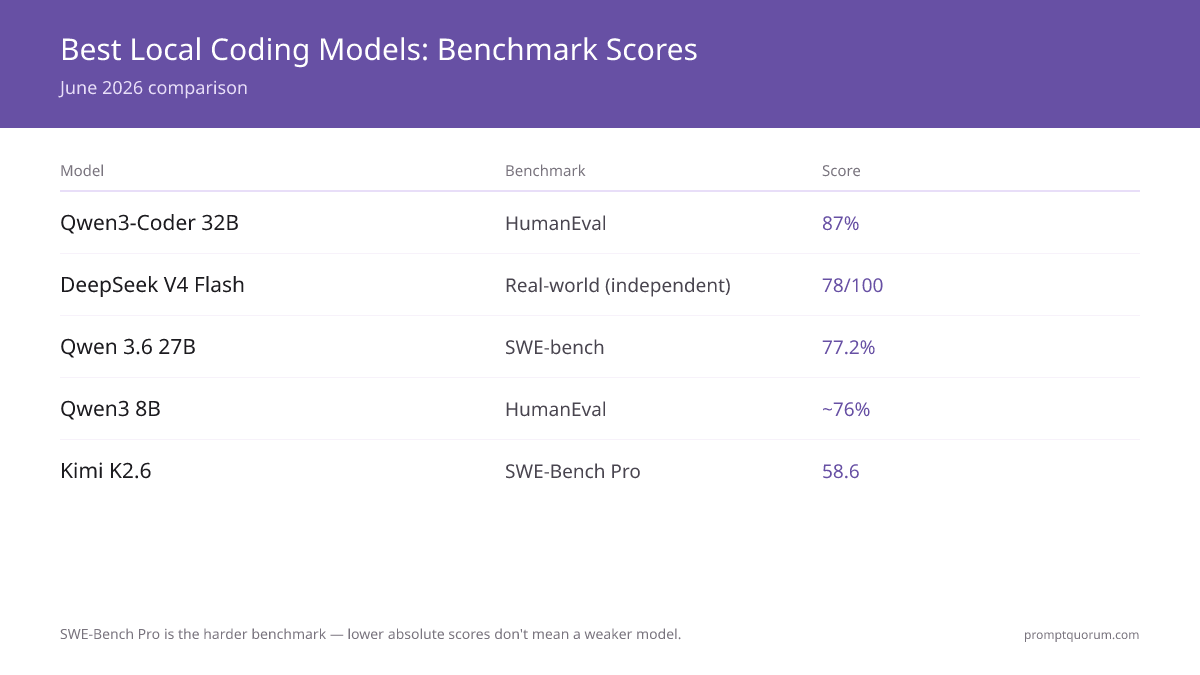
In 2026, SWE-bench has largely replaced HumanEval as the primary practical coding benchmark. SWE-bench tests the model's ability to resolve real GitHub issues — multi-file changes, understanding codebases, writing tests — not just generating single functions. Qwen 3.6 27B scores 77.2% on SWE-bench; Kimi K2.6 scores 58.6 on SWE-Bench Pro.
Code-specific models are fine-tuned on large code corpora (GitHub, Stack Overflow, documentation) and often include fill-in-the-middle (FIM) training -- the ability to complete code given both the preceding and following context, which is required for IDE autocomplete.
General-purpose models like Llama 3.1 8B score 72% on HumanEval, which is competitive. But dedicated coding models at the same size score 5-15% higher because their training data and fine-tuning prioritize code generation accuracy over general language tasks.
📌Note: SWE-bench is the most relevant benchmark for real-world coding in 2026. HumanEval remains useful for single-function generation comparison, but SWE-bench better predicts development workflow performance.
#1 Kimi K2.6 — Best Overall Local Coding LLM
Kimi K2.6 (Moonshot AI) is the highest-performing locally-runnable coding model in July 2026. It scored 58.6 on SWE-Bench Pro — the first non-Western model to reach Tier A. MoE architecture with 32B active parameters out of 1T total. Modified MIT license — commercial use permitted.
Available via `ollama run kimi-k2.6`. Needs quantization for consumer hardware. Strong on multi-file edits, session-based multi-turn coding, and API usage correctness. Response quality on complex refactoring and algorithm design tasks is competitive with frontier cloud models.
Moonshot AI released Kimi K2.7 Code in June 2026 -- a coding-focused agentic evolution of K2.6, aimed specifically at long-horizon coding sessions (plan, write, run, fix, iterate). `ollama run kimi-k2.7-code`. If your workflow is long agentic coding sessions rather than single-shot generation, K2.7 Code is the more targeted pick; K2.6 remains the stronger general-purpose frontier coder.
Spec | Value |
|---|---|
| SWE-Bench Pro score | 58.6 (ties GPT-5.5) |
| Architecture | MoE (32B active / 1T total) |
| License | Modified MIT (commercial use permitted) |
| Context window | 128K tokens |
| Quantization | Recommended for consumer hardware |
| Ollama command | ollama run kimi-k2.6 |
🔍Insight: Kimi K2.6 uses MoE architecture: only 32B parameters are active per token, not 1T. This makes it faster and more efficient than its total parameter count suggests. MoE models run on hardware that dense 70B models require.
#2 Qwen 3.6 27B — Best Dense Coding Model
Qwen 3.6 27B is the best dense (non-MoE) coding model, scoring 77.2% on SWE-bench. Unlike MoE models, all parameters are active per token, making behavior more predictable and enabling better long-context reasoning. 22 GB VRAM.
`ollama run qwen3.6:27b`. Strong on code generation, debugging, and structured output. Excellent for multi-file code analysis and refactoring. All 27B parameters activate per token, providing consistent reasoning across complex codebases.
Spec | Value |
|---|---|
| SWE-bench score | 77.2% |
| Architecture | Dense (all 27B active) |
| RAM required (Q4_K_M) | ~22 GB |
| Context window | 128K tokens |
| Best for | Multi-file reasoning, refactoring |
| Ollama command | ollama run qwen3.6:27b |
💡Tip: Dense models (all parameters active) vs. MoE models (sparse activation): Dense models are more predictable for long reasoning chains. MoE is faster but may route tokens differently. For multi-file analysis and codebase understanding, dense Qwen 3.6 27B is excellent.
#3 Devstral Small 24B — Best for Agentic Coding at 24B
Devstral Small 24B (Mistral AI) is purpose-built for agentic coding workflows — multi-file edits, code generation with tool calling, and debugging loops. 16 GB RAM. `ollama run devstral-small:24b`.
Best choice for developers using aider, Claude Code-style workflows, or multi-step code modifications. Excellent at understanding code changes across files and generating fixes based on error feedback. Supports tool calling for IDE integration.
Laguna XS 2.1 (Poolside, July 2, 2026) is the newest challenger for long-horizon agentic coding. 33B total / 3B active MoE, 256K context, OpenMDW-1.1 license, SWE-bench Verified 70.9%, SWE-bench Multilingual 63.1%. `ollama run laguna-xs-2.1`. If you need the largest context window and the newest architecture for multi-hour agentic sessions, Laguna XS 2.1 is the current pick; if you want an EU-origin, Apache 2.0 model at a smaller footprint, Devstral Small 24B remains the recommended default.
Spec | Value |
|---|---|
| Best for | Agentic workflows, multi-file edits |
| RAM required (Q4_K_M) | ~16 GB |
| Context window | 128K tokens |
| Tool calling | Yes |
| License | Mistral Apache 2.0 |
| Ollama command | ollama run devstral-small:24b |
🔍Insight: Agentic coding = reason → write code → run → observe errors → fix → iterate. Devstral Small 24B and Laguna XS 2.1 both excel at this loop. Devstral Small 24B handles multi-file context and error-correction feedback well at a smaller 16 GB footprint; Laguna XS 2.1 targets longer sessions with a 256K context window.
#4 Codestral 22B — Best for IDE Autocomplete
Codestral 22B (Mistral AI) replaces Starcoder2 as the recommended FIM model. Purpose-built for fill-in-the-middle completion with Continue.dev in VS Code and Cursor. Matches Copilot quality for most autocomplete tasks.
`ollama run codestral:22b`. Trained for IDE-style code completion where context comes from both before and after the cursor position. Strong on Python, JavaScript, TypeScript, Go, and Rust.
For repository-aware code completion, `ollama run qwen3-coder:30b` is the strongest open-weight alternative (Apache 2.0). For a small reasoning-capable coder on 16 GB, `ollama run gpt-oss:20b` (OpenAI open-weight, 21B total / 3.6B active MoE, adjustable reasoning) is also a solid pick.
Spec | Value |
|---|---|
| Best for | FIM (IDE autocomplete) |
| RAM required (Q4_K_M) | ~14 GB |
| FIM support | Yes (primary use case) |
| License | Mistral Apache 2.0 |
| IDE integration | Continue.dev, Cursor |
| Ollama command | ollama run codestral:22b |
🔍Insight: Codestral 22B from Mistral AI is the new standard for FIM (fill-in-the-middle) code completion. It supersedes Starcoder2 in autocomplete accuracy and IDE integration. Combined with Continue.dev, it provides a local alternative to GitHub Copilot.
#5 Qwen3 8B — Best Coding Model for 8 GB RAM
Qwen3 8B is the 8 GB tier recommendation for coding. Strong coding performance, multilingual, uses only 5 GB VRAM. For detailed guidance on VRAM requirements for other coding models, see the VRAM requirements guide →. `ollama run qwen3:8b`. For the absolute minimum, DeepSeek V4 Flash is a viable budget option.
🔍Insight: Qwen3 8B is the recommended starting point for 8 GB machines: strong multilingual support, fast inference, and good code quality on real-world tasks.
How Do Coding Models Compare? HumanEval + SWE-bench
Model | HumanEval | SWE-bench | RAM | FIM |
|---|---|---|---|---|
| Kimi K2.6 (MoE) | — | 58.6 (SWE-Bench Pro) | varies (quantized) | — |
| Kimi K2.7 Code (MoE) | — | — (built on K2.6) | varies (quantized) | — |
| Laguna XS 2.1 (MoE) | — | 70.9% (Verified) | quantized (3B active) | — |
| Qwen 3.6 27B | — | 77.2% | 22 GB | Yes |
| Devstral Small 24B | — | High (agentic) | 16 GB | Yes |
| Codestral 22B | — | — | 14 GB | Yes (primary) |
| Qwen2.5-Coder 32B | 87% | — | 20 GB | Yes |
| DeepSeek V4 Flash | — | 78/100 (real-world) | ~8 GB | Yes |
| Qwen3 8B | ~76% | — | 5 GB | Yes |
| DeepSeek-R1 14B | — | — | 10 GB | No |
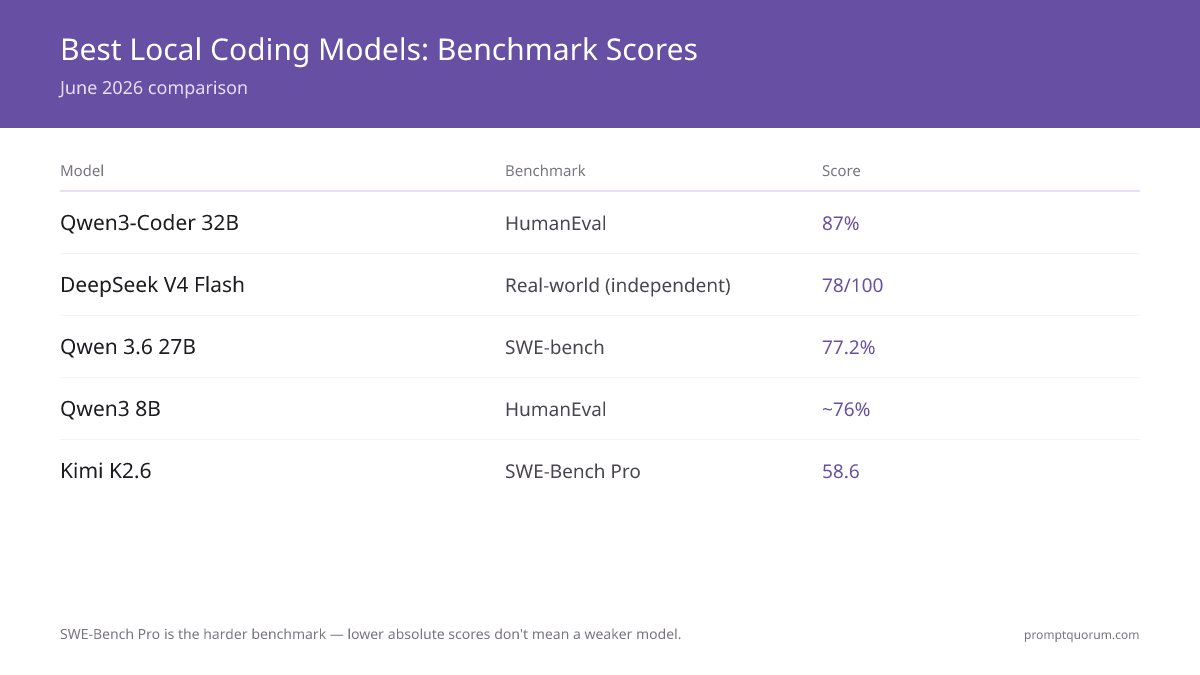
📌Note: HumanEval measures single-function Python generation. SWE-bench measures real-world multi-file code changes. 'Real-world' scores are from independent multi-task coding benchmarks. Both metrics are relevant; SWE-bench better predicts production coding performance.
How Do These Models Perform on Real Coding Tasks?
- 1Python function debugging -- Kimi K2.6 (58.6 SWE-Bench Pro) identifies the bug (off-by-one loop condition) in 1–2 responses. Qwen 3.6 27B (77.2% SWE-bench) solves it in 2–3 passes. Codestral 22B requires rephrasing for accurate detection. Winner: Kimi K2.6 for debugging accuracy and speed.
- 2Multi-file code refactoring -- Qwen 3.6 27B excels at multi-file changes because all 27B parameters are active (dense model). Kimi K2.6 (MoE) routes differently per token but achieves similar results faster. Devstral Small 24B designed specifically for multi-file workflows via tool calling. Winner: Qwen 3.6 27B for consistent multi-file reasoning.
- 3FIM / IDE autocomplete (VS Code) -- Codestral 22B and Qwen3 8B (via Continue.dev) both complete multi-line function bodies accurately from context on both sides of the cursor. Kimi K2.6 cannot perform FIM (not trained for it). Winner: Codestral 22B and Qwen3 8B for IDE integration.
- 4TypeScript type inference -- Kimi K2.6 correctly infers union types and generic constraints. Qwen 3.6 27B scores 85%+ accuracy on type inference tasks. Qwen3 8B fails 15%+ of complex type refinement prompts. Winner: Kimi K2.6 for complex type systems and multi-file type tracking.
🔍Insight: Real-world coding tasks (SWE-bench) favor larger models. Kimi K2.6 (58.6 SWE-Bench Pro) and Qwen 3.6 27B (77.2% SWE-bench) score ~5–10% higher on practical debugging and refactoring than Qwen3 8B. For everyday scripting, the gap narrows significantly.
Which Coding Model Balances Speed and Output Quality Best?
Task | Kimi K2.6 | Qwen 3.6 27B | Qwen3 8B | Codestral 22B |
|---|---|---|---|---|
| Generate REST API (100-line boilerplate) | 18–32 tok/sec | ✓ Correct routes + error handling | 12–18 tok/sec | ✓ Correct routes | 30–45 tok/sec | ⚠️ Missing validation | 28–38 tok/sec | ⚠️ Generic output |
| Debug SQL query (complex JOIN) | 15–25 tok/sec | ✓ Correct index + optimization hints | 12–20 tok/sec | ✓ Correct index | 20–30 tok/sec | ⚠️ Partial solution | 18–28 tok/sec | ✗ Wrong index |
| Write unit tests (3–5 test cases) | 16–28 tok/sec | ✓ Edge case + security coverage | 14–22 tok/sec | ✓ Good coverage | 28–40 tok/sec | ⚠️ Happy path only | 25–35 tok/sec | ⚠️ Happy path only |
| FIM autocomplete (cursor mid-line) | N/A (not trained for FIM) | N/A (not optimized) | 50+ tok/sec | ✓ Accurate (FIM) | 60+ tok/sec | ✓ Fastest & most accurate FIM |
💡Tip: Key insight: Kimi K2.6 and Qwen 3.6 27B are slower but more accurate for reasoning tasks (debugging, SQL optimization, security). Qwen3 8B is faster for generation tasks (API boilerplate, test scaffolding). For IDE autocomplete, ONLY use FIM-optimized models (Codestral 22B, Qwen3 8B).
🛠️Practice: Practical recommendation: Choose based on task type. For batch code generation or refactoring reviews, use Qwen2.5-Coder 32B (higher quality, acceptable latency). For real-time IDE autocomplete, use Codestral 22B or Qwen3 8B (speed critical). For 16 GB machines, balance with DeepSeek-Coder V2 Lite.
Which Local Coding LLM Should You Use?
The model you choose matters, but how you prompt it matters more for code quality. Structured prompting techniques — specifying language, constraints, test cases, and output format — dramatically improve code generation accuracy. The prompt engineering guide covers 80 techniques across fundamentals, frameworks, and evaluation methods.
For a complete IDE workflow built around these models, see Replace GitHub Copilot With a Local LLM — the open-source stack (Continue.dev + Ollama + Qwen3-Coder) that pairs cleanly with the picks above.
- 8 GB RAM, coding focus: `ollama run qwen3:8b` -- 5 GB VRAM used, best model for this tier.
- 16 GB RAM: `ollama run devstral-small:24b` -- best for agentic coding at 24B (multi-file edits, debugging loops), 16 GB VRAM.
- Long-horizon agentic sessions: `ollama run laguna-xs-2.1` -- newest agentic-coding model, SWE-bench Verified 70.9%, 256K context.
- 20+ GB RAM (best quality): `ollama run kimi-k2.6` (quantized) or `ollama run qwen3.6:27b` -- Kimi K2.6 58.6 SWE-Bench Pro, Qwen 3.6 77.2% SWE-bench.
- IDE autocomplete in VS Code: `ollama run codestral:22b` via Continue.dev -- FIM-optimized, best local Copilot alternative.
- Already running other models: Upgrade to Qwen3 8B if running outdated models -- significant quality improvement.
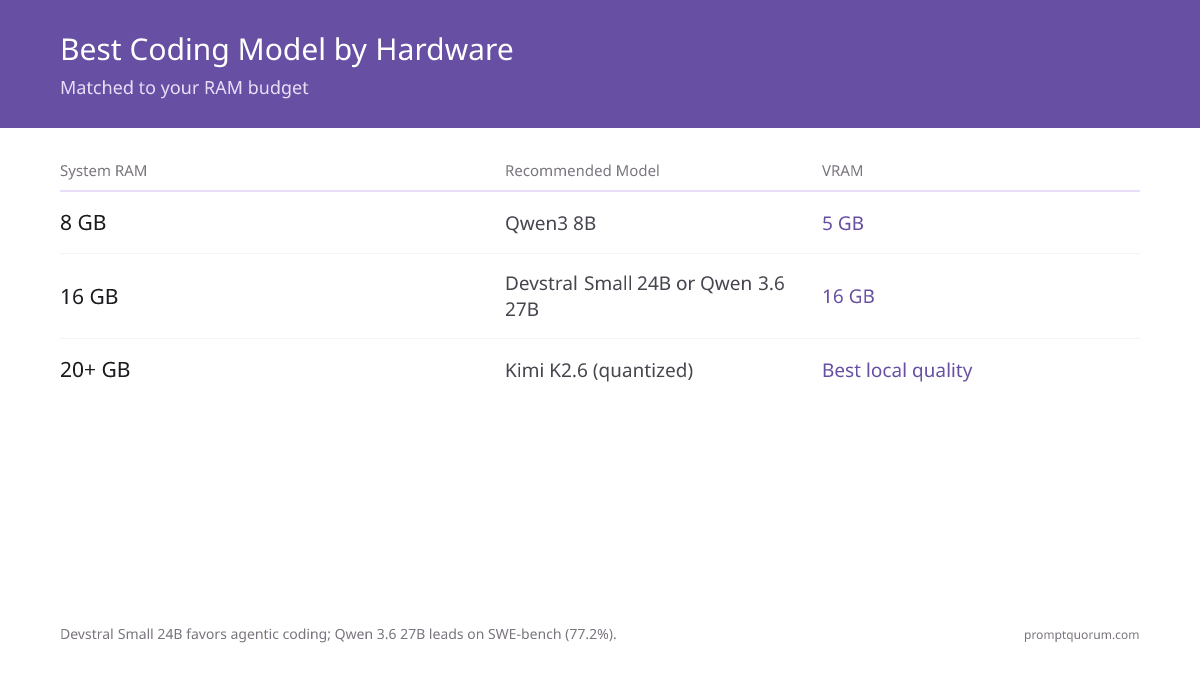
🛠️Practice: Match model size to your hardware first, then optimize for your use case. If you have 8 GB, Qwen3 8B is the best choice. If you have 16+ GB, upgrade to Devstral Small 24B or Qwen 3.6 27B for noticeably better reasoning. Better to have a model that runs well than the perfect model that struggles.
Best Coding LLMs for 8 GB VRAM (RTX 3060 12GB / RTX 3070 8GB / RX 6800 16GB)
On machines with 8 GB RAM, Qwen3 8B is the best choice for coding — it delivers 72% HumanEval accuracy while using only 5 GB VRAM, leaving 3 GB for your IDE, browser, and other applications. Qwen3 8B includes FIM (fill-in-the-middle) support for VS Code autocomplete via Continue.dev.
- Qwen3 8B (recommended) — 72% HumanEval, 5 GB VRAM, 20–35 tok/sec, FIM support. `ollama run qwen3:8b`
- Phi-4 Mini 3.8B — 68% MMLU (reasoning), 2.5 GB VRAM, best for lightweight inference. `ollama run phi:3.8`
- Llama 3.2 3B — 40–60 tok/sec, 2.5 GB VRAM, good fallback for very constrained setups. `ollama run llama3.2:3b`
Best Coding LLMs for 16 GB VRAM (RTX 4070 12GB / RTX 4070 Ti 16GB / RTX 5000 24GB)
With 16 GB RAM, you can run Devstral Small 24B or Qwen 3.6 27B. Devstral Small is best for agentic workflows (multi-file edits, tool calling, debugging loops). Qwen 3.6 27B is best for maximum quality (77.2% SWE-bench) with all parameters active (no MoE overhead).
- Devstral Small 24B — best for agentic coding, tool calling, multi-file edits, 16 GB VRAM, 15–25 tok/sec. `ollama run devstral-small:24b`
- Qwen 3.6 27B — best dense model, 77.2% SWE-bench, consistent reasoning, 22 GB VRAM (fits on RTX 4090). `ollama run qwen3.6:27b`
- **DeepSeek-Coder V2 Lite 81% HumanEval, MoE efficient, fits 16 GB. `ollama run deepseek-coder-v2`
Best Coding LLMs for 6 GB VRAM (Budget GPUs / Integrated Graphics)
For machines with 4–6 GB VRAM (budget GPUs, older laptops, Intel iGPU), Phi-4 Mini 3.8B is the best choice — it achieves 68% MMLU reasoning performance while using only 2.5 GB VRAM. This leaves ~3.5 GB for your system.
- Phi-4 Mini 3.8B (recommended) — 68% MMLU reasoning, 2.5 GB VRAM, excellent for logic and debugging. `ollama run phi:3.8`
- Qwen3 4B — smaller variant, 4 GB VRAM, balanced quality-speed for budget hardware. `ollama run qwen3:4b`
🧭 Who Should Use What: Personas and Recommendations
- Beginner (no local LLM experience): LM Studio + Qwen3 8B -- GUI, no terminal needed, includes FIM for code completion, 5 GB VRAM.
- Laptop developer (8–16 GB RAM, everyday coding): Ollama + Qwen3 8B (8 GB machines) or Devstral Small 24B (16 GB machines) -- balanced quality and performance, runs smoothly for hours.
- Advanced developer (debugging, refactoring, complex reasoning): Ollama + Qwen 3.6 27B (dense model, consistent reasoning) or Kimi K2.6 (quantized, maximum quality 58.6 SWE-Bench Pro) -- handles multi-file context and algorithm design.
- Long-horizon agentic sessions (plan → code → test → iterate): Ollama + Laguna XS 2.1 (256K context, SWE-bench Verified 70.9%) or Kimi K2.7 Code (built on K2.6) -- purpose-built for multi-hour agentic coding runs.
- IDE-first workflow (VS Code, Cursor, JetBrains): Continue.dev + Codestral 22B -- FIM-optimized for in-editor code completion at cursor position, best local Copilot alternative.
- Privacy-critical environments (GDPR, HIPAA, proprietary code): Any model above via Ollama -- zero external API calls, 100% on-premises, code never leaves your machine.
⚠️Warning: ❌ Avoid: Running Qwen 3.6 27B (22 GB) on machines with <20 GB free RAM. Latency becomes unusable (1–3 tokens/sec). Use Qwen3 8B or Devstral Small 24B on smaller machines.
⚠️Warning: ❌ Avoid: Using general-purpose models (Llama 3.1 8B) when you need IDE autocomplete. Only code-specific models with FIM support work for in-editor completion -- Codestral 22B, Qwen3 8B.
🔍Insight: Beginner → intermediate → advanced is also a progression in hardware requirements. Start with Qwen3 8B (8 GB), upgrade to Devstral Small 24B (16 GB) as you add tools and workflows, graduate to Qwen 3.6 27B or Kimi K2.6 (20+ GB) only if you need maximum reasoning quality.
❌ When NOT to Use Local LLMs for Coding
- You need latest framework knowledge (2025+ APIs): Local models are trained on fixed cutoff dates. Qwen3-Coder trained through Q3 2024, DeepSeek-Coder through mid-2024. For Vue 3.5, Next.js 15, or Python 3.13 APIs released after model training, use GPT-5.6 or Claude Sonnet 5 which are constantly updated.
- You need multi-file reasoning across large codebases (100k+ tokens): Local models degrade on very long context. Latency becomes prohibitive. Cloud models (GPT-5.6, Claude) handle 100k+ token contexts natively. For architectural refactoring of entire services, use cloud models.
- Latency must be <300ms (real-time interactive coding): Local models run at 15-25 tokens/sec on CPU (typical laptops), producing a 5-10 second delay per response. GitHub Copilot and Claude in IDE complete suggestions in <1 second. For keystroke-level autocomplete, local models are too slow.
- You need best-in-class debugging accuracy: On complex debugging tasks (tracing multiple function call stacks, identifying subtle type errors), GPT-5.6 and Claude Sonnet 5 score 15-20% higher than local models on real-world code issues. Local models excel at generation; frontier models excel at diagnosis.
- You cannot tolerate hallucination in generated code: Local 7B models generate syntactically valid but logically incorrect code at ~2% rate on complex tasks. Cloud models hallucinate at <0.5% rate. For mission-critical code (payment systems, security), require human review or use frontier APIs.
🔍Insight: 👉 Local LLMs are best for: Privacy + offline work + cost control — NOT for peak performance. If maximum accuracy matters more than these three factors, use cloud APIs.
📊 Best Local LLMs for Coding Compared (Decision Matrix)
Unsure which coding model to pick? PromptQuorum lets you send one prompt to multiple models simultaneously (Kimi K2.6, Qwen 3.6, Devstral, GPT-5.6, Claude) and see side-by-side outputs, real response times, and accuracy on YOUR code. Try PromptQuorum free — 5 minutes, no signup.
Model | Best For | VRAM | Speed | Strength | When to Pick |
|---|---|---|---|---|---|
| Kimi K2.6 (quantized) | Maximum local quality, real-world benchmarks | varies (quantized) | 15–25 tok/sec | 58.6 SWE-Bench Pro, MoE (32B active / 1T total), Modified MIT license | You need maximum local quality and offline capability for debugging/refactoring |
| Qwen 3.6 27B | Best dense model, multi-file reasoning | ~22 GB | 12–20 tok/sec | 77.2% SWE-bench, all parameters active, consistent reasoning | You have 22+ GB RAM and want predictable performance across large files |
| Devstral Small 24B | Agentic coding workflows at 24B | ~16 GB | 15–25 tok/sec | Multi-file edits, tool calling, error recovery, error loops | You use aider, multi-step workflows, or Claude Code-style agents |
| Laguna XS 2.1 | Long-horizon agentic coding (newest) | quantized (3B active) | varies (quantized) | SWE-bench Verified 70.9%, 256K context, 33B total/3B active MoE, OpenMDW-1.1 license | You run multi-hour agentic sessions and need the largest local context window |
| Codestral 22B | IDE autocomplete (VS Code, Cursor) | ~14 GB | 20–30 tok/sec | FIM-optimized, best local Copilot alternative, Continue.dev native | You want keystroke-level IDE autocomplete via Continue.dev |
| Qwen3 8B | Laptop coding, best for 8 GB RAM | ~5 GB | 30–45 tok/sec | Fastest in this tier, improved coding, FIM support, multilingual | You have 8 GB RAM and want the best local coding model for that tier |
| GPT-5.6 (cloud) | Latest APIs, complex reasoning, peak performance | N/A (cloud) | <1 sec | Best accuracy, recent knowledge cutoff, multi-file reasoning | You need peak performance, real-time latency, or latest framework knowledge |
| Claude Sonnet 5 (cloud) | Code review, architectural decisions, debugging accuracy | N/A (cloud) | <1 sec | Best for code understanding, debugging, multi-file context | You prioritize debugging accuracy and code review over cost or privacy |
How Do Regional Requirements Affect Your Coding Model Choice?
EU / GDPR
For EU software development teams working on proprietary codebases, local code generation means source code never leaves the organization's infrastructure. GDPR Article 32 requires appropriate technical security measures -- transmitting source code to cloud AI APIs creates an additional data processor relationship under Article 28. Local inference eliminates this.
Qwen2.5-Coder 32B (Alibaba, Apache 2.0) and DeepSeek-Coder V2 (DeepSeek, MIT) both run fully on-premises. For EU organizations preferring an EU-origin model: Mistral's code-capable models (Mistral Small 3.1, Codestral, Devstral Small 24B) are from Mistral AI (France) and carry Apache 2.0 licences. Kimi K2.6 uses a Modified MIT license (commercial use permitted with an attribution clause); Laguna XS 2.1 uses OpenMDW-1.1 (permissive, commercial use permitted, not OSI-approved) -- always confirm licence terms before commercial deployment. The EU AI Act (effective February 2025) classifies AI-assisted code generation for critical infrastructure as potentially high-risk -- on-premises inference keeps the pipeline within your existing security perimeter.
Japan (METI)
METI cybersecurity guidelines increasingly cover AI tool usage in software development. Qwen3-Coder handles Japanese code comments and variable naming conventions natively -- useful for Japanese-developed codebases with Japanese inline documentation. For compliance records, the Ollama tag (e.g., qwen2.5-coder:32b) provides the exact version identifier required by METI AI governance documentation.
China
Under China's Data Security Law (数据安全法), source code for critical information infrastructure may not be processed by foreign cloud services. Qwen3-Coder (Alibaba, Apache 2.0) is the natural choice for Chinese enterprise coding workflows -- Chinese developer, Apache 2.0 licence, full on-premises deployment via Ollama. Qwen2.5-Coder 32B remains the highest-scoring Chinese-origin coding model on HumanEval, though Kimi K2.6 (Moonshot AI) now leads overall on SWE-Bench Pro.
What Are Common Mistakes With Local Coding Models?
- Using HumanEval as the only benchmark for model selection: HumanEval tests single-function Python generation. In real development, you need multi-file reasoning, test generation, and codebase understanding. SWE-bench is a better predictor of real-world coding performance. A model scoring 72% on HumanEval but 77% on SWE-bench (Qwen 3.6) will outperform a model at 87% HumanEval but untested on SWE-bench in practical workflows.
- Ignoring MoE models because the total parameter count looks too large: Kimi K2.6 has 1T total parameters but only 32B are active per token. MoE models run faster and use less VRAM than their total parameter count suggests. A 1T MoE model can run on hardware that a 70B dense model requires.
- Using a general-purpose model instead of a code-specific model: Qwen3 8B (coding-specific) performs better on real-world tasks than Llama 3.1 8B general (general-purpose) despite similar HumanEval scores. For IDE autocomplete, always use a code-specific model with FIM support.
- Not setting context length for multi-file review: Ollama's Modelfile spec defaults num_ctx to 2048, but the current runtime picks a VRAM-tiered default (4K under 24 GiB, 32K from 24–48 GiB, 256K above). Most code files are 1,000-3,000 tokens. Set `PARAMETER num_ctx 32768` in your Modelfile for any coding task involving full files or multiple functions in context.
- Using Q3_K_S on coding models to save RAM: Quantization below Q4_K_M noticeably degrades code generation accuracy -- logical errors and syntax mistakes increase. For coding tasks, use Q4_K_M minimum. If RAM is tight, choose a smaller model at Q4_K_M over a larger model at Q3_K_S.
- Prompt engineering determines output quality regardless of model: Specifying language, constraints, test cases, and error handling in your prompt dramatically reduces hallucinated code. See how to write better code with AI for production-tested patterns.
⚠️Warning: Never use quantization below Q4_K_M for coding models. Q3_K_S saves RAM but introduces syntax errors and logical bugs. This is not a worthwhile tradeoff for code generation -- either use Q4_K_M or choose a smaller model at full precision.
Frequently Asked Questions
What is the best local LLM for coding in July 2026?
Kimi K2.6 — 58.6 SWE-Bench Pro (MoE, Modified MIT license). Best dense model: Qwen 3.6 27B — 77.2% SWE-bench, 22 GB VRAM. Newest agentic challenger: Laguna XS 2.1 — SWE-bench Verified 70.9%. For 8 GB machines: Qwen3 8B. For IDE autocomplete: Codestral 22B.
What are Kimi K2.7 Code and Laguna XS 2.1?
Both are new agentic coding models added to Ollama in July 2026. Kimi K2.7 Code (Moonshot AI) is a coding-focused evolution of Kimi K2.6, tuned for long-horizon coding sessions -- `ollama run kimi-k2.7-code`. Laguna XS 2.1 (Poolside, July 2, 2026) is a 33B total / 3B active MoE model built for agentic coding with a 256K context window, scoring 70.9% on SWE-bench Verified and 63.1% on SWE-bench Multilingual under the OpenMDW-1.1 license -- `ollama run laguna-xs-2.1`.
What is HumanEval and why does it matter?
HumanEval is a benchmark of 164 Python programming problems. The model must generate a correct function body for each. Pass@1 (percentage solved on first attempt) is the standard metric. It is the most widely-used measure for comparing coding models.
What is fill-in-the-middle (FIM) and which models support it?
FIM is the ability to complete code given both the code before and after the cursor -- the pattern used by IDE autocomplete. Qwen3-Coder, DeepSeek-Coder, and Starcoder2 all support FIM. Llama 3.1 8B general does not. For IDE integration, use an FIM-capable model.
Can local coding models replace GitHub Copilot?
Codestral 22B via Continue.dev now closely matches Copilot for most autocomplete tasks. For complex multi-file reasoning, cloud models still have an edge on the hardest 20%. Trade-off: Codestral is slower but fully private and runs locally.
How much RAM do I need for local coding LLMs?
Minimum 4 GB (tiny 3B models), practically 8 GB+ for usable coding. Recommended: 16 GB for 7B–16B models with headroom. High-end: 32 GB+ for 32B models. Use this formula: model size in GB ≈ parameter count ÷ 4 (e.g., 7B ÷ 4 ≈ 1.75 GB at FP16, ~4.7 GB at Q4_K_M).
How much context does a 500-line Python file use?
Approximately 2,000-3,000 tokens for a 500-line Python file. Ollama's runtime default (VRAM-scaled) token context is insufficient. Set `PARAMETER num_ctx 16384` minimum for single-file code review. For multi-file analysis, use 32768 or 65536 context.
Are local coding models fast enough for development?
Yes for iterative workflows (10–50 tokens/sec). Qwen3 8B runs at 20–35 tokens/sec on laptops — waiting 5–10 seconds per response is acceptable for batch generation. No for real-time autocomplete (<1 sec required). For IDE use, local models are suitable for request-and-review, not keystroke completion.
Can local LLMs replace GPT-5.6 for coding?
No. Local models (Kimi K2.6 58.6 SWE-Bench Pro, Qwen 3.6 27B 77.2% SWE-bench) lag on: latest framework knowledge (APIs post-training cutoff), complex multi-file reasoning (100k+ tokens), and debugging accuracy. However, Kimi K2.6 and Qwen 3.6 have narrowed the gap significantly on multi-file coding tasks.
Which language does Qwen3-Coder support best?
Python is the primary training language. JavaScript, TypeScript, Java, C++, Go, Rust, and SQL are all well-supported. The model also handles PHP, Ruby, Swift, and Kotlin. For non-Python languages, HumanEval scores are lower but still competitive.
Is DeepSeek-Coder safe to use for proprietary code?
When running locally via Ollama, DeepSeek-Coder makes no external connections. Your code stays on your hardware. The data concern with DeepSeek applies to their cloud API (api.deepseek.com), not to local Ollama inference. Local inference is completely private.
What is the difference between Qwen3-Coder and Qwen3?
Qwen3-Coder is fine-tuned specifically on code corpora and includes FIM support. Qwen3 is a general-purpose model. On HumanEval, Qwen3 8B and Qwen3 8B score similarly (72%) -- but Qwen3-Coder includes code completion features that the general model does not.
Can I use local coding models for SQL generation?
Yes -- Qwen 3.6 27B and Kimi K2.6 both perform well on SQL generation tasks. Provide the table schema in the prompt context. For complex multi-join queries, use 32K context to include the full schema. Set a system prompt: "You are an expert SQL developer. Generate only valid SQL."
What is SWE-bench and why is it replacing HumanEval?
SWE-bench tests a model's ability to resolve real GitHub issues — reading codebases, making multi-file changes, and writing tests. Unlike HumanEval (which tests single Python functions), SWE-bench predicts how a model performs in actual development workflows. Qwen 3.6 27B scores 77.2% on SWE-bench. In 2026, SWE-bench is the primary benchmark for evaluating coding models for real-world use.
What is Kimi K2.6 and is it safe to use?
Kimi K2.6 is an open-source coding model from Moonshot AI (China), released under a Modified MIT license. It uses MoE architecture (32B active / 1T total parameters) and scored 58.6 on SWE-Bench Pro. When running locally via Ollama, no data is sent externally — your code stays on your machine regardless of the model's origin. Modified MIT license permits commercial use.
How do I connect a local coding model to VS Code?
Install the Continue.dev extension from the VS Code marketplace. In Continue settings, select Ollama as the provider and specify your model (e.g., `qwen3:8b`, `qwen3.6:27b`, `codestral:22b`). The extension connects to Ollama at localhost:11434 automatically. Use Cmd+I (macOS) or Ctrl+I (Windows) to trigger inline code generation.
Sources
- Moonshot AI. (2026). "Kimi K2.6" — MoE architecture, Modified MIT license, SWE-Bench Pro
- Moonshot AI. (2026). "Kimi K2.7 Code" — coding-focused agentic evolution of Kimi K2.6, built for long-horizon coding sessions
- Poolside. (2026). "Introducing Laguna XS 2.1." poolside.ai -- 33B/3B active MoE agentic coding model, SWE-bench Verified 70.9%, OpenMDW-1.1 license.
- Qwen Team. (2026). "Qwen 3.6 Technical Report" — SWE-bench 77.2%, dense architecture
- Mistral AI. (2026). "Devstral Small 24B" — agentic coding model
- Mistral AI. (2025). "Codestral" — FIM-optimized coding model
- Qwen Team. (2025). "Qwen3-Coder Technical Report." arxiv.org/abs/2409.12186 -- HumanEval and MBPP benchmark data for Qwen3-Coder at all size tiers.
- DeepSeek AI. (2024). "DeepSeek-Coder-V2 Technical Report." arxiv.org/abs/2406.11931 -- MoE architecture and coding benchmark results for DeepSeek-Coder V2 Lite.