Key Takeaways
- 7B models: Too weak. Catch ~45% of bugs -- surface-level feedback only.
- 13B-14B models: DeepSeek-R1 14B catches ~75% of bugs via chain-of-thought. Acceptable for algorithmic review.
- 32B models: Qwen2.5-Coder 32B catches ~88% of bugs at 20 GB RAM. Practical minimum for pre-merge review.
- 70B+ models: Llama 3.3 70B catches ~85% of bugs. Best for security analysis and multi-file architectural review.
- Best overall: Qwen2.5-Coder 32B (88% bugs, 20 GB RAM). Best 70B: Llama 3.3 70B (security). Best reasoning: DeepSeek-R1 14B (algorithms).
- Setup: vLLM + custom prompt template. Use Qwen2.5-Coder 32B for general review; Llama 3.3 70B for security-sensitive code.
- Latency: 70B takes 2-3 min per 500-line file. 32B takes ~60 sec. Batch processing reduces total time.
- Cost: Zero (open source) vs. $50/mo (GitHub Copilot Code Review).
📍 In One Sentence
The best local LLMs for code review are Qwen2.5-Coder 32B for overall accuracy, Llama 3.3 70B for security analysis, and DeepSeek-R1 14B for algorithmic review; 7B models only catch about 45% of real bugs, while 32B+ models catch 80-88% and are the practical minimum for pre-merge review.
💬 In Plain Terms
For code review, model size matters more than for most tasks -- a small 7B model will miss more than half of real bugs, which isn't good enough to trust before merging code. If you want a local model that actually catches problems reliably, 32B or larger is the realistic starting point, with different models being stronger at different things: general accuracy, security issues, or algorithmic logic.
Why Model Size Matters for Code Review?
7B models lack reasoning depth. They spot obvious syntax errors but miss:
- Race conditions (concurrency bugs)
- SQL injection vulnerabilities
- Off-by-one errors in loops
- Type confusion in duck-typed languages
13B-14B models understand basic logic but struggle with:
- Architectural anti-patterns
- Performance implications (cache misses, O(n²) algorithms)
- Security edge cases
32B+ models excel at:
- Refactoring suggestions (extract method, reduce cyclomatic complexity)
- Security analysis (injection, XSS, CSRF)
- Performance optimization (caching, indexing, parallelization)
70B models add:
- Multi-file architectural review (128K context)
- Deep security pattern recognition across entire codebases
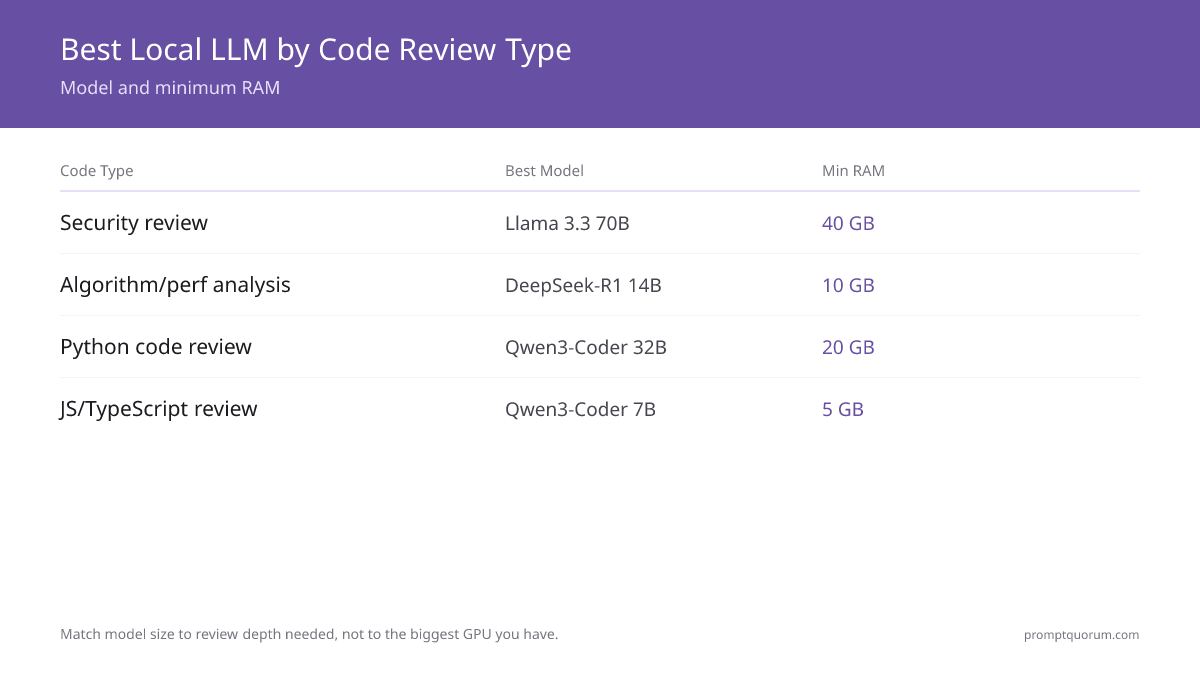
Model Comparison Table
Code Type | Best Model | Min RAM | Reasoning |
|---|---|---|---|
| Security review (injection, XSS, CSRF) | Llama 3.3 70B | 40 GB | Highest security pattern recognition |
| Algorithm + performance analysis | DeepSeek-R1 14B | 10 GB | Chain-of-thought for O(n) analysis |
| Python code review | Qwen2.5-Coder 32B | 20 GB | Highest HumanEval at accessible RAM |
| JavaScript/TypeScript | Qwen2.5-Coder 7B | 5 GB | FIM support, strong TS type analysis |
| Quick lint-level feedback | Llama 3.1 8B | 6 GB | Fast, acceptable for style review |
| Multi-file architectural review | Llama 3.3 70B | 40 GB | 128K context handles full codebases |
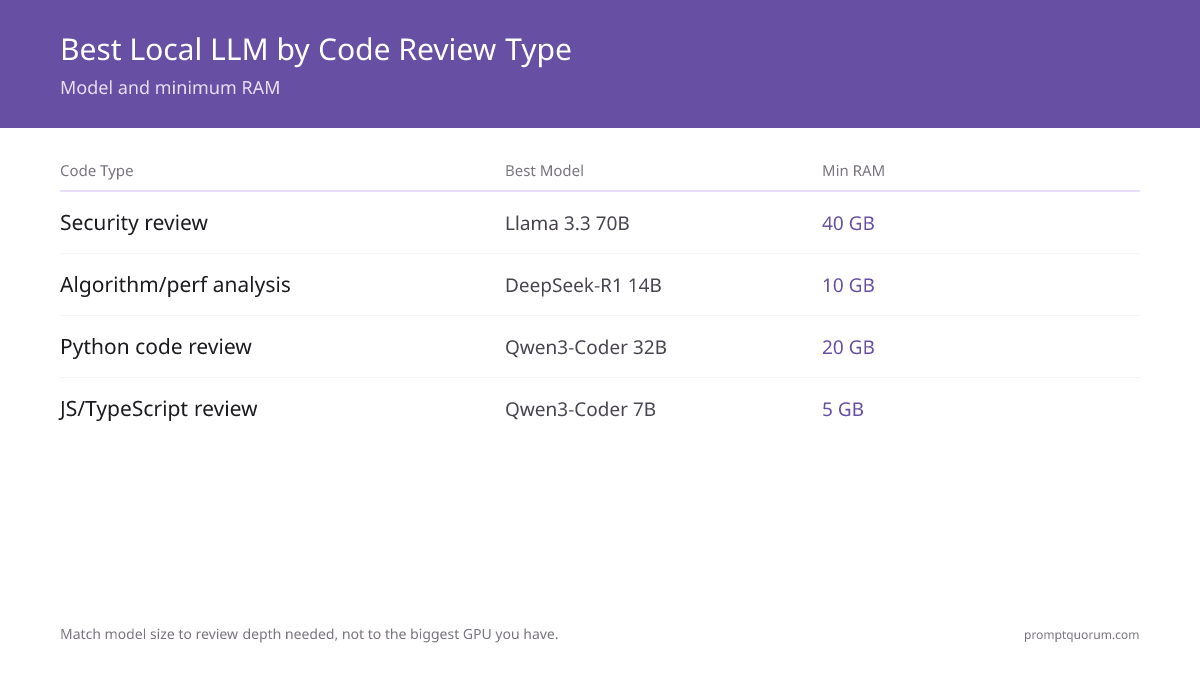
Accuracy vs Speed Trade-offs
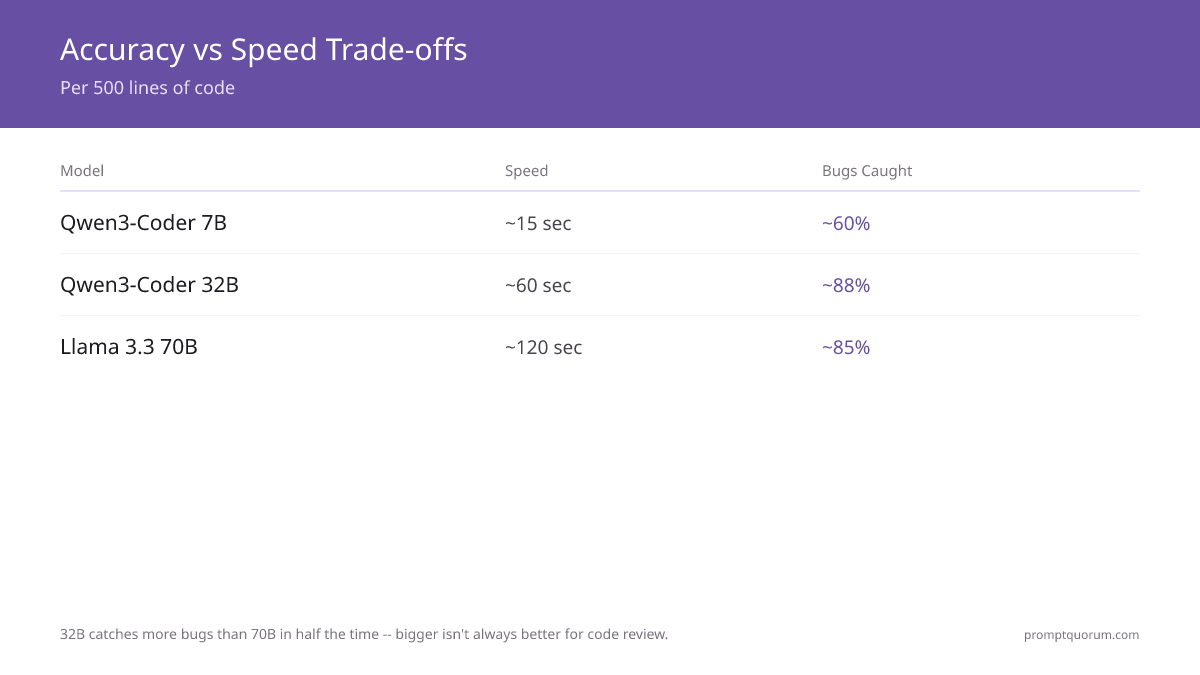
Speed per file: Qwen2.5-Coder 7B ~15 sec/500 lines. Qwen2.5-Coder 32B ~60 sec/500 lines. Llama 3.3 70B ~120 sec/500 lines.
Accuracy (bugs caught): Qwen2.5-Coder 7B ~60%. Qwen2.5-Coder 32B ~88%. Llama 3.3 70B ~85%.
When to use 7B: Quick feedback during development, non-critical code paths.
When to use 32B: Pre-commit hooks, general Python/TypeScript review, most day-to-day review tasks.
When to use 70B: Security-sensitive code, public APIs, multi-file architectural analysis.
Optimal workflow: Use Qwen2.5-Coder 7B for real-time IDE feedback; Qwen2.5-Coder 32B for pre-commit review; Llama 3.3 70B for security audits.
Setup: Local Code Review Pipeline
- 1Start vLLM with Qwen2.5-Coder 32B: `python -m vllm.entrypoints.openai.api_server --model Qwen/Qwen3-Coder-32B-Instruct`
- 2Write a focused review prompt: "Review this code for bugs, security issues, and refactoring suggestions. Focus on [ISSUE_TYPE]. Output: severity (critical/warning/info), line number, issue description, suggested fix."
- 3Integrate with Git pre-commit hook: `pre-commit` hook calls the API with the diff or patch for staged files only.
- 4Batch requests: group files by directory, send 3-5 files per request (vLLM processes in parallel within a batch).
- 5Parse response: extract suggestions by severity (critical, warning, info).
- 6Format output: post results as PR comments or inline suggestions via GitHub Actions.
Code Review with Local LLMs: Regional Context
EU / GDPR + Security
For EU software teams reviewing code that handles personal data, running code review locally means the source code itself -- which may contain hardcoded credentials, PII in test fixtures, or personal data processing logic -- never leaves the organization's infrastructure. GDPR Article 32 requires appropriate technical security measures; sending proprietary source code to cloud AI APIs creates an additional data processor relationship under Article 28.
For German BSI-compliant software development environments: Qwen2.5-Coder 32B (Apache 2.0) and Llama 3.3 70B (Meta Llama Community Licence) both run entirely on-premises. The EU AI Act (effective February 2025) classifies AI-assisted code review for critical infrastructure as potentially high-risk -- local inference keeps the process within your existing security perimeter.
Japan (METI)
Japanese enterprise software teams are subject to METI cybersecurity guidelines which increasingly include AI tool usage policies. For Japanese teams, Qwen3-Coder supports Japanese comments and variable naming conventions naturally -- useful for codebases with Japanese inline documentation. METI AI governance requires documenting AI tools used in software development: record the model name, version (Ollama tag), and quantization level used in code review pipelines.
China
Under China's Data Security Law (数据安全法), source code for critical information infrastructure systems may not be processed by foreign cloud services. Local code review via Qwen3-Coder (Alibaba, Apache 2.0) satisfies this requirement. Qwen2.5-Coder 32B runs on a dual-RTX 4090 workstation (48 GB VRAM) and processes Python, Java, C++, and Go code with native Chinese comment support.
Common Mistakes
- Using 7B models for security review. False positives everywhere; developers start ignoring all feedback.
- Reviewing without context. Single-function review misses architectural issues. Always pass related files, imports, and type definitions.
- Not specifying issue type. "Review this code" is vague. Use "Check for SQL injection vulnerabilities" or "Suggest performance optimizations for this loop".
- Using Llama 3.3 70B for every review task when a smaller model is sufficient: Llama 3.3 70B takes 2-3 minutes per 500-line file on most hardware. For style feedback and obvious bugs, Qwen2.5-Coder 7B completes the same review in ~15 seconds at 60-65% accuracy. Reserve 70B for security-sensitive code and pre-merge review; use 7B for real-time IDE feedback.
- Not setting num_ctx for multi-file review: Ollama's Modelfile spec defaults num_ctx to 2048, and even the VRAM-tiered runtime default can fall short for large multi-file reviews — set num_ctx explicitly (e.g., 32768) or the review silently truncates and misses bugs in later sections.
Frequently Asked Questions
Can I use a 13B model for code review?
Yes for linting-level feedback -- style and obvious bugs. For security and performance review, use 32B+. Qwen2.5-Coder 32B at 20 GB RAM is the practical minimum for serious code review.
How many files can I review in parallel?
vLLM default batch=32. On 70B models, batch=1 per file is realistic. Process 5-10 files sequentially for full review in 10-15 min.
Is Llama 3.3 70B better than DeepSeek for code review?
DeepSeek-R1 14B is better for math and algorithm optimization due to chain-of-thought reasoning. Llama 3.3 70B is better for security analysis. Qwen2.5-Coder 32B outperforms both on pure code completion benchmarks at lower RAM.
Can I use local models for pair programming?
Yes. Use Qwen2.5-Coder 7B for real-time suggestions (fast, ~15 sec per file). Refresh every 5 minutes as code changes. For deeper feedback, batch review with Qwen2.5-Coder 32B between sessions.
What prompt should I use for code review?
System: "You are an expert code reviewer." User: "Review for: [list issues]. Output severity (critical/warning/info), line number, issue, and suggested fix. Code: [code]"
How do I avoid hallucinated bugs?
Provide full context -- imports, types, and related functions. Hallucinations decrease significantly with larger models. Qwen2.5-Coder 32B hallucinates far less than 7B models on code review tasks.
How much VRAM does Llama 3.3 70B need for code review?
At Q4_K_M quantization, approximately 40 GB VRAM. A dual-GPU setup (2× RTX 4090, 48 GB total) or Mac Studio M5 Max (up to 128 GB unified memory) works. CPU-only inference is possible with 48+ GB RAM at 5-10 tokens/sec.
Is Qwen3-Coder better than Llama 3.3 for Python code review?
Yes for pure coding tasks. Qwen2.5-Coder 32B scores higher on HumanEval and supports FIM (fill-in-the-middle) for code completion. Llama 3.3 70B is better for security analysis of Python code. For Python-specific review at reasonable RAM (20 GB), Qwen2.5-Coder 32B is the recommended choice.
Sources
- Qwen Team. (2025). "Qwen3-Coder Technical Report." arxiv.org/abs/2409.12186 -- HumanEval and code completion benchmarks for Qwen3-Coder at all size tiers.
- Meta AI. (2025). "Llama 3.3 Model Card." huggingface.co/meta-llama/Llama-3.3-70B-Instruct -- Official specifications and code understanding benchmarks for Llama 3.3 70B.
- DeepSeek AI. (2025). "DeepSeek-R1 Technical Paper." arxiv.org/abs/2501.12948 -- Chain-of-thought architecture and reasoning benchmark data for DeepSeek-R1.