Key Takeaways
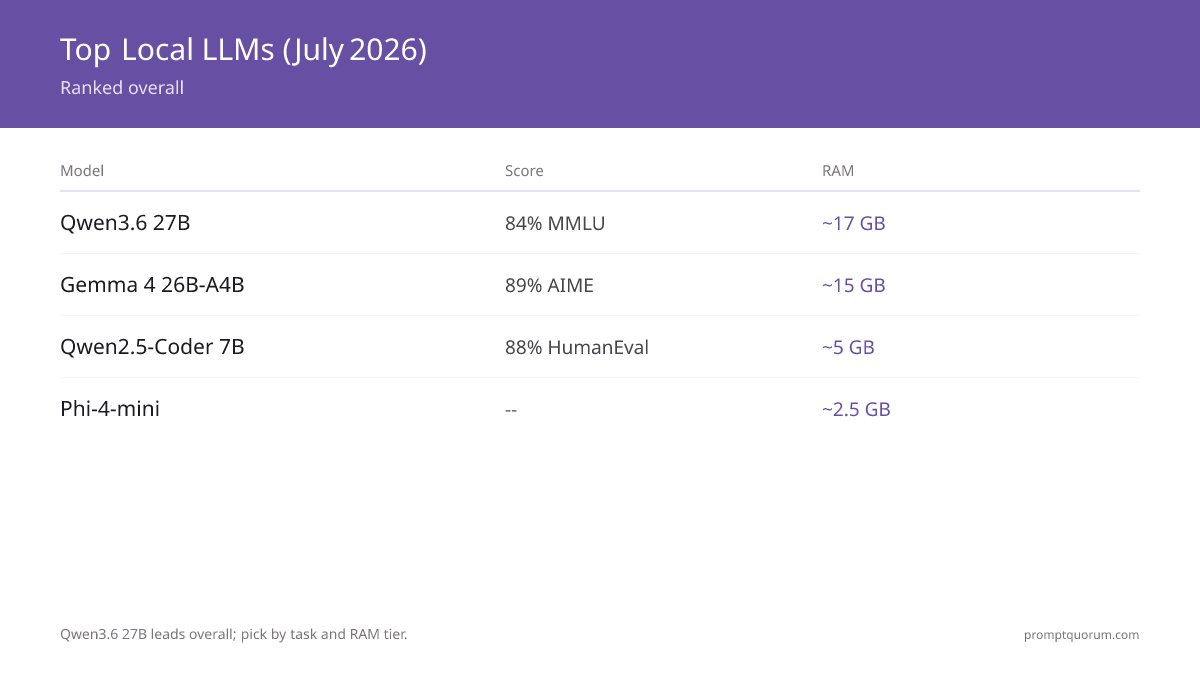
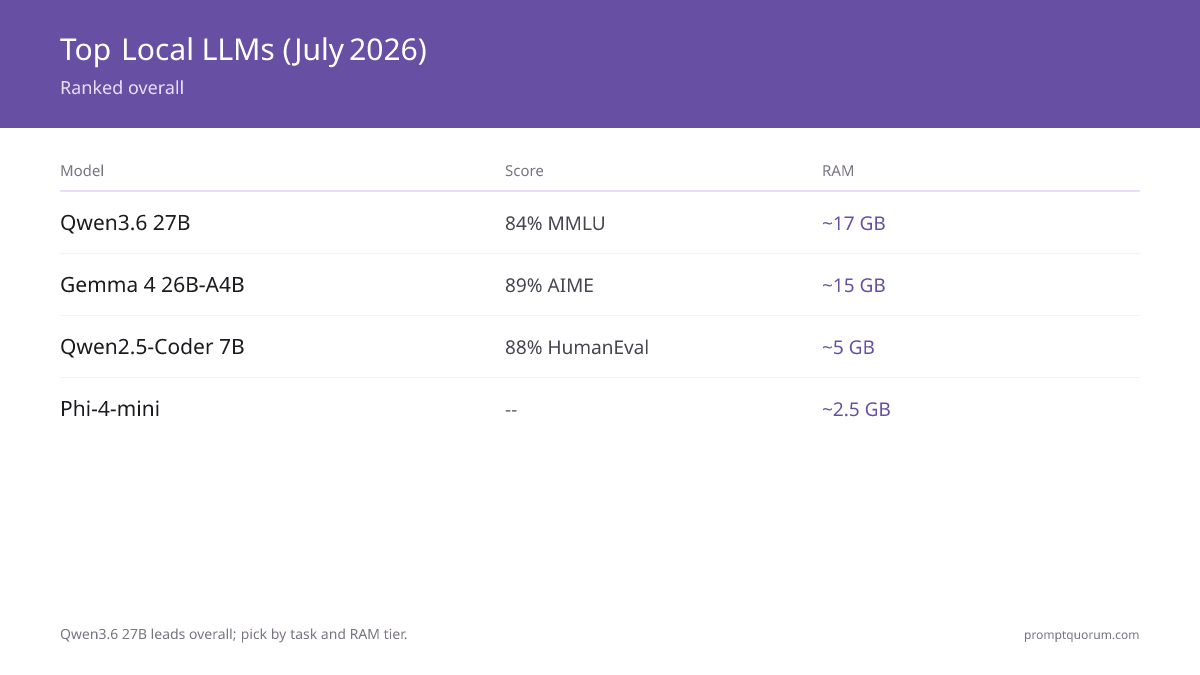
- Best overall: Qwen3.8-27B — 89.2% GPQA Diamond, 61.7% SWE-bench Pro, native vision-language, 262K context (up to 1M), fits in ~24 GB RAM (`ollama pull qwen3.8:27b`).
- Best reasoning: Gemma 4 26B-A4B — MoE architecture (26B total, ~4B active), 89% AIME 2026, requires ~15 GB RAM (`ollama pull gemma4:26b`).
- Best coding: Qwen2.5-Coder 7B — 88% HumanEval, purpose-built for code generation and debugging, ~5 GB RAM (`ollama run qwen2.5-coder:7b`).
- Best CPU-only: Phi-4-mini — 68% MMLU, 70% HumanEval, ~2.5 GB RAM, 30–50 tok/s on any modern laptop CPU (`ollama run phi4-mini`).
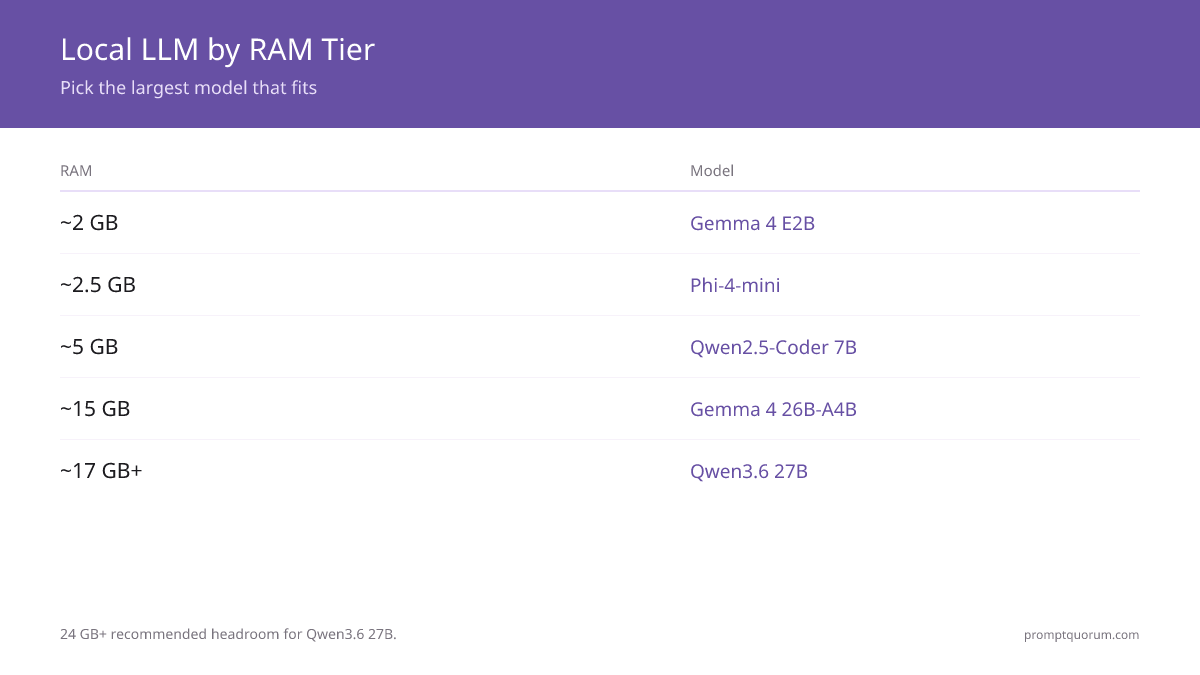
- Best small: Gemma 4 E2B — 2.3B effective params, ~2 GB RAM, 128K context, runs on a Raspberry Pi 5 (`ollama pull gemma4:e2b`).
📍 In One Sentence
Qwen3.8-27B is the best overall local LLM (89.2% GPQA Diamond, native vision-language, ~24 GB RAM), Gemma 4 26B-A4B leads reasoning (89% AIME 2026, ~15 GB RAM), Qwen2.5-Coder 7B leads coding (88% HumanEval, ~5 GB RAM), and Phi-4-mini is the best CPU-only pick (~2.5 GB RAM).
💬 In Plain Terms
If you're not sure which local AI model to pick: Qwen3.8-27B is the strongest all-rounder if you have 24 GB of RAM, Gemma 4 26B-A4B is best for math and logic problems, Qwen2.5-Coder 7B is purpose-built for writing code, and Phi-4-mini runs well even without a graphics card. A small model like Gemma 4 E2B works on almost anything, including a Raspberry Pi.
How These Models Were Ranked?
Rankings are based on benchmarks published by each lab plus independent community measurements: MMLU (57-subject knowledge test), HumanEval and SWE-bench Verified (coding ability), AIME (competition math), and GPQA Diamond (graduate-level reasoning). Scores are from official model cards and community benchmark trackers as of Q3 2026.
Hardware requirements are calculated for Q4_K_M quantization -- the standard beginner setting that balances quality and RAM use. For a primer on quantization, see LLM Quantization Explained.
All models are available via Ollama. For installation, see How to Install Ollama.
#1 Qwen3.8-27B -- Best Overall Local LLM in 2026
Qwen3.8-27B is the best local LLM for most users in 2026. It scores 89.2% on GPQA Diamond, 61.7% on SWE-bench Pro, and 90.3% on LiveCodeBench v6, while fitting in ~24 GB of RAM at Q4_K_M quantization. The 262K native context window (extensible to 1M tokens) handles long documents. Unlike the previous Qwen3.6 27B, it is a native vision-language model — it understands images and video directly, not just text.
The dense 28B architecture (Apache 2.0) replaces Qwen3.6 27B, which is now superseded. Its RAM footprint grew from ~17 GB to ~24 GB, so 16-17 GB machines that fit the old model comfortably will want the smaller Qwen3.6-35B-A3B MoE variant or a different model instead — see the Which Model section below. For most users with 24 GB+ VRAM or unified memory, Qwen3.8-27B provides the best quality-per-gigabyte of any dense model in 2026, with the added benefit of vision support.
Spec | Value |
|---|---|
| GPQA Diamond | 89.2% |
| SWE-bench Pro | 61.7% |
| RAM required (Q4_K_M) | ~24 GB |
| Context window | 262K tokens (up to 1M extended) |
| Ollama command | ollama pull qwen3.8:27b |
#2 Gemma 4 26B-A4B -- Best for Reasoning Tasks
Gemma 4 26B-A4B is the best local model for reasoning-heavy tasks in 2026. It scores 89% on AIME 2026 — a competition-math benchmark — while using a Mixture-of-Experts design that activates only ~4B parameters per token, generating at close to 4B-model speed despite loading all 26B parameters into memory.
The model requires ~15 GB RAM at Q4_K_M, fitting on a single RTX 4090 or 24 GB+ Mac unified memory. Because it is a MoE model, Ollama still loads every expert into memory before inference starts, so the RAM requirement matches a 26B dense model even though only ~4B parameters compute per token. See DeepSeek vs Qwen Coding Comparison for benchmark comparisons against other reasoning-focused picks.
Spec | Value |
|---|---|
| AIME 2026 score | 89% |
| Active parameters | ~4B of 26B (MoE) |
| RAM required (Q4_K_M) | ~15 GB |
| Context window | 128K tokens |
| Ollama command | ollama pull gemma4:26b |
#3 Qwen2.5-Coder 7B -- Best for Code Generation
Qwen2.5-Coder 7B is the best local model for coding tasks in 2026. It scores 88% on HumanEval (84% on the harder HumanEval+ benchmark) — outperforming general-purpose 14B-27B models on code generation — while fitting in ~5 GB RAM at Q4_K_M quantization. It was trained specifically on code (80+ programming languages), not adapted from a general model, giving it superior performance on function completion, debugging, and code explanation.
For users with 24+ GB RAM, Qwen2.5-Coder 32B scores 92% on HumanEval and is the strongest locally-runnable coding model available (`ollama run qwen2.5-coder:32b`). The 7B variant is recommended for most users as a fast, low-RAM starting point. See Best Local LLMs for Coding for a full comparison.
Spec | Value |
|---|---|
| HumanEval score | 88% |
| EvalPlus score | 78% |
| RAM required (Q4_K_M) | ~5 GB |
| Context window | 128K tokens |
| Ollama command | ollama run qwen2.5-coder:7b |
#4 Phi-4-mini -- Best CPU-Only Model
Microsoft Phi-4-mini achieves 68% on MMLU and 70% on HumanEval — matching models twice its size — through training on high-quality synthetic reasoning data. It requires only ~2.5 GB of RAM at Q4_K_M and runs at 30–50 tok/s on any modern laptop CPU, including machines with no dedicated GPU.
Phi-4-mini is the recommended model for machines with 4–8 GB RAM, Raspberry Pi and SBC deployments, or any situation where response speed and low hardware footprint matter more than maximum quality. Its instruction-following significantly outpaces Gemma 4 E2B on complex prompts at comparable RAM usage.
Spec | Value |
|---|---|
| MMLU score | 68% |
| HumanEval score | 70% |
| RAM required (Q4_K_M) | ~2.5 GB |
| Context window | 128K tokens |
| Ollama command | ollama run phi4-mini |
#5 Gemma 4 E2B -- Best Tiny Model
Google Gemma 4 E2B is the best model in the sub-3B effective-parameter class. It has 2.3B effective parameters (5.1B including embeddings) and needs only ~2 GB of VRAM or ~4 GB of system RAM. The 128K context window is unusually large for a model this size, making it useful for summarizing long documents on minimal hardware.
Gemma 4 E2B is recommended for edge deployments, single-board computers (it runs on a Raspberry Pi 5), NVIDIA Jetson boards, phones, and quick-response tasks where a 7B model is too slow. For most desktop or laptop users, Phi-4-mini provides higher quality at similar RAM requirements. Download via: `ollama pull gemma4:e2b`.
Spec | Value |
|---|---|
| Effective parameters | 2.3B (5.1B with embeddings) |
| VRAM required (Q4_K_M) | ~2 GB |
| System RAM (CPU-only) | ~4 GB |
| Context window | 128K tokens |
| Ollama command | ollama pull gemma4:e2b |
Full Benchmark Comparison: Top 5 Local LLMs 2026
Model | MMLU | HumanEval | RAM | Best For |
|---|---|---|---|---|
| Qwen3.8-27B | — | — | ~24 GB | Overall (GPQA Diamond 89.2%, vision) |
| Gemma 4 26B-A4B | — | — | ~15 GB | Reasoning, AIME (89%) |
| Qwen2.5-Coder 7B | — | 88% | ~5 GB | Code generation |
| Phi-4-mini 3.8B | 68% | 70% | ~2.5 GB | CPU-only, edge |
| Gemma 4 E2B | — | — | ~2 GB | Tiny / SBC |
Which Local LLM Should You Use in 2026?
- Under 4 GB RAM (CPU-only): Phi-4-mini (`ollama run phi4-mini`) — best instruction-following at minimal RAM.
- 2–4 GB RAM (tiny/edge): Gemma 4 E2B (`ollama pull gemma4:e2b`) — smallest viable model, 128K context.
- 8–16 GB RAM (most laptops): Phi-4-mini or the Qwen3.6-35B-A3B MoE variant — Qwen3.8-27B's ~24 GB footprint does not fit this tier at all.
- 24 GB+ VRAM/RAM (best overall quality): Qwen3.8-27B (`ollama pull qwen3.8:27b`) — best overall quality at this tier, native vision-language support.
- Coding tasks: Qwen2.5-Coder 7B (`ollama run qwen2.5-coder:7b`) — or 32B if you have 24+ GB RAM.
- Reasoning / math / logic: Gemma 4 26B-A4B (`ollama pull gemma4:26b`) — requires ~15 GB RAM, 89% AIME 2026, near-4B generation speed.
- Non-English languages: Qwen3.8-27B — see Qwen vs Llama vs Mistral.
Best Local LLMs by Region
European Union (GDPR): The EU's General Data Protection Regulation permits local inference as part of a lawful data-processing setup (Article 28). Organizations processing personal data (employee records, customer information, healthcare) should note that Qwen3.8-27B and Gemma 4 26B-A4B run entirely on local hardware with zero data transmission to cloud services — this removes the cross-border transfer question a cloud API would raise, and supports (but does not by itself satisfy) the security-of-processing obligations in GDPR Article 32. This contrasts with cloud LLM APIs, which may store or log requests for an unspecified duration. For sentiment analysis, NLP classification, and document processing under GDPR, running inference locally eliminates the data-residency question — overall compliance still depends on your organization's lawful basis, technical and organizational measures, and DPIA, not on the software alone. This is not legal advice; consult a data-protection professional for your specific processing activities.
Japan (METI Guidelines): Japan's Ministry of Economy, Trade and Industry (METI) released AI Governance 2024 guidelines recommending local deployment for sensitive enterprise use cases (financial institutions, healthcare, telecommunications). Qwen3.8-27B's multilingual capability (including native Japanese support) makes it the recommended choice for Japanese organizations processing customer data. Gemma 4 26B-A4B is also suitable for reasoning-heavy work; ensure your quantization method preserves linguistic nuance (Q6_K or Q5_K_M recommended for Japanese text).
China (Data Security Law): China's 2021 Data Security Law (DSL) mandates data localization and governance controls for sensitive categories (financial, telecommunications, education). Qwen3.8-27B is built by Alibaba (a Chinese company) and optimized for Mandarin Chinese, making it the native choice. Gemma 4 26B-A4B (built by Google) is strong for reasoning but requires Mandarin fine-tuning for best results on Chinese-language legal, financial, or medical documents. Both models can run entirely on domestic hardware (NVIDIA A100, Huawei Ascend, or local x86 servers), meeting DSL compliance.
Common Mistakes When Choosing Models in 2026
- Choosing based on benchmarks alone -- real-world performance on your task may differ significantly.
- Not testing model outputs on your specific use case before deploying.
- Forgetting to check license restrictions for commercial use.
- Comparing models across different hardware tiers -- Qwen3.8-27B's 89.2% GPQA Diamond doesn't directly "compete" with Qwen2.5-Coder 7B's 88% HumanEval when they require fundamentally different RAM (~24 GB vs ~5 GB). Choose the model that fits your hardware constraint, then verify its performance on your task.
- Downloading a large model before verifying available RAM -- a ~24 GB download takes 30-60 minutes on typical home internet. Run `free -h` (Linux) or check Activity Monitor (macOS) before pulling large models. If insufficient RAM is available, Ollama will begin CPU offloading, degrading speed to 2-5 tok/sec.
- Assuming a MoE model's "active parameters" figure is what determines its RAM footprint -- for Gemma 4 26B-A4B and similar MoE models, every expert must be loaded into memory before inference starts, so plan RAM around the total parameter count, not the active count.
Not Sure Local Is Right for You?
Before choosing between Qwen3.8-27B, Gemma 4, or Qwen2.5-Coder, confirm that local inference actually matches your needs. Compare local LLM vs cloud APIs to understand the full trade-off — you may find that a cloud API is cheaper, faster, or more practical for your specific use case, especially if you need real-time information access or frontier-level reasoning performance.
Best local models trade speed and setup complexity for privacy and cost control. If you have limited hardware (< 16 GB RAM), unreliable internet for downloads, or tasks that require current world knowledge, cloud APIs may be the better choice.
Once you have picked a model, the next step for most readers is connecting it to your machine. See Local AI Agents With MCP for the protocol that turns any of the models above into an agent that reads files, queries databases, and drives a browser.
Frequently Asked Questions
What is the best local LLM in 2026?
Qwen3.8-27B is the best overall local LLM in 2026 — 89.2% GPQA Diamond, 61.7% SWE-bench Pro, ~24 GB RAM at Q4_K_M quantization, native vision-language support, 262K context (up to 1M extended). For specific use cases: Gemma 4 26B-A4B for reasoning and math (89% AIME 2026, ~15 GB RAM), Qwen2.5-Coder 7B for coding (~5 GB RAM), Phi-4-mini for CPU-only setups (~2.5 GB RAM), and Gemma 4 E2B for the smallest RAM footprint (~2 GB RAM).
How much RAM do I need for Qwen3.8-27B?
Qwen3.8-27B requires approximately 24 GB of RAM at Q4_K_M quantization. A 24 GB VRAM card (RTX 4090, RTX 3090) or 24 GB+ Mac unified memory fits it, though headroom is tighter than the previous Qwen3.6 27B needed (~17 GB). Pull with `ollama pull qwen3.8:27b`. If your hardware has less than 24 GB, use the Qwen3.6-35B-A3B MoE variant or a smaller model instead.
Is Gemma 4 26B-A4B better than Qwen3.8-27B?
For reasoning and math tasks, yes. Gemma 4 26B-A4B scores 89% on AIME 2026 and generates at close to 4B-model speed thanks to its Mixture-of-Experts design. For general-purpose tasks (writing, analysis, multilingual, vision, coding-adjacent work), Qwen3.8-27B is more broadly capable, natively multimodal, and shares the same 262K context window. Gemma 4 26B-A4B requires ~15 GB RAM; Qwen3.8-27B requires ~24 GB RAM — both load their full parameter count into memory regardless of active parameters.
What is the best local LLM for 8 GB RAM?
Phi-4-mini is the recommended pick for 8 GB RAM machines — it fits in ~2.5-3.5 GB at Q4_K_M and leaves plenty of headroom for other applications, while still matching the instruction-following quality of models twice its size. Neither Qwen3.8-27B (~24 GB) nor Gemma 4 26B-A4B (~15 GB) fit an 8 GB machine; those need 16-24 GB+ tiers instead.
What is the best local LLM for coding in 2026?
Qwen2.5-Coder 7B scores 88% on HumanEval — the highest of any locally-runnable model under 10 GB RAM. It was trained specifically on code (not adapted from a general model), making it more reliable on function completion, debugging, and code explanation. Run it with `ollama run qwen2.5-coder:7b`. For users with 24+ GB RAM, Qwen2.5-Coder 32B scores 92% HumanEval and is the strongest coding model available locally. See Best Local LLMs for Coding for a full breakdown.
Are these models free to use commercially?
Yes, all five models are open-weight and commercial-use-permitted: Qwen3.8-27B is Apache 2.0, Qwen2.5-Coder is under the Qwen License (permits commercial use), Gemma 4 (both the 26B-A4B and E2B variants) is under Google's Gemma license (permits commercial use with acceptable-use restrictions), and Phi-4-mini is under the MIT License. Always verify license terms for your specific jurisdiction and use case before deployment.
What does Q4_K_M quantization mean?
Q4_K_M is a 4-bit quantization scheme offered by llama.cpp and Ollama. It compresses model weights from 16-bit to 4-bit precision, reducing Qwen3.8-27B from ~56 GB (full BF16 precision) to ~24 GB with minimal quality loss. "Q4" = 4-bit precision per weight; "K_M" = a specific variant that preserves important weight patterns (K-quants method). For beginners, Q4_K_M is the recommended default: it balances speed, RAM usage, and output quality. Ollama applies Q4_K_M automatically — you do not need to set it manually.
Can I run these models completely offline?
Yes. All five models run entirely offline once downloaded to your machine. Download via Ollama (or GGUF files from Hugging Face), load locally, and inference happens 100% on your hardware with zero network calls. This is a key advantage over cloud APIs: perfect for confidential documents, air-gapped networks, GDPR compliance, and privacy-sensitive workloads.
How do these models compare to current frontier cloud models?
Qwen3.8-27B and Gemma 4 26B-A4B approach older frontier cloud models on reasoning and coding benchmarks, but current frontier cloud models remain ahead on the hardest reasoning, video understanding, and real-world instruction following. For text-only work (analysis, coding, writing), local models are competitive and provide privacy and zero latency. Choose a frontier cloud model when you need maximum capability or multimodal tasks; choose local models for privacy, cost, and speed.
Why doesn't the benchmark table show Qwen3.8-27B's MMLU, HumanEval, or AIME score?
Alibaba's official Qwen3.8-27B model card does not report MMLU, HumanEval, or AIME scores for this model — those fields are genuinely undisclosed, not omitted by this page. The benchmarks Alibaba did publish are GPQA Diamond (89.2%), SWE-bench Pro (61.7%), LiveCodeBench v6 (90.3%), and Terminal-Bench 2.1 (73.0%), all shown above. If you need a model with a published MMLU/HumanEval score at a similar size, Qwen2.5-Coder 7B (88% HumanEval) and Phi-4-mini (68% MMLU, 70% HumanEval) both report those numbers. For other Qwen3 sizes (8B, 14B, 32B) and how the family compares to DeepSeek and Llama, see Qwen vs Llama vs Mistral.
What are the Qwen3 family HumanEval, GSM8K, and AIME scores, and where does it rank on the Hugging Face Open LLM Leaderboard?
The base Qwen3 family's officially published scores (Qwen Team Technical Report) are: Qwen3-8B scores 72.0% on HumanEval and 84.2% on GSM8K; Qwen3-32B (post-trained) scores 81.4% on AIME 2024 and 72.9% on AIME 2025. These are distinct from the Qwen3.8-27B pick above — Alibaba's Qwen3.8-27B model card does not publish HumanEval, GSM8K, or MMLU numbers for that specific model (see the previous question), so anyone comparing Qwen3 sizes against DeepSeek or Llama on those exact benchmarks should use the Qwen3-8B/32B scores above, not Qwen3.8-27B's undisclosed fields. For current, continuously-updated open-weight rankings across Qwen, DeepSeek, and Llama on MMLU, HumanEval, and MATH, check the live Hugging Face Open LLM Leaderboard — standings shift as new checkpoints are submitted, so this page reports what each lab's own model card discloses rather than a live leaderboard snapshot that would go stale within days.
Sources
- Hugging Face. (2026). "Open LLM Leaderboard." huggingface.co/spaces/open-llm-leaderboard -- Real-time MMLU, HumanEval, and MATH benchmark rankings across all open-weight models.
- Ollama. (2026). "Ollama Model Library." ollama.com/library -- Available models with download sizes, quantization options, and Ollama commands.
- Alibaba Qwen Team. (2026). "Qwen3.8-27B Model Card." huggingface.co/Qwen/Qwen3.8-27B -- Official benchmark scores (GPQA Diamond, SWE-bench Pro, LiveCodeBench v6), license, and vision-language capability data for Qwen3.8-27B.
- Qwen Team. "Qwen3 Technical Report." arxiv.org/abs/2505.09388 -- Official HumanEval, GSM8K, and AIME scores for the base Qwen3-8B and Qwen3-32B models.