In One Sentence
Local LLMs trade performance and real-time capability for privacy and cost control.
In Plain Terms
<strong>Local LLMs:</strong> Download a language model to your computer (Ollama, LM Studio). All data stays private. Downsides: slow, limited intelligence, complex setup.
<strong>Cloud APIs (GPT-5.6, Claude):</strong> Send text to a remote server, get response in < 1 sec. Fast and smart, but costs money (~$0.01 per 1,000 characters).
<strong>Decision:</strong> Local for privacy & offline use. Cloud for speed & quality.
Key Takeaways
- Quality gap: local 7B models score 10-20 percentage points below GPT-5.6 on reasoning and coding benchmarks. The gap narrows significantly at 70B scale but requires 40-48 GB of RAM.
- Speed: CPU-only inference on a 7B model produces 10-25 tok/sec. Cloud APIs produce 50-200 tok/sec. Apple Silicon and NVIDIA GPUs close this gap for consumer hardware.
- No internet access: local models have a training cutoff date and cannot retrieve current information. Cloud models can use web search plugins.
- Setup overhead: a working local LLM requires 5-15 minutes of installation and periodic model management. Cloud APIs require only an API key.
- Context window: most practical local models support 4K-128K tokens. Some cloud models (Gemini 3.1 Pro) support 1M+ tokens -- currently impractical locally.
📍 In One Sentence
Local LLMs are best for privacy, offline tasks, and zero cost; they trail frontier cloud models by 10–20 benchmark points on reasoning at 7B, and lack internet access — use cloud APIs when accuracy or real-time data matter.
💬 In Plain Terms
Running AI locally means your data never leaves your device, and you pay nothing after setup. The trade-off: local models are slower and less capable than GPT-5.6 or similar. Think of it as the difference between a skilled local employee (private, always available) vs a specialist consultant (more capable, billed by use).
Should You Use a Local LLM or a Cloud Model?
Use a local LLM if:
- You need data privacy (no data leaves your device)
- You want zero API costs
- Your tasks are simple (summarization, classification, Q&A)
Use a cloud model if:
- You need frontier-level reasoning (complex analysis, code generation)
- You need real-time information access
- You want the fastest possible inference speed
Fast decision rule:
- Privacy critical → always use local
- Performance critical → always use cloud
- Unsure → test both with PromptQuorum before committing
Quick Decision Matrix: Local LLM vs Cloud API
Task | Local LLM | Cloud API | Winner |
|---|---|---|---|
| Privacy-sensitive data | Data never leaves device | Sent to remote server (requires DPA) | ✅ Local |
| Real-time chat (< 2 sec) | 5–10 sec (CPU) | 0.5–1 sec | ✅ Cloud |
| Code generation | 45–55% HumanEval (7B) | 90% HumanEval (GPT-5.6) | ✅ Cloud |
| Document summarization | Capable (7B sufficient) | Capable + faster | ⚖️ Either |
| Zero API cost | $0/token (after hardware) | $0.01–0.05 per 1K tokens | ✅ Local (high volume) |
| Offline / no internet | Fully offline | Requires internet | ✅ Local |
| Large context (100K+ tokens) | 4K–32K tokens max | 128K–200K tokens | ✅ Cloud |
| Production SLA (99.9%) | No SLA (hardware can fail) | 99.9% uptime guaranteed | ✅ Cloud |
30-Second Decision Tree
Q1: Is data privacy critical (legal, medical, confidential)?
- ✓ YES → Use local. Privacy is the primary advantage.
- ✗ NO → Next question.
Q2: Do you need real-time information (news, prices, current events)?
- ✓ YES → Use cloud. Local models have training cutoff.
- ✗ NO → Next question.
Q3: Can you afford 40+ GB of RAM or a $2,000–$2,600 used GPU?
- ✓ YES → Use local 70B. Quality matches cloud, zero ongoing costs.
- ✗ NO → Use cloud. More practical than underpowered local.
Q4: Still unsure? Test both with PromptQuorum.
Still Deciding? Test Before Committing
If you're torn between local and cloud for your specific task, use PromptQuorum free to:
- Send one prompt to your local Ollama AND 25+ cloud models
- Compare output quality side-by-side
- See actual speed, cost, and quality differences on YOUR data
- Make the decision with real results, not theory
Why Are Local LLMs Worse Than GPT-5.6 on Complex Tasks?
The most significant limitation of local LLMs is output quality on complex tasks. Frontier cloud models -- OpenAI GPT-5.6, Anthropic Claude Sonnet 5, Google Gemini 3.1 Pro -- are trained on more data, with more compute, and with more sophisticated RLHF fine-tuning than any publicly available local model. Open-weight alternatives like Llama 3.3, Qwen3, and Mistral (deployed via Ollama, LM Studio, or llama.cpp) cannot match this scale.
On MMLU (general knowledge), HumanEval (Python coding), and MATH benchmarks, frontier models score 85-92%. The best locally-runnable 70B models (Llama 3.3 70B, Qwen3 72B) score 75-85%. Consumer-friendly 7B models score 55-70%.
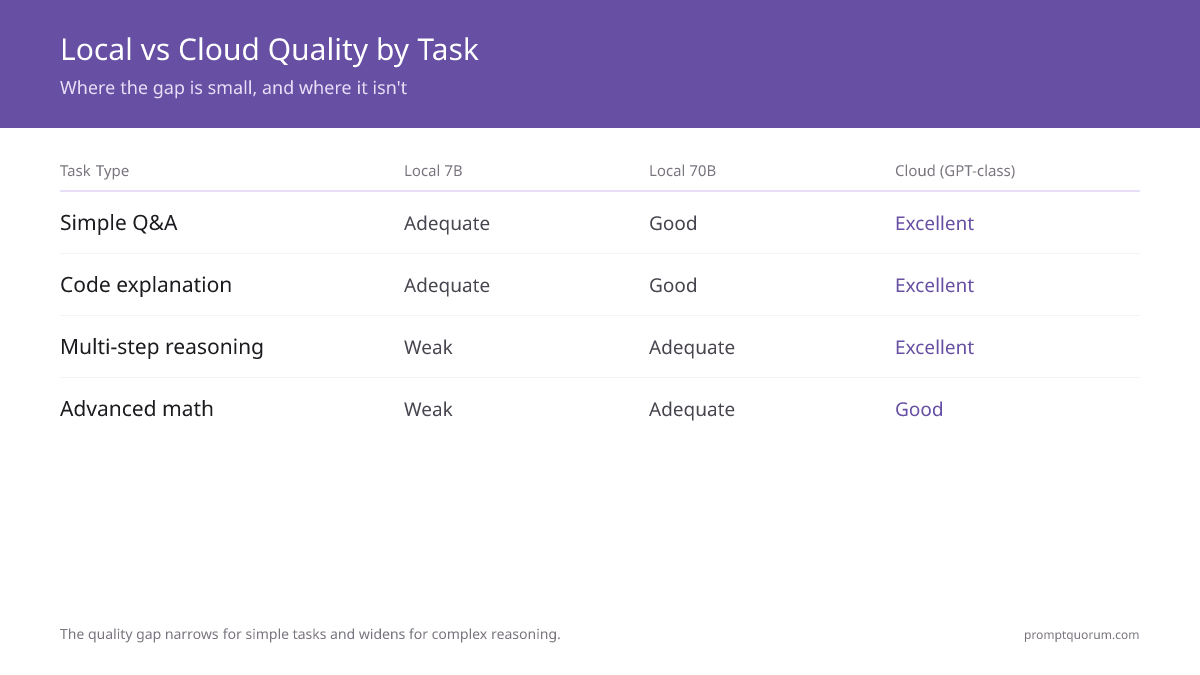
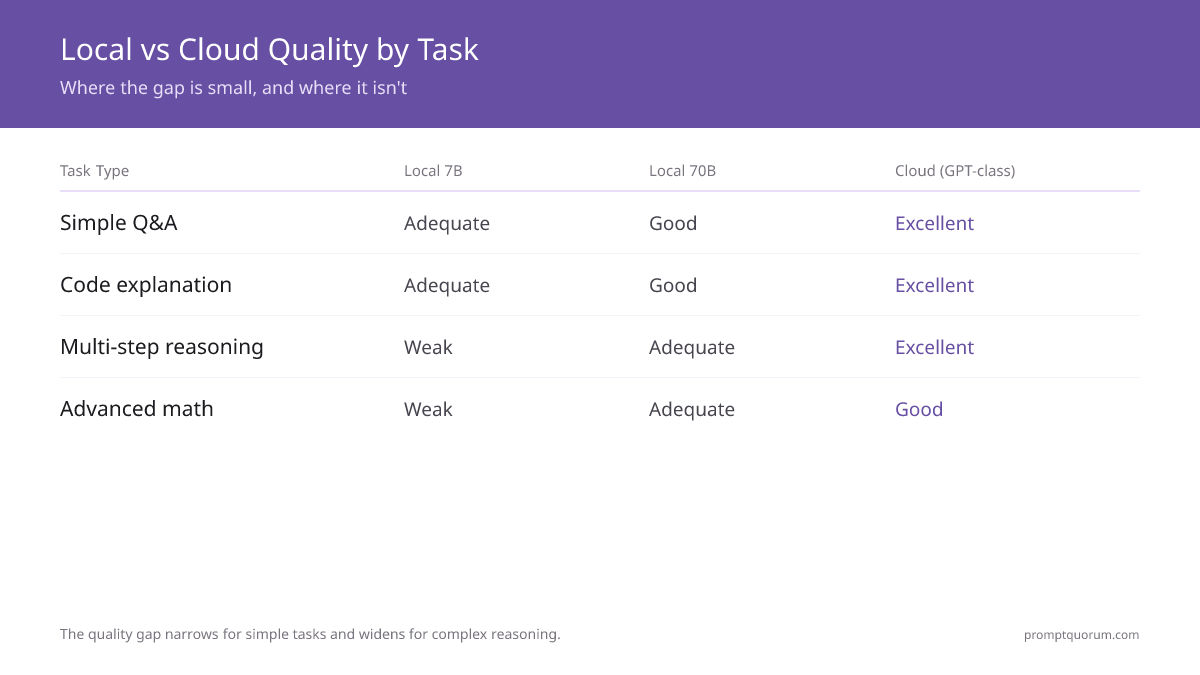
The quality gap is task-dependent. For summarization, simple Q&A, translation, and code explanation, a 7B model produces results that are difficult to distinguish from GPT-5.6 in blind evaluations. The gap is widest on: complex multi-step reasoning, advanced mathematics, nuanced long-form writing, and tasks requiring current world knowledge.
Local model limitations overlap with broader LLM constraints — hallucinations, reasoning failures, and knowledge cutoffs affect all models regardless of deployment. For the complete picture of what LLMs still cannot do reliably, see AI limitations: what LLMs can't do.
Task Type | Local 7B | Local 70B | GPT-5.6 |
|---|---|---|---|
| Simple Q&A | Adequate | Good | Excellent |
| Code explanation | Adequate | Good | Excellent |
| Multi-step reasoning | Poor | Adequate | Excellent |
| Advanced math | Poor | Adequate | Good |
| Long-form writing | Adequate | Good | Excellent |
| Current events | None (no internet) | None (no internet) | Good (with browsing) |
When Does Output Quality Matter?
When Does Output Quality Matter?
Use a local LLM if:
- •Your task is summarization, simple Q&A, or code review on existing code
- •Quality differences do not impact business outcomes
Use a cloud model if:
- •Your task involves complex reasoning (legal analysis, financial modeling)
- •Output quality directly affects revenue or customer experience
Quick decision:
- →Quality-critical tasks (legal, medical, finance) → use cloud
- →Simple tasks matching the "Adequate" rows above → try local first
How Fast Are Local LLMs Compared to Cloud APIs?
Cloud APIs process tokens on dedicated server hardware with NVIDIA H100 or A100 GPUs. Consumer hardware -- even high-end laptops and desktop GPUs -- cannot match this throughput.
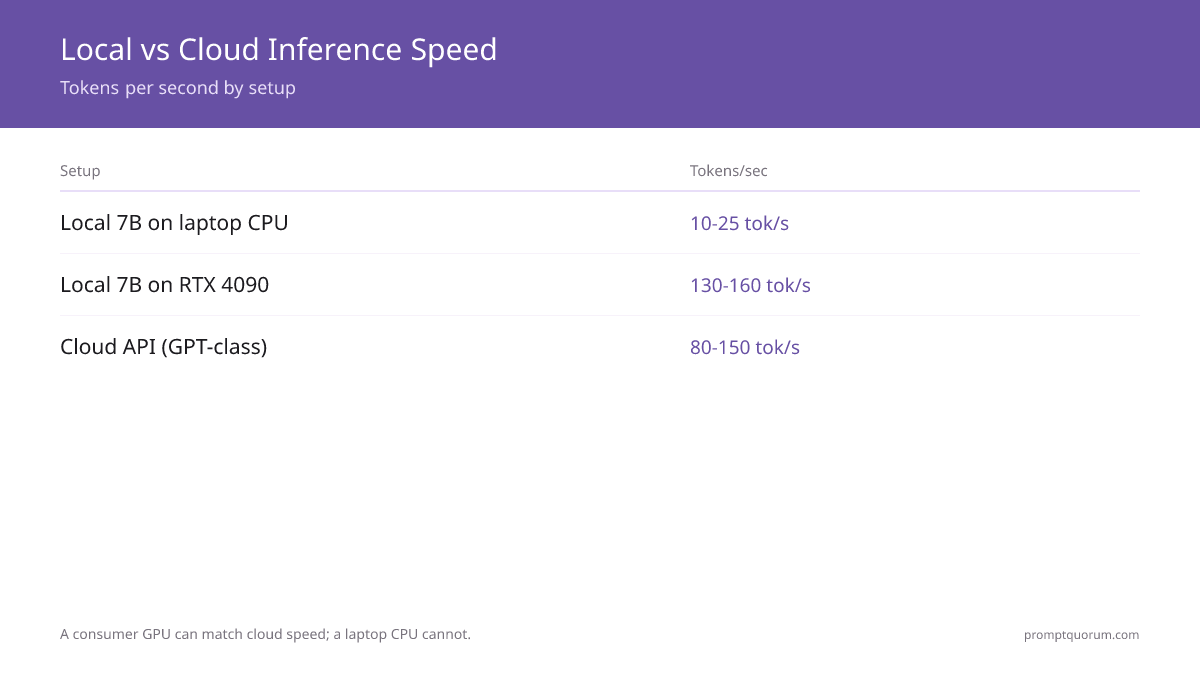
GPT-5.6 generates approximately 80-150 tokens/sec under typical load. A local 7B model on a modern laptop CPU generates 10-25 tokens/sec -- 4-10× slower. On an NVIDIA RTX 4090 (the fastest consumer GPU, now discontinued), the same 7B model reaches 130-160 tokens/sec -- comparable to cloud speed, but the hardware costs $2,000–$2,600 on the used market (NVIDIA discontinued it in 2026).
For interactive chat use, the speed difference is noticeable but tolerable at 20+ tok/sec. For batch processing (summarizing hundreds of documents), the speed gap becomes a significant constraint.
When Does Speed Matter?
When Does Speed Matter?
Use a local LLM if:
- •You are doing interactive chat and can tolerate 10–25 tok/sec
- •You prioritize privacy over latency
Use a cloud model if:
- •You process large batches (100+ documents)
- •You need <1 second responses consistently
Quick decision:
- →Interactive → local is fine
- →High throughput → use cloud
What Hardware Do You Need to Run Local LLMs?
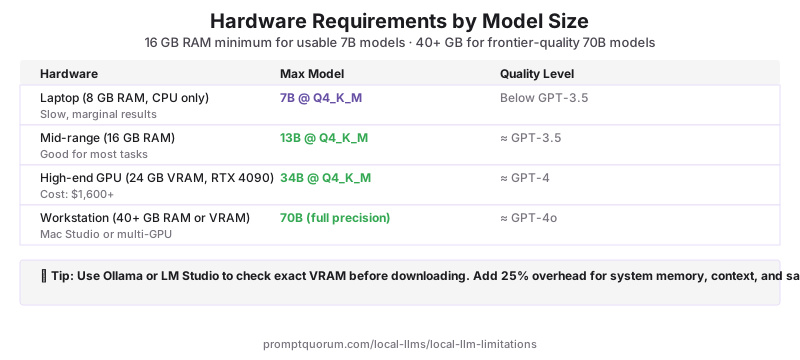
Running a capable local model (13B+) requires hardware that not every user has. The minimum for a genuinely useful local LLM experience -- matching GPT-5.6 Luna quality -- is 16 GB RAM and a modern CPU or Apple Silicon chip. This rules out roughly half of consumer laptops currently in use. For a detailed breakdown and VRAM calculations, see Local LLM Hardware Guide 2026.
Matching frontier model quality locally requires a 70B model, which demands 40-48 GB of RAM -- only available on high-end workstations or Mac Studio / Mac Pro with 64+ GB unified memory. If your hardware is constrained, cloud APIs provide better quality at lower setup cost.
Apple's August 2026 Mac Studio refresh (M5 Max and M5 Ultra, shipping September 22, 2026) raised the top-end unified memory ceiling from 192 GB to 512 GB. That 512 GB M5 Ultra configuration is a $10,000+ extreme config for running very large models locally, not the practical mainstream option -- for running a 70B model at full quality, the base M5 Max (from $2,499, up to 128 GB) is the realistic choice.
CPU-only (no GPU): best models for laptops without a dedicated GPU. Phi-4 (14B, Q4) is the strongest reasoning model that runs at a usable 4–8 tok/s on a modern Intel or AMD laptop CPU with 16 GB RAM. Qwen3 1.7B and Llama 3.1 8B Q4 are also practical at 5–10 tok/s CPU-only. Apple Silicon (M-series) is the exception — the unified memory architecture runs at 45–120 tok/s on the same model sizes that a PC CPU would run at 5 tok/s, making it far more practical for CPU-only local inference.
Hardware | Max Useful Model | Quality Equivalent |
|---|---|---|
| Basic laptop (8 GB RAM, CPU only) | 7B at Q4_K_M | Below GPT-5.6 Luna |
| Mid-range laptop (16 GB RAM) | 13B at Q4_K_M | Roughly GPT-5.6 Luna |
| Apple M3 Pro (18 GB) | 13B full quality | GPT-5.6 Luna to GPT-4 (task dependent) |
| NVIDIA RTX 4090 (24 GB VRAM) | 34B at Q4_K_M | Close to GPT-4 |
| Mac Studio M5 Max (128 GB) | 70B full quality | Competitive with GPT-5.6 |
When Does Hardware Matter?
When Does Hardware Matter?
Use a local LLM if:
- •Your machine has 16+ GB RAM and a modern CPU or Apple Silicon
- •You're willing to invest in a GPU like RTX 4090 or Mac Studio
Use a cloud model if:
- •Your machine has 4–8 GB RAM and you cannot upgrade
- •You do not want to manage hardware maintenance and updates
Quick decision:
- →≤8 GB RAM → cloud is mandatory for good quality
- →16 GB RAM → try a 7B local model
- →40+ GB RAM → local 70B matches cloud quality
Why Can't Local LLMs Access Real-Time Information?
Local LLMs have a training data cutoff. They cannot access the internet, cannot retrieve current news, cannot check live prices or stock data, and cannot visit URLs. A model trained with a cutoff of early 2024 will not know about events after that date.
Cloud models with browsing capabilities (GPT-5.6 with web search, Gemini with Google Search integration) can retrieve and cite current information. No consumer-grade local inference tool replicates this capability without significant additional infrastructure (RAG with a live web crawler).
For tasks that require current information -- news summaries, recent product comparisons, live data analysis -- cloud APIs are the practical choice. See Local LLMs vs Cloud APIs for a full comparison.
When Does Real-Time Information Matter?
When Does Real-Time Information Matter?
Use a local LLM if:
- •Your task uses only historical or internal data (company docs, codebases, archives)
- •You can accept answers based on knowledge from early 2024 or earlier
Use a cloud model if:
- •You need current stock prices, weather, news, or market data
- •Your task requires retrieving and citing recent articles or visiting URLs
Quick decision:
- →Need live data (news, prices) → cloud required
- →Using private/historical data only → local is fine
How Hard Is It to Set Up and Maintain a Local LLM?
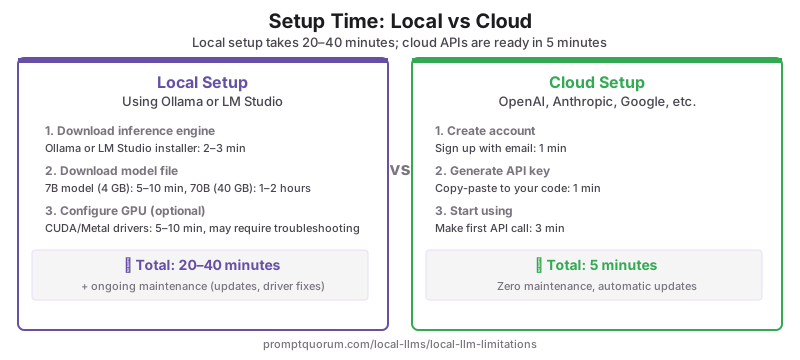
A cloud API requires creating an account, generating an API key, and making an HTTP call -- typically 5-10 minutes total. A local LLM requires installing an inference engine (like Ollama or LM Studio), downloading a model file (2-50 GB), configuring GPU offloading, and troubleshooting driver issues. Ollama reduces this to a single binary installation, simplifying the process compared to manual setup.
Maintenance adds ongoing complexity: new model releases must be manually downloaded, inference tools require updates, and hardware compatibility issues arise with OS updates. For a user who wants to focus on using AI rather than managing infrastructure, cloud APIs have a dramatically lower operational burden.
See how to install Ollama for step-by-step instructions and Troubleshooting Local LLM Setup for fixes to the most common errors. For a full setup time comparison, see Setup Time: Local vs Cloud.
When Does Setup Complexity Matter?
When Does Setup Complexity Matter?
Use a local LLM if:
- •You're comfortable with command-line tools and troubleshooting
- •You have 30+ minutes for initial setup and ongoing maintenance
Use a cloud model if:
- •You want zero infrastructure management overhead
- •You need to deploy for non-technical users without setup burden
Quick decision:
- →Non-technical user → cloud is mandatory
- →Solo developer who likes tinkering → local is fine
- →Production app for others → cloud eliminates maintenance
How Large Is the Context Window of Local LLMs?
Most practical local models support 4K-128K token context windows. Google Gemini 3.1 Pro supports 1M tokens; OpenAI GPT-5.6 supports 128K tokens. While 128K is available locally (Llama 3.3, Qwen3), the inference speed for very long contexts degrades significantly -- processing a 100K token context on a 7B model may take several minutes on consumer hardware.
For tasks involving very long documents (entire books, large codebases, hours of transcripts), cloud APIs with large context windows are more practical than local inference.
When Does Context Window Matter?
When Does Context Window Matter?
Use a local LLM if:
- •Your typical request is under 8K tokens (roughly a 6,000-word document)
- •You can break larger documents into chunks and process separately
Use a cloud model if:
- •You need to process entire books, codebases (100K+ lines), or multi-hour transcripts in one request
- •You want Gemini 3.1 Pro's 1M-token context for document analysis
Quick decision:
- →< 8K tokens → local is fine
- →8K–128K tokens → local works but slow
- →> 128K tokens → cloud or split the document
Regional Considerations: Local vs Cloud LLMs by Geography
EU (GDPR Compliance): The EU General Data Protection Regulation (GDPR) Articles 44-50 restrict cross-border data transfers unless specific safeguards are in place. Local LLM inference satisfies GDPR Article 28 (data processing) by keeping all data within EU borders. This eliminates the need for Standard Contractual Clauses (SCCs) or adequacy decisions, making local LLM deployment a compliance advantage for companies handling sensitive EU citizen data.
Japan (METI AI Governance): Japan's Ministry of Economy, Trade and Industry (METI) AI Governance Framework 2024 recommends local inference for enterprise AI systems to reduce data exposure risk and maintain operational sovereignty. Japanese enterprises in finance, healthcare, and government favor local LLM deployment for classified information.
China (Data Security Law): China's 2021 Data Security Law mandates that data about Chinese citizens and entities remain processed within China. Cloud APIs operated by non-Chinese companies violate this requirement. Local LLM inference using open-source models (Llama, Qwen3) meets this requirement when deployed on Chinese-controlled infrastructure.
When Should You Use a Cloud API Instead of a Local LLM?
- Maximum output quality is required -- legal documents, complex code generation, advanced research analysis. Use GPT-5.6 or Claude Sonnet 5. For a full comparison, see Local LLMs vs Cloud APIs.
- Real-time information is needed -- current news, live data, URL retrieval. Local models have a training cutoff.
- Setup time is a constraint -- for a quick prototype or one-off task, a cloud API key is faster to get working than a local install.
- Your hardware is limited -- on a machine with 4-6 GB RAM, local inference is marginal. Cloud APIs produce better results with zero hardware strain.
- Processing very long documents -- 100K+ token contexts are slow locally. Cloud models handle this more practically.
- Comparing local vs cloud side-by-side: Tools like PromptQuorum dispatch one prompt to your local Ollama model and 25+ cloud models simultaneously, letting you evaluate quality differences on your specific tasks before committing to either approach.
When NOT to Use Local LLMs
Local LLMs are the wrong choice in these scenarios:
Complex multi-step reasoning -- Your task requires breaking down a problem, using intermediate results, and iterating. Local 7B models fail on these tasks. Use GPT-5.6 or Claude Sonnet 5 instead.
Real-time information requirements -- You need current news, live data feeds, or the ability to visit URLs. Local models have a training cutoff and no internet access. Cloud APIs with web search are required.
High-accuracy legal or medical tasks -- Documents with legal, medical, or financial implications require frontier-level accuracy. A local model's 10-20 point benchmark gap could introduce costly errors.
Large-scale production deployments -- You're building a consumer-facing product requiring 99.9% uptime. Local inference requires managing servers and updates yourself; cloud APIs provide SLAs and support.
Batch processing at scale -- You're processing 1,000+ documents and speed matters. Cloud APIs process batches in minutes; local inference takes hours or days.
🏆 Best Local LLM by Use Case
- Best for privacy and compliance → Local LLM (Ollama + Llama 3.3 70B or Qwen3 8B)
- Best for reasoning and coding → Cloud API (OpenAI GPT-5.6 or Anthropic Claude Opus 5)
- Best for speed with good quality → Cloud API (OpenAI GPT-5.6 Luna for 10× cheaper token cost)
- Best for cost at scale → Local LLM (if you have the hardware; amortized cost approaches zero)
- Best for trying both approaches → PromptQuorum (dispatch to both local and cloud, see the quality difference before choosing)
Quick Facts: Local vs Cloud Metrics
Metric | Local LLM (CPU) | Local LLM (GPU) | Cloud API |
|---|---|---|---|
| Speed | 10–25 tokens/sec | 50–130 tokens/sec | 80–150 tokens/sec |
| Quality Gap | ~15–20% below GPT-5.6 | ~5–10% below GPT-5.6 | Frontier level |
| RAM Required | 16 GB (minimum) | 24 GB VRAM (GPU) | None (cloud-managed) |
| Setup Time | 20–40 minutes | 30–60 minutes | 5 minutes |
| Context Window | 4K–128K tokens | 4K–128K tokens | 128K–1M+ tokens |
| Cost per Month | ~$0 (hardware amortized) | $800–$3,000+ (hardware) | $5–$50 (API) |
| Real-Time Data | ❌ No internet access | ❌ No internet access | ✅ Web search available |
| Maintenance | Ongoing (updates, drivers) | Ongoing (updates, drivers) | None (cloud-managed) |
Common Questions About Local LLM Limitations
Should I use a local LLM or cloud API?
Local if privacy is critical. Cloud if speed or real-time data is critical. Unsure? Test both with PromptQuorum — dispatch one prompt to your local Ollama and 25+ cloud models simultaneously to compare quality on your specific task.
Is local LLM faster than cloud API?
No. Cloud APIs generate 80–150 tokens/sec. Local LLMs on CPU generate 10–25 tok/sec — 4–10× slower. GPU helps: NVIDIA RTX 4090 reaches 130–160 tok/sec, matching cloud, but costs $2,000–$2,600 on used market.
Is local LLM cheaper than cloud?
Depends on usage. Local costs $800–2,000 upfront hardware. Cloud costs $5–50/month. For light users (<100K tokens/month), cloud is cheaper. For heavy users (>10M tokens/month), local breaks even in 6–12 months.
When should you use a local LLM instead of cloud?
Use local when: data privacy is critical (no data leaves your device), you have adequate hardware (16+ GB RAM or 40+ GB for 70B models), you don't need real-time information, and setup complexity is acceptable. Use cloud when: speed is critical, real-time data access is needed, hardware is limited (<8 GB RAM), or you need frontier-level reasoning.
What are the main limitations of local LLMs?
Six key limitations: (1) Lower quality on complex reasoning vs frontier cloud models, (2) 4–10× slower inference on consumer hardware, (3) High hardware requirements ($800–2,000 upfront), (4) No real-time information access (training cutoff date), (5) Setup complexity (20–40 minutes vs 5 minutes cloud), (6) Limited context window (4K–128K tokens locally vs 1M+ in cloud).
Sources
- GPT-5.6 Technical Report -- Benchmark comparisons and capability analysis from OpenAI
- Meta Llama 3.3 Model Card -- Official performance metrics and limitations
- Understanding Hallucination in LLMs -- Academic research on model accuracy and error patterns
Common Mistakes Regarding LLM Limitations
- Expecting 7B models to match GPT-5.6: They are 10–20% lower on reasoning. HumanEval: local 7B scores 45–55% vs GPT-5.6's 90%. Use 70B locally or cloud for complex tasks.
- Ignoring hardware limits: 16 GB RAM is the minimum for useful models. Below that, quality degrades significantly. Check hardware requirements before starting.
- Assuming local = faster: CPU inference is 4–10× slower (10–25 tok/sec vs 80–150 tok/sec cloud). Requires $2,000–$2,600 GPU to match cloud speed.
- Underestimating setup time: Local setup takes 20–40 minutes. Cloud is 5 minutes. Add ongoing maintenance (updates, drivers) to your local cost calculation.