Key Takeaways
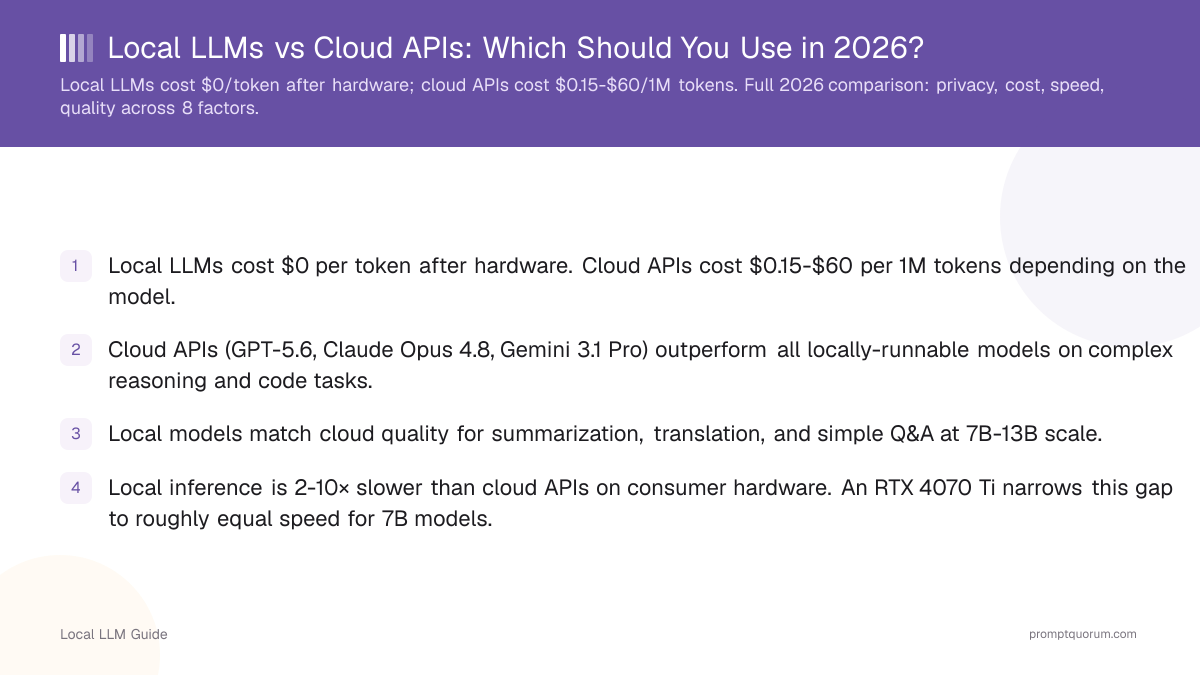
- Local LLMs cost $0 per token after hardware. Cloud APIs cost $0.15-$60 per 1M tokens depending on the model.
- Cloud APIs (GPT-5.6, Claude Opus 5, Gemini 3.1 Pro) outperform all locally-runnable models on complex reasoning and code tasks.
- Local models match cloud quality for summarization, translation, and simple Q&A at 7B-13B scale.
- Local inference is 2-10× slower than cloud APIs on consumer hardware. An RTX 4070 Ti narrows this gap to roughly equal speed for 7B models.
- Use local LLMs when: data privacy is non-negotiable, costs are high, or offline access is required. Use cloud APIs when: maximum quality matters and cost is acceptable.
📍 In One Sentence
Local LLMs run for $0 per token on your own hardware with full data privacy; cloud APIs (GPT-5.6, Claude Opus 5, Gemini 3.1 Pro) cost $0.15-$60 per 1M tokens but deliver higher output quality with zero setup.
💬 In Plain Terms
A local LLM is an AI model that runs entirely on your own computer -- no internet needed, no monthly bill, but you need a capable GPU to run it well. A cloud API (like ChatGPT or Claude) runs on someone else's servers -- you pay per use and get the smartest available models instantly, with no hardware required.
What Is the Core Difference Between Local LLMs and Cloud APIs?
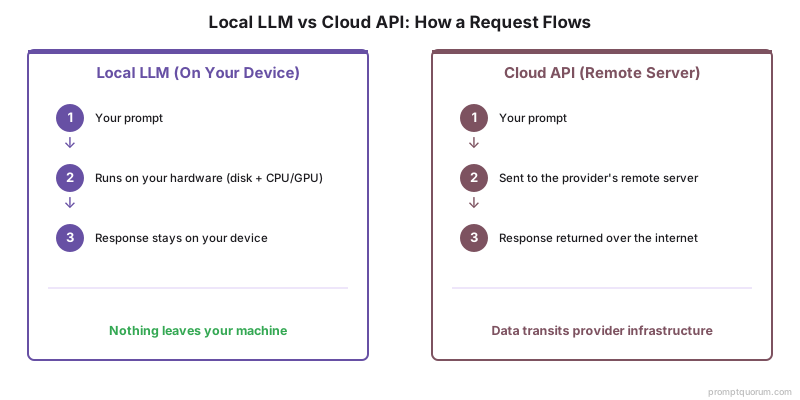
Local LLMs run all inference on your own hardware; cloud APIs send your prompt to a remote server and return the response. A local LLM means the model file is stored on your disk and all computation happens on your CPU or GPU. Nothing leaves your machine. You pay nothing per inference, but you need hardware capable of running the model.
A cloud API means your prompt is sent over the internet to a provider's server (OpenAI, Anthropic, Google), processed by their model, and the response is returned to you. You pay per token and never touch the model weights.
Both approaches use the same underlying transformer architecture. The practical differences are in where the compute happens, who controls the data, and what quality/speed tradeoff you get.
How Do Local LLMs and Cloud APIs Compare Across 8 Factors?
Factor | Local LLM | Cloud API |
|---|---|---|
| Data privacy | Complete -- data never leaves your device | Data processed on provider servers; subject to their privacy policy |
| Cost per token | $0 (after hardware investment) | $0.15-$60 per 1M tokens (varies by model) |
| Output quality | Good at 13B-70B; competitive on many tasks | Best available -- GPT-5.6, Claude Sonnet 5 lead benchmarks |
| Response speed | 10-120 tok/sec (hardware dependent) | 50-200 tok/sec (provider load dependent) |
| Setup time | 5-15 minutes with Ollama or LM Studio | 2-5 minutes to create an account and get an API key |
| Offline access | Yes -- works without internet | No -- requires active connection |
| Model updates | Manual -- you choose when to update | Automatic -- provider updates without notice |
| Customization | Full -- fine-tuning, system prompts, quantization | Limited -- system prompts only; no weight access |
How Do the Costs of Local LLMs and Cloud APIs Compare?
Cloud APIs cost $0.15-$60 per 1M tokens; local LLMs cost $0 per token after the hardware investment. Cloud API pricing varies by model tier. In 2026, representative prices per 1M tokens: GPT-5.6 at $2.50 input / $10 output, Claude Opus 5 at $5.00 / $25, Gemini 3.1 Pro at $1.25 / $5, and GPT-5.6 Luna at $0.15 / $0.60.
A developer running 10M output tokens per month on GPT-5.6 pays approximately $100/month. The same workload on a local 8B model costs $0 per token -- the only cost is electricity (roughly $0.10-0.30/hour for GPU inference) and the upfront hardware.
Local LLMs become cost-effective within weeks for high-volume use cases. For occasional use (a few thousand tokens per day), cloud APIs are cheaper when you factor in the time cost of setup and maintenance.
Which Is More Private: a Local LLM or a Cloud API?
Local LLMs are categorically more private. No prompt text, no context, and no response data is transmitted to any external server. This makes local inference the only viable option for regulated industries (healthcare HIPAA, finance PCI-DSS, legal privilege) and for personal data that must stay on-device.
Cloud API providers publish data-use policies that typically exclude training on API inputs, but the data still transits their infrastructure and is subject to legal process. Enterprise tiers (OpenAI Enterprise, Google Workspace) offer stricter data isolation, but at a significant cost premium.
For the full security audit checklist for local models, see Local LLM Security & Privacy Checklist.
•⚠️ Warning: Cloud API terms can change without notice. Always review the current data-use policy for your specific tier before processing sensitive data.
How Does Speed Compare Between Local and Cloud Models?
Speed depends heavily on hardware. On CPU only, a 7B model produces 10-30 tokens/sec -- noticeably slower than cloud APIs. With a modern GPU, the gap closes significantly:
Hardware | Model | Speed |
|---|---|---|
| CPU only (modern laptop) | Llama 3.1 8B Q4 | 10-25 tok/sec |
| Apple M3 Pro (18 GB unified) | Llama 3.1 8B Q4 | 55-75 tok/sec |
| NVIDIA RTX 4060 (8 GB VRAM) | Llama 3.1 8B Q4 | 70-100 tok/sec |
| NVIDIA RTX 4090 (24 GB VRAM) | Llama 3.1 8B Q4 | 130-160 tok/sec |
| Cloud API (GPT-5.6 Luna) | GPT-5.6 Luna | 80-150 tok/sec (varies) |
Which Has Better Model Quality: Local or Cloud?
Cloud frontier models (GPT-5.6, Claude Sonnet 5, Gemini 3.1 Pro) lead on complex reasoning; local 13B models match on summarization, translation, and simple Q&A. On MMLU (knowledge breadth) and HumanEval (coding) benchmarks, frontier cloud models score 85-90% vs. 65-80% for the best local 70B models.
For everyday tasks -- summarization, translation, classification, simple Q&A, and document drafting -- a well-prompted 13B local model produces results that are difficult to distinguish from GPT-5.6 Luna in blind evaluations. The quality gap is most visible on tasks requiring deep world knowledge or multi-step reasoning chains.
The gap is narrowing. Meta Llama 3.3 70B (2025) matches GPT-4 (2023) on most benchmarks. Local model quality at the 7B scale has improved by roughly one generation per year.
Which Should You Choose: Local LLM or Cloud API?
Use this decision framework:
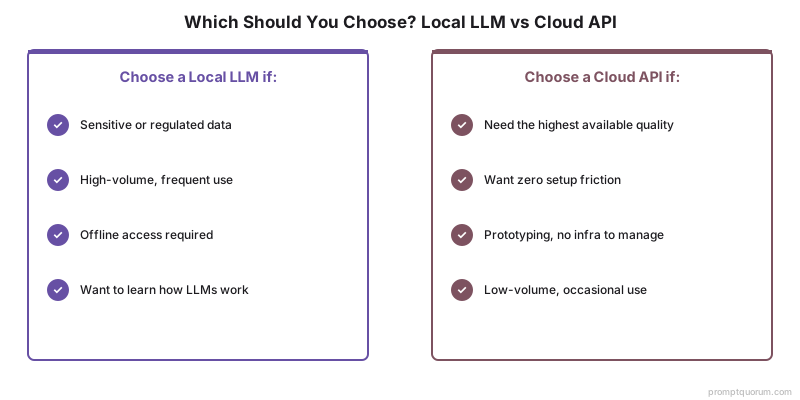
- Choose a local LLM if: you process sensitive or regulated data, you run high-volume workloads where per-token costs accumulate, you need offline capability, or you want to learn how LLMs work internally.
- Choose a cloud API if: you need the highest available output quality, you want zero setup friction, you are prototyping and don't want to manage infrastructure, or your usage is low-volume.
- Use both in parallel: Tools like PromptQuorum let you dispatch one prompt to your local Ollama model alongside 25+ cloud models simultaneously, so you can compare local vs. cloud results in one view and route tasks to the right model for each job.
Local LLMs vs Cloud APIs: Regional Context
The choice between local and cloud inference carries direct compliance implications across regulatory jurisdictions.
- EU / GDPR + AI Act: GDPR Article 28 requires a Data Processing Agreement with any third-party that processes personal data on your behalf -- including cloud AI API providers. Local LLMs eliminate this requirement entirely: no DPA, no Article 46 transfer mechanism, no cross-border data flow. The EU AI Act (effective February 2025) classifies AI systems processing personal data in regulated sectors (healthcare, HR, legal, financial) as high-risk. For these sectors, local inference is the lowest-risk deployment path. Cloud API enterprise tiers (OpenAI Enterprise, Anthropic for Teams) offer GDPR-compliant data processing, but require procurement, DPA signing, and ongoing compliance monitoring. Model preference for EU: Mistral (France, Apache 2.0) provides the strongest EU compliance narrative for local deployments. Llama 3.x and Qwen3 are also usable under GDPR for local inference.
- Japan (METI): METI AI Governance Guidelines recommend on-premises inference for enterprise data classified as sensitive. For Japanese companies handling customer data, local LLMs align with METI's principle of "appropriate management of AI systems." Cloud APIs require verifying that the provider's data processing location complies with Japan's Act on the Protection of Personal Information (APPI). Qwen3 8B via Ollama is the recommended local model for Japanese-language business workflows -- native Japanese tokenization processes Japanese text 30-40% more efficiently than Llama, reducing inference time for Japanese documents.
- China: Under China's Personal Information Protection Law (PIPL, 2021) and Data Security Law (数据安全法, 2021), cross-border transfer of personal data to foreign cloud providers requires regulatory approval. For most Chinese enterprises, local LLMs are not just preferable -- they are legally necessary for sensitive data processing. Cloud APIs from foreign providers (OpenAI, Anthropic) require PIPL impact assessments for personal data processing. Local Qwen3 deployment avoids all of these requirements.
What Are Common Questions About Local LLMs vs Cloud APIs?
Can I switch between local and cloud models in the same application?
Yes. Ollama and LM Studio both expose an OpenAI-compatible REST API at localhost. Any application built on the OpenAI SDK can point its base URL to localhost:11434 (Ollama) or localhost:1234 (LM Studio) to use a local model without changing code. Switching back to cloud requires only changing the base URL and API key.
Do cloud API providers train on my prompts?
For paid API tiers, most major providers (OpenAI, Anthropic, Google) explicitly opt API customers out of training data collection by default. Free tiers and consumer products typically do use inputs for improvement. Always verify the current data policy for the specific tier and product you are using.
Is a local 70B model better than GPT-5.6 Luna?
On most benchmarks in 2026, yes -- Meta Llama 3.3 70B and Qwen3 72B score above GPT-5.6 Luna on standard reasoning and coding tasks. However, 70B models require 40-48 GB of RAM, putting them out of reach for most consumer hardware. For practical local use, 7B-13B models are the common range.
What hardware do I need to run a 7B model locally?
A modern laptop CPU can run Llama 3.2 3B at 10-20 tokens/sec, but GPU is essential for practical use. For 7B models: RTX 4070 Ti (12 GB, ~80 tok/sec), RTX 4090 (24 GB, ~130 tok/sec), or Apple M3 Pro (18 GB, ~60 tok/sec). With Q4 quantization, VRAM requirements drop significantly.
Are cloud APIs GDPR-compliant?
Most providers (OpenAI, Anthropic, Google) offer GDPR-compliant tiers, but you must opt-in and verify your tier. Enterprise plans include stricter data isolation. For regulated healthcare, finance, or legal data, local LLMs offer the strongest guarantee by keeping data entirely on-device.
What is the best local model for beginners?
Llama 3.2 3B or 8B is the best starting point: small (3-8 GB VRAM), fast (~50-80 tok/sec on GPU), and good quality for summarization and Q&A. Download via Ollama or LM Studio. Both have built-in chat interfaces.
How do I reduce cloud API costs?
Use cheaper models for simple tasks (GPT-5.6 Luna: $0.15 per 1M tokens vs. GPT-5.6: $2.50). Batch requests. Cache prompts where supported. For high-volume use, batch processing APIs offer 50% discounts. Or switch to local models for high-frequency workloads.
Can I use both local and cloud models in parallel?
Yes. Tools like PromptQuorum let you dispatch one prompt to your local Ollama model and 25+ cloud models simultaneously, compare results side-by-side, and route tasks to the best model for each job. This combines local privacy with cloud quality when needed.