Key Takeaways
- Coding: Qwen3.8-27B leads SWE-bench (61.7% real-world, best dense model). For agentic coding: Mistral Devstral Small 24B. For IDE autocomplete: Mistral Codestral 22B.
- General reasoning: Llama 3.3 70B and Qwen3 72B remain nearly tied; Llama 3.x is stronger in English, Qwen in multilingual.
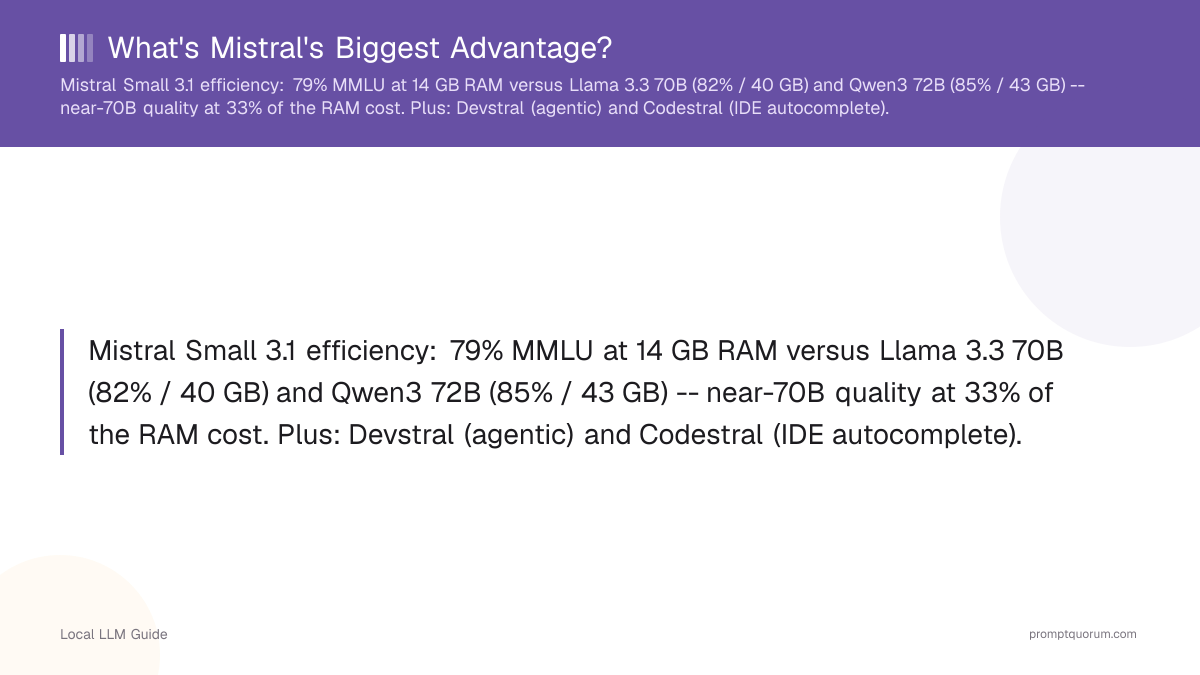
- Efficiency (quality per GB of RAM): Mistral Small 3.1 24B delivers near-70B quality at 14 GB RAM -- unchanged since April.
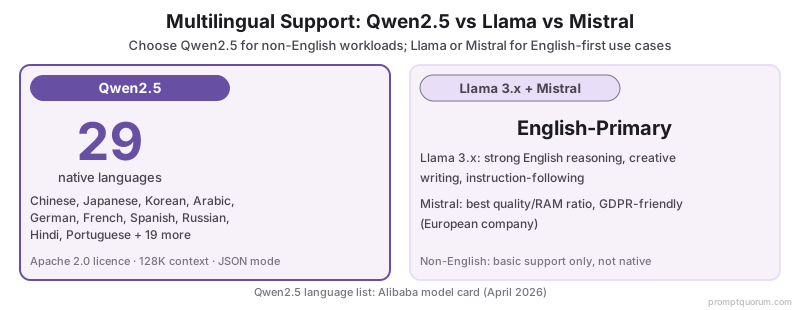
- Languages beyond English: Qwen3 supports 29 languages natively; Llama and Mistral are primarily English-optimized.
- MoE long-context (new in 2026): Llama 4 Scout (17B active / 109B total, 16 experts, multimodal) offers a 10M token context but needs ~55 GB VRAM at Q4 -- it does not fit a 24 GB consumer GPU at normal quants (only at 1.78-bit, ~20 tok/s).
- Legacy models still relevant: Mistral Small 24B, Qwen3 14B, and Llama 3.1 8B remain widely deployed. The "Legacy Benchmark Reference" section below covers when to upgrade vs when to stay.
📍 In One Sentence
Qwen3.8-27B wins for coding on consumer hardware (61.7% SWE-bench, fits 24 GB at Q4); Llama 4 Scout leads on long context and multimodal (10M context, MoE, ~55 GB at Q4).
💬 In Plain Terms
These are three of the most popular open-source AI model families you can run locally. Qwen3 (by Alibaba) excels at coding, Llama 4 (by Meta) handles very long documents and images, and Mistral (French AI) offers efficient smaller models. All are free to download and run offline.
•Info: 📌 Looking for the older comparison? Jump to Mistral 24B vs Qwen3 14B vs Llama 3.1 8B Legacy Benchmarks below.
Which Open-Weight Model Family Should You Choose?
Previous generation models (Qwen3, Llama 3.3) remain available on Ollama and are still widely used. This comparison focuses on current-generation models. Ready to run one? Full Qwen local setup guide →
Family | Developer | Current Releases | Licence |
|---|---|---|---|
| Qwen3 | Alibaba | Qwen3 (April 2026), Qwen 3.5 (multimodal), Qwen3.8-27B (SWE-bench 61.7%) | Apache 2.0 (most sizes) |
| Llama 4 | Meta | Scout (17B active/109B MoE, 16 experts, 10M ctx, multimodal, ~55 GB VRAM Q4), Maverick (17B active/400B MoE), Legacy: 3.3 70B | Llama Community (custom) |
| Mistral | Mistral AI | Small 3.1 (24B), Devstral Small 24B (agentic), Codestral 22B (FIM/IDE) | Apache 2.0 (most sizes) |
How Do These Models Compare on Benchmarks?
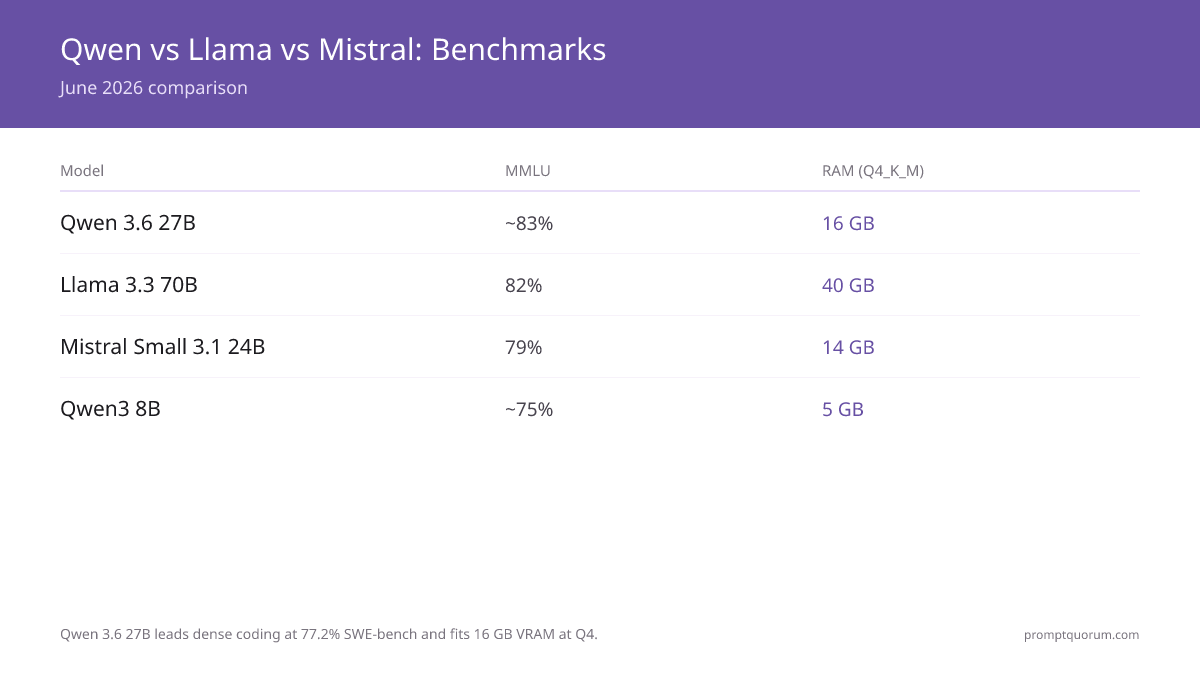
SWE-bench (real-world GitHub issue resolution) is the primary 2026 coding benchmark for practical coding evaluation. It tests multi-file changes, codebase understanding, and test writing. HumanEval (single-function Python) remains useful for comparison but is secondary. MMLU and MATH evaluate general knowledge and reasoning. Llama 4 Scout benchmarks are limited due to recent release and MoE complexity. Dashes indicate benchmarks not yet published or not applicable.
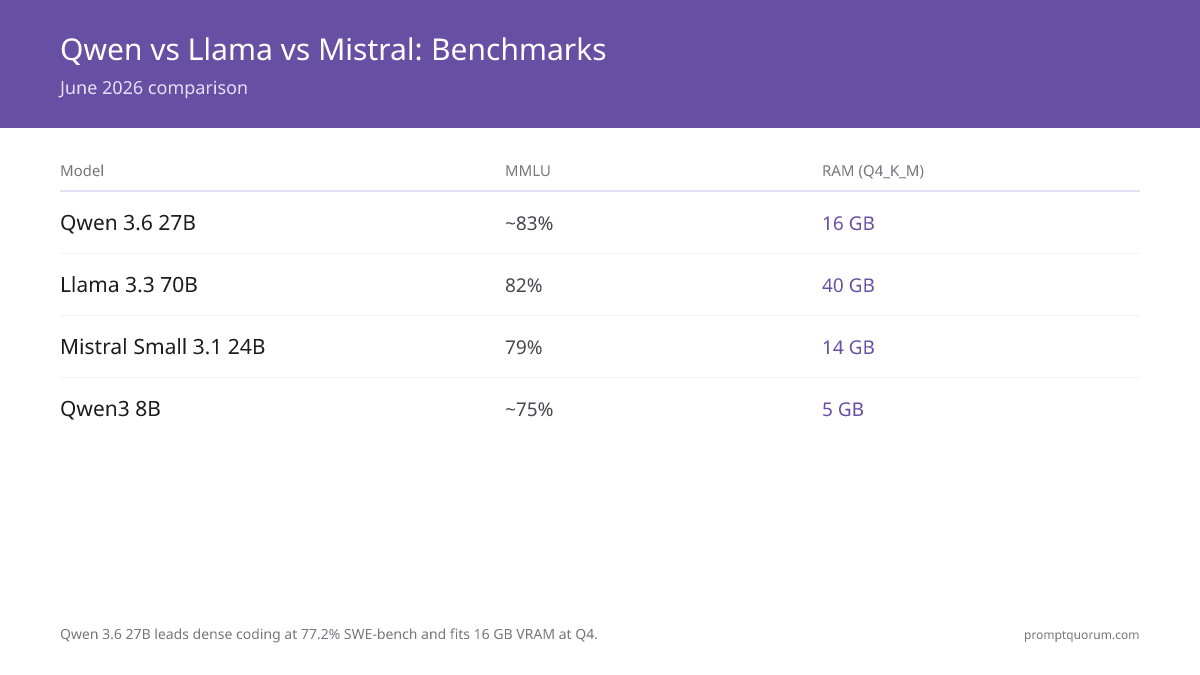
Model | MMLU | SWE-bench | MATH | RAM (Q4_K_M) |
|---|---|---|---|---|
| Qwen3.8-27B | — | 61.7% | — | 24 GB |
| Qwen3 72B | ~85% | — | ~84% | 43 GB |
| Llama 4 Scout 17B (MoE) | — | — | — | ~55 GB |
| Llama 3.3 70B (legacy) | 82% | — | 77% | 40 GB |
| Mistral Small 3.1 24B | 79% | — | 65% | 14 GB |
| Devstral Small 24B | — | High (agentic) | — | 16 GB |
| Qwen3 8B | ~75% | — | ~55% | 5 GB |
| Mistral Small v0.3 | 64% | — | 28% | 4.5 GB |
Which Tasks Does Qwen3 / Qwen3.8-27B Excel At?
Qwen3 (April 2026) and Qwen3.8-27B (August 2026) from Alibaba lead on coding benchmarks. Qwen3.8-27B scores 61.7% SWE-bench Pro and 89.2% GPQA Diamond — the best dense coding model available, and unlike the earlier Qwen 3.6 27B it superseded, it is a native vision-language model (understands images and video, not text-only). Qwen3 72B continues to lead on MMLU at ~85%. The Qwen3 family includes both dense models and MoE variants (35B-A3B).
Strengths: coding (Python, JavaScript, SQL, SWE-bench leading), mathematical reasoning (84% MATH at 72B), 29-language native support, JSON mode, function calling, 128K context window across all sizes.
Weaknesses: English instruction-following style can feel less natural than Llama or Mistral; some users report less fluent creative writing in English. The Alibaba origin raises data-handling concerns for some enterprise users despite open weights.
Why Is Llama 4 Scout the Long-Context Pick?
Llama 4 (April 2025) introduced MoE architecture to the Llama family. Scout (17B active / 109B total, 16 experts, multimodal) offers a 10M token context window — the largest context of any locally-runnable model — but needs ~55 GB VRAM at Q4 and does not fit a 24 GB consumer GPU at normal quants (only at 1.78-bit, ~20 tok/s). Maverick (17B active / 400B total) targets multi-GPU setups. Llama 3.3 70B remains the most battle-tested dense model. For best overall on consumer hardware, Qwen3.8-27B (fits 24 GB at Q4) outperforms Scout; choose Scout when you need its 10M context or multimodal input.
Strengths: 10M context window (Scout), multimodal input, strongest English instruction-following and creative writing, ecosystem support remains widest of any open-source family, Llama 3.3 70B still widely fine-tuned.
Weaknesses: high VRAM demand (~55 GB at Q4) puts Scout out of reach for a single 24 GB consumer GPU at normal quants; no native multilingual support (Qwen3 still leads for non-English by a wide margin); Llama 4 Scout benchmarks still emerging. Llama 3.3 70B and Llama 3.1 8B remain available and are still the most widely fine-tuned base models.
What's Mistral's Biggest Advantage?
Mistral AI produces the most parameter-efficient models in this comparison and now offers specialized variants. Mistral Small 3.1 at 24B delivers benchmark scores close to the 70B class while requiring only 14 GB RAM -- the best quality-per-RAM ratio. Devstral Small 24B (Mistral AI, 2026) is purpose-built for agentic coding — multi-file edits, tool calling, and debugging loops. Codestral 22B is Mistral's FIM-optimized model for IDE autocomplete — the recommended model for Continue.dev and Cursor integrations.
Strengths: best quality-to-RAM ratio (Small 3.1), Devstral for agentic coding, Codestral for IDE/FIM, strong function calling and tool use, clean Apache 2.0 licence on key models, European provenance (France) for EU AI Act compliance.
Weaknesses: Mistral Small v0.3 is now outperformed on benchmarks by Qwen3 8B and Llama 3.1 8B; fewer size options at the frontier than Qwen or Llama (though specialization partially offsets this).
Tool Calling and Reasoning Comparison
Tool calling (function calling) allows a model to invoke external APIs and tools in agentic workflows. All three families support it natively.
Model | Tool Calling | Reasoning (MATH) | Best For |
|---|---|---|---|
| Qwen3 72B | ✅ Native | 83% | Complex multi-step agents |
| Llama 3.3 70B | ✅ Native | 77% | English-first agent workflows |
| Mistral Small 3.1 24B | ✅ Native, well-tested | 65% | Production tool use at 16 GB |
| Qwen3 14B | ✅ Native | 70% | Cost-effective tool calling |
| Llama 3.2 3B | ✅ Native | 51% | Lightweight agents |
| Mistral Small v0.3 | ⚠️ Limited | 28% | Not recommended for tool use |
For reasoning-heavy tasks (math, logic, code review): DeepSeek-R1 (MIT licence, 7B-32B) outperforms all three families on MATH benchmarks. Consider it alongside these three for analytical workflows. (DeepSeek has since released DeepSeek-V4 — Flash/Pro — as a newer open-weight generation; R1/V3 remain valid to run locally.)
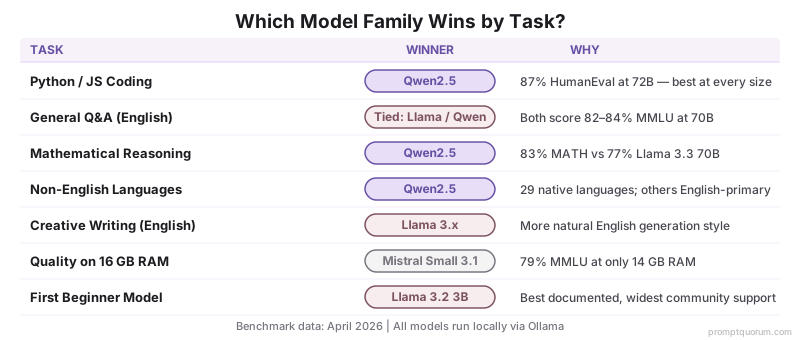
Which Model Family Wins by Task?
Model choice is step one; prompt design is step two. The same prompt can produce vastly different results across Qwen, Llama, and Mistral. For systematic techniques to get consistent results from any model family, see the prompt engineering guide.
Task | Winner | Why |
|---|---|---|
| Python / JavaScript coding (generation) | Qwen3.8-27B | 61.7% SWE-bench — best dense coding model |
| Agentic coding (multi-file, debugging) | Mistral (Devstral) | Purpose-built for agentic workflows |
| IDE autocomplete (FIM) | Mistral (Codestral) | FIM-optimized, Continue.dev/Cursor support |
| General Q&A (English) | Llama 3.3 / Qwen3 (tied) | Both score 82-85% MMLU at 70B |
| Mathematical reasoning | Qwen3 | 84% MATH at 72B vs 77% for Llama 3.3 70B |
| Non-English languages | Qwen3 | 29 native languages; Llama and Mistral are English-primary |
| Creative writing (English) | Llama 3.x/4 | More natural English generation style |
| Quality on 16 GB RAM | Mistral Small 3.1 | Near-70B quality at 14 GB RAM — unchanged |
| Long-context tasks (10M+ tokens) | Llama 4 Scout | 10M token context window — no competitor matches |
| Beginner first model | Llama 4 3B | Best documented, most community support — unchanged |
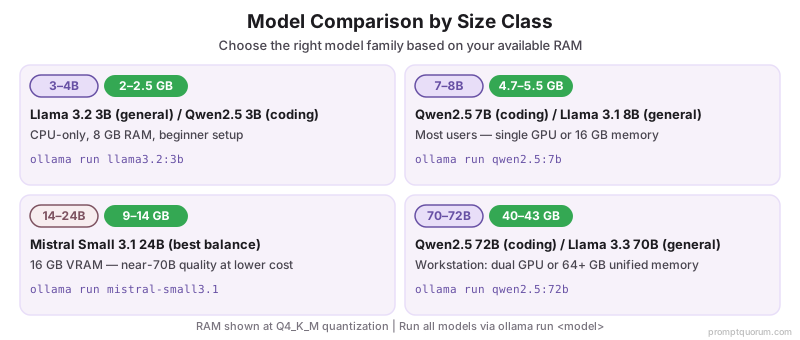
How Do Models Compare at the Same Scale?
3B-4B class: Qwen3 3B and Phi-4 Mini 3.8B outperform Llama 4 3B on coding and math. For general English use, Llama 4 3B is more reliable.
7B-8B class: Qwen3 8B (~5 GB) and Llama 3.1 8B (~5.5 GB) both significantly outperform Mistral Small v0.3. Qwen3 8B leads on coding; Llama 3.1 8B leads on English instruction-following.
14B-24B class: Qwen3 14B and Mistral Small 3.1 24B are the primary options. Mistral Small 3.1 is stronger overall despite requiring more RAM. Devstral Small 24B is the best choice for developers doing agentic coding at this tier.
MoE class (new in 2025-2026): Llama 4 Scout (17B active / 109B total, 16 experts) and Qwen3.6-35B-A3B (3B active / 35B total, 73.4 SWE-bench) use Mixture-of-Experts architecture — only a fraction of parameters activate per token. Scout needs ~55 GB VRAM at Q4 (it fits a 24 GB GPU only at 1.78-bit, ~20 tok/s), so it is a long-context / multimodal pick rather than a consumer-VRAM efficiency play; the smaller MoE variants are far more VRAM-friendly. gpt-oss:20b (21B total / 3.6B active MoE) also runs in 16 GB at ~o3-mini level with adjustable reasoning.
70B-72B class: Llama 3.3 70B and Qwen3 72B are the best locally-runnable dense models in 2026. Choose Qwen3 72B for coding and multilingual; choose Llama 3.3 70B for English-first general tasks.
Qwen, Llama, and Mistral cover the open-source landscape. For a comparison that includes commercial alternatives — GPT-5.6, Claude Opus 5, and Gemini 3.5 — and when to choose proprietary over open-source, see how to pick the right AI model.
Mistral Small 24B vs Qwen3 14B vs Llama 3.1 8B: Legacy Benchmark Reference
Many developers still run the previous generation: Mistral Small 24B (2024), Qwen3 14B (2024), and Llama 3.1 8B (2024). These models remain available on Ollama and are widely deployed in production. This section compares them directly for teams who haven't upgraded yet, and explains when upgrading to Qwen 3, Llama 4, or current Mistral makes sense.
- Mistral Small 24B delivers the highest absolute benchmarks of the three but requires 14 GB RAM. Best for 16 GB+ machines where quality matters more than headroom.
- Qwen3 14B is the strongest coding model in this legacy tier, scoring 71% HumanEval at 8 GB RAM. Best for developers on 12-16 GB RAM machines who prioritize code generation.
- Llama 3.1 8B has the broadest ecosystem support — most fine-tunes, most tutorials, most community help. Best for first-time users or teams that need broad community resources.
- When to upgrade Mistral Small 24B → Mistral Small 3.1 24B: if you need agentic coding (use Devstral Small 24B), IDE autocomplete (use Codestral 22B), or incremental quality improvements at same RAM footprint.
- When to upgrade Qwen3 14B → Qwen3 14B or Qwen3.8-27B: if you need SWE-bench performance (Qwen3.8-27B scores 61.7%, the best dense coding model in 2026), already on 16 GB RAM, or need 29-language native support (Qwen 3 expanded multilingual coverage).
- When to upgrade Llama 3.1 8B → Llama 4 Scout: only if you have ~55 GB+ VRAM at Q4 (Scout's 16-expert MoE activates 17B/109B params but needs ~55 GB at Q4; it fits a 24 GB GPU only at 1.78-bit, ~20 tok/s) and you need its 10M-token context (vs Llama 3.3's 128K) or multimodal input. On a single 24 GB consumer GPU, Qwen3.8-27B (fits 24 GB at Q4) is the better upgrade.
- Stay on legacy models if: your fine-tunes are built on Llama 3.1 8B or Qwen 3 (migration cost > benefit), production stability matters more than benchmarks (legacy models are battle-tested), or your workload doesn't require the new capabilities (general chat, summarization, basic Q&A).
- Quick decision matrix for legacy users:
- • Have 8 GB RAM, doing general chat: Stay on Llama 3.1 8B or Mistral Small v0.3.
- • Have 12-16 GB RAM, doing coding: Upgrade Qwen3 14B → Qwen3 14B or Qwen3.8-27B.
- • Have 16+ GB RAM, want best quality: Upgrade Mistral 24B → Mistral Small 3.1 24B (general) or Devstral 24B (agentic coding).
- • Have 24 GB VRAM: Use Qwen3.8-27B (fits 24 GB at Q4) for the best overall on consumer hardware. Reserve Llama 4 Scout (MoE, 10M context, ~55 GB at Q4) for multi-GPU or workstation rigs that need its long context or multimodal input.
Model | Parameters | RAM (Q4_K_M) | MMLU | HumanEval | Best For |
|---|---|---|---|---|---|
| Mistral Small 24B | 24B dense | 14 GB | 79% | 73% | Best quality per RAM (legacy tier) |
| Qwen3 14B | 14B dense | 8 GB | 73% | 71% | Coding on mid-range hardware |
| Llama 3.1 8B | 8B dense | 5 GB | 68% | 65% | Most documented, easiest start |
Regional Context: Which Family for EU, Japan, China
EU and GDPR Compliance: All three model families (Qwen3, Llama 3.x/4, Mistral) run fully locally with zero external data transmission, ensuring GDPR compliance. Mistral (French-origin, Mistral AI) has the strongest EU compliance posture. Devstral Small 24B and Codestral 22B are French-origin (Mistral AI), Apache 2.0 — the strongest EU-origin coding models available. Both Qwen3 (Apache 2.0) and Llama 3.x/4 work equally well under EU AI Act transparency and open-source auditability requirements. Qwen3 natively supports German, French, and other EU languages without quality degradation. EU AI Act August 2026 deadline impacts classification of these model tiers.
Japan and METI Compliance: Qwen3 and Llama 3.x/4 both align with Japan's METI (Ministry of Economy, Trade and Industry) local AI governance guidelines. No special reporting required if deployed on private infrastructure within Japanese corporate networks. Qwen3 benefits from strong Japanese language support (native tokenization) among its 29 languages, making it preferred for Japanese-language workloads. Mistral is also compliant but less commonly documented in Japanese AI governance contexts. Llama 4 Scout's MoE efficiency appeals to hardware-constrained Japanese enterprises.
China and CAC Requirements: Qwen3 (Alibaba, domestic) is strongly preferred for CAC (Cyberspace Administration of China) compliance. Qwen3 is natively optimized for Chinese tokenization with no degradation across its 29-language support — a critical advantage for Mandarin and dialect support. Kimi K2.6 (Moonshot AI, 1T total / 32B active MoE, Modified MIT license) is also available for Chinese enterprise coding — frontier performance (58.6 SWE-Bench Pro), Modified MIT license. Llama and Mistral are acceptable if deployed on private servers within Chinese territory, but cloud API calls incur stricter CAC scrutiny and data residency requirements. For content moderation compliance, Qwen3's Chinese training heritage ensures alignment with local content policies.
Common Mistakes When Choosing Model Families
- Comparing models at different parameter counts -- Qwen 32B vs Llama 70B is not an apples-to-apples test.
- Misreading MoE VRAM. Llama 4 Scout has 109B total parameters but only 17B active per token — yet at Q4 it still needs ~55 GB VRAM (all experts must be resident), not the ~14 GB a 17B dense model would use. It does not fit a 24 GB consumer GPU at normal quants (only at 1.78-bit, ~20 tok/s). Compare by actual VRAM footprint and benchmark, not active-parameter count.
- Using Qwen3 when Qwen3 is available. Qwen3 8B improves over Qwen3 8B on coding benchmarks. Unless you have a specific fine-tune built on Qwen3, upgrade to Qwen3.
- Not considering task-specific Mistral models. Mistral now has three distinct model lines: Small 3.1 (general), Devstral (agentic coding), Codestral (IDE autocomplete). Picking "Mistral" without specifying which model for which task wastes the family's main advantage — specialization.
- Ignoring multilingual benchmarks when choosing between models if your workload is multilingual.
- Mistral Small 3.1 overlooked: Many users skip Small 3.1 (24B) thinking it requires 30+ GB RAM. It fits at Q5 quantization with 22 GB, outperforming Llama 3.1 8B on many tasks.
Frequently Asked Questions
Is Qwen or Llama better for my use case?
Best overall on consumer hardware: Qwen3.8-27B (61.7% SWE-bench, fits 24 GB at Q4). For coding and multilingual tasks: Qwen3.8-27B or Qwen3 8B. For long-context (10M tokens) or multimodal input: Llama 4 Scout (needs ~55 GB VRAM at Q4). For maximum quality per GB of RAM: Mistral Small 3.1. Test with sample prompts from your actual workload.
What is Llama 4 Scout and how is it different from Llama 3.3?
Llama 4 Scout uses a 16-expert Mixture-of-Experts (MoE) architecture — 17B parameters are active per token out of 109B total, and it is multimodal. All experts must stay resident, so at Q4 it needs ~55 GB VRAM (not the ~14 GB a 17B dense model would use) and does not fit a 24 GB consumer GPU at normal quants — only at 1.78-bit (~20 tok/s). Its draw is the 10M token context window — the largest of any locally-runnable model. Llama 3.3 70B is a dense model requiring 40 GB VRAM. On a single 24 GB GPU, Qwen3.8-27B is the better overall pick; choose Scout when you need its long context or multimodal input and have the VRAM.
Should I use Qwen3 or Qwen3?
Use Qwen3 for new projects. Qwen3 8B improves over Qwen3 8B on coding and reasoning benchmarks. Qwen3.8-27B (61.7% SWE-bench) is the best dense coding model available. The only reason to stay on Qwen3 is if you have an existing fine-tune or workflow that depends on its specific behavior. For fresh installations, always start with Qwen3.
How much faster is Mistral on consumer hardware?
Mistral Small 3.1 (24B) runs 1.5-2× faster than Llama 3.1 8B on the same hardware. For throughput-sensitive workloads, Mistral Small is fastest at 40-60 tok/sec on a single GPU. Codestral 22B is optimized for FIM (fill-in-the-middle) in IDE autocomplete workflows.
Can all three run on 8 GB VRAM?
Yes, all can run 7B models at Q4 quantization on 8 GB. Qwen3 8B uses ~5 GB, Llama 3.1 8B uses ~5.5 GB, Mistral Small uses ~4.5 GB at Q4_K_M. Llama 4 Scout (MoE) does NOT fit 8 GB — it needs ~55 GB VRAM at Q4.
Do I need an RTX 5090 to run these?
No, not for the consumer picks. RTX 5070 (12 GB) runs 7B models comfortably. A 24 GB GPU runs Qwen3.8-27B at Q4 (the best overall on consumer hardware). Llama 4 Scout needs ~55 GB at Q4 — a multi-GPU or workstation rig, not a single consumer card. RTX 5090 is overkill unless running 70B+ dense models.
What quantization should I use?
Start with Q4_K_M (4-bit) -- good balance of quality and speed on all hardware. Use Q5_K_M if you have VRAM headroom and need higher quality. Q3_K_S for constrained devices.
Which is best for coding?
Qwen3 8B (~76% HumanEval) for 8GB tier. Qwen3.8-27B (61.7% SWE-bench) for best dense coding. Devstral Small 24B for agentic multi-file workflows. Codestral 22B for IDE autocomplete (FIM).
Which model should I use on 16 GB RAM?
Mistral Small 3.1 24B at Q4_K_M (14 GB) -- best overall quality at 16 GB RAM (79% MMLU). Alternatively: Qwen3 14B at Q4_K_M (9 GB) for coding with headroom to spare. Qwen3.8-27B (best dense coding, 61.7% SWE-bench) needs ~24 GB and does not fit 16 GB. Avoid Llama 3.3 70B on 16 GB -- it requires 40 GB.
Is Qwen better than Llama for reasoning?
Qwen3 72B scores 84% on MATH vs 77% for Llama 3.3 70B -- a 7-point advantage. For MMLU: Qwen3 72B 85% vs Llama 3.3 70B 82% -- very close. Qwen wins reasoning; Llama 3.3 wins English instruction-following.
Sources
- Qwen Team. (2026). Qwen3 Technical Report. -- Qwen3 family benchmarks, Qwen3.8-27B SWE-bench (61.7%), MoE variants.
- Meta AI. (2025). Llama 4 Model Card. -- Official benchmark and architecture for Llama 4 Scout/Maverick MoE, 10M context window.
- Mistral AI. (2026). Devstral Small 24B. -- Architecture and benchmarks for agentic coding model.
- Mistral AI. (2025). Codestral. -- FIM-optimized coding model for IDE autocomplete.
- Meta AI. (2024). Llama 3.3 Model Card. -- Official benchmark data for Llama 3.3 70B (legacy, still widely used).
Update Log
- 2026-05-17: Added Legacy Benchmark Reference section comparing Mistral Small 24B, Qwen3 14B, and Llama 3.1 8B. Updated title to bridge legacy and current model searches.