What Is an Open Source LLM?
📍 In One Sentence
Open-weights means model parameters are downloadable but may be restricted by license; open-source means unrestricted code availability under OSI-compliant licensing.
"Open source" and "open weights" are not synonymous. Open-source licensing (Apache 2.0, MIT, GPL) applies to source code and permits unrestricted commercial and private use. Open-weights means the trained model weights are downloadable but may be restricted under a specialized license. LLaMA 3.1 is open-weights, not open source — Meta releases the weights under Llama Community License 2.1, which permits commercial use but includes restrictions that prevent calling derivative models "LLaMA" and require attribution.
Proprietary models are neither open weights nor open source. OpenAI (GPT-5.6), Anthropic (Claude Opus 5), and Google (Gemini 3.1 Pro) do not release model weights. You access them exclusively via API. The weights remain closed; you cannot see, download, modify, or deploy the model yourself.
Understanding this distinction matters for compliance, customization, and data sovereignty. Learn how LLMs work internally to understand why weights matter.
What Is a Proprietary LLM?
Proprietary LLMs are closed models accessible only via API — the vendor controls the weights, training data, safety alignment, and all updates. OpenAI (GPT-5.6), Anthropic (Claude Opus 5), Google (Gemini 3.1 Pro), and Mistral API are proprietary. You cannot download weights, view training data, run inference locally, or customize the model weights directly.
Pricing is per-token API billing on a vendor-controlled server. GPT-5.6 costs $5 per 1M input tokens and $30 per 1M output tokens. Claude Opus 5 costs $5/$25. Gemini 3.1 Pro costs $2.00/$12.00 (≤200K context; higher above 200K). You have no infrastructure cost but cannot predict monthly spend precisely — costs scale with usage.
Proprietary vendors maintain control over model updates, behavior, and alignment. When OpenAI updates GPT-5.6, you automatically get the new version. Safety alignment, constitutional AI, and instruction-following are vendor responsibilities. For regulated industries, this can simplify compliance — the vendor maintains audit trails and published safety practices.
🔍 Pro Tip
Proprietary API pricing can surprise you. Set up cost monitoring alerts in OpenAI or Anthropic dashboards to avoid runaway bills from long-running agents or high-volume inference.
Key Concepts & Definitions
💬 In Plain Terms
Think of open-weights models like open-source software you can download and modify; proprietary models are like SaaS you can only use through a vendor's website.
Open-Weights Model. A large language model whose trained weights (the numerical parameters learned during training) are publicly available and can be downloaded, modified, fine-tuned, and self-hosted. Examples: LLaMA 4 Scout/Maverick (Meta), Mistral Large 2 (Mistral AI), Qwen 3 (Alibaba), DeepSeek-R1 (DeepSeek AI). Not to be confused with open-source licensing; "open weights" is about downloadable model files, not necessarily source code or OSI-compliant licensing.
Proprietary LLM. A large language model whose weights are kept private and never released. Access is exclusively through a vendor's API, requiring per-token billing and network connectivity. Examples: GPT-5.6 (OpenAI), Claude Opus 5 (Anthropic), Gemini 3.1 Pro (Google). Users cannot download, inspect, modify, or self-host the model.
Fine-Tuning. The process of retraining a pretrained model on a new, smaller dataset specific to a domain or task. Fine-tuning updates the model's weights to specialize in your use case (e.g., customer service tone, domain vocabulary). Open-weights models support full fine-tuning via LoRA, QLoRA, or full backpropagation; most proprietary models restrict or forbid fine-tuning.
Training Data Cutoff. The date after which a model has no knowledge of events or information. GPT-5.6 has a cutoff of December 2025; Claude Opus 5 has early-to-mid 2025; Gemini 3.1 Pro has January 2025. Models cannot provide accurate information about events after their cutoff date.
Mixture of Experts (MoE). An LLM architecture where the model contains many "expert" sub-networks, but only a fraction are activated per token. LLaMA 4 Scout (16 experts, ~17B active of 109B total) and Mistral use MoE — meaning inference cost scales with active parameters, not total parameters. MoE enables very large total parameter counts with efficient per-token computation, typically 2–4× more throughput than dense models of equivalent total size.
Model Weights. The numerical parameters (billions to trillions of numbers) learned during model training. Weights determine the model's behavior, knowledge, and reasoning patterns. Open-weights models release these files (~15–800 GB depending on model size); proprietary models keep weights secret.
What is the Difference Between Open-Source and Proprietary LLMs?
Open-source LLMs (LLaMA 3.1, Mistral, Qwen) make model weights publicly available — organizations can download, inspect, fine-tune, and self-host them. Proprietary LLMs (GPT-5.6, Claude, Gemini) are owned by vendors and accessible only through APIs. Users cannot download or modify proprietary weights, but benefit from managed infrastructure and vendor updates.
Are Open-Source LLMs as Good as Proprietary Models?
On many tasks, yes. The performance gap has narrowed to 7–8 percentage points on reasoning benchmarks (MMLU). On classification, summarization, and domain-specific tasks, open-weights models like LLaMA 3.1 70B now match proprietary peers. Proprietary models still lead on complex multi-step reasoning, agent orchestration, and multimodal input handling.
When Should Companies Use Open-Source LLMs?
Companies should use open-source LLMs when data privacy is mandatory (healthcare, finance, legal), when processing more than 10 million tokens per day, when domain-specific fine-tuning is required, or when EU AI Act compliance demands on-premises data residency. Open-weights models also eliminate vendor lock-in and per-token API billing.
Can Open-Source LLMs Replace Proprietary AI Models?
For many use cases, yes. Open-source LLMs are production-ready for classification, summarization, extraction, and domain-specific tasks. Proprietary models maintain advantages on complex reasoning, multimodal input, tool integration, and zero-infrastructure deployment. A hybrid approach — routing tasks based on cost, privacy, and performance requirements — outperforms relying on either model class alone.
Quick Feature Comparison
Feature | Open Source LLM | Proprietary LLM |
|---|---|---|
| Cost | Infrastructure only ($0.50–2.00/hr self-hosted) | Pay-per-token ($0.15–5.00 per 1M input tokens) |
| Control | Full — own weights, can fine-tune and modify | Limited — vendor controls model and updates |
| Setup | Complex — requires GPUs, VRAM, DevOps skill | Easy — API keys, network access only |
| Performance | 80–82% MMLU; LLaMA 4 competitive on coding (SWE-bench). Lag on abstract reasoning vs frontier. | 88–90% MMLU; Claude Opus 5 leads agentic coding (SWE-bench Pro 64.3%); GPT-5.6 leads reasoning benchmarks. |
| Data Privacy | Full control — no data leaves your infrastructure | Provider dependent — data transits vendor servers |
Decision Framework: Which Should You Choose?
Use this framework to decide in 30 seconds. Answer: Does your use case fit one of the categories below? If multiple criteria apply, weight them by importance to your project.
- Choose open-source LLMs if:
- • Data privacy is critical (healthcare, finance, legal, EU GDPR)
- • You need full model control and customization (fine-tuning, domain specialization)
- • You process 10M+ tokens/day (cost savings dominate at scale)
- • You operate with no internet access (submarines, aircraft, offline networks)
- • EU AI Act compliance is required for high-risk AI systems
- • You want to avoid vendor lock-in and maintain independence
- Choose proprietary LLMs if:
- • You need frontier performance on reasoning and multi-step tasks
- • You process <5M tokens/day (APIs are cheaper than infrastructure)
- • You want zero infrastructure overhead and managed scaling
- • You need multimodal input (images, audio) reliability
- • You require tool integration and agent orchestration
- • You prefer vendor-managed safety alignment and updates
- • You lack GPU resources or DevOps expertise
- Choose a hybrid approach (both) if:
- • You have mixed use cases: private work on open-weights, complex reasoning on proprietary
- • You can route requests intelligently by privacy/cost/latency requirements
- • You want to compare models before committing to one vendor
Quick Comparison: Top Open-Source vs Proprietary Models in 2026
Model | Type | Context Window | Approx. Cost | Best For |
|---|---|---|---|---|
| GPT-5.6 | Proprietary | 1M tokens | $5/$30 per 1M input/output tokens | Tool integration, agents, Terminal-Bench tasks |
| GPT-5.6 Pro | Proprietary | 1M tokens | $30/$180 per 1M input/output tokens | High-stakes reasoning, complex multi-step agents |
| Claude Opus 5 | Proprietary | 1M tokens | $5/$25 per 1M input/output tokens | Agentic coding, writing, structured reasoning |
| Gemini 3.1 Pro | Proprietary | 1M tokens | $2.00/$12.00 per 1M input/output tokens (≤200K) | Multimodal, Google integration, ARC-AGI-2 tasks |
| LLaMA 4 Scout | Open-weights (MoE) | 10M tokens | ~$2/hr on single H100 (self-hosted) | Privacy, fine-tuning, ultra-long context at scale |
| LLaMA 4 Maverick | Open-weights (MoE) | 1M tokens | ~$4–6/hr on multi-GPU (self-hosted) | High-performance open-weights, complex reasoning |
| DeepSeek-R1 | Open-source (MIT) | 128K tokens | ~$2/hr on A100 (self-hosted) | Math, science, reasoning — true open-source |
| Mistral Large 2 | Open-weights | 128K tokens | ~$2/hr on A100 (self-hosted) | European deployments, competitive reasoning |
| Qwen 3 72B | Open-weights | 128K tokens | ~$2/hr on A100 (self-hosted) | Asia-Pacific workloads, Chinese language |
The Open-Weights Landscape in 2026
Open-weights models are the leading alternative to proprietary APIs — model weights are downloadable, self-hostable, and fine-tunable without per-token API billing. The landscape shifted significantly in 2025: Meta released the LLaMA 4 family, introducing Mixture-of-Experts (MoE) architecture that dramatically increases parameter counts while keeping inference costs similar to smaller dense models.
Meta's LLaMA 4 family is the new open-weights frontier (released April 2025). LLaMA 4 Scout uses MoE with 16 experts (17B active of 109B total parameters) and a 10M token context window — the largest of any open-weights model. It fits on a single H100 80GB GPU for inference, or can run quantized on an RTX 4090. LLaMA 4 Maverick uses 128 experts (17B active of 400B total) with a 1M context window — requiring multi-GPU deployment but offering stronger performance. LLaMA 4 Behemoth (288B active, ~2T total) has been announced but is not publicly released. All remain under Llama Community License 2.1 (not OSI open-source).
DeepSeek-R1 and DeepSeek v3 are strong open-weights competitors from DeepSeek AI. DeepSeek-R1 is a reasoning-focused model that matches frontier performance on math and science tasks at a fraction of the training cost. Both models are released under MIT license — genuinely open-source. They require significant VRAM for inference (70B+ class) but are available via Hugging Face and Ollama.
Mistral Large 2 and Qwen 3 remain strong options. Mistral Large 2 (123B parameters, 128K context) targets the "frontier lite" band with competitive reasoning. Qwen 3 72B (128K context) excels on Chinese-language tasks. Muse Spark, released by Meta Superintelligence Labs in April 2026, is an emerging successor model — early details are sparse.
🔍 Pro Tip
Start with LLaMA 4 Scout for testing — it runs on a single H100 (or quantized on RTX 4090), covers most use cases, and demonstrates MoE efficiency before investing in larger deployments. Upgrade to Maverick only after proving you need the performance.
The Proprietary Landscape in 2026
Proprietary LLMs are accessed exclusively through vendor-controlled APIs; model weights are never released and cannot be downloaded, modified, or deployed locally. Users pay per-token API billing and accept vendor control over model updates, safety policies, and performance characteristics.
OpenAI's GPT-5.6 is the current general reasoning leader, released April 23, 2026. GPT-5.6 supports 1M token context (922K input + 128K output) with a training cutoff of December 2025. It excels at tool use, agent workflows, multimodal input (images, text), and Terminal-Bench tasks (82.7% on Terminal-Bench 2.0). API pricing: $5 per 1M input tokens, $30 per 1M output tokens. GPT-5.6 Pro variant: $30/$180 per 1M tokens. GPT-5.6 is API-only; weights are never released.
Anthropic's Claude Opus 5 leads on agentic coding and writing quality. Claude supports 1M token context — enabling full codebase analysis and extended research. Training data cutoff: early-to-mid 2025. API pricing: $5 per 1M input tokens, $25 per 1M output tokens. On SWE-bench Pro (agentic coding), Claude Opus 5 scores 64.3% — ahead of GPT-5.6 at 58.6%. Claude does not offer public fine-tuning. Claude Mythos Preview (invitation-only): $25/$125 per 1M tokens, cybersecurity-focused.
Google's Gemini 3.1 Pro offers competitive multimodal capabilities and Google Workspace integration. Context window: 1M tokens (note: the 2M context was Gemini 2.5 Pro; 3.1 Pro is capped at 1M). ARC-AGI-2 score: 77.1%. Training data cutoff: January 2025. API pricing: $2.00 per 1M input tokens, $12.00 per 1M output tokens (≤200K context); $4.00/$18.00 above 200K. Fine-tuning is available for Gemini models.
Benchmark Performance: Where the Gap Stands in 2026
Benchmark performance depends heavily on the task type — proprietary models no longer lead across all categories. MMLU (broad academic reasoning) still shows a 7–8 point gap, but agentic coding (SWE-bench Pro) shows Claude Opus 5 ahead of GPT-5.6, and ARC-AGI-2 (abstract reasoning) is led by Gemini 3.1 Pro.
MMLU (broad reasoning) — 2024/2025:
GPT-5.6: 88.7% | Claude Opus 5: ~88% | LLaMA 3.1 70B: 80.5% | Mistral Large 2: 81.2% | Qwen 3 72B: 82.1%
SWE-bench Pro (agentic coding, 2026):
Claude Opus 5: 64.3% (SWE-bench Pro) / 87.6% (SWE-bench Verified) | GPT-5.6: 58.6% | LLaMA 4 Maverick: data pending
Terminal-Bench 2.0 (CLI & system tasks, 2026):
GPT-5.6: 82.7% | Claude Opus 5: 69.4%
ARC-AGI-2 (abstract reasoning, 2026):
Gemini 3.1 Pro: 77.1% | GPT-5.6: data pending | Claude Opus 5: data pending
The benchmark picture is more fragmented in 2026 than in prior years. No single model leads all benchmarks. On agentic coding, Claude Opus 5 leads. On CLI reasoning, GPT-5.6 leads. On abstract reasoning, Gemini leads. On MMLU (academic knowledge), GPT-5.6 and Claude are near-tied. Open-weights (LLaMA 4 Maverick, DeepSeek-R1) are closing the gap on reasoning tasks.
For task-specific deployment, run your own benchmarks. See how to pick the right model for your use case.
🔍 Did You Know?
LLaMA 4 Scout/Maverick and DeepSeek-R1 are increasingly competitive on coding and extraction tasks. No single model leads all categories in 2026. Always benchmark on your actual task.
Cost Analysis: API Pricing vs. Self-Hosting
Direct cost comparison: proprietary APIs dominate at low volume; open-weights self-hosting wins at scale. The crossover point is typically 5–10M tokens per day. Below this threshold, API simplicity and no infrastructure cost favor proprietary. Above this, open-weights self-hosting becomes cost-effective.
API pricing:
Self-hosting infrastructure cost: NVIDIA A100 80GB rents for ~$2/hour on cloud; RTX 4090 consumer hardware costs ~$1.50/hour in electricity + amortization (3-year lifespan). For Mistral Small, inference throughput is ~50–100 tokens/second per GPU, or ~180–360M tokens/day per GPU. Mistral Large 2 or LLaMA 70B: ~20–30 tokens/second per A100, or ~1.7–2.6M tokens/day. At these throughputs:
At 5M tokens/day: A100 self-hosting costs ~$2.50/day. API costs for Claude Opus 5: 2.5M × $5/1M + 2.5M × $25/1M = $12.50 + $62.50 = $75/day (assumes 50% input, 50% output). APIs still cheaper. Using GPT-5.6 at $5/$30: $12.50 + $75 = $87.50/day.
At 50M tokens/day: Need ~20 A100s self-hosting = ~$50/day (or fewer H100s with LLaMA 4 Scout MoE efficiency). API costs: $750/day (Claude Opus 5). Open-weights wins decisively.
At 100M tokens/day: Self-hosting ~$100/day (A100). API costs: $1,500/day (Claude Opus 5). Open-weights is 15× cheaper.
Verify pricing: OpenAI Pricing · Anthropic Pricing · Google Pricing — rates change quarterly. See tokens, costs, and limits explained for detailed token cost breakdown.
Model | Input (per 1M tokens) | Output (per 1M tokens) |
|---|---|---|
| GPT-5.6 | $5.00 | $30.00 |
| GPT-5.6 Pro | $30.00 | $180.00 |
| GPT-5.4 | $2.50 | $15.00 |
| Claude Opus 5 | $5.00 | $25.00 |
| Claude Sonnet 5 | $3.00 | $15.00 |
| Claude Haiku 4.5 | $1.00 | $5.00 |
| Gemini 3.1 Pro | $2.00 (≤200K ctx) | $12.00 |
| Gemini 3 Flash | $0.50 | $3.00 |
🔍 Warning
Infrastructure costs hidden: GPU electricity, amortization over 3 years, on-call staff, downtime risk, and model updates can shift the cost crossover point. Calculate your actual burn rate before committing to self-hosting.
🔍 Did You Know?
Batching 1M tokens for classification costs $5–30 on Claude Opus 5 or GPT-5.6. Running 1M tokens on self-hosted LLaMA 4 Scout costs ~$0.20–0.30 in GPU time (MoE efficiency). At 50M tokens/day, the difference is $750–1,500/day API vs ~$15/day self-hosted.
Privacy, Data Sovereignty, and the EU AI Act
Open-weights models deployed locally = zero data leaves your infrastructure. When you run LLaMA 3.1 via Ollama on your private GPU, no inference data, metadata, or query logs leave your network. This is data sovereignty: you maintain complete control. Proprietary APIs (OpenAI, Anthropic, Google) require you to send requests over the network to external servers. Even with contractual data deletion, the data briefly transits vendor infrastructure and is logged for compliance.
The EU AI Act (2024) designates certain LLM applications as "high-risk," requiring risk documentation, bias testing, and audit trails. Categories include systems that make significant decisions (hiring, credit, legal discovery, benefits determination). High-risk systems must maintain records of how decisions are made, prove non-discrimination, and support human oversight. Open-weights models deployed on-premises make this easier — you control the audit trail and data storage. Proprietary APIs make this harder — you depend on vendor compliance reports, which may be inadequate for regulated industries.
For regulated industries (healthcare, finance, legal services), open-weights is often mandatory. HIPAA (healthcare), SOX (finance), and attorney-client privilege require data residency — meaning data cannot leave your jurisdiction. Proprietary APIs based in the US or other countries violate these requirements. Teams in these sectors typically deploy open-weights models (LLaMA, Mistral, or commercial distributions) on on-premises infrastructure.
🔍 Best Practice
If you operate in Europe, GDPR requires data processing agreements (DPAs) with vendors. Proprietary vendors provide DPAs, but compliance can still be complex. On-premises open-weights eliminate API data routing and simplify GDPR evidence.
🔍 Key Point
Data sovereignty is not just a privacy concern — it's a legal requirement in regulated sectors. Consult legal counsel before choosing open-weights vs proprietary based on your jurisdiction.
Fine-Tuning and Customization: Where Open Weights Win
Open-weights models permit full fine-tuning; proprietary models restrict it or forbid it. Fine-tuning means retraining the model weights on your own data to specialize it for your domain. You can use LoRA (Low-Rank Adaptation) for efficient fine-tuning, QLoRA for quantized training, or full backpropagation training if you have the compute. After fine-tuning, the model becomes yours — you own the resulting weights, can deploy them anywhere, and can update them offline.
Proprietary fine-tuning availability: OpenAI fine-tuning API works only for GPT-5.6 Luna, GPT-4 (older models). Not available for GPT-5.6 flagship. Anthropic does not offer fine-tuning for Claude via API. Google offers limited fine-tuning for Gemini. None of these permit ownership of the fine-tuned weights — you rent a fine-tuned copy of the proprietary model.
Security consideration: When fine-tuning on proprietary APIs, your training data is uploaded to vendor servers. For sensitive domains, this violates compliance rules. Open-weights fine-tuning stays on-premises. See prompt injection and security for additional attack surface considerations when using external APIs.
🔍 Best Practice
Fine-tune open-weights models with domain-specific examples to 10–50% cost improvement on task quality. Most teams skip fine-tuning; those who invest gain significant competitive advantage on specialized tasks.
Key Differences Between Open Source and Proprietary LLMs
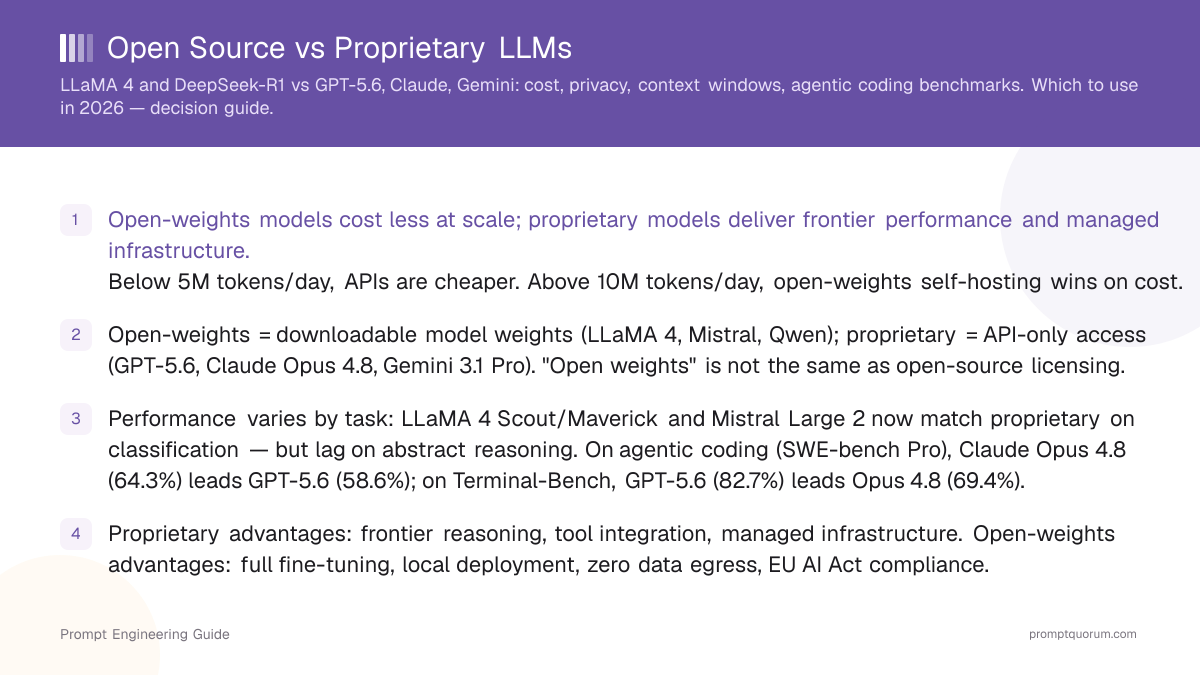
Open-weights models cost less at scale and enable full customization; proprietary models deliver faster time-to-value and managed infrastructure at higher per-token cost. Below 5M tokens/day, proprietary APIs are usually cheaper. Above 10M tokens/day, self-hosted open-weights wins on cost. Choose based on your volume, privacy requirements, and infrastructure readiness.
Cost model
- Open-Weights Models:
- Self-host: $0.50–2.00/hr infrastructure. Free once deployed. No per-token billing.
- Proprietary Models:
- API billing: $0.15–5.00 per 1M input tokens; $0.30–15.00 per 1M output tokens. Scales with usage.
Performance ceiling
- Open-Weights Models:
- Best open-weights (LLaMA 4 Maverick, DeepSeek-R1): MMLU 80–84%. Competitive on coding and extraction; lag on abstract multi-step reasoning.
- Proprietary Models:
- Frontier (GPT-5.6, Claude Opus 5, Gemini 3.1 Pro): MMLU 88–90%. Claude Opus 5 leads SWE-bench Pro (64.3%); GPT-5.6 leads Terminal-Bench (82.7%).
Context window
- Open-Weights Models:
- LLaMA 4 Scout: 10M. LLaMA 4 Maverick: 1M. Mistral Large: 128K. Open-weights now match or exceed proprietary on context length.
- Proprietary Models:
- GPT-5.6: 1M. Claude Opus 5: 1M. Gemini 3.1 Pro: 1M. All frontier proprietary models now offer ≥1M context.
Privacy
- Open-Weights Models:
- Complete data sovereignty. No data leaves your infrastructure. Zero logging via vendor.
- Proprietary Models:
- Data transits vendor servers. Contractual deletion promised but brief exposure during processing.
Fine-tuning
- Open-Weights Models:
- Full fine-tuning supported (LoRA, QLoRA, full training). You own weights. Domain customization.
- Proprietary Models:
- Limited (OpenAI mini models only) or unavailable (Anthropic Claude). You do not own resulting weights.
Data sovereignty
- Open-Weights Models:
- On-premises deployment: full sovereignty. EU AI Act compliant. HIPAA/SOX/legal compliance achievable.
- Proprietary Models:
- API-dependent: data residency unclear. Harder to prove compliance for regulated industries.
Inference speed
- Open-Weights Models:
- Depends on hardware. A100: 20–30 tokens/sec (70B). RTX 4090: 10–15 tokens/sec.
- Proprietary Models:
- Optimized servers: 30–50+ tokens/sec. Deterministic. Vendor manages optimization.
Support
- Open-Weights Models:
- Community-driven. Documentation good; vendor SLA unavailable. You support yourself.
- Proprietary Models:
- Vendor support included. API SLAs, incident response, uptime guarantees.
Update cadence
- Open-Weights Models:
- Offline. New versions released; you choose when to adopt. No forced updates.
- Proprietary Models:
- Server-side. Vendor updates models; you adapt or use versioned API endpoints.
Vendor lock-in
- Open-Weights Models:
- Zero lock-in. Deploy anywhere. Switch vendors or self-host freely. Own your compute.
- Proprietary Models:
- Moderate to high lock-in. Model behavior, APIs, and pricing under vendor control. Switching costs migration effort.
Open Source vs Proprietary LLMs for Prompt Engineering
Open-weights models enable deeper prompt experimentation at lower cost. You can run the same prompt 100 times against a local LLaMA 3.1 instance and iterate on wording, temperature, and structure without per-token billing. Fine-tune the model on prompt-response pairs from your domain. Experiment with jailbreaks and edge cases in your private infrastructure. This sandbox environment is ideal for research, prototyping, and understanding model behavior.
Proprietary APIs are faster to test and easier to scale. You write a prompt, call the GPT-5.6 or Claude API, and get results in milliseconds with zero infrastructure setup. No need to manage VRAM, quantization, or model downloads. For quick A/B testing, production deployment, and handling variable traffic, proprietary models reduce operational complexity.
Hybrid approach: prototype on open-weights, validate on proprietary. Develop and refine prompts locally with LLaMA 3.1 8B (fast iteration, no cost). Once the prompt strategy is locked, test on GPT-5.6 or Claude 4.6 to confirm frontier performance. Deploy the better performer to production. This combines open-weights flexibility with proprietary reliability.
When to Use Open Source Models
Choose open-weights when data privacy, cost at scale, or deep customization requirements dominate your constraints. Open-weights excel in:
- Sensitive data (healthcare, finance, legal): Patient records, financial data, attorney-client communications cannot transit external APIs. Open-weights deployed on-premises keeps data in your control and achieves compliance. Use LLaMA 3.1 or Mistral for HIPAA, GDPR, and attorney-client privilege compliance. Pair with security controls against prompt injection to protect model inputs.
- High-volume automation (50M+ tokens/day): Above ~10M tokens/day, self-hosting becomes cheaper than proprietary APIs. Use open-weights for high-volume classification, extraction, summarization, or data processing pipelines where API costs would be prohibitive.
- Domain customization and fine-tuning: You have labeled datasets and need the model to specialize on your terminology, writing style, or task distribution. Open-weights permit LoRA, QLoRA, or full fine-tuning. Proprietary APIs forbid or restrict customization.
- Geographic or network constraints: You need inference with no internet access (submarines, aircraft, remote sites). Open-weights runs offline. Proprietary APIs require network connectivity.
- EU AI Act compliance (high-risk deployments): Hiring systems, credit decisions, benefits determination. Audit trails, risk documentation, and on-premises data residency are easier with open-weights. Proprietary APIs make compliance harder to demonstrate.
- Cost predictability: Open-weights infrastructure cost is fixed (hardware + electricity). Proprietary APIs scale unpredictably with usage. For cost-sensitive organizations, open-weights budgeting is clearer.
When to Use Proprietary Models
Choose proprietary when absolute performance, managed infrastructure, or safety alignment matters most. Proprietary excels in:
- Complex multi-step reasoning: Agent workflows, complex research synthesis, and abstract problem-solving. GPT-5.6, Claude 4.6, and Gemini 3.1 Pro maintain a 7–8 point edge on MMLU. Open-weights close the gap on specific tasks but lag on general reasoning.
- Long-context document research (1M+ tokens): Gemini 3.1 Pro is the only production model with 2M token context. For processing entire books, research corpora, or exhaustive case law, no open-weights model matches it. Use proprietary when document length exceeds open-weights capabilities.
- Zero infrastructure overhead: You lack GPU resources, DevOps expertise, or on-call coverage for model infrastructure. Proprietary APIs handle availability, scaling, and optimization. Pay for simplicity; avoid operational burden.
- Tool integration and agents: OpenAI leads on tool use, function calling, and multi-step agent orchestration. If your system requires reliable function routing and multi-turn agent behaviors, GPT-5.6 is the pragmatic choice.
- Managed safety and alignment: Proprietary vendors invest heavily in constitutional AI, RLHF, and instruction-following. For chatbots, customer service, and user-facing systems, proprietary models are typically safer out-of-the-box.
- Multimodal input (images, audio): GPT-5.6 and Claude Opus 5 handle image input reliably. Multimodal open-weights models exist but are less mature. Use proprietary for reliable vision-language tasks.
Hybrid AI Architectures (Open + Closed Models)
Organizations can use hybrid AI architectures that route requests to open-weights models for sensitive data and cost-sensitive tasks, while dispatching complex reasoning and multimodal work to proprietary models. This approach combines the cost efficiency, privacy, and customization of open-weights with the performance and managed infrastructure of proprietary LLMs.
- Privacy-sensitive data → local open-weights; complex reasoning → proprietary API. Route patient records, financial data, and legal documents to LLaMA 3.1 running locally via Ollama. Route multi-step research synthesis, code generation, and agent orchestration to GPT-5.6 or Claude Opus 5. This hybrid approach achieves compliance while maintaining frontier performance.
- Cost-sensitive batch processing → local open-weights; interactive requests → proprietary API. For background tasks (classification, extraction, summarization), use self-hosted LLaMA 3.1 70B (~$2/hr on A100). For real-time user requests where latency matters, use GPT-5.6 API ($5/$15 per 1M tokens). Hybrid reduces total cost and latency.
- Multi-model comparison and consensus → PromptQuorum. Dispatch a single prompt to local Ollama, GPT-5.6, Claude 4.6, and Gemini 3.1 Pro simultaneously via PromptQuorum. Compare outputs side-by-side on quality, latency, and cost. Choose the winner for production or combine outputs for ensemble reasoning.
- Testing and staging → open-weights; production serving → proprietary. Use LLaMA 3.1 8B running locally for rapid prototyping and development. Once the prompt and pipeline are validated, upgrade to GPT-5.6 or Claude for production traffic where reliability, tool integration, and safety guarantees matter most.
Where the Conventional Wisdom Is Wrong
Open-weights is not always cheaper than proprietary APIs. At <5M tokens/day, proprietary APIs (GPT-5.6 Luna, Claude Haiku, Gemini Flash) are often cheaper because infrastructure cost (GPU amortization, electricity, DevOps labor) exceeds API billing. Only above 10M tokens/day do open-weights self-hosting become cost-optimal.
- The performance gap is task-specific, not universal. Proprietary models lead on MMLU (reasoning) by 7–8 points. But on classification, summarization, extraction, and many domain tasks, LLaMA 3.1 70B matches or beats proprietary models. "Proprietary is better" is too broad. Benchmark your actual task.
- "Open source" licensing is complex and often not actually open source. LLaMA, Mistral, and Qwen are not OSI-compliant open source — they are "open weights" under non-standard licenses. Calling them "open source" is misleading and invites legal confusion. Clarify licensing with counsel before relying on legal protections.
- Proprietary is not always more safe or aligned. All models hallucinate. Proprietary training data, cutoffs, and constitutional AI do not prevent jailbreaking, prompt injection, or misuse. Open-weights can be fine-tuned to match or exceed proprietary alignment. Safety is a property of the deployment and guardrails, not the model class.
Key Terms
- Open Weights — Model weights are downloadable but may be restricted by license
- Fine-tuning — Retraining model weights on domain-specific data
- LoRA — Efficient fine-tuning via low-rank adaptation (5–10% of full training cost)
- RAG — Retrieval-Augmented Generation; grounding LLM outputs in external documents
- Context Window — Maximum token capacity for input + output combined
- VRAM — GPU memory required for model inference
Prompt Structure in Practice
Vague questions don't elicit useful comparisons. Specific context (volume, constraints, requirements) drives better decision-making.
❌ Vague
Which is better, open source or GPT-5.6?
✅ Specific constraints + volume + requirements
I need to process 20M tokens/day of customer support tickets. I cannot send data outside the EU. Compare open-weights (LLaMA 3.1 70B self-hosted) vs proprietary (GPT-5.6 via API) for this use case: include infrastructure cost at 20M tokens/day, GDPR data residency compliance, fine-tuning feasibility, and expected quality on ticket classification tasks.
Frequently Asked Questions
Is Llama 3.3 truly open source or just open-weights?
Just open-weights. LLaMA 3.1 releases model weights under Llama Community License 2.1, which is not OSI-compliant open source. The license permits commercial use but restricts naming derivatives "LLaMA," requires attribution, and includes non-compete clauses. True open-source licenses (Apache 2.0, MIT, GPL) have none of these restrictions. LLaMA is more permissive than closed proprietary access but is not legally "open source."
Which is cheaper in 2026 — self-hosting Llama or using GPT-5.6 API?
It depends on volume. Below 5M tokens/day, GPT-5.6 API (or GPT-5.6 Luna) is cheaper because infrastructure cost exceeds API billing. At 5–10M tokens/day, costs roughly equalize. Above 10M tokens/day, self-hosting LLaMA 3.1 wins on cost. At 100M tokens/day, self-hosting is 10–20× cheaper. Hidden factors: GPU amortization, electricity (~$0.10/kWh), DevOps labor, and downtime risk often tip marginal cases toward API.
Does the EU AI Act affect open-source LLMs?
Yes, depending on how you deploy them. The EU AI Act (2024) designates "high-risk" AI systems — hiring, credit scoring, legal discovery — as requiring risk documentation, bias testing, and audit trails. Open-weights deployed on-premises make compliance easier because you control data and logs. Proprietary APIs force reliance on vendor attestations. General-purpose AI models with >10^25 FLOP training compute (frontier models) face additional transparency obligations. For regulated sectors, consult compliance counsel.
Which open-source LLM is closest to GPT-5.6 in 2026?
LLaMA 4 Maverick, DeepSeek-R1, and Mistral Large 2 are closest. On MMLU, GPT-5.6 scores 88.7% vs open-weights top competitors at 80–83%. On agentic coding (SWE-bench Pro), Claude Opus 5 (64.3%) leads GPT-5.6 (58.6%), showing task-specific parity is achievable. The benchmark picture is fragmented — test on your specific task.
Can I fine-tune GPT-5.6?
No. OpenAI fine-tuning is available only for GPT-5.6 Luna, GPT-4, and gpt-3.5-turbo — not GPT-5.6 itself. Anthropic offers no fine-tuning for Claude. Google offers fine-tuning for Gemini. Open-weights models (LLaMA, Mistral, Qwen) support full fine-tuning via LoRA, QLoRA, or full gradient training — you own the resulting weights.
What hardware do I need to run LLaMA 4 locally?
LLaMA 4 Scout (MoE, 17B active params): fits on a single H100 80GB GPU, or quantized 4-bit on RTX 4090 (24GB VRAM). LLaMA 4 Maverick (17B active, 400B total): requires multi-GPU setup (4× A100 80GB or H100). For the older LLaMA 3.1 70B: full precision needs ~40GB VRAM; 4-bit quantized via Ollama needs ~16–20GB (single RTX 4090). LLaMA 4 Scout is generally recommended for new deployments over LLaMA 3.1.
Can I run open-source LLMs on a MacBook?
Yes. Apple Silicon (M1/M2/M3/M4/M5) Macs can run open-weights models via Ollama or LM Studio. M4 Max / M5 Pro/Max (shipping since Oct 2025) support 64–128GB unified memory. M5 Pro (307 GB/s bandwidth) runs LLaMA 3.1 70B (4-bit) at usable inference speeds; M5 Max (460–614 GB/s, 128GB) can run LLaMA 4 Scout quantized. LLaMA 4 Scout quantized may run on M5 Pro/Max — test via Ollama.
Do open-source LLMs have the same limitations as proprietary ones?
Yes on fundamentals: both hallucinate, have knowledge cutoffs, context window limits, and reasoning boundaries. Open-weights cannot be patched server-side — weight updates require a new release and retraining. Proprietary models can be improved incrementally without user action. Fine-tuning open-weights can mitigate specific limitations (domain knowledge, tone), but cannot overcome structural constraints like knowledge cutoff or hallucination risk.
Which open-weights model is best for coding in 2026?
LLaMA 4 Maverick and Mistral Large 2 are strongest open-weights coding models. On SWE-bench Verified (agentic coding), Claude Opus 5 scores 87.6% and GPT-5.6 scores ~77%. Open-weights best: LLaMA 4 Maverick and DeepSeek-R1 are competitive on HumanEval (~75–80%) and improving on SWE-bench. For Python and structured output, open-weights is viable. For multi-file refactoring and agent loops, proprietary models maintain an edge.
Can I use open-source LLMs for commercial applications?
Yes. LLaMA, Mistral, and Qwen explicitly permit commercial use under their licenses. Key constraints: cannot brand derivatives "LLaMA" (must rename); must include license attribution; Llama 3.3 restricted organizations with >700M monthly active users (removed in LLaMA 3.x). Most teams deploy open-weights internally (private inference), which avoids naming issues entirely.
What is LoRA and why does it matter for open-weights fine-tuning?
LoRA (Low-Rank Adaptation) is a fine-tuning method that trains only a small set of adapter weights (~1–5% of model parameters) rather than full backpropagation across all layers. This reduces training cost 5–10× vs full fine-tuning with minimal quality loss. QLoRA extends this with 4-bit quantization, enabling fine-tuning on consumer GPUs (16–24GB VRAM). LoRA is the standard approach for adapting LLaMA and Mistral to domain-specific tasks without full retraining.
What is Mixture-of-Experts (MoE) and why does it matter for open-weights models?
MoE is an architecture where a model contains many "expert" sub-networks but activates only a subset per token. LLaMA 4 Scout has 109B total parameters but only 17B active per token (16 experts). This enables very large model capacity with inference cost similar to a smaller dense model. Practical benefit: LLaMA 4 Scout fits on a single H100 despite having 109B total parameters. The tradeoff: MoE models require more VRAM to load all parameters, even though compute per token is lower.
How does LLaMA 4 compare to LLaMA 3.1?
LLaMA 4 is a generational upgrade. Scout (MoE, 109B total / 17B active) replaces LLaMA 3.1 70B as the primary mid-range model — with a 10M context window vs 131K, and MoE efficiency allowing single-H100 inference. Maverick (400B total / 17B active) replaces LLaMA 3.1 405B in the high-performance slot. Training data and alignment have improved. LLaMA 3.1 remains usable and widely supported in Ollama, but new deployments should start with LLaMA 4 Scout unless you have specific reasons for the older generation.
Sources
- Meta AI, "Introducing LLaMA 4: Herd of Models" (2025) — LLaMA 4 Scout, Maverick, Behemoth architecture specs, MoE details, and benchmark scores
- OpenAI, "Introducing GPT-5.6" (April 2026) — GPT-5.6 and GPT-5.6 Pro pricing, context window (1M), training cutoff (December 2025), benchmark scores
- Anthropic, "Claude Opus 5 Model Card" (April 2026) — pricing ($5/$25), context window (1M), SWE-bench Pro score (64.3%), training cutoff
- Google DeepMind, "Gemini 3.1 Pro Technical Report" (February 2026) — pricing ($2.00/$12.00), context window (1M), ARC-AGI-2 score (77.1%), training cutoff (January 2025)
- Meta AI, "Llama 3 Herd of Models" (Touvron et al., 2024) — LLaMA 3.1 architecture, benchmarks, and training data (previous generation; superseded by LLaMA 4)
- Mistral AI, Model Cards and Technical Documentation (2024) — Mistral Large 2 and Mistral Small specifications
- Hendrycks et al., "Measuring Massive Multitask Language Understanding" (2021) — MMLU benchmark definition and baseline scores. arXiv:2009.03300
- Chen et al., "Evaluating Large Language Models Trained on Code" (2021) — HumanEval benchmark for code generation. arXiv:2107.03374
- European Union, "Artificial Intelligence Act" (2024) — high-risk AI system categories, GPAI model obligations, and compliance requirements
- Hu et al., "LoRA: Low-Rank Adaptation of Large Language Models" (2021) — LoRA method definition and efficiency results. arXiv:2106.09685
- Dettmers et al., "QLoRA: Efficient Finetuning of Quantized LLMs" (2023) — QLoRA method and consumer GPU fine-tuning results. arXiv:2305.14314