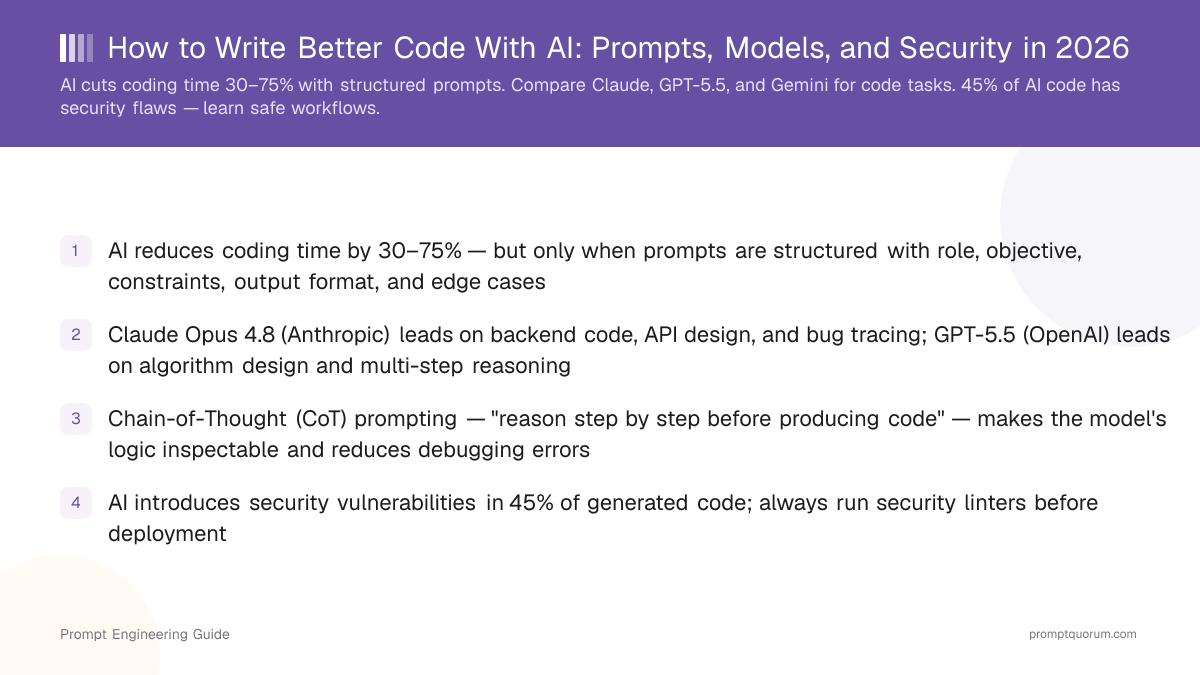
The Direct Answer: Prompt Quality Determines Code Quality
📍 In One Sentence
The developer's job has shifted from writing every line to writing instructions an AI executes, so output quality tracks how precisely the prompt states the interface, constraints and edge cases.
💬 In Plain Terms
The model writes the code; you decide what it should do. Vague in, vague out — the same request that would make a junior developer ask three clarifying questions is the one that produces confidently wrong code here.
The output of any AI coding session is only as good as the instruction you give — a vague prompt produces vague code, a structured prompt produces production-ready code. Large Language Models (LLMs) — the class of neural networks behind GPT-5.6, Claude Opus 5, and Gemini 3.1 Pro — do not "understand" your project; they predict the next most likely token based on patterns learned from billions of lines of code.
This means your prompt is an architectural contract, not a casual question. When you specify the programming language, expected inputs/outputs, and edge cases to handle, you consistently receive code closer to production-ready.
These prompting techniques apply identically to local coding stacks. To replace a cloud assistant with an open-source pairing of Continue.dev + Ollama + Qwen3-Coder, see Replace GitHub Copilot With a Local LLM.
Which AI Model to Use for Coding Tasks
Different models excel at different coding tasks — routing your prompt to the right model reduces errors and token costs.
Claude Opus 5 (Anthropic) dominates backend code generation, API design, database schemas, and multi-file refactoring. GPT-5.6 (OpenAI) leads for creative algorithmic solutions and complex step-by-step reasoning. Gemini 3.1 Pro (Google DeepMind) handles the longest documents with its 2-million-token context window — useful for codebase-wide analysis.
Task | Best Model | Why |
|---|---|---|
| React component generation | Claude Opus 5 | Strong performance per Anthropic benchmark releases; accurate JSX and prop handling |
| Bug fixing | Claude Opus 5 | Superior step-by-step trace output for debugging multi-file issues |
| Algorithm design | GPT-5.6 | Slight edge on creative algorithmic solutions; strong reasoning capabilities |
| Long document/codebase analysis | Gemini 3.1 Pro | Handles contexts up to 2M tokens |
| Multi-language projects (CJK) | Qwen3.6 (Alibaba) | Faster token processing for Chinese/Japanese/Korean scripts |
| Local inference (privacy) | Llama 3.1 8B via Ollama | Zero data leaves your machine; 7B model requires 8GB RAM |
How to Write Prompts That Produce Better Code
Structured prompts — those that define role, objective, constraints, and output format before asking for code — produce measurably fewer errors than open-ended requests. The core principle: minimize the model's guesswork. Every assumption the model makes on your behalf is a potential error. Specify the programming language, target runtime, edge cases, performance constraints, and expected output format explicitly.
- 1Role — "You are a senior Python backend engineer."
- 2Objective — "Write a REST API endpoint that accepts a JSON payload and validates it."
- 3Constraints — "Use FastAPI. No external validation libraries. Handle missing fields with HTTP 422."
- 4Output format — "Return only the Python code. No prose explanation."
- 5Edge cases — "Handle empty strings and null values in all fields."
How Does Chain-of-Thought Prompting Improve Debugging?
Chain-of-Thought (CoT) prompting — asking the model to reason step-by-step before producing a final answer — reduces debugging errors by making the model's logic inspectable. CoT prompting is a technique that asks an LLM to generate intermediate reasoning steps before producing output. For debugging, this means the model traces the error path explicitly, allowing you to identify exactly where logic breaks down.
How to Inject Coding Rules as Persistent Instructions
Rules — short sets of explicit instructions embedded in system prompts or project configuration — make AI coding tools consistent across sessions, not just in single-shot generation. Modern coding tools (Cursor, GitHub Copilot, Claude Code) support project-level rules that persist across all interactions. These function as an architectural contract between you and the model. Using role definition as a foundational rule makes all subsequent requests consistent. Examples of effective rules:
- Always use TypeScript strict mode. No `any` types.
- Never install new packages — use only existing dependencies in package.json.
- All functions must include JSDoc comments.
- Always read `ARCHITECTURE.md` before generating new components.
Which AI Coding Tool Has the Lowest Hallucination Rate?
A hallucination in AI coding refers to generated output that appears plausible but references non-existent functions, libraries, or APIs. Cursor reports the lowest hallucination rate at ~10–15% due to project-level Retrieval-Augmented Generation (RAG) indexing — which indexes your codebase to provide the model with relevant context. GitHub Copilot operates at ~15–20% with file-level context only. Claude Code provides long-context codebase understanding for multi-file refactoring tasks.
Tool | Hallucination Rate | Architecture Awareness | Best For |
|---|---|---|---|
| GitHub Copilot | ~15–20% | File-level context | Individual developers, boilerplate |
| Cursor | ~10–15% | Project-level RAG indexing | Teams wanting AI-native IDE |
| Claude Code (Anthropic) | Lower on structured tasks | Full codebase context | Backend, multi-file refactoring |
| Devin (Cognition AI) | Variable | Autonomous task execution | Autonomous ticket-to-PR pipelines |
| Qwen Code (Alibaba) | Variable | Local deployment capable | Research, full infrastructure control |
The Security Problem: What AI Gets Wrong
AI generates code with security vulnerabilities in 45% of cases — a rate that has not improved as models have become more capable. A 2025 Veracode report found that when given a choice between a secure and insecure implementation, generative AI models chose the insecure option 45% of the time. Academic research confirms this pattern: over 40% of AI-generated code solutions contain security flaws.
The three most critical failure categories:
- Hallucinated dependencies — Models recommend importing packages that do not exist. Researchers at the University of Texas at San Antonio, University of Oklahoma, and Virginia Tech found a 20% tendency in LLMs to recommend non-existent libraries. Attackers exploit this via "slopsquatting" — registering the hallucinated package name with malicious code.
- Insecure implementations — AI reproduces insecure patterns from training data (SQL injection risks, improper input sanitization, weak cryptographic defaults).
- Missing edge cases — Robustness failures occur when generated code does not handle unexpected inputs, leading to crashes or exploitable exceptions.
The Multi-Model Cross-Check Method
Running the same prompt through multiple models simultaneously reduces the chance of accepting a hallucinated dependency or insecure implementation — because independent models rarely fabricate the same specific incorrect detail.
PromptQuorum is a multi-model AI dispatch tool that sends one prompt to multiple AI providers simultaneously and displays all responses side-by-side. When GPT-5.6, Claude Opus 5, and Gemini 3.1 Pro recommend the same package name, that convergence is a strong signal the package is real. When they disagree on an implementation approach, that divergence is a signal to investigate before committing.
How Do Temperature and Context Window Settings Affect Code Quality?
Temperature (T) controls the randomness of AI output: for code generation, T = 0.0–0.3 produces deterministic, conservative output; T = 0.7–1.0 increases creative variation but also error rate. Temperature is a hyperparameter applied to the softmax probability distribution over the model's vocabulary. At T = 0.0, the model always selects the highest-probability token — producing deterministic output.
For production code generation, set Temperature (T) to 0.1–0.2 for reliability. For exploratory brainstorming of algorithmic approaches, T = 0.7–0.9 produces more diverse options to evaluate.
The context window is the maximum number of tokens (input + output combined) the model can process in a single request. A larger context window lets the model see more of your codebase, improving consistency for multi-file refactoring tasks. Context window size determines how much of your codebase the model can "see" during generation:
Model | Context Window | Implication |
|---|---|---|
| GPT-5.6 | 128k tokens | ~96,000 lines of code visible per session |
| Claude Opus 5 | 1M tokens | Larger codebase context; better for multi-file refactoring |
| Gemini 3.1 Pro | 2M tokens | Full codebase analysis for large projects |
How Does AI Coding Vary by Region?
European development teams increasingly adopt Mistral AI (developed in France) for coding tasks where EU AI Act compliance and data residency matter. Mistral Large 3 and Mistral Small 4 are available for local deployment via Ollama, ensuring no code leaves on-premise infrastructure — critical under GDPR for teams processing sensitive source code.
Chinese enterprises widely use Qwen3.6 (Alibaba) and DeepSeek-V4 as open-source alternatives to GPT-series models, particularly for projects requiring CJK language support or full on-premise deployment under China's Interim Measures for Generative AI (2023).
Japanese enterprises operating under METI data governance guidelines often prefer Ollama-based local model deployment. Llama 3.1 8B, running locally via Ollama, requires 8GB RAM and produces zero external API calls — meeting strict data residency requirements.
Common Mistakes When Using AI for Code
Avoid these frequent errors when working with AI coding tools:
- Treating AI output as ready-to-deploy: AI generates plausible-looking code, not verified code. Per 2025 Veracode research, AI models chose insecure implementations in 45% of test cases. Every output requires developer review and security linting before deployment.
- Vague prompts for complex tasks: "Write a login system" produces insecure defaults. "Write a JWT-based authentication endpoint in FastAPI, using bcrypt for password hashing, returning 401 on invalid credentials, and handling database connection errors with 500" produces usable code. Specificity is the variable.
- Ignoring the temperature setting: Default temperature on most platforms is 0.7–1.0 — correct for creative writing, wrong for code. Set temperature to 0.1–0.2 for production code generation on every session.
- Accepting hallucinated package names: AI recommends non-existent libraries 20% of the time. Before running pip install or npm install on any AI-suggested package, verify it exists on PyPI or npm and check the download count. Low download counts on a recently-created package are a red flag for slopsquatting.
- Not providing existing code context: AI generates code that conflicts with your architecture when it cannot see your existing patterns. Paste relevant existing files or interfaces into the prompt before asking for new implementations.
Step-by-Step Workflow: Write Better Code With AI
- 1Define your role and constraints upfront. Before writing the request, specify 'You are a senior language engineer,' the target framework (React, FastAPI, etc.), and any architectural constraints (no new packages, strict type safety, etc.).
- 2Structure your prompt with role, objective, constraints, and output format. Use a consistent template: role → objective → constraints → output format → edge cases. This reduces the model's guesswork and produces cleaner code on the first attempt.
- 3Use Chain-of-Thought (CoT) prompting for debugging tasks. Ask the model to 'trace the execution step by step' before producing the final fix. This makes the model's reasoning inspectable and catches logic errors before they enter production.
- 4Set Temperature (T) to 0.1–0.2 for production code. Deterministic output is safer than creative variation when writing code that will run in production. Reserve T = 0.7–0.9 only for algorithmic brainstorming.
- 5Run the code through a security linter and multi-model cross-check. Never deploy AI-generated code without: (1) a security scanner (Bandit for Python, ESLint for JavaScript), and (2) verification via PromptQuorum or similar multi-model dispatch to catch hallucinated dependencies.
Frequently Asked Questions
What is the best AI model for writing code in 2026?
Claude Opus 5 (Anthropic) produces the most consistent results for backend code, API design, and bug tracing. GPT-5.6 (OpenAI) has a slight edge for algorithm design and complex reasoning. For privacy-sensitive codebases, Llama 3.1 8B running locally via Ollama produces zero external API calls. Benchmark performance varies by task; we recommend testing all three on your specific use cases.
Is AI-generated code safe to deploy directly?
No. Per a 2025 Veracode report, generative AI models chose insecure implementations in 45% of cases when both secure and insecure options were available. All AI-generated code must be reviewed by a developer and scanned with a security linter (e.g., Bandit for Python, ESLint Security for JavaScript) before production deployment.
How much faster are developers who use AI coding tools?
Developers using AI coding assistants complete 126% more projects per week than manual coders in controlled studies. However, a 2025 METR field study found experienced developers took 19% longer on tasks requiring complex codebase integration — the productivity gain is task-dependent and requires structured prompt discipline.
How does chain-of-thought prompting improve code debugging?
Chain-of-Thought (CoT) prompting asks the model to trace each step of its reasoning before producing the final output. For debugging, this means the model identifies the exact operation that produces the incorrect intermediate value, making the error traceable and correctable rather than requiring full output regeneration.
Does AI coding assistance work the same way in all programming languages?
No. AI tools are trained primarily on English-language codebases, meaning Python and JavaScript receive the strongest support. For Japanese (kanji/kana), Chinese, or other CJK-heavy projects, Qwen3.6 (Alibaba) or DeepSeek-V4 provide faster token processing because their tokenizers handle CJK scripts at a better ratio than Western-trained models.
What temperature should I use for AI code generation?
Set temperature to 0.1–0.2 for production code generation. This produces deterministic, conservative output with minimal random variation. Use temperature 0.7–0.9 only when brainstorming algorithmic approaches where you want diverse options to evaluate — not when writing code that will be deployed.
What are hallucinated dependencies in AI coding?
Hallucinated dependencies are package or library names that the model recommends but do not actually exist. A 2024 academic study found that LLMs recommend non-existent libraries approximately 20% of the time. Attackers exploit this via slopsquatting — registering the hallucinated package name on PyPI or npm with malicious code inside. Always verify any AI-suggested package before installing by checking the official repository.
Can I use AI coding tools with local LLMs for privacy?
Yes. Llama 3.1 8B running via Ollama on a machine with 8GB RAM produces zero external API calls. All inference happens on your hardware. This is suitable for codebases containing proprietary algorithms, credentials in source files, or any code that cannot leave your infrastructure. Quality is lower than GPT-5.6 or Claude for complex tasks but acceptable for boilerplate and simple functions.
How do I write a system prompt for AI coding tools?
Define four things in your system prompt: (1) the technical role ("senior Python backend engineer"), (2) the tech stack and forbidden libraries, (3) code style rules ("TypeScript strict mode, no any types"), (4) output format ("return only code, no prose"). Persist this as a project-level rule in Cursor, Claude Code, or your IDE's AI settings so it applies across all sessions.
Does GitHub Copilot or Cursor produce fewer bugs?
Cursor uses project-level RAG (Retrieval-Augmented Generation) indexing to understand your entire codebase, reducing hallucinations compared to GitHub Copilot's file-level context only. For single-file boilerplate tasks the difference is minimal. For multi-file refactoring where architectural consistency matters, Cursor's codebase-aware context produces fewer integration errors. Both require security linting before deployment.
Sources & Further Reading
- Wei et al., 2022. "Chain-of-Thought Prompting Elicits Reasoning in Large Language Models" — foundational paper on step-by-step reasoning in LLMs
- Veracode, 2025. "AI Code Security Report" — documents 45% vulnerability rate in AI-generated code
- METR, 2025. "Measuring the Impact of Early-2025 AI on Experienced Open-Source Developer Productivity" — field study showing 19% task-completion slowdown with AI tools