What AI Code Review Actually Does
📍 In One Sentence
AI code review is a first-pass filter that surfaces logic bugs, security issues and standards violations the moment a pull request opens, so human reviewers spend their time on logic and architecture instead of variable naming.
💬 In Plain Terms
Think of it as a spellchecker for code. It catches the obvious problems before a colleague ever looks at your pull request, so the human review can be about whether the approach is right rather than whether you forgot a null check.
AI code review tools analyse pull requests, detect logic bugs, flag security vulnerabilities, enforce coding standards, and generate actionable fix suggestions — operating in seconds rather than the hours required for manual peer review.
Traditional peer code review is the single most time-consuming task in software development workflows, requiring senior engineers to context-switch between their own work and evaluating others' code. AI code review tools integrate directly into CI/CD pipelines and pull request workflows — GitHub, GitLab, Bitbucket, and Azure DevOps — and begin analysing code the moment a PR is opened, without waiting for a human reviewer to become available.
AI Code Review Tools: Which One to Use
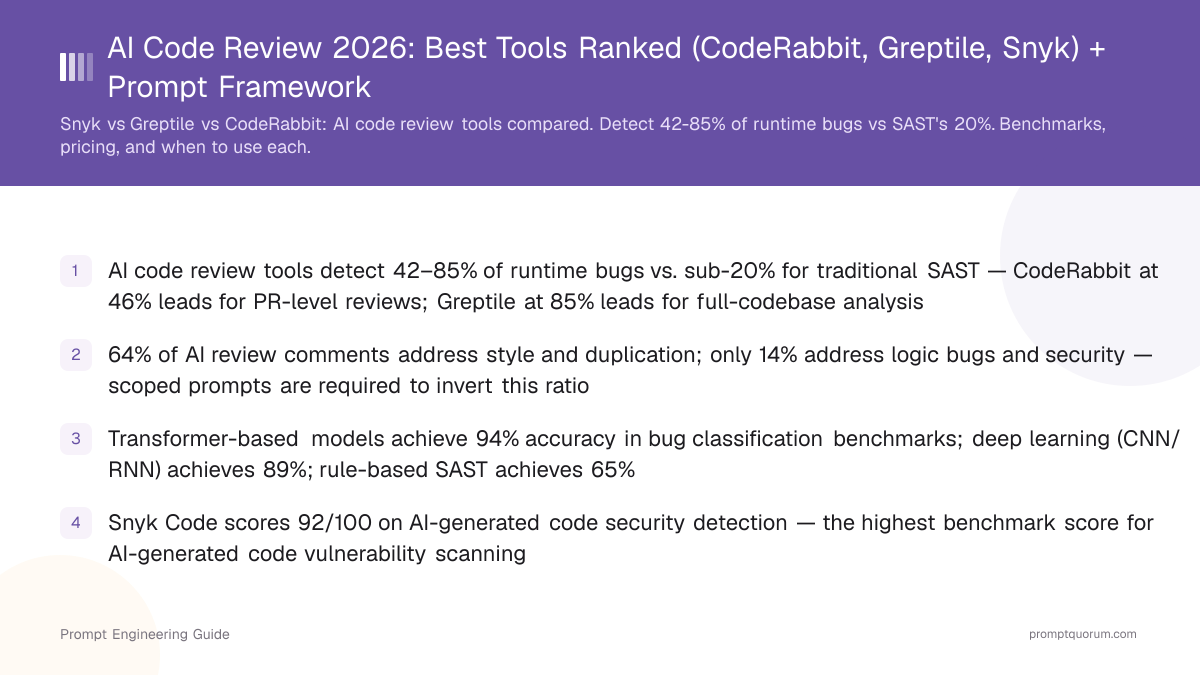
CodeRabbit leads the market with 2 million+ connected repositories and 13 million+ PRs processed; GitHub Copilot Code Review is the lowest-friction entry point for teams already on GitHub; Greptile achieves the highest bug detection rate through full-codebase indexing.
CodeRabbit is the most widely deployed AI code review tool in 2026, supporting GitHub, GitLab, Bitbucket, and Azure DevOps — the only major tool with true multi-platform coverage. It uses deep contextual analysis across the full codebase and learns from team-specific patterns over time. GitHub Copilot Code Review reached general availability in April 2025 and hit 1 million users in its first month — if your team already pays for Copilot ($10–39/month), PR review is bundled at no extra cost.
Greptile's 85% bug detection rate is the highest in the benchmark — but at the cost of the highest noise output. Greptile is the right choice when catching deep bugs matters more than comment volume. CodeRabbit at 46% detection is the better choice for teams where review fatigue is already a problem.
Tool | Bug Detection | False Positive Rate | Context Depth | Price/Dev/Month |
|---|---|---|---|---|
| Greptile | 85% | Sub-3% | Full codebase | $30 |
| Qodo | 78% | Low | Multi-repo | From $19 |
| CodeRabbit | 46% | 10–15% | PR diff | $12–24 |
| Cursor Bugbot | 42% | Sub-15% | PR diff | $40 (above Cursor base) |
| GitHub Copilot | Basic | Under 15% | File-level | $10–39 (bundled) |
| Traditional SAST | Under 20% | High | Rule-based | Variable |
Why Is Signal-to-Noise a Problem in AI Code Review?
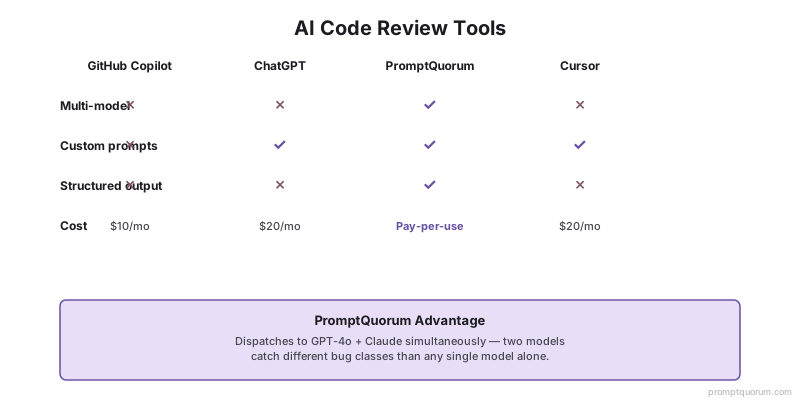
AI code review tools currently catch style issues at near-100% accuracy while catching critical runtime bugs at 42–46% — creating a comment volume problem that causes developer adoption collapse.
An eight-month internal audit across 1,247 AI review comments in 340 pull requests found: ~64% of all AI review comments addressed style, duplication, and test coverage. Only ~14% of comments addressed logic bugs and security issues — the issues that cause production incidents. Tools with less than 60% actionable feedback see developer adoption collapse as engineers begin ignoring all feedback, including critical findings.
The root cause is training data: AI models are trained on codebases where style violations vastly outnumber logic errors. The model learns to surface what it sees most frequently — not what matters most.
A tuned AI review system, with prompt engineering specifically instructing the model to prioritise logic and security over style, reached a 52% developer action rate — matching and slightly surpassing the 50% action rate of human-led code reviews across 10,000+ analysed comments.
In One Sentence: The signal-to-noise problem means AI code review tools generate 64% style comments but only 14% actionable security/logic findings — requiring scoped prompts to invert this ratio and reach 50%+ developer adoption.
⚠️ Warning
Teams that deploy AI code review without scoping prompts see developer adoption collapse within 3-6 months. Engineers start ignoring ALL comments — including critical security findings — because 64% of comments are noise. Always configure explicit review priorities before rolling out to the team.
How to Write Prompts for AI Code Review
Scoped, context-rich prompts — specifying language, framework, review priorities, and output format — reduce false positives and improve signal quality; vague prompts like "review this code" produce generic, high-noise output.
Prompt engineering is the practice of structuring AI instructions to constrain and direct model output. For code review, the most impactful variable is explicit scope: when you tell the model exactly which classes of issues to prioritise, it produces fewer style comments and more logic and security findings.
What Is the Code Review Prompt Framework?
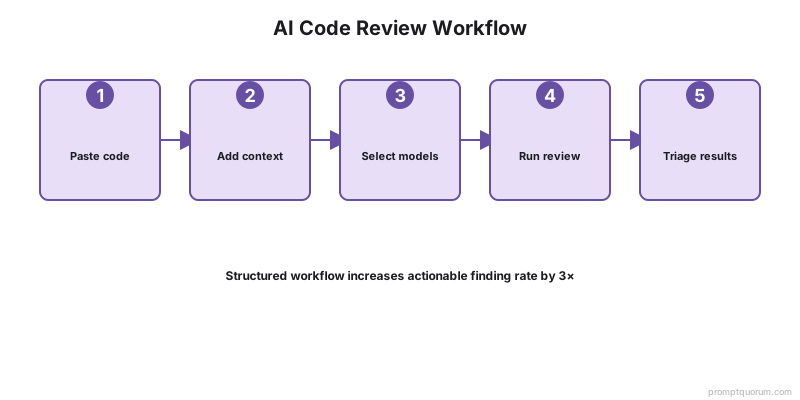
Use this structure for any AI code review request:
In Plain Terms: The framework is a five-part template (role, scope, context, output format, noise instruction) that transforms vague code review requests into structured prompts that produce 10x better results by explicitly constraining what the AI should focus on.
- Role — "You are a senior software engineer with expertise in language/framework security."
- Scope — "Review only for: (1) logic bugs, (2) missing edge cases, (3) security vulnerabilities, (4) performance regressions. Do NOT comment on style, naming, or formatting."
- Context — "Language: TypeScript. Framework: Next.js 14. This endpoint handles authenticated user data — treat all inputs as untrusted."
- Output format — "For each issue: state severity (Critical / High / Medium), quote the specific line, explain the risk, and provide a corrected code snippet."
- Noise instruction — "If you find nothing in a category, state 'None found' — do not add padding comments."
🔍 Pro Tip
The single most impactful line you can add to any AI code review prompt is: "Do NOT comment on style, naming, or formatting." This one constraint cuts comment noise by 60%+ and forces the model to focus on logic bugs and security issues — the findings that actually prevent production incidents.
What Is the Difference Between a Bad and a Good Code Review Prompt?
Bad Prompt
Review this code.
What Does a Good Code Review Prompt Look Like?
Good Prompt
You are a senior TypeScript engineer specialising in security. Review the following Next.js API route for: (1) authentication bypass risks, (2) SQL injection or NoSQL injection vectors, (3) missing input validation, (4) unhandled promise rejections. Do not comment on style or variable naming. For each issue found: state severity (Critical / High / Medium), quote the line, explain why it is exploitable, and provide a corrected version. If no issues exist in a category, write 'None found.'
The structured prompt produces a triage-ready security report. The open prompt produces 12 comments about variable naming and one buried security finding the engineer never reads.
How Does Chain-of-Thought Improve Complex Logic Review?
Chain-of-Thought (CoT) prompting — asking the model to trace data flow through each function before producing findings — surfaces logic bugs that single-step review misses, because the model must model the execution path explicitly rather than pattern-matching against common error signatures.
Use this extension for any function with complex conditional logic: "Before identifying bugs: trace the input data through each branch of this function step by step. Identify every path where a null, empty string, or unexpected type could propagate. Then list every path that reaches an unhandled state."
How Do You Perform Security-Focused AI Code Review?
AI-powered SAST (Static Application Security Testing) tools trained on real-world vulnerability datasets achieve bug detection scores of 84–92 out of 100 on AI-generated code — compared to 65% accuracy for rule-based methods and 94% for transformer-based models in deep learning benchmarks.
Transformer-based models — the architecture behind GPT-5.6, Claude Opus 5, and dedicated code security tools — achieve 94% accuracy in bug classification benchmarks, with very low false positive rates. This represents a measurable advance over convolutional neural network (CNN) and recurrent neural network (RNN) approaches at 89%, static analysis at 72%, and rule-based methods at 65%.
The three security-focused AI code review tools for 2026, benchmarked on AI-generated code:
Tool | Detection Score (AI code) | False Positives | Best For |
|---|---|---|---|
| Snyk Code + DeepCode AI | 92/100 | Lowest volume | Teams shipping daily with IDE integration |
| Semgrep Enterprise | 87/100 | Low | Policy-as-code; custom YAML rule packs |
| GitHub Advanced Security (CodeQL) | 84/100 | Medium | GitHub-first orgs; deep semantic coverage |
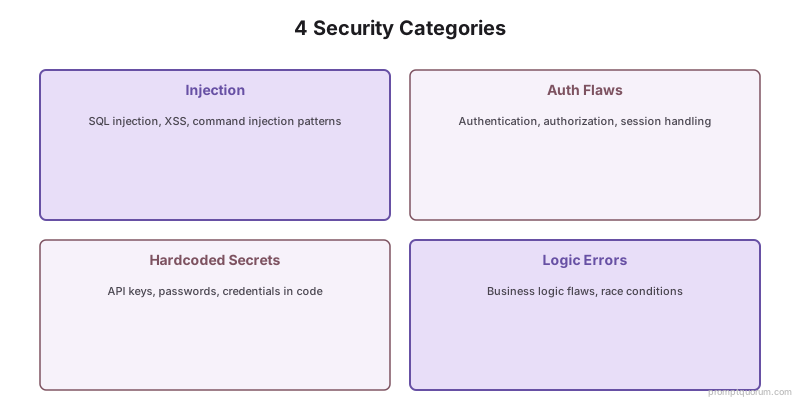
Snyk Code detects SQL injection, cross-site scripting (XSS), weak cryptographic defaults, and hardcoded credentials in real time as developers write code — before a PR is even opened. CodeQL performs semantic analysis using an Abstract Syntax Tree (AST), making it capable of detecting complex multi-step vulnerability chains that pattern-matching tools miss.
What Is AI Bug Triaging?
AI-powered bug triaging achieves 85–90% accuracy in severity classification — compared to 60–70% for manual methods — while reducing triage time by 65% and cutting false positives by up to 60%.
AI bug triaging is the downstream step after detection: classifying bugs by severity, predicting production impact, and routing issues to the right engineer. A study by Khaleefulla et al. demonstrated AI-driven triaging systems achieved over 85% accuracy in bug classification and 82% precision in priority prediction — reducing average triage time by 65%.
Time-to-resolution (TTR) improves by 30–40% compared to manual methods, with the primary gain from faster classification and routing rather than faster fixing. Bug severity classification at 85–90% accuracy means engineers spend significantly less time debating priority and more time resolving the issues that matter.
🔍 Did You Know
AI bug triaging achieves 85-90% severity classification accuracy vs 60-70% for manual triage. The primary time saving isn't faster fixing — it's faster classification and routing. Engineers spend less time debating priority and more time resolving the issues that matter.
Why Does Context Window Size Determine Codebase Coverage?
A model's context window determines how much of your codebase it can analyse simultaneously — the difference between reviewing a single file, a full PR diff, and an entire repository determines which bugs are detectable.
The context window gap between models has closed — all three frontier models support 1M tokens. The differentiation is now between cloud models (1M, API-based) and local models (LLaMA 4 Scout at 10M tokens, fully private — no code leaves your infrastructure).
Model | Context Window | Lines of Code (approx.) | Use Case |
|---|---|---|---|
| GPT-5.6 (OpenAI) | 1M tokens | ~750,000 lines | Full-project PR review |
| Claude Sonnet 5 (Anthropic) | 1M tokens | ~750,000 lines | Multi-file security review |
| Gemini 3.1 Pro (Google DeepMind) | 1M tokens | ~750,000 lines | Large codebase analysis |
| LLaMA 4 Scout (local, Meta) | 10M tokens | ~7,500,000 lines | Largest context, fully private |
How Do Regional Regulations Affect AI Code Review?
European enterprises sending source code to external AI APIs must conduct a Data Protection Impact Assessment (DPIA) under GDPR Article 35 before deployment — source code containing personal data processing logic is classified as high-risk automated processing. The CNIL (France's data protection authority) confirmed in January 2026 that both GDPR and the EU AI Act apply simultaneously to AI-assisted code review when personal data is processed. European enterprises are paralysed between AI adoption and regulatory compliance risk — €1.2 billion in GDPR fines were levied in 2024, including a €30.5 million penalty against Clearview AI.
For EU teams, CodeRabbit and Augment Code offer on-premise/self-hosted deployment for teams with 500+ seats, keeping source code within the organisation's infrastructure. Mistral AI (France) is deployable locally via Ollama for teams requiring zero cloud egress — Mistral Large handles code review tasks on-premise with no data leaving EU infrastructure.
Chinese development teams use Qwen3 (Alibaba) and DeepSeek V4 Flash as locally-deployable code review models, both of which support Chinese-language code comments and documentation — critical for mixed-language codebases common in Chinese enterprise environments. Japanese enterprises under METI data governance guidelines deploy LLaMA 4 Scout or LLaMA 3.3-based code review workflows locally via Ollama — LLaMA 4 Scout requires ~55 GB VRAM for inference, with zero external API calls.
How to Use AI for Code Review
- 1Brief the AI on your codebase architecture, naming conventions, and constraints before asking it to review code. Provide a short context doc: 'This is a Next.js app. We use TypeScript strict mode, no `any` types, all components must have JSDoc, all API endpoints must have rate limiting.' Without this, the AI makes generic comments that miss project-specific issues.
- 2Ask AI to check for specific categories of bugs: security, performance, logic, consistency. Instead of 'review this code,' ask: 'Review for security vulnerabilities (inputs, auth, data exposure), then check if this pattern matches our established error handling.' Specific questions produce more focused, useful feedback.
- 3Use Chain-of-Thought (CoT) prompting: ask the model to trace execution before producing feedback. For complex functions, ask 'Trace the execution for input X, then identify any logic errors.' This makes the AI's reasoning transparent and catches subtle bugs humans might miss.
- 4Use multi-model code review for high-risk changes (auth, payments, infrastructure). Run the same code through GPT-5.6, Claude Sonnet 5, and Gemini 3.1 Pro. When all three flag the same issue, it's a strong signal. When only one model catches something, investigate carefully.
- 5Treat AI as a first-pass filter, not the final arbiter. AI is excellent at catching obvious bugs (missing returns, type mismatches, SQL injection patterns) but can miss context-specific issues (performance implications, scaling problems, team conventions). Always have a human review AI-based feedback.
Common Mistakes in AI Code Review
❌ Deploying AI review with default settings and no prompt customization.
Why it hurts: Default AI review produces 64% style comments. Developers ignore all comments within weeks. Critical security findings get buried.
Fix: Use the 5-part prompt framework. Explicitly exclude style/naming. Scope to logic, security, and performance.
❌ Using AI code review as the only review layer.
Why it hurts: AI catches 42-85% of bugs — not 100%. Context-specific issues (scaling implications, team conventions, business logic errors) require human judgment.
Fix: AI is the first-pass filter. Human reviewers focus on architecture, business logic, and the 15-58% of bugs AI misses.
❌ Reviewing only PR diffs without codebase context.
Why it hurts: Bugs caused by cross-file interactions are invisible to tools that only see changed lines. A function change that breaks a caller in another file won't be caught.
Fix: Use full-codebase indexing tools (Greptile, Qodo) for high-risk changes. Reserve diff-only tools (CodeRabbit, Copilot) for low-risk PRs.
❌ Not measuring developer action rate on AI comments.
Why it hurts: Without tracking what percentage of AI comments developers act on, you can't tell if the tool is producing value or noise. Teams assume AI review is working when it may have already collapsed.
Fix: Track action rate monthly. If below 40%, tighten prompt scope. If below 20%, the tool is producing pure noise — reconfigure or replace.
AI Code Review FAQ
What is the most accurate AI code review tool in 2026?
Greptile achieves the highest bug detection rate at 85% with a sub-3% false positive rate, using full-codebase indexing rather than PR-diff-only analysis. For security-focused review of AI-generated code, Snyk Code + DeepCode AI scores 92/100 on detection benchmarks. CodeRabbit leads in market adoption with 2 million+ connected repositories, but detects 46% of runtime bugs — a lower rate that trades accuracy for significantly lower comment noise.
How much does AI code review reduce review time?
AI code review tools reduce overall code review time by 40%, increase PR merge rates by 39%, and cut production bugs by 62% in controlled team studies. AI bug triaging reduces triage time specifically by 65%, with time-to-resolution improving by 30–40% compared to manual methods. Teams that tune AI review prompts to scope findings to logic and security (not style) see developer action rates of ~52% — matching human reviewer action rates.
How does AI code review compare to traditional static analysis (SAST)?
Traditional rule-based SAST tools detect under 20% of meaningful runtime bugs and produce high false positive rates. AI-powered SAST trained on vulnerability datasets achieves 84–92/100 detection scores on AI-generated code. Transformer-based models achieve 94% accuracy in bug classification benchmarks vs. 65% for rule-based methods. The key advantage of AI over traditional SAST is contextual reasoning — AI evaluates how code paths interact rather than matching against fixed vulnerability signatures.
Is AI code review GDPR-compliant for European teams?
Not automatically. Sending source code containing personal data processing logic to external AI APIs requires a Data Protection Impact Assessment (DPIA) under GDPR Article 35. The CNIL confirmed in 2026 that both GDPR and the EU AI Act apply simultaneously to AI-assisted code review for personal data. EU teams requiring strict compliance should use self-hosted deployments — CodeRabbit offers on-premise for 500+ seat teams; Mistral AI models are deployable locally via Ollama with zero cloud egress.
Does Chain-of-Thought prompting improve AI code review quality?
Yes — for complex logic with multiple conditional branches, Chain-of-Thought (CoT) prompting asks the model to trace data flow through each execution path before generating findings. This surfaces logic bugs that pattern-matching misses, because the model must explicitly model every path a null value or unexpected input type can take through the function — rather than matching the code against templates of common errors. CoT is most valuable for security-sensitive functions and complex state management; it adds latency and is unnecessary for simple utility functions.
What percentage of AI code review comments are actually useful?
In an 8-month audit of 1,247 AI review comments across 340 PRs, only 14% addressed logic bugs and security issues — the issues that cause production incidents. 64% addressed style, duplication, and test coverage. Tools with less than 60% actionable feedback see developer adoption collapse as engineers start ignoring all comments. Scoped prompts that explicitly exclude style comments invert this ratio and reach developer action rates above 50%.
Which AI model is best for code review?
Claude Sonnet 5 produces the most complete security analysis — identifying SQL injection vectors, missing input sanitisation, and authentication edge cases. GPT-5.6 produces the most actionable fix suggestions — concrete corrected code rather than descriptions. All three frontier models now support 1M token context windows (~750,000 lines of code in a single session). For codebases exceeding this, LLaMA 4 Scout (10M tokens, local) is the only option without chunking. For security reviews, run all three and treat convergent findings as high-confidence issues.
How do I reduce false positives in AI code review?
Three techniques: (1) scope the prompt explicitly — "review only for logic bugs, security vulnerabilities, and performance regressions; do NOT comment on style or naming"; (2) add a noise instruction — "if you find nothing in a category, write None found, do not add padding comments"; (3) use Chain-of-Thought for complex functions — ask the model to trace execution paths before producing findings. These three changes move AI comment actionability from roughly 14% to above 50% in controlled tests.
How should I integrate AI code review into our CI/CD pipeline?
AI code review tools integrate directly into GitHub, GitLab, Bitbucket, and Azure DevOps CI/CD pipelines by installing the vendor's bot and granting repository access. CodeRabbit, Greptile, and Snyk Code all provide GitHub Actions / GitLab CI integrations that trigger on every pull request. Best practice: configure AI review to run in parallel with other checks (linting, unit tests) — AI findings block merge only for critical security issues, with other findings as advisory comments for developer discretion.
Can AI code review detect security vulnerabilities better than dedicated SAST tools?
Yes — AI-powered SAST tools (Snyk Code, Semgrep Enterprise, CodeQL) achieve 84–92% detection accuracy on AI-generated code, compared to 65% for rule-based static analysis. However, traditional SAST is better at high-volume checking of large codebases due to faster execution time — AI requires more compute per PR. Best practice: use lightweight SAST tools (linting) for speed, supplement with AI review for deep security analysis on high-risk changes (auth, payments, infrastructure).
Can I run AI code review locally for fully private code?
Yes. Devstral Small 24B (Mistral AI, 16 GB RAM) and LLaMA 4 Scout (~55 GB VRAM, 10M context) run fully on-premises via Ollama. No code is transmitted to external APIs. For EU teams requiring GDPR compliance without a DPIA, local deployment eliminates the data processing concern entirely. Quality is lower than frontier cloud models on complex security analysis but sufficient for most PR-level review.
What is the best AI code review tool for small teams (under 10 developers)?
GitHub Copilot Code Review is the lowest-friction option — if your team already pays for Copilot ($10-39/month), PR review is bundled at no extra cost. CodeRabbit Free tier covers open-source repositories. Promptfoo (free, open-source) can automate code review assertions in CI/CD. For teams under 10, avoid $30+/dev/month tools until review volume justifies the cost.
Sources & Further Reading
- Graphite, 2025. "Effective prompt engineering for AI code reviews" — technical guide to scoped prompts for reducing false positives and improving signal
- Sanjay, 2025. "Best AI Code Security Tools 2025: Snyk vs Semgrep vs CodeQL" — Q3 2025 benchmark of three leading SAST tools on AI-generated code
- DigitalApplied, 2025. "AI Code Review Automation: Complete Guide" — industry benchmarks: 42–85% bug detection, 40% time savings, 62% fewer production bugs
- Note: Tool pricing and detection benchmarks verified May 2026. AI code review is a fast-moving market — verify current pricing on vendor websites before purchasing.