Best LLM Right Now?
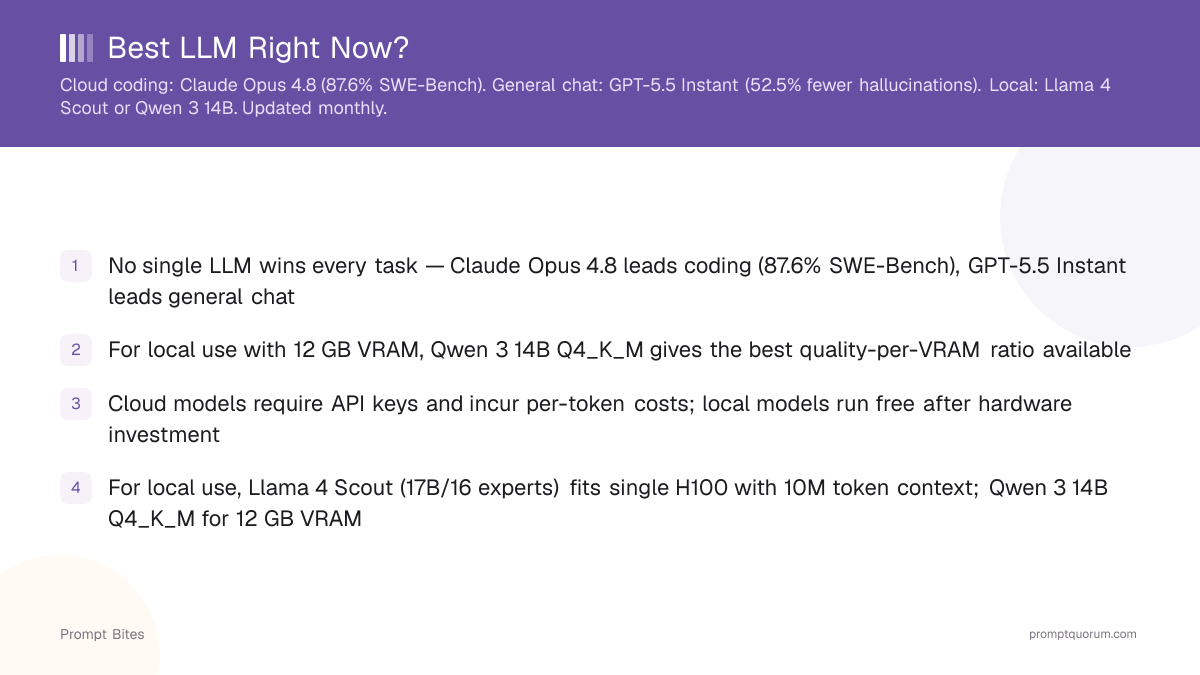
Quick Answer
Three flagships landed in July 2026 and they lead different things. Claude Opus 5 (24 July) tops Frontier-Bench v0.1 and is the coding pick. GPT-5.6 Sol (9 July) sets the state of the art on Terminal-Bench 2.1 for command-line and agentic work. Gemini 3.1 Pro leads natively multimodal tasks with a verified 77.1% on ARC-AGI-2. For local use, qwen3.5:9b is a 6.6 GB download.
- ▸Cloud coding: Claude Opus 5 — leads Frontier-Bench v0.1
- ▸Cloud agentic/CLI: GPT-5.6 Sol — SOTA on Terminal-Bench 2.1
- ▸Multimodal: Gemini 3.1 Pro — 77.1% verified on ARC-AGI-2
- ▸Local: qwen3.5:9b — 6.6 GB download
Key Takeaways
- ✓No single LLM wins every task — Claude Opus 5 leads Frontier-Bench v0.1, GPT-5.6 Sol leads Terminal-Bench 2.1, Gemini 3.1 Pro leads multimodal
- ✓All three flagships shipped in July 2026, so any comparison written before then is a generation out of date
- ✓GPT-5.6 is a family, not one model: Sol is the flagship, Terra matches GPT-5.5 intelligence at half the price, Luna costs 80% less than Sol
- ✓For local use, qwen3.5:9b (6.6 GB) covers general work and qwen2.5-coder:7b (4.7 GB) covers coding — both far below the hardware most guides assume
- ✓Cloud models need API keys and cost per token; local models are free to run after the hardware is bought
The Best LLM Depends on the Task — Here's the Map
Three flagships arrived within a fortnight in July 2026. Claude Opus 5 (24 July) for coding, GPT-5.6 Sol (9 July) for agentic and command-line work, Gemini 3.1 Pro for anything multimodal. Below: when each one wins, and which to pick by workflow.
The vendors no longer publish a shared headline benchmark, so comparing them means comparing different evals. Anthropic reports that Opus 5 surpasses all other models on Frontier-Bench v0.1 and more than doubles Opus 4.8 at a lower cost per task. OpenAI reports GPT-5.6 Sol setting the state of the art on Terminal-Bench 2.1, which tests planning and tool coordination in command-line workflows. Google reports Gemini 3.1 Pro at a verified 77.1% on ARC-AGI-2.
One structural change worth noting: GPT-5.6 is a three-model family rather than a single release. Sol is the frontier model, Terra matches GPT-5.5 on intelligence benchmarks at half the price, and Luna is priced 80% below Sol. If cost is your binding constraint, the interesting comparison is Terra or Luna against a competitor flagship, not Sol.
| Use Case | Best LLM | Why |
|---|---|---|
| Coding | Claude Opus 5 | Tops Frontier-Bench v0.1; >2x Opus 4.8 at lower cost per task |
| Agentic / command line | GPT-5.6 Sol | State of the art on Terminal-Bench 2.1 |
| Multimodal (video, image, audio) | Gemini 3.1 Pro | Natively multimodal; 77.1% verified on ARC-AGI-2 |
| Cost-sensitive throughput | GPT-5.6 Luna or Terra | Luna 80% below Sol; Terra matches GPT-5.5 at half price |
| Local / offline general | qwen3.5:9b | 6.6 GB download, newest Qwen available in Ollama |
| Local / offline coding | qwen2.5-coder:7b | 4.7 GB download, runs on an 8 GB card |
How to Pick Without Reading 50 Reviews
Start with the constraint. Budget, privacy, latency, or capability? Pick the model that clears your hardest constraint first. If privacy is the constraint, no cloud flagship qualifies and the question becomes which local model fits your card.
Test two models on your actual task. Published benchmarks do not predict your use case, and this is more true now than it was a year ago — the three vendors report on three different evals, so there is no like-for-like number to rank them by. Use free API tiers for the cloud models and run the local ones through Ollama.
Re-check quarterly, not monthly. All three flagships landed in July 2026 within about two weeks of each other. That clustering is the pattern worth planning around: the landscape moves in bursts, and a comparison written before a burst is a full generation stale rather than slightly dated.
Quick Answers About the Best LLM Right Now
Is Claude Opus 5 or GPT-5.6 better?▾
What is the difference between GPT-5.6 Sol, Terra and Luna?▾
What is the best local LLM if I only have 8 GB VRAM?▾
How does Gemini 3.1 Pro compare to the other two?▾
Want the full breakdown?
Read the complete guide →