What Is the CO-STAR Prompt Framework?
Quick Answer
CO-STAR is a six-part prompt structure for consistent LLM output: Context (background), Objective (task), Style (writing style), Tone (emotional register), Audience (who reads it), Response (output format). It helps produce targeted outputs by making every constraint explicit and reduces ambiguity in instructions.
- ▸C = Context: background information the LLM needs
- ▸O = Objective: the specific task to complete
- ▸S/T/A = Style, Tone, Audience: how and for whom to write
- ▸R = Response: format (list, paragraph, JSON, etc.)
Key Takeaways
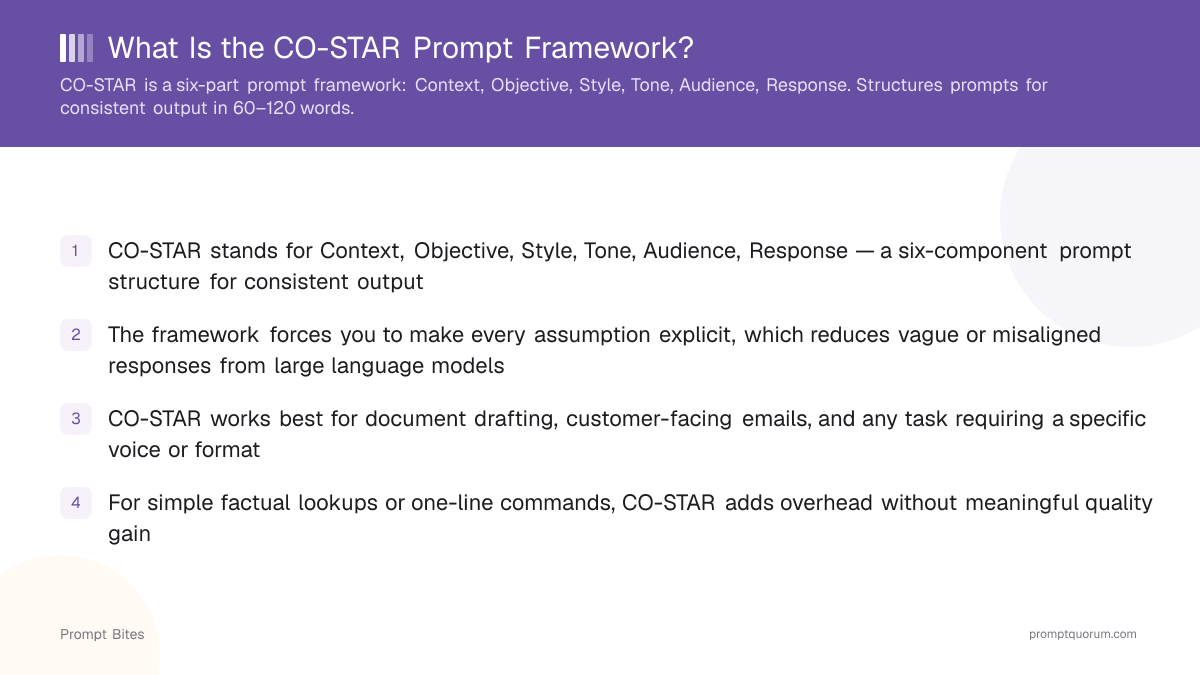
- ✓CO-STAR stands for Context, Objective, Style, Tone, Audience, Response — a six-component prompt structure for consistent output
- ✓The framework forces you to make every assumption explicit, which reduces vague or misaligned responses from large language models
- ✓CO-STAR works best for document drafting, customer-facing emails, and any task requiring a specific voice or format
- ✓For simple factual lookups or one-line commands, CO-STAR adds overhead without meaningful quality gain
What CO-STAR Stands For
CO-STAR is a six-part prompt structure: Context, Objective, Style, Tone, Audience, Response format. It is one of the most-cited frameworks for structuring complex LLM prompts because it forces the writer to specify each dimension that affects output quality.
The framework was developed to solve a recurring problem in prompt engineering: prompts that are technically clear but miss implicit constraints. When you write "Summarize this document," the model makes assumptions about length, formality, audience, and format. CO-STAR replaces those assumptions with explicit instructions.
Each component targets a different dimension of the output. Context anchors the model in the relevant situation. Objective pins the exact deliverable. Style and Tone control the writing register. Audience calibrates vocabulary and complexity. Response specifies the structural format.
| Letter | Element | Purpose |
|---|---|---|
| C | Context | Background information the model needs |
| O | Objective | What you want the model to do |
| S | Style | Writing style (formal, casual, technical, etc.) |
| T | Tone | Emotional register (neutral, encouraging, direct) |
| A | Audience | Who reads the output (expert, beginner, executive) |
| R | Response format | Structure (bullets, paragraphs, JSON, table) |
When CO-STAR Beats Quick Prompts
CO-STAR is not the right tool for every task. It adds the most value for document creation, customer-facing communications, formal reports, and any output where voice, format, and audience consistency matter. A well-structured CO-STAR prompt typically takes 60–120 words of setup but eliminates multiple rounds of correction.
Consider a real example. BEFORE: "Write an email to the team about the project delay." AFTER: "Context: Q2 project is 3 weeks behind schedule due to vendor delays. Objective: Inform the team and reassure them. Style: Professional. Tone: Empathetic, solution-focused. Audience: 12 engineers, varied seniority. Response: 150-word email with subject line." The CO-STAR version produces a more specific, usable first draft.
For simple factual queries, code generation, or one-shot lookups, CO-STAR adds overhead without meaningful quality gain. Asking "What does the Python `zip()` function do?" does not benefit from a six-component structure. Reserve CO-STAR for tasks where the output will be read by real people in a specific context. For a deeper look at prompt patterns that pair well with CO-STAR, see the full CO-STAR prompt engineering guide covering advanced examples and common failure modes.
Quick Answers About the CO-STAR Framework
How does CO-STAR differ from other prompt frameworks like RISEN or TRACE?▾
What is the most important component in CO-STAR?▾
Does CO-STAR work with all large language models?▾
When should I skip CO-STAR entirely?▾
Want the full breakdown?
Read the complete guide →Related Prompt Bites