Key Takeaways
- Standard benchmarks (MMLU, HumanEval) do not measure creative writing quality -- evaluate models with your own sample prompts.
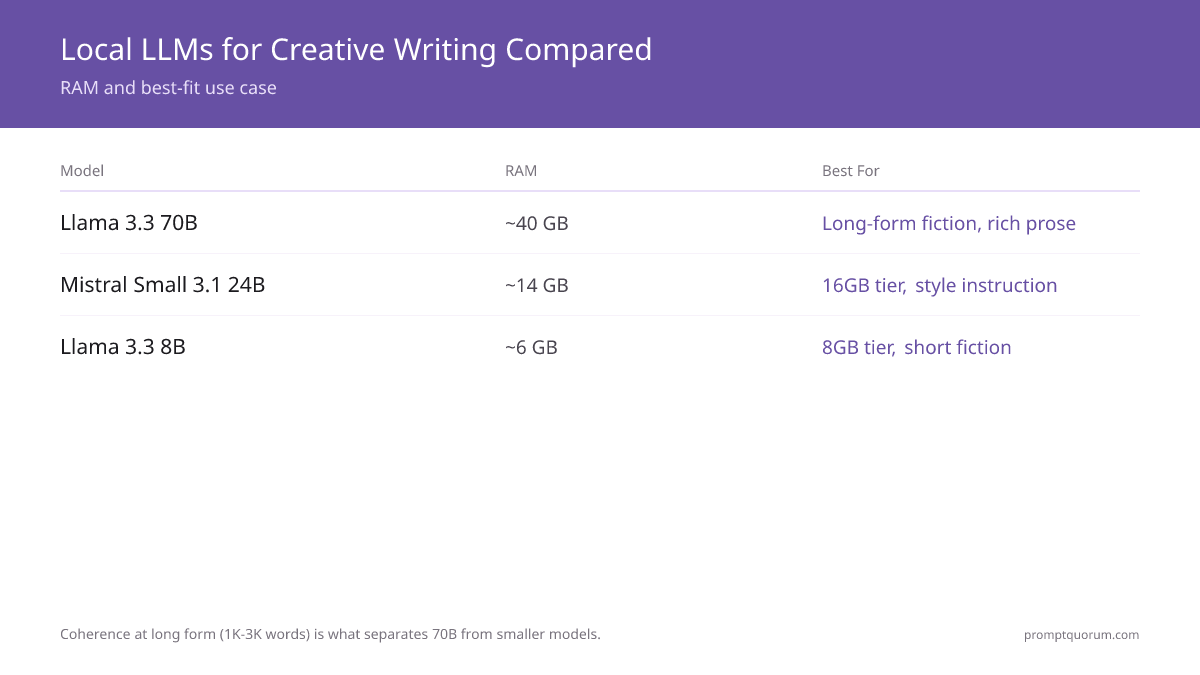
- Best overall prose: Llama 3.3 70B -- most natural English narrative style at the locally-runnable scale.
- Best for 16 GB RAM: Mistral Small 3.1 24B -- strong creative output, noticeably better than 7B models for long-form narrative.
- Best for 8 GB RAM: Llama 3.1 8B -- better creative instruction-following than Qwen3 8B for English fiction tasks.
- Community fine-tunes (Fimbulvetr-11B, Midnight-Rose-70B) trained specifically on creative fiction outperform base Llama on sustained narrative tasks.
📍 In One Sentence
The best local LLMs for creative writing are Meta Llama 3.3 70B for prose quality, Mistral Small 3.1 24B for the best quality under 16 GB RAM, and community fine-tunes like Fimbulvetr and Midnight-Rose for specialized fiction and roleplay voices.
💬 In Plain Terms
Standard AI benchmarks don't measure creative writing well, since there's no single right answer to a story prompt. In practice, Llama 3.3 70B tends to produce the richest prose if you have the RAM for it, Mistral Small 3.1 24B is the best choice if you're limited to 16 GB, and community fine-tunes trained specifically on fiction and roleplay often outnumber general-purpose models for voice and tone.
How Do You Evaluate Local LLM Quality for Creative Writing?
Creative writing performance is not well captured by standard benchmarks (MMLU, HumanEval). To evaluate a model for creative writing, test it directly with the types of prompts you plan to use:
- Prose continuity test: give the model the first two paragraphs of a scene and ask it to continue for 500 words. Does it maintain consistent tone, character voice, and narrative logic?
- Style instruction test: ask the model to write a paragraph "in the style of Raymond Carver" or "with the pacing of a thriller novel." Does it demonstrably shift style, or produce generic output?
- Long-form coherence test: ask for a 1,000-word short story with a specific twist ending. Does the model plant the setup naturally and deliver the payoff?
- Dialogue test: write a scene with two characters with different speech patterns. Does each character sound distinct, or does the dialogue feel uniform?
#1 Meta Llama 3.3 70B -- Best Prose Quality Locally
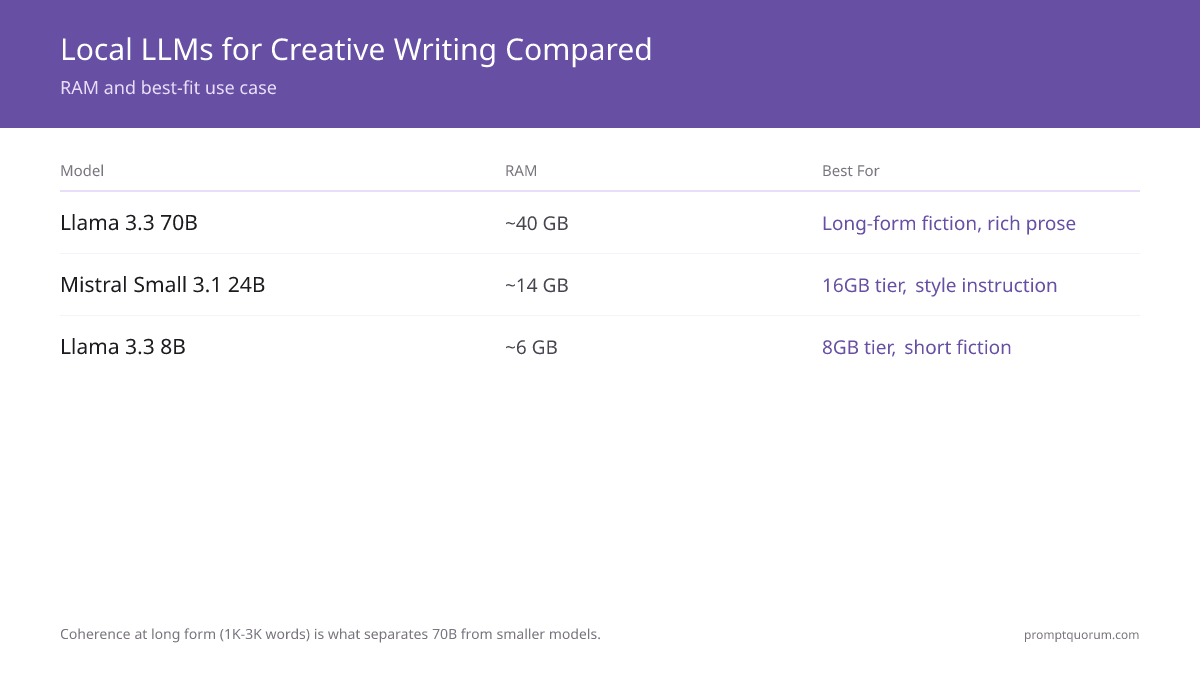
Llama 3.3 70B produces the most natural, varied English prose of any locally-runnable model. Its training on a diverse English text corpus gives it the widest stylistic range -- from minimalist literary fiction to genre thriller pacing. Long-form coherence (1,000-3,000 words) is noticeably better than any 7B or 13B model.
The constraint is hardware: 40 GB RAM at Q4_K_M. For creative writing sessions (rather than batch generation), the slower generation speed (8-15 tok/sec on CPU) is tolerable. On Apple M2 Ultra or M5 Max with 64+ GB unified memory, generation reaches 20-35 tok/sec.
Spec | Value |
|---|---|
| Best for | Long-form fiction, rich prose |
| RAM required (Q4_K_M) | ~40 GB |
| Prose style range | Widest of any local model |
| Long-form coherence | Strong (1K-3K word scenes) |
| Ollama command | ollama run llama3.3:70b |
#2 Mistral Small 3.1 24B -- Best Creative Writing for 16 GB RAM
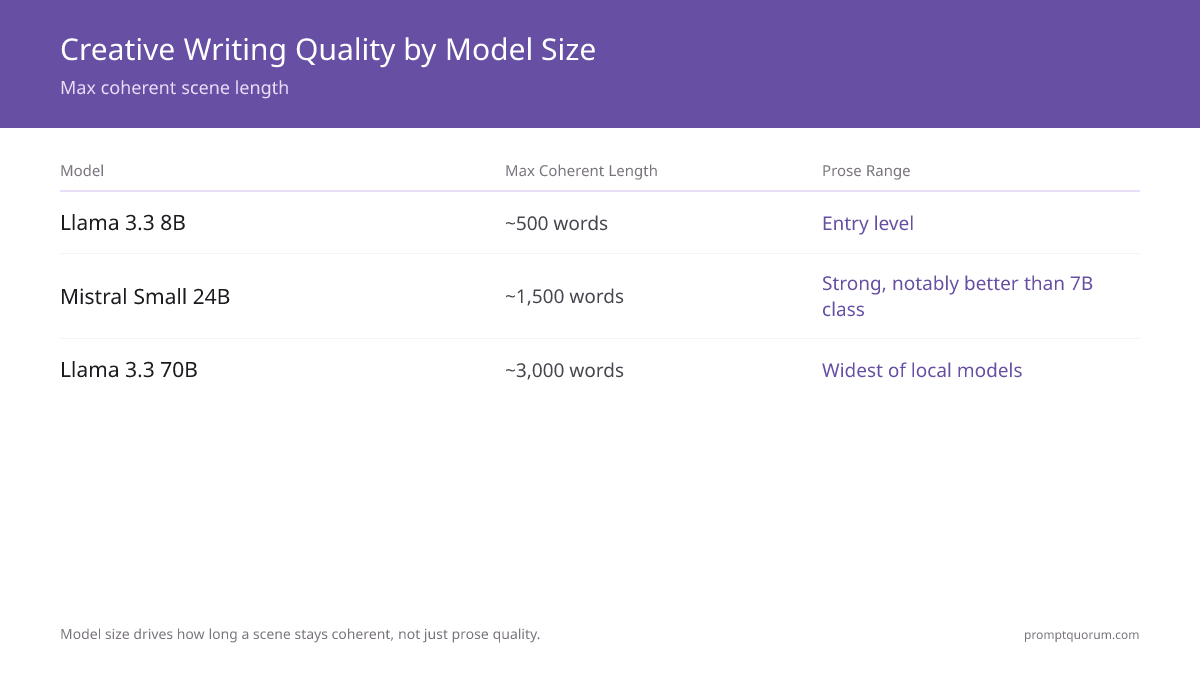
Mistral Small 3.1 24B delivers creative writing quality noticeably above any 7B model while fitting in 14 GB RAM. Its instruction-following is precise enough to handle detailed style specifications ("write in second person, present tense, with short punchy sentences") without drifting after a few paragraphs.
For users who want genuine long-form narrative capability without a workstation-class machine, Mistral Small 3.1 is the practical choice.
Spec | Value |
|---|---|
| Best for | Long-form narrative, style instruction |
| RAM required (Q4_K_M) | ~14 GB |
| Prose style range | Strong -- noticeably above 7B class |
| Long-form coherence | Good (500-1,500 word scenes) |
| Ollama command | ollama run mistral-small3.1 |
#3 Llama 3.1 8B -- Best Creative Writing for 8 GB RAM
At the 8 GB RAM tier, Llama 3.1 8B outperforms Qwen3 8B and Mistral Small for English creative writing. Qwen3 is stronger at coding and structured tasks, but its English prose generation is less fluid for narrative purposes.
Llama 3.1 8B handles short fiction (up to 500 words) reliably. For stories over 1,000 words, quality consistency degrades -- the model tends to drift from established narrative details. This is a fundamental limitation of 8B-scale models for long-form creative work.
#4 Community Fine-Tunes for Fiction and Roleplay
The local LLM community maintains specialized fine-tunes trained on fiction corpora, which outperform base models on sustained narrative tasks. These are available on Hugging Face and can be loaded in LM Studio or Ollama (via custom Modelfiles):
- Fimbulvetr-11B -- fine-tuned on high-quality fantasy and science fiction prose. Produces more vivid sensory detail and consistent character voice than base Llama 3.1 8B.
- Midnight-Rose-70B -- a Llama 3.3 70B fine-tune focused on creative writing and roleplay scenarios. Better long-form narrative coherence than the base model.
- Noromaid / Openhermes variants -- community fine-tunes focused on conversational roleplay. Lower prose quality than Fimbulvetr but more responsive to character direction.
- GLM-4 (Zhipu AI) -- another open-weight option worth testing for creative writing, particularly if you already have a Chinese-language workflow or a roleplay-focused use case. Available on Hugging Face as GGUF; benchmark it against Fimbulvetr and Llama 3.1 8B on your own prompts before committing, since it has not been evaluated here against the models above for English prose quality.
- Download these from Hugging Face (search "creative writing GGUF") and load in LM Studio's model browser or via `ollama create` with a custom Modelfile.
Prompting Tips That Improve Local LLM Creative Writing
- Specify style concretely: "Write in the style of Cormac McCarthy -- sparse dialogue, long descriptive sentences, no quotation marks" outperforms "write literary fiction."
- Give the model a role: "You are a professional novelist. Continue this scene without summarizing, only showing." Instruction-following improves when the model has a defined identity.
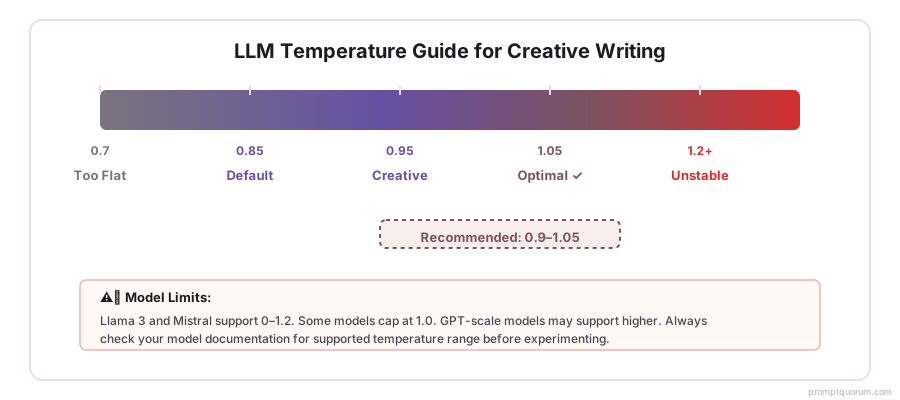
- Set temperature to 0.9-1.1: creative tasks benefit from higher temperature (more randomness). Default Ollama temperature is 0.8; LM Studio default is 0.7. Increase via the parameters slider.
- Use a system prompt: set a persistent style instruction at the session level. "You are writing a gothic horror novel. Maintain dark, atmospheric prose throughout all responses."
- Break long tasks into sections: for a 3,000-word chapter, generate it in 500-word sections. This keeps the model within its reliable coherence range.
- Compare local vs cloud outputs: use PromptQuorum to send the same creative prompt to your local Ollama model and cloud models simultaneously -- useful for calibrating when local quality is sufficient.
- Loading these models in LM Studio: LM Studio and Ollama run the same GGUF quantized files, so the ranking above applies unchanged -- search for "Llama 3.3", "Mistral Small 3.1", or "Fimbulvetr" in LM Studio's built-in model browser and load directly. There is no separate "best LM Studio model" -- it is the same model file loaded through a different interface.
Which Local LLM Is Best for Poetry?
Poetry needs a different setup than prose: strict form (meter, rhyme, syllable count) benefits from lower temperature than free-flowing fiction. For form-constrained poetry (sonnets, haiku, villanelles), set temperature to 0.7-0.85 -- the 0.9-1.1 range recommended above for prose breaks meter and rhyme scheme more often than it helps. For free verse, the prose temperature range still applies.
- Best overall: Llama 3.3 70B for rich imagery and the widest vocabulary of literary devices (metaphor, alliteration, enjambment).
- Best for structured forms: base Mistral Small 3.1 24B or Llama 3.1 8B -- both track syllable counts and rhyme schemes more reliably than fiction-focused fine-tunes like Fimbulvetr, which are trained on narrative prose rather than verse.
- Prompting approach: state the form explicitly -- "Write a haiku (5-7-5 syllables) about autumn rain" or "Write a Shakespearean sonnet (ABAB CDCD EFEF GG, iambic pentameter) about loss." Vague prompts ("write a poem about love") produce generic free verse regardless of model.
Bad Prompt vs Good Prompt
- ❌ "Write a fantasy story" → ✅ "Write a 500-word fantasy scene where a smuggler negotiates with a dragon over ancient artifacts. Use sensory details and make the dialog tense."
- ❌ "Write something interesting" → ✅ "Write a 300-word opening scene of a heist gone wrong. The protagonist discovers their partner betrayed them mid-mission. Use short, punchy sentences to match the pace."
- ❌ "Write a mystery" → ✅ "Continue this detective scene: [previous text]. The detective realizes the suspect is lying based on one detail. Show--do not tell--how she catches the inconsistency."
- ❌ "Make it more interesting" → ✅ "Rewrite the previous paragraph to feel more like noir fiction: sparse dialogue, cynical internal monologue, specific sensory details (sounds, smells, textures)."
Creative Writing with Local LLMs: Regional Context
Europe (GDPR & Data Residency): The GDPR requires sensitive personal data (character backstories, fictional content for publication) to remain within EU borders when processed. Running local models on EU-based hardware ensures compliance. LM Studio and Ollama deployed on German, French, or Austrian servers meet Article 28 processor agreements without cloud dependency.
Japan (Localization & Character Encoding): Japanese creative writing uses mixed scripts (hiragana, katakana, kanji), complex punctuation, and subtle spacing rules. Models fine-tuned on Japanese literature handle these patterns better than English-optimized models. LM Studio supports UTF-8 and Unicode; Ollama works with Japanese models like Shisa-7B-v1 and Weblab-10B.
China (Content Policy & Model Access): Mainland China restricts cloud AI services and requires content moderation compliance. Running locally with Qwen3 or Qwen1.5 avoids geopolitical restrictions. Local deployment suits Chinese publishers, game developers, and enterprises managing proprietary story IP.
Can a local LLM replace a writing assistant like Claude or GPT-5.6 for fiction?
For short-form content (under 500 words), a well-prompted 13B+ local model produces output that is difficult to distinguish from cloud models in blind tests. For long-form fiction (novels, full short stories), Claude Opus 5 and GPT-5.6 maintain narrative coherence more reliably at any hardware tier. A 70B local model narrows this gap significantly.
Does the model remember earlier parts of my story?
Only within the current context window. If your conversation history exceeds the model's context limit (typically 4K-128K tokens), earlier details are forgotten. For long projects, periodically provide a story summary at the start of each session to re-establish context.
Which local model produces the most vivid prose?
Llama 3.3 70B with Q5_K_M quantization produces the most consistently vivid sensory detail and natural dialogue flow. Mistral Small 3.1 24B achieves 80-85% of this quality at 14 GB RAM vs 45 GB for 70B. Fimbulvetr-11B fine-tune on a 13B base model also excels at prose richness within smaller resource budgets.
How do I handle inconsistencies in character voice across chapters?
Provide a detailed character sheet (name, background, speech patterns, motivations) in your system prompt. For each new chapter, begin the session with: "You are writing as [Character]. Maintain the following voice and perspective..." Then paste the character sheet. This keeps coherence for 500-2,000 word sections.
Is quantization (Q4, Q5, Q8) noticeable in creative writing?
Yes, measurably. FP16 (full precision) and Q8 produce near-identical prose. Q5 introduces subtle flattening -- fewer unique adjectives, slightly repetitive phrasing (5-10% of users notice). Q4 creates obvious quality loss: generic descriptions, missing sensory details. For fiction, Q5_K_M is minimum recommended; Q8_K_M is ideal.
Can I fine-tune a local LLM on my own writing style?
Yes. Collect 500-2,000 examples of your prose in .jsonl format (input/output pairs), then use Unsloth or Axolotl libraries on a 24 GB GPU to fine-tune a 13B model in 4-8 hours. Cost: ~$5-15 on cloud GPU. Result: a model that mimics your voice. LoRA (low-rank adaptation) fine-tuning is faster and cheaper than full fine-tuning.
What's the difference between creative writing and creative *dialogue* quality?
Dialogue requires tighter word economy and distinct character voices; prose requires sensory richness and narrative flow. Llama 3.3 70B excels at both. Smaller models (7B, 8B) often produce flat, generic dialogue. If dialogue-heavy fiction is your focus, prioritize models with strong instruction-following over prose quality; Mistral Small dialoguequality rivals Llama 8B.
How much context (tokens) do I need for a full novel outline?
A detailed outline of a 80,000-word novel (plot, characters, chapters, conflicts) is typically 3,000-6,000 tokens. A 128K-context model (Llama 3.2, Phi-4) lets you load the entire outline + previous chapters in one session. For models with 4K-8K context, provide a rolling summary: previous chapter summary + outline of next 3 chapters.
Do I need a GPU to run a creative-writing-optimized local LLM?
No, but it dramatically speeds up generation. A 13B model on CPU (8-core): 10-15 tokens/sec. Same model on a 10GB GPU (RTX 3060): 80-100 tokens/sec. For iterative creative writing (testing variations, rewriting), GPU cuts session time from 2 hours to 15 minutes. CPU is viable for one-shot generation or outlining.
Which local LLM is best for science fiction world-building and storytelling?
Llama 3.3 70B for consistency across 50+ page outlines. Qwen3 14B-32B for technical accuracy (physics, orbital mechanics, chemistry). Fimbulvetr-11B for rich descriptive world details. For budget-conscious setups, Mistral Small 3.1 24B balances world-coherence and resource use. Test all three on a sample world description before committing.
What is the best local LLM for creative writing, fiction, and novel writing?
Llama 3.3 70B (40 GB) produces the richest prose and widest style range. For 16 GB VRAM, Mistral Small 3.1 24B (14 GB) delivers strong narrative quality with good long-form coherence. For 8 GB budget, Llama 3.1 8B handles short fiction (up to 500 words). Community fine-tunes like Fimbulvetr-11B add specialized fiction training on smaller resource budgets.
Which local LLMs work best for writing with only 8GB VRAM?
Llama 3.1 8B Q4_K_M (~6 GB) is the best choice for creative writing on 8 GB VRAM. Handles short stories (up to 500 words) reliably with natural prose. Mistral Small is faster but produces flatter creative output. Qwen3 8B excels at technical content but lacks narrative fluidity. For 8 GB, accept that models run slower; creative quality > speed on this tier.
Which local LLM is best for poetry?
For free verse and imagery-rich poetry, Llama 3.3 70B produces the widest range of literary devices. For form-constrained poetry (sonnets, haiku, villanelles), use a base model rather than a fiction fine-tune, and lower temperature to 0.7-0.85 -- fine-tunes like Fimbulvetr are trained on narrative prose, not verse, and the higher creative-writing temperatures that help fiction break meter and rhyme scheme more often than they help.
Which model should I load in LM Studio for creative writing?
The same ranking applies: Llama 3.3 70B, Mistral Small 3.1 24B, or Llama 3.1 8B, depending on your RAM tier. LM Studio and Ollama both run the same GGUF quantized files, so there is no separate "LM Studio model" -- search for the model name in LM Studio's built-in model browser (or download the GGUF from Hugging Face) and load it directly. Community fine-tunes like Fimbulvetr-11B are also loadable in LM Studio's model browser.
Which Ollama model is best for creative writing and story writing?
ollama run llama3.3:70b for best prose quality (40 GB RAM), ollama run mistral-small3.1 for the 16 GB RAM tier, or ollama run llama3.2 for 8 GB RAM. For fiction and story writing specifically, community fine-tunes like Fimbulvetr-11B (loaded via a custom Ollama Modelfile) outperform the base models on sustained narrative tasks.
Is GLM-4 a good option for creative writing?
GLM-4 (Zhipu AI's open-weight model family) is another option worth testing for creative writing, especially for Chinese-language workflows or roleplay use cases. It has not been benchmarked here against Llama 3.3 or Mistral Small for English prose quality, so test it directly against your own sample prompts before switching your primary model.
Sources
- Llama 3.3 Release Announcement -- Meta's official model paper with creative writing benchmark results
- Mistral AI Model Cards -- Mistral Small 3.1 specification and quantization guides
- The Fimbulvetr Project -- Community-maintained creative writing fine-tunes collection
Common Mistakes in Creative Writing Prompting
- Generic prompts for specific goals: "Write a story" produces generic output. Instead: "Write a 800-word opening scene of a heist. The protagonist discovers the vault is already empty. Show--do not tell--her emotional reaction through physical description."
- Ignoring quantization effects: Running a 13B model in Q4 and expecting prose quality matching full-precision. Q4 noticeably flattens prose. Use Q5_K_M minimum for creative writing; Q8 for publishable quality.
- Neglecting temperature and sampling params: Using default temperature (0.7-0.8) for creative tasks. Increase to 0.95-1.1 and set top_p to 0.85-0.9 for more varied, interesting prose. Too high (>1.2) produces incoherence.
- Forgetting context decay: After 2,000-4,000 tokens in one conversation, even 70B models lose track of earlier character details. Periodically re-introduce character summaries or start fresh sessions.
- Treating local models like cloud models: Cloud models like Claude 4 excel at long-form planning and multi-step tasks. Local models excel at scene-by-scene generation with strict prompts. Use local for execution, cloud for outlining.