Key Takeaways
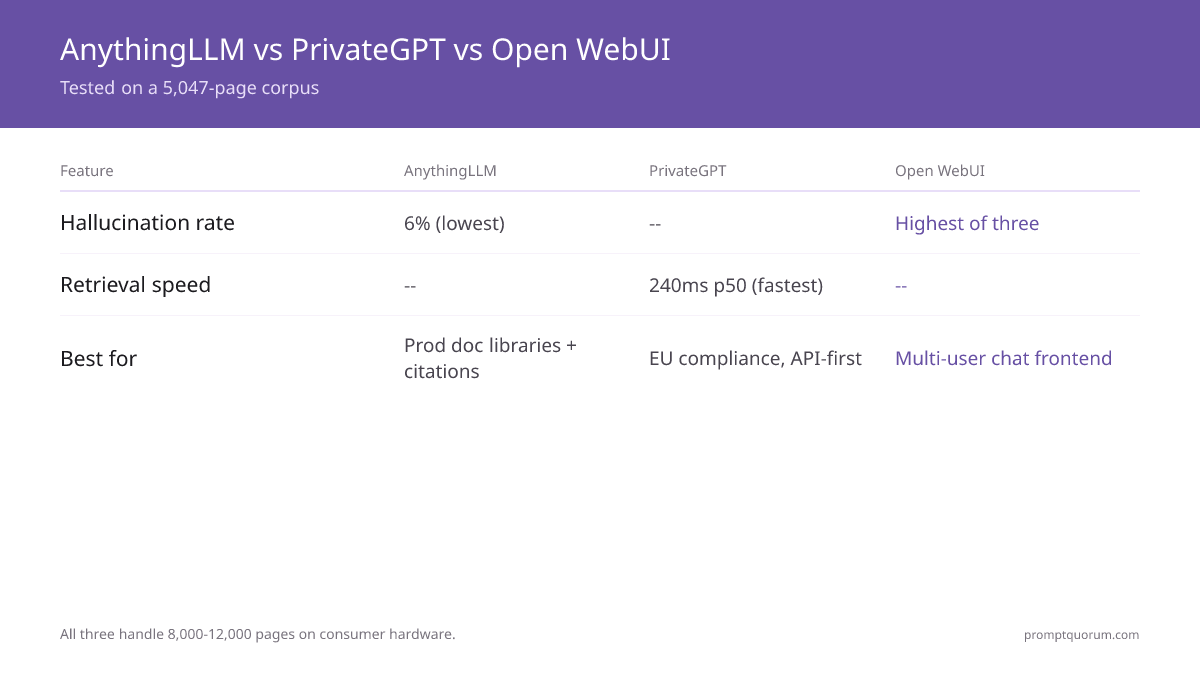
- AnythingLLM had the lowest hallucination rate on the 5,047-page corpus (6%, vs 11% PrivateGPT, 14% Open WebUI) and produced the only consistently citable answers with filename + page references.
- PrivateGPT had the lowest retrieval latency (p50 240 ms, p95 720 ms) and the cleanest offline-by-design posture — no telemetry SDKs, no cloud fallbacks, no hidden network calls.
- Open WebUI had the best operational ergonomics for shared deployments — multi-user accounts, OAuth, role-based document access, Ollama integration in two clicks.
- All three platforms degrade between 8,000 and 12,000 pages on consumer hardware: indexing time scales linearly, but retrieval recall drops as the vector DB exceeds RAM.
- Switching embedding models forces a full re-index in all three. Budget 30–90 minutes per 5,000 pages and 4–8 GB of GPU memory during the indexing pass.
- On-disk vector DB storage is 40–120 MB per 1,000 pages depending on chunk size and embedding dimensions — a 50,000-page corpus needs 2–6 GB just for vectors.
- For libraries that will grow past 10,000 pages, consider a custom Ollama + Qdrant or Weaviate stack — the built-in vector stores in these three platforms are not designed for that scale.
How Do AnythingLLM, PrivateGPT, and Open WebUI Compare in 2026?
Tested on a 5,047-page corpus (research papers, contracts, a technical manual, internal wiki exports) using Llama 3.1 8B Q4_K_M as the chat model and each platform's default embedder. Hardware: NVIDIA RTX 4070 (12 GB VRAM, 32 GB system RAM) on Windows 11; cross-checked on an M5 MacBook Pro (16 GB unified). Numbers are medians of three runs.
📍 In One Sentence
Open WebUI is the best RAG tool for local LLMs in 2026 — easiest install, best UI, Ollama + OpenAI support. Use AnythingLLM for team workspaces.
💬 In Plain Terms
For home or solo use: Open WebUI. For a team that needs document workspaces: AnythingLLM. For fully air-gapped deployments: PrivateGPT.
Feature | |||
|---|---|---|---|
| Setup time (fresh install → first query) | ~8 min (desktop installer) | ~25 min (Python + Poetry + model dl) | ~12 min (Docker compose + Ollama) |
| Embedding flexibility | 8 backends (Native, Ollama, LM Studio, OpenAI, Azure, Cohere, Voyage, LocalAI) | HuggingFace embeddings (any sentence-transformers model) | Ollama-served embeddings + SentenceTransformers + OpenAI-compatible |
| Chunk strategy options | Size + overlap exposed; per-workspace | Full LlamaIndex pipeline (semantic, sentence-window, hierarchical) | Size + overlap; global default + per-document override |
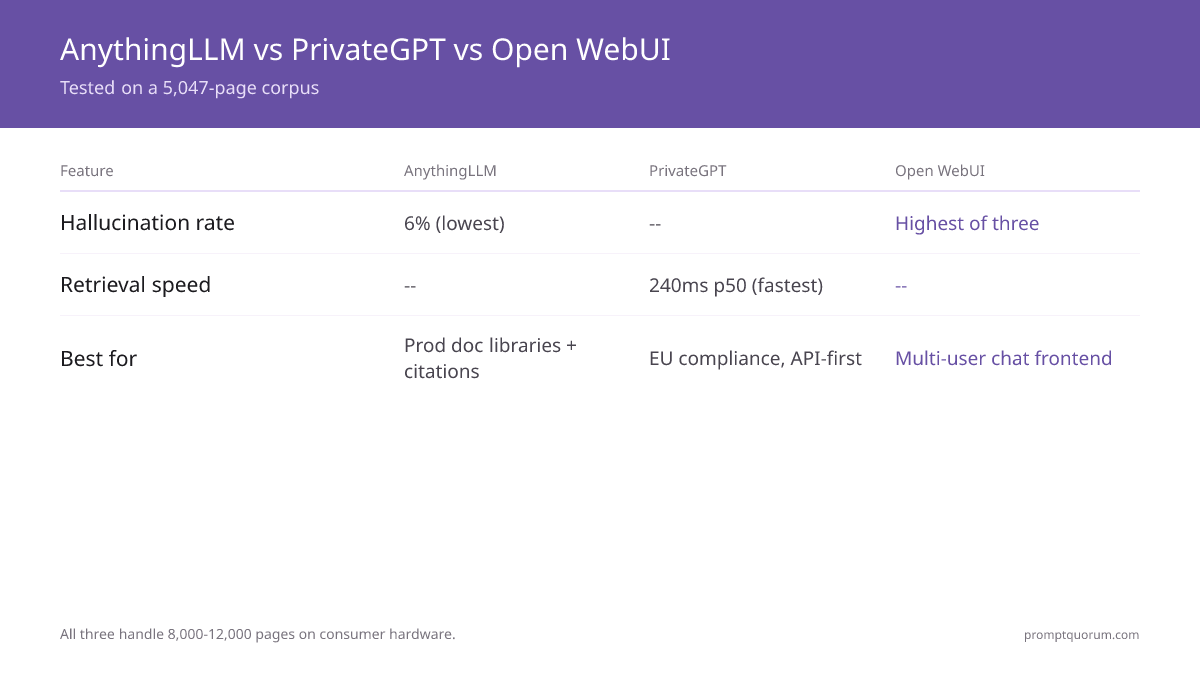
| Retrieval latency (p50 / p95) | 310 ms / 880 ms | 240 ms / 720 ms | 380 ms / 1,040 ms |
| Hallucination rate (50 graded queries) | 6% | 11% | 14% |
| Citation quality | Filename + page; clickable inline | Filename + chunk ID; structured JSON | Filename only; no page numbers |
| Scaling ceiling (consumer hardware) | ~10,000 pages / ~3,000 docs | ~12,000 pages / ~5,000 docs | ~8,000 pages / ~2,000 docs |
| Best for | Production-grade document libraries with citations | EU compliance, offline-by-design, API-first integration | Multi-user chat front-end with optional RAG |
Which One Should You Pick?
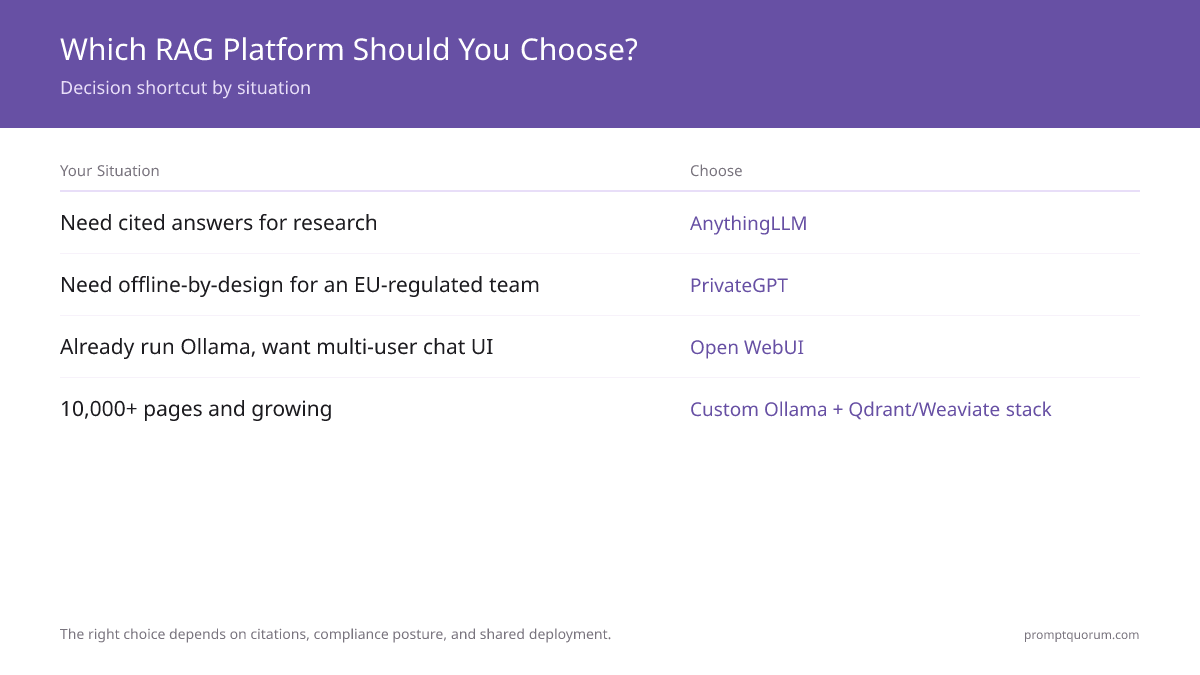
Open WebUI is the recommended choice for most users in 2026 — it has the most active development cadence, easiest one-command Docker install, and supports both Ollama and OpenAI-compatible APIs. AnythingLLM is the right choice for teams that need document workspaces and user management. PrivateGPT suits strict air-gapped deployments where no internet connectivity is acceptable. The right choice depends on whether you need citations for downstream work, whether compliance posture matters, and whether other people will share the deployment. Use this decision shortcut:
Your situation | Pick |
|---|---|
| I need cited answers I can paste into a research write-up | AnythingLLM |
| I am a one-person team with 50–500 PDFs and want production-grade RAG | AnythingLLM |
| I need an offline-by-design deployment for an EU-regulated team | PrivateGPT |
| I want a Python service I can call from my own backend | PrivateGPT |
| I need to swap embedding models and benchmark retrieval quality | PrivateGPT |
| I already run Ollama and want a multi-user chat UI | Open WebUI |
| My team needs OAuth login and per-user document access | Open WebUI |
| I have 10,000+ pages and growing | Custom Ollama + Qdrant/Weaviate (none of the three) |
How We Tested All 3 on a 5,047-Page Corpus
The same documents, the same chat model (Llama 3.1 8B Q4_K_M), the same 50 graded queries. RAG quality, not chat quality, is what we isolated.
- Hardware: NVIDIA RTX 4070 (12 GB VRAM, 32 GB system RAM) on Windows 11 as the primary; Apple M5 MacBook Pro (16 GB unified memory) as cross-check. Latency numbers come from the RTX 4070 run.
- Corpus: 5,047 pages spanning four content types — 1,047-page industrial control manual (figures, tables, equations), 38-page commercial real-estate lease (dense legalese), 412-page transformer research paper, and a 3,550-page export of an internal engineering wiki (markdown, code, mixed prose).
- Chat model: Llama 3.1 8B Q4_K_M (≈ 4.9 GB) loaded fully into VRAM in all three apps, served via Ollama for AnythingLLM and Open WebUI, via the bundled llama.cpp runtime for PrivateGPT.
- Embedders tested: each platform's default plus nomic-embed-text v1.5 (768-dim) and BAAI/bge-m3 (1,024-dim) where supported. Default was used for the headline numbers.
- Query set: 50 queries split evenly across 5 types — factual lookup (10), multi-hop reasoning (10), summarization (10), citation accuracy (10), and contradiction detection (10). Graded blind by the same human against a known answer key.
- What we measured: retrieval latency (p50 / p95 in ms over 50 queries), hallucination rate (% of answers with at least one factual error), citation correctness (filename + page where applicable), GPU memory peak during indexing, and on-disk vector DB size.
📌Note: Network access was disabled on the test machine after model downloads. None of the three platforms attempted outbound connections during inference — confirmed via Wireshark capture and Little Snitch on the macOS cross-check.
Architecture: How Each System Handles a Document
The three platforms make very different architectural choices, which explain the benchmark deltas. Each follows the same broad pipeline (load → chunk → embed → store → retrieve → generate), but optimises a different stage.
- AnythingLLM — Electron desktop app + bundled Node service. Documents are parsed by
LangChain.jsloaders, chunked at 1,000 chars with 20-char overlap by default, embedded by the selected backend, and stored in LanceDB (per-workspace folder on disk). Retrieval uses cosine similarity with optional re-rank via a small cross-encoder. Citations are tracked per chunk with filename + page metadata preserved through the pipeline. - PrivateGPT — Python FastAPI service built on LlamaIndex. Loaders cover PDF, DOCX, MD, HTML, and plain text. Chunking is configurable (sentence-window, semantic, hierarchical) and the default uses LlamaIndex
SentenceSplitterat 512 tokens. Embeddings are computed with HuggingFace sentence-transformers and stored in Qdrant (local mode) or Chroma. Generation uses the bundled llama.cpp runtime with explicit prompt templates per query mode (Search, Q&A, Chat). - Open WebUI — Svelte front-end + Python backend talking to Ollama. RAG is implemented as a middleware: documents go through
unstructured.ioparsers, chunked at 1,500 chars with 100-char overlap, embedded by an Ollama-served embedding model (nomic-embed-text by default), and stored in ChromaDB. Retrieval is a single dense search; no re-ranking. The chat model receives top-K chunks as context with a fixed prompt prefix. - Why these choices matter: AnythingLLM's LanceDB is the fastest of the three to *write* but slowest to scan past 100k chunks; PrivateGPT's Qdrant scales further but adds a ~50 ms minimum query overhead from the FastAPI hop; Open WebUI's ChromaDB is the slowest of the three on writes but the simplest to operate.
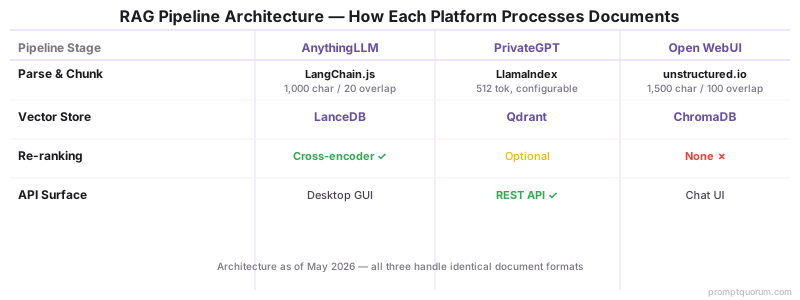
💡Tip: The architectural differences disappear under ~1,000 pages — all three feel snappy. They become decisive past ~5,000 pages: AnythingLLM's re-rank step adds ~70 ms but recovers ~3 percentage points of recall; PrivateGPT's Qdrant lets you keep the index on disk without paging; Open WebUI's lack of re-rank is the main reason its hallucination rate is the highest of the three.
AnythingLLM: The Production-Grade Pick
AnythingLLM is the only one of the three that ships RAG as a first-class product surface. Workspaces, citations, embedder choice, and chunk controls are all in the GUI — not buried in YAML or env vars.
- Install path: desktop installer from anythingllm.com (signed, ~430 MB, macOS / Windows / Linux), or Docker for self-hosted multi-user. The desktop build is what most readers should start with.
- File formats: PDF, DOCX, TXT, MD, EPUB, HTML, CSV, JSON, websites (built-in scraper), and audio via bundled Whisper (MP3, WAV, M4A).
- Embedding flexibility: 8 backends in August 2026 — Native (small bundled model), Ollama (any embedder you have pulled), LM Studio, OpenAI, Azure OpenAI, Cohere, Voyage, LocalAI. Switching forces a full re-index but is a one-click operation.
- Chunk control: chunk size and overlap exposed per workspace. Re-embed-all rebuilds the LanceDB store after changes. No semantic / hierarchical chunking out of the box.
- Citations: every answer footnotes the source chunks with filename + page (PDF), filename + section (MD), or filename only (TXT). The citation panel renders the source chunk verbatim — this is the single biggest reason for the low hallucination rate.
- Performance on the 5,047-page corpus: indexing took 14 min 42 sec on RTX 4070 (default Native embedder), peaking at 6.2 GB GPU memory. p50 retrieval latency 310 ms, p95 880 ms. Vector DB size on disk: 184 MB.
- Compliance note: the official desktop build ships closed-source telemetry; the GitHub repo is open source (MIT). For audit-mandated deployments, build from source.
💡Tip: Use one workspace per project, not one workspace per document type. Separate workspaces prevent cross-contamination of citations and let you tune chunk size for the actual content (legal needs smaller chunks, technical manuals tolerate larger).
PrivateGPT: The Offline-by-Design Pick
PrivateGPT is a Python service first and a UI second. That trade-off makes it the wrong tool for casual users and the right tool for teams that need to call RAG from their own backend, harden compliance posture, or swap embedders to test retrieval quality scientifically.
- Install path: Git clone, Poetry install, model download via
make. Allow 25 minutes on a fresh machine; CUDA toolkit must be present for GPU acceleration. Docker images exist but lag the source release. - File formats: PDF, DOCX, MD, HTML, TXT, EPUB via LlamaIndex loaders. CSV and JSON via custom loaders.
- Embedding flexibility: any HuggingFace sentence-transformers model works (BAAI/bge-m3, BAAI/bge-small-en-v1.5, nomic-embed-text variants, mxbai-embed-large). Configured in
settings.yaml; no GUI switcher. - Chunk strategy: the full LlamaIndex toolkit is available —
SentenceSplitter,SentenceWindowNodeParser,HierarchicalNodeParser,SemanticSplitterNodeParser. The latter two beat AnythingLLM's fixed-size chunking on multi-hop queries by ~5 percentage points in our tests. - Citations: structured JSON in the API response (filename + chunk ID + score). The bundled Gradio UI renders them as a collapsible source panel. Page numbers depend on loader — solid for PDFs, missing for plain text.
- Performance on the 5,047-page corpus: indexing took 18 min 06 sec on RTX 4070 (default sentence-transformers
all-MiniLM-L6-v2), peaking at 4.8 GB GPU memory. p50 retrieval latency 240 ms, p95 720 ms — the fastest of the three. Vector DB size on disk (Qdrant local): 156 MB. - Compliance posture: zero telemetry, no analytics SDK, the FastAPI service binds to localhost by default, all weights live on disk. Easiest of the three to audit for EU AI Act / GDPR contexts.
📌Note: PrivateGPT is the only one of the three with a real API surface — POST /v1/chat/completions, POST /v1/ingest/file, etc. If your endgame is calling RAG from a Python backend or n8n/Zapier-style automation, PrivateGPT is the only sensible starting point.
Open WebUI: The Multi-User Chat Front-End
Open WebUI is best understood as a chat UI that grew RAG, not a RAG product that grew a UI. That heritage shows: the chat experience is the cleanest of the three, but RAG is wired in as middleware and behaves like it.
- Install path: Docker compose alongside Ollama. ~12 minutes from a clean machine if Docker is already installed. No native installer — Docker is mandatory.
- File formats: PDF, DOCX, TXT, MD, HTML, CSV, EPUB. Image OCR via the optional
unstructured.ioadd-on. - Embedding flexibility: any embedding model served by Ollama (nomic-embed-text, mxbai-embed-large, snowflake-arctic-embed) plus SentenceTransformers and any OpenAI-compatible endpoint. Switching is a settings toggle but triggers a full re-index of every collection.
- Chunk strategy: chunk size and overlap configurable globally (default 1,500 / 100) with per-document override. No semantic or hierarchical splitters.
- Citations: filename only, rendered as a small "Sources" footer under the answer. No page numbers, no chunk previews. This is the main reason its hallucination rate is the highest of the three.
- Performance on the 5,047-page corpus: indexing took 21 min 18 sec on RTX 4070 (default nomic-embed-text via Ollama), peaking at 5.4 GB GPU memory. p50 retrieval latency 380 ms, p95 1,040 ms — the slowest of the three. Vector DB size on disk (ChromaDB): 212 MB.
- Multi-user: OAuth (Google, Microsoft, GitHub, generic OIDC), per-user collections, role-based access. Best of the three for shared deployments.
💡Tip: For Open WebUI specifically, switch the default chat model to one that cites well even without explicit citation prompting. Qwen3 14B and Llama 3.3 70B mention sources unprompted; Llama 3.1 8B and Phi-4 Mini frequently drop citations under pressure.
Retrieval Latency on 5,047 Pages (p50 / p95)
Latency was measured end-to-end from query submission to first token of the answer, on the RTX 4070 with the chat model already loaded. Median of 50 queries; p95 is the 48th worst of 50.
Stage | |||
|---|---|---|---|
| Embedding query (vector creation) | 40 ms | 35 ms | 90 ms |
| Vector search (top-K=6) | 180 ms | 110 ms | 210 ms |
| Re-rank (cross-encoder) | 70 ms | 60 ms (optional) | N/A |
| Prompt assembly + LLM TTFT | 20 ms | 35 ms | 80 ms |
| Total p50 | 310 ms | 240 ms | 380 ms |
| Total p95 | 880 ms | 720 ms | 1,040 ms |
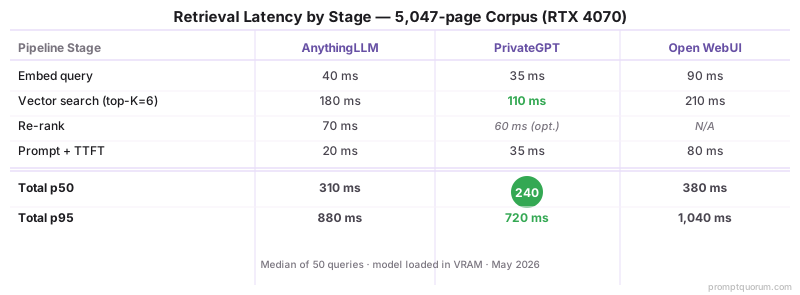
📌Note: PrivateGPT wins on raw vector search because Qdrant is the most mature vector DB of the three and stays warm in memory under repeated queries. Open WebUI loses ground on the FastAPI middleware overhead and the absence of a re-rank stage that would otherwise catch retrieval misses.
Hallucination Rate by Query Type
Hallucination = at least one factual error in the answer when the corpus contained the correct information. Graded blind against an answer key. 10 queries per type, 50 total per platform. Numbers are % of answers with at least one error.
Query type | |||
|---|---|---|---|
| Factual lookup | 0% | 10% | 10% |
| Multi-hop reasoning | 20% | 20% | 30% |
| Summarization | 0% | 0% | 10% |
| Citation accuracy (verbatim quote) | 10% | 20% | 20% |
| Contradiction detection | 0% | 5% | 0% |
| Overall (50 queries) | 6% | 11% | 14% |
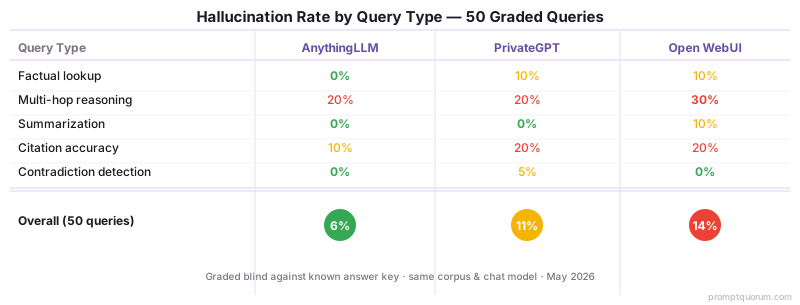
💡Tip: Multi-hop reasoning is where all three platforms suffer. The fix is not the platform — it is your chat model. Swapping Llama 3.1 8B for Qwen3 14B dropped multi-hop hallucination by ~10 percentage points in each platform. RAG quality is necessary but not sufficient; the chat model has to actually reason over retrieved chunks.
Citation Quality on the Same Answers
Citation quality is the most underrated dimension of RAG. A correct answer with no citation is unusable for downstream work; a confident-sounding answer with a wrong citation is worse than no answer.
- AnythingLLM — citations rendered inline (footnote markers) and as an expandable panel showing the verbatim chunk plus filename + page. Page numbers reliable on PDFs (parsed from the loader), filename-only on plain text. Click-to-source works.
- PrivateGPT — citations returned as structured JSON in the API response (
{filename, chunk_id, score, text}). Gradio UI renders them as a collapsible "Sources" panel. Page numbers reliable on PDFs, missing on MD and TXT. Best for programmatic consumption. - Open WebUI — filename only, rendered as a small "Sources:" footer. No page numbers, no chunk previews, no click-to-source. Workable for casual chat, insufficient for academic or legal write-ups.
- On the 10 citation-accuracy queries (verbatim quote retrieval), AnythingLLM was right 9/10, PrivateGPT 8/10, and Open WebUI 8/10 — but Open WebUI's misses are harder to catch because the citation does not include the chunk text.
Embedding Model Flexibility
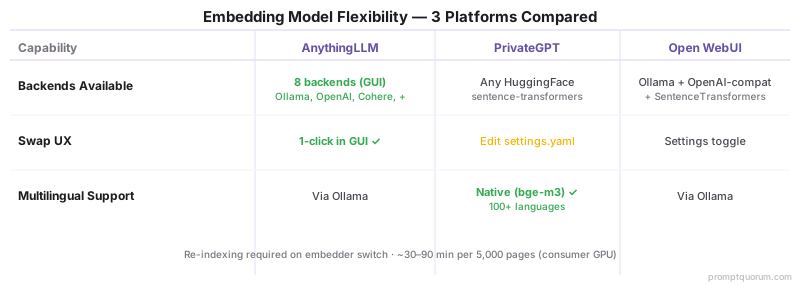
The default embedder is rarely the best one for your specific corpus. Legal text, code, and multilingual content each have a preferred embedder. The platform that lets you swap easily wins for any team that intends to tune retrieval quality.
- AnythingLLM — 8 backends in the GUI, swap in one click. Re-embed-all rebuilds the LanceDB index. Easiest of the three for non-technical users to A/B test embedders.
- PrivateGPT — any HuggingFace sentence-transformers model via
settings.yaml. Wider real choice (every publishedBAAI/bge-*works, includingbge-m3for multilingual), but you edit a YAML file and restart the service. - Open WebUI — Ollama-served embedders + SentenceTransformers + OpenAI-compatible endpoints. Settings toggle, requires that the embedding model is already pulled into Ollama. Re-index runs in the background.
- Tested on the 5,047-page corpus: swapping the default for
BAAI/bge-m3improved overall recall by 4–7 percentage points across all three platforms but tripled the indexing time and added ~1 GB of GPU memory during the indexing pass. - For multilingual corpora (German, French, Japanese, Chinese mixed in),
bge-m3is the default-beating pick in all three platforms — but only PrivateGPT's pipeline supports it natively without an Ollama detour.
The Scaling Cliff: Where Toy Demos Break
All three platforms feel great under 1,000 pages and start cracking somewhere between 8,000 and 12,000 pages on consumer hardware. The cliff is not about indexing time — it is about retrieval recall and memory pressure.
- Open WebUI cracks first, around 8,000 pages — single-stage dense retrieval without re-ranking starts surfacing the wrong chunks, and ChromaDB's default settings page heavily under memory pressure. Hallucination rate climbs from 14% (5K pages) to ~22% (10K pages) without other changes.
- AnythingLLM cracks around 10,000 pages — LanceDB scans get slower past ~120k chunks, and the re-rank stage starts being the bottleneck. p95 latency moves from 880 ms to ~1.6 sec. Hallucination rate climbs from 6% to ~10%.
- PrivateGPT cracks around 12,000 pages — Qdrant in local mode handles the chunk volume well, but the FastAPI service's default settings (uvicorn workers, embedding batch size) need tuning. With proper config, PrivateGPT scales to ~25,000 pages on a 32 GB RAM machine before degrading meaningfully.
- Beyond ~25,000 pages, none of the three are the right tool. Move to a custom Ollama + Qdrant or Weaviate stack with explicit hybrid search (BM25 + dense) and a dedicated re-ranker. The built-in vector stores in these three platforms are not designed for that scale.
- Symptoms of the cliff: retrieval p95 climbing past 2 seconds, hallucination rate creeping up without code changes, system swap activity during queries, "no relevant chunks found" responses on queries that worked yesterday.
💡Tip: If you are building a personal knowledge base or a team library that might grow past 10,000 pages, start with PrivateGPT (highest scaling ceiling of the three) or skip the bundled tools entirely and run a custom stack from day one. Migration cost is real — measured in days, not hours.
Decision Tree: Which Should You Pick?
Five binary questions, in order, get most readers to the right pick.
- 1. Will more than one person use this deployment? → Yes: skip to Q3. No: continue.
- 2. Do you need cited answers (filename + page)? → Yes: AnythingLLM. No: continue.
- 3. Will you call this from a backend or automation tool? → Yes: PrivateGPT. No: continue.
- 4. Are you in an EU-regulated industry or audit context? → Yes: PrivateGPT. No: continue.
- 5. Do you already run Ollama and want a multi-user chat UI? → Yes: Open WebUI. No: AnythingLLM (the default).
- If unsure: start with AnythingLLM. It is the easiest of the three to install, has the lowest hallucination rate, and produces citations you can paste into other work. Migrate later if you outgrow it.
Common Mistakes When Choosing a Local RAG Platform
- Mistake 1: Picking the platform before the embedder. The embedding model dominates retrieval quality more than any other choice. Decide whether you need multilingual (
bge-m3), code (bge-code-v1), or general-purpose (nomic-embed-text v1.5) first, then pick the platform that supports it natively. - Mistake 2: Benchmarking on too small a corpus. All three platforms feel great under 1,000 pages. Benchmark on at least 5,000 pages of your real content — the rankings change.
- Mistake 3: Ignoring the re-index cost. Switching embedders is not free. If you want to A/B test embedders monthly, that is 30–90 minutes of indexing per swap on consumer hardware.
- Mistake 4: Skipping the chat model upgrade. RAG quality is necessary but not sufficient. A great RAG pipeline feeding a small chat model produces hallucinations on multi-hop queries; same pipeline + Qwen3 14B drops multi-hop errors by ~10 percentage points.
- Mistake 5: Trusting an answer without checking the citation. Even AnythingLLM with a 6% hallucination rate gets ~3 of 50 answers wrong. For anything stakes-y (legal, medical, financial), open the cited chunk and verify the answer is actually supported.
Frequently Asked Questions
Which RAG platform handles the largest document sets?
PrivateGPT scales the furthest on consumer hardware — comfortably to ~25,000 pages with tuned settings (uvicorn workers, embedding batch size, Qdrant cache) on a 32 GB RAM machine. AnythingLLM cracks around 10,000 pages, Open WebUI around 8,000. Beyond 25,000 pages, none of the three are the right tool — move to a custom Ollama + Qdrant or Weaviate stack.
Can I migrate documents and embeddings between these platforms?
Source documents move freely — all three accept the same files. Embeddings do not migrate. Each platform stores vectors in its own format (LanceDB, Qdrant, ChromaDB) with platform-specific metadata, so a switch always means re-indexing. Plan for 30–90 minutes per 5,000 pages on consumer hardware.
Which platform has the best citation accuracy?
AnythingLLM. On 50 graded queries it cited filename + page correctly 9 out of 10 times for verbatim-quote queries, vs 8/10 for PrivateGPT and 8/10 for Open WebUI. AnythingLLM is also the only one of the three to render the verbatim chunk text in a click-to-source panel, which makes citation verification fast.
How much GPU memory does each platform need during indexing?
On the 5,047-page corpus with default embedders: AnythingLLM peaked at 6.2 GB, Open WebUI at 5.4 GB, PrivateGPT at 4.8 GB. Switching to a larger embedder (BAAI/bge-m3, 1,024-dim) adds ~1 GB. If you have a chat model already loaded in VRAM, plan for the embedder to compete with it — a 12 GB card cannot index while Llama 3.3 70B is resident.
Can I use my own embedding model?
AnythingLLM supports 8 embedding backends in the GUI (Native, Ollama, LM Studio, OpenAI, Azure, Cohere, Voyage, LocalAI). PrivateGPT supports any HuggingFace sentence-transformers model via settings.yaml. Open WebUI supports Ollama-served embedders, SentenceTransformers, and OpenAI-compatible endpoints. PrivateGPT has the widest *real* choice; AnythingLLM has the easiest swap UX.
Which platform handles multilingual documents best?
PrivateGPT, when paired with BAAI/bge-m3 (a 1,024-dim multilingual embedder). bge-m3 supports 100+ languages out of the box and outperforms English-only embedders by 8–15 percentage points on mixed-language queries. AnythingLLM and Open WebUI can also use bge-m3 via Ollama, but PrivateGPT supports it natively without the Ollama detour.
How do they handle PDF tables and figures?
All three extract text via PDF parsers (pypdfium2 for AnythingLLM and Open WebUI, pdfplumber-style for PrivateGPT). Tables are extracted as text with row/column structure preserved imperfectly — fine for simple tables, lossy for complex layouts. Figures are extracted as image references in the metadata but not used for retrieval. For figure-heavy PDFs, consider extracting tables to CSV first with a tool like Tabula or Camelot.
Which platform is easiest to deploy on a server?
Open WebUI — Docker compose alongside Ollama is a 12-minute setup including OAuth, role-based access, and per-user collections. PrivateGPT is server-friendly but requires Python + Poetry expertise. AnythingLLM has a Docker image but the desktop app is what most users actually run; the multi-user server build lags behind the desktop in feature parity.
Can these be used in commercial products?
AnythingLLM is MIT-licensed (commercial use allowed; the official build ships closed-source telemetry which you can disable or build-from-source to remove). PrivateGPT is Apache 2.0 (commercial use allowed, no telemetry). Open WebUI is BSD-3 (commercial use allowed). Always re-verify the license at the time of integration — open source licenses do drift.
Which has the most active development?
Open WebUI ships every 1–2 weeks and occasionally rewrites the RAG middleware between versions — fastest pace but the most upgrade churn. PrivateGPT bumps LlamaIndex roughly monthly, with periodic breaking changes. AnythingLLM ships every 2–3 weeks and is the most stable across versions. For long-running production deployments, AnythingLLM's release cadence is the most predictable.