Is DeepSeek GDPR Safe to Use?
Quick Answer
DeepSeek API poses the highest GDPR risk of any major LLM because servers are subject to Chinese data-access law (PIPL), there is no EU adequacy decision for China, and the Terms of Service explicitly reserve the right to share data with Chinese authorities. DeepSeek local open-weight models carry a different, lower risk profile.
- ▸DeepSeek API: servers in China, subject to PIPL data disclosure law — highest risk
- ▸No EU adequacy decision for China: SCCs + TIA required, but TIA outcome may be unfavourable
- ▸DeepSeek-R1/V3 local weights (Apache 2.0): much lower risk if deployed locally without API calls
Key Takeaways
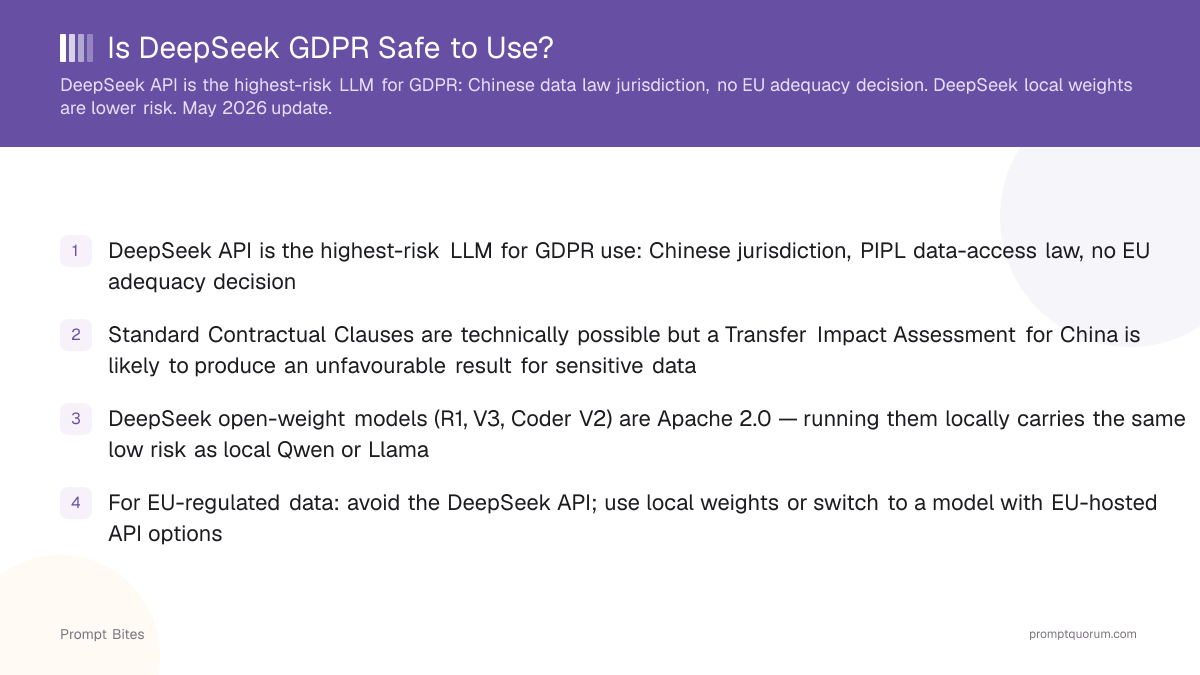
- ✓DeepSeek API is the highest-risk LLM for GDPR use: Chinese jurisdiction, PIPL data-access law, no EU adequacy decision
- ✓Standard Contractual Clauses are technically possible but a Transfer Impact Assessment for China is likely to produce an unfavourable result for sensitive data
- ✓DeepSeek open-weight models (R1, V3, Coder V2) are Apache 2.0 — running them locally carries the same low risk as local Qwen or Llama
- ✓For EU-regulated data: avoid the DeepSeek API; use local weights or switch to a model with EU-hosted API options
Why the DeepSeek API Is High-Risk Under GDPR
Three compounding factors make the DeepSeek API the highest-risk option for GDPR-regulated data among major LLMs. First: servers are in China, meaning every API call is a GDPR Article 44 third-country transfer. Second: China has no EU adequacy decision (unlike the US, which has the EU-US Data Privacy Framework). Third: China's Personal Information Protection Law (PIPL) compels organisations operating in China to provide data to state authorities on request.
Standard Contractual Clauses are a valid legal mechanism for transfers to China. However, post-Schrems II, organisations must also conduct a Transfer Impact Assessment evaluating whether SCCs provide real protection in practice. For China, the TIA is difficult to pass for sensitive data: PIPL overrides contractual protections, and the Chinese government can demand access. The EU's EDPB guidance makes clear that where supplementary measures cannot compensate for deficiencies in the destination country's legal framework, the transfer should not go ahead.
This applies to any personal data: HR records, customer information, medical notes, legal correspondence. If your prompts contain any of this, the DeepSeek API creates regulatory exposure that SCCs alone may not cure.
📍 In One Sentence
DeepSeek API is the highest GDPR risk among major LLMs because China's PIPL law can override Standard Contractual Clauses and compel data disclosure to state authorities.
💬 In Plain Terms
Chinese law requires companies to hand over data to the government on request, and that law can override any privacy contracts you sign. This means promising to protect EU data with DeepSeek's API may not be legally enforceable.
DeepSeek Local Weights — A Completely Different Risk Profile
The open-weight DeepSeek models (R1, V3, Coder V2) are a separate product from the API. They are released under Apache 2.0 and can be downloaded and run locally with no connection to DeepSeek servers. Running local weights eliminates the GDPR Article 44 transfer problem entirely — the same way local Qwen or local Llama does.
Local DeepSeek-R1 7B or 8B runs comfortably via Ollama on a 6–8 GB VRAM GPU. The performance is excellent: R1 is one of the strongest reasoning models available at the 7B tier. For coding tasks, DeepSeek Coder V2 is available in smaller variants.
The one remaining question for local DeepSeek: model training. DeepSeek has not published full details of what data was used to train these models. For high-assurance environments (healthcare, legal, government), this uncertainty may be relevant even for local deployment. Qwen 3 (Alibaba/Tongyi) and Llama 4 (Meta) provide more transparency about training data provenance.
| Deployment | GDPR Risk | Reason | Recommended Action |
|---|---|---|---|
| DeepSeek API | Highest | Chinese servers, PIPL, no adequacy decision | Avoid for personal or sensitive data |
| DeepSeek local (R1/V3) | Low | No transfer, Apache 2.0 weights | Acceptable; note training-data opacity |
| Qwen local (2.5/3) | Low | No transfer, Apache 2.0, published training info | Recommended for data-sensitive use |
| Claude / OpenAI API | Medium | US jurisdiction; EU region reduces but doesn't eliminate risk | SCCs + DPA required; EU region preferred |
Quick Answers: DeepSeek and GDPR
Can I use DeepSeek API with Standard Contractual Clauses for GDPR?▾
Is DeepSeek-R1 the same as the DeepSeek API?▾
ollama run deepseek-r1:7b) has no transfer risk.What is the PIPL and why does it matter for GDPR?▾
Which LLM is safest for GDPR-regulated data?▾
Want the full breakdown?
Read the complete guide →Related Prompt Bites