Can a Local LLM Help with GDPR Compliance?
Quick Answer
Yes — running an open-weight model locally eliminates the Article 44 third-country data transfer that makes cloud AI legally complex under GDPR, meaning your prompts and responses never leave your server. Local models like Qwen3 14B or Llama 4 Scout can handle HR, legal, and medical text entirely on-premises.
- ▸No transfer = no Article 44 problem: the biggest GDPR hurdle for cloud AI disappears
- ▸Article 25 (privacy by design) satisfied: data never leaves your jurisdiction by architecture
- ▸Best for 12 GB VRAM: Qwen3 14B Q4_K_M via Ollama — general + coding capable
Key Takeaways
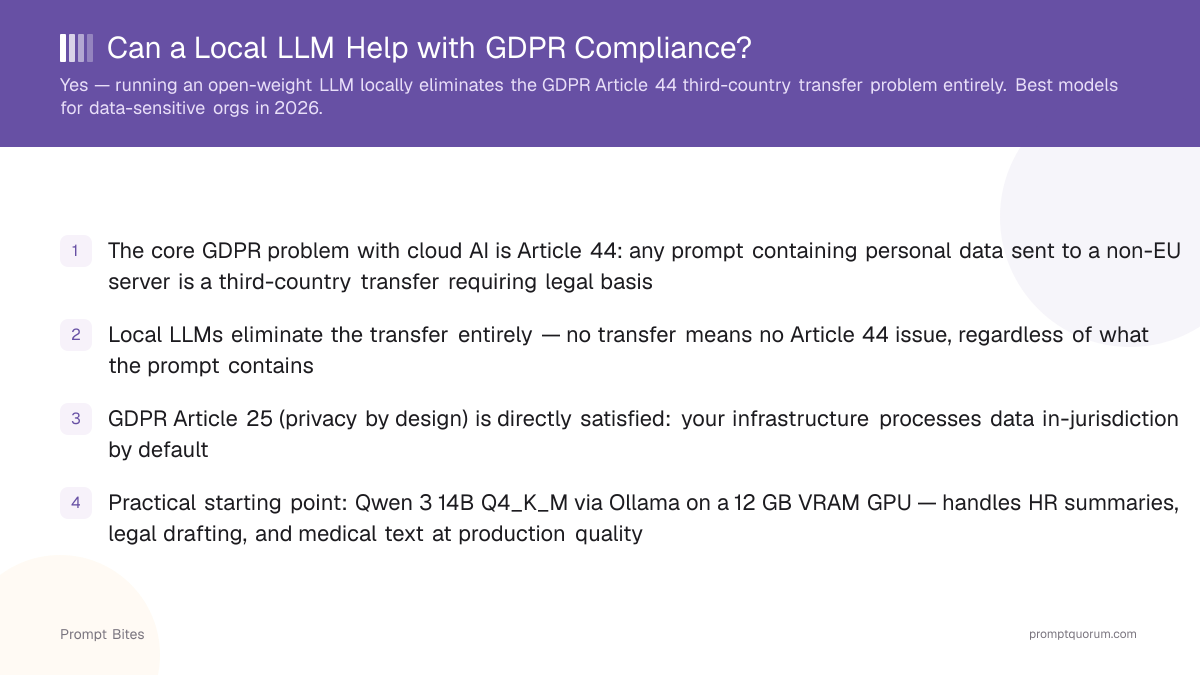
- ✓The core GDPR problem with cloud AI is Article 44: any prompt containing personal data sent to a non-EU server is a third-country transfer requiring legal basis
- ✓Local LLMs eliminate the transfer entirely — no transfer means no Article 44 issue, regardless of what the prompt contains
- ✓GDPR Article 25 (privacy by design) is directly satisfied: your infrastructure processes data in-jurisdiction by default
- ✓Practical starting point: Qwen3 14B Q4_K_M via Ollama on a 12 GB VRAM GPU — handles HR summaries, legal drafting, and medical text at production quality
The GDPR Problem with Cloud AI — and Why Local Solves It
Every time you send a prompt to a cloud LLM (ChatGPT, Claude, Gemini), any personal data in that prompt is transferred to a server outside the EU. GDPR Article 44 requires a legal basis for that transfer — typically Standard Contractual Clauses plus a Transfer Impact Assessment. That is the compliance burden cloud AI creates. Local LLMs eliminate it by removing the transfer entirely.
When a local model runs on your own hardware, data processing happens in-jurisdiction. The model receives your prompt and generates a response entirely on your CPU or GPU — no network call leaves your building. This satisfies Article 44 (no transfer, no legal basis needed), Article 25 (privacy by design: your default architecture prevents external transfer), and Article 5(1)(f) (data integrity and confidentiality: data is processed only by systems under your control).
This is not a technicality or a workaround — it is the intended privacy-by-design architecture GDPR regulators describe. When EU institutions publish guidance on AI and GDPR, local processing is consistently identified as the lowest-risk deployment model.
📍 In One Sentence
A local LLM helps GDPR compliance by eliminating the Article 44 third-country transfer entirely — no data ever leaves your server, so no legal basis for international transfer is required.
💬 In Plain Terms
Cloud AI sends your questions to servers abroad. GDPR restricts that. A local AI model processes everything on your own computer — the data never travels, so the GDPR rules about data leaving the EU simply do not apply.
Which Local Models Are Practical for GDPR-Regulated Work
Three open-weight models cover the main GDPR-regulated workflows in 2026. For general HR, legal, and document drafting: Qwen3 14B Q4_K_M (needs 10–12 GB VRAM). For code analysis and technical documentation: Qwen2.5-Coder 14B (same VRAM, stronger on structured output). For organisations with a single GPU or tighter hardware: Qwen3 8B Q4_K_M (6–8 GB VRAM).
All three run via Ollama with a single command and require no cloud connectivity after the one-time model download. The download happens once from Hugging Face over HTTPS and can be done on an air-gapped machine via sneakernet. After that: fully offline.
For larger organisations needing near-frontier quality: Llama 4 Scout (17B MoE) fits on 24 GB VRAM with a 10M token context window — suitable for processing long contracts, HR policy documents, or medical records in a single context.
| Workflow | Recommended Model | VRAM Required | Ollama Command |
|---|---|---|---|
| HR documents, summaries | Qwen3 14B Q4_K_M | 10–12 GB | ollama run qwen3:14b |
| Legal drafting, contracts | Qwen3 14B Q4_K_M | 10–12 GB | ollama run qwen3:14b |
| Code, technical docs | Qwen2.5-Coder 14B | 10–12 GB | ollama run qwen2.5-coder:14b |
| Budget / 8 GB VRAM | Qwen3 8B Q4_K_M | 6–8 GB | ollama run qwen3:8b |
| Long documents (>100K tokens) | Llama 4 Scout | 24 GB | ollama run llama4:scout |
Quick Answers: Local LLMs and GDPR
Does using a local LLM mean I have no GDPR obligations at all?▾
Can I use Ollama in a corporate environment for GDPR compliance?▾
Is a local LLM sufficient for processing medical or legal data under GDPR?▾
Do open-source LLM weights carry GDPR risk from their training data?▾
Want the full breakdown?
Read the complete guide →Related Prompt Bites