Is Qwen GDPR Compliant?
Quick Answer
Qwen run locally on your own hardware is GDPR-compliant because no prompt data leaves your infrastructure and no Article 44 third-country transfer occurs. The Qwen API via Alibaba Cloud is a different story — it requires Standard Contractual Clauses and a Transfer Impact Assessment like any non-EU cloud provider.
- ▸Local Qwen: no data transfer = no GDPR Article 44 issue
- ▸Qwen API (Alibaba Cloud): requires SCCs + TIA under post-Schrems II rules
- ▸Recommended: Qwen3 14B or Qwen3 8B locally via Ollama for data-sensitive tasks
Key Takeaways
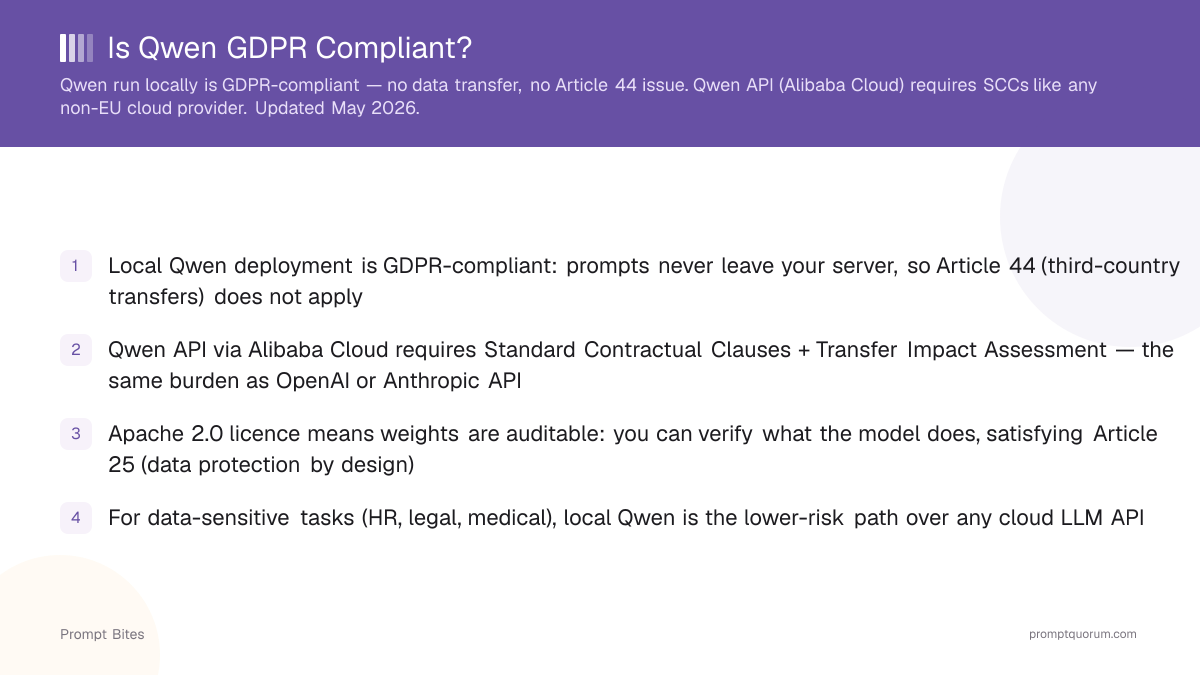
- ✓Local Qwen deployment is GDPR-compliant: prompts never leave your server, so Article 44 (third-country transfers) does not apply
- ✓Qwen API via Alibaba Cloud requires Standard Contractual Clauses + Transfer Impact Assessment — the same burden as OpenAI or Anthropic API
- ✓Apache 2.0 licence means weights are auditable: you can verify what the model does, satisfying Article 25 (data protection by design)
- ✓For data-sensitive tasks (HR, legal, medical), local Qwen is the lower-risk path over any cloud LLM API
Local Qwen Is GDPR-Compliant — Architecture Is the Reason
GDPR Article 44 prohibits transferring personal data to a country outside the EU without an adequate legal basis. When you run Qwen locally, no data transfer occurs — the model processes everything on your hardware, inside your jurisdiction. That is why local deployment is the most defensible GDPR position.
The Qwen model weights (Qwen3 14B, Qwen3 8B) are released under Apache 2.0. This means you can download them, inspect them, and run them on your own server permanently — the licence cannot be revoked. Article 25 (data protection by design) is satisfied because you can demonstrate that sensitive data is never transmitted externally.
Run Qwen locally via Ollama: ollama run qwen3:14b for general tasks, or ollama run qwen3:8b for lighter hardware. The 14B model needs 10–12 GB VRAM at Q4_K_M (a standard RTX 3080 or RTX 4070 is sufficient); the 8B model runs on 6–8 GB VRAM.
📍 In One Sentence
Local Qwen is GDPR-compliant because no prompt data leaves your infrastructure, eliminating the Article 44 third-country transfer requirement entirely.
💬 In Plain Terms
Running Qwen on your own computer or server means your data stays on your machine. GDPR only restricts data leaving the EU — if it never leaves your building, there is no GDPR problem.
Qwen API via Alibaba Cloud — A Different Risk Profile
The Qwen API (api.qwen.ai, via Alibaba Cloud) is hosted in China. Any personal data sent through the API is a third-country transfer under GDPR Article 44. China does not have an EU adequacy decision, so you need Standard Contractual Clauses (SCCs) and a Transfer Impact Assessment (TIA) before using it for data containing personal information.
This is the same requirement that applies to OpenAI, Anthropic, and Google Cloud. It is not uniquely a Qwen problem — it is a structural issue with any cloud LLM hosted outside the EU. The additional China-specific risk is the Personal Information Protection Law (PIPL), which can compel data disclosure on government request. This matters for the TIA: EU regulators may view Chinese jurisdiction as higher-risk than US jurisdiction when assessing transfer adequacy.
If you must use the Qwen API, use it only for non-personal data (e.g., public documents, code generation with no PII). For personal or business-confidential data, use local deployment instead.
| Deployment | Data leaves server? | GDPR Article 44 applies? | Action needed |
|---|---|---|---|
| Qwen local (Ollama) | No | No | None — architecture is compliant |
| Qwen API (Alibaba Cloud) | Yes | Yes | SCCs + TIA required for personal data |
| Claude / OpenAI (EU region) | Yes (EU) | Partial | SCCs still required; TIA may be lighter |
Related Reading
Quick Answers: Qwen and GDPR
Does running Qwen locally satisfy GDPR Article 25?▾
Is Alibaba Cloud GDPR compliant?▾
Which Qwen model is best for GDPR-sensitive workflows?▾
Do I need a Data Processing Agreement with Ollama?▾
Want the full breakdown?
Read the complete guide →Related Prompt Bites