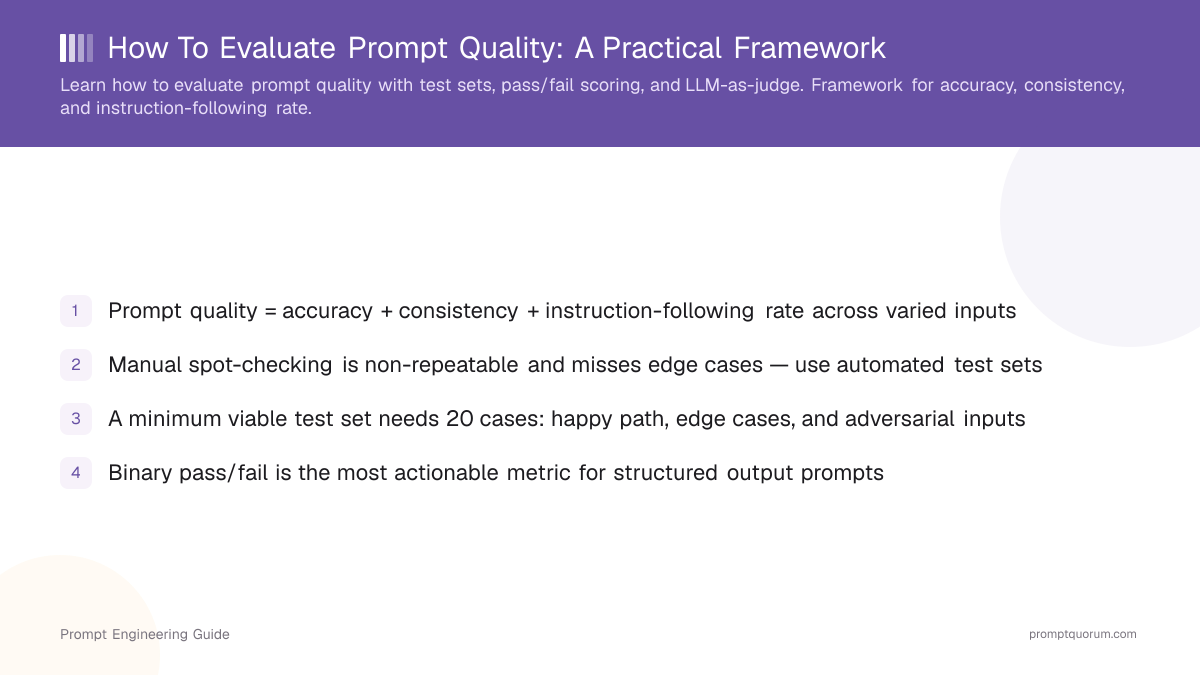
What Is Prompt Quality?
📍 In One Sentence
Prompt quality is the percentage of test inputs where the model produces an output that meets all defined success criteria.
Prompt quality is how reliably a prompt produces the intended output across varied inputs, models, and conditions. A prompt that works on ten handpicked examples may fail 20% of the time when real users interact with it at scale.
Quality is not a single number. It has three independent dimensions: accuracy, consistency, and instruction-following rate. A prompt can fail any one of them while appearing to work on cherry-picked examples.
Systematic evaluation means measuring all three dimensions against a reproducible test set — before deploying to production. See prompt evaluation metrics for a full breakdown of scoring approaches.
🔍 Pro Tip
Define success criteria before building your test set. Scoring outputs without a pre-written rubric reintroduces the subjectivity that systematic evaluation is designed to eliminate.
What Are the Three Components of Prompt Quality?
The three components are accuracy, consistency, and instruction-following rate — and each requires a separate test strategy.
Accuracy measures whether the output matches the intended meaning or result. For classification prompts, accuracy is the percentage of inputs correctly classified. For generation prompts, accuracy requires a rubric or reference output.
Consistency measures whether the same input produces output within the same expected range across multiple runs. High temperature and underspecified prompts both reduce consistency.
Instruction-following rate measures whether the model obeyed every constraint: output format, length limit, required fields, tone, and prohibited content. A prompt that says "respond in JSON" fails on instruction-following any time it returns plain text.
🔍 Key Point
Accuracy and instruction-following rate are different metrics. A prompt can be factually correct but still fail on format, length, or tone constraints — both must be measured separately.
Why Does Manual Spot-Checking Fail?
Manual spot-checking produces irreproducible results and misses the edge cases that cause production failures. Two engineers reviewing the same prompt against different handpicked examples will reach different conclusions.
The structural problems with manual review:
- Selection bias: Reviewers pick inputs they expect to work, not inputs designed to break the prompt
- Non-repeatable: A prompt change cannot be compared fairly against a prior manual review
- Does not scale: 10 examples misses 90% of failure modes visible in a 100-case test set
- No baseline: Without a recorded pass rate, you cannot detect regressions
Criterion | Manual Spot-Check | Systematic Test Set |
|---|---|---|
| Reproducibility | None - different each review | Full - same test set every run |
| Edge case coverage | Misses most edge cases | Explicitly includes edge cases |
| Baseline comparison | Not possible | Built-in - compare pass rates |
| Scale | 5-10 examples in practice | 20-200+ cases |
⚠️ Warning
Manual spot-checks are not baselines. If you cannot reproduce your evaluation, you cannot detect regressions when the prompt or model changes.
How Do You Build a Prompt Test Set?
Build a test set by collecting inputs across three categories then writing explicit pass criteria for each before you run any tests.
Happy-path inputs (40%): Typical inputs the prompt was designed to handle. All should pass.
Edge-case inputs (30%): Inputs at the boundary: empty input, very long input, multilingual input, unusual formatting, missing required fields. These reveal brittleness.
Adversarial inputs (30%): Inputs designed to make the prompt fail: instructions that conflict with the system prompt, requests to ignore constraints, injection-like patterns. These reveal security and reliability gaps.
Write a pass criterion for each input before running the test. A test set without expected outputs is not an evaluation. If you store prompts in a prompt library, track test set pass rate as metadata per entry.
🔍 Pro Tip
Write expected outputs for each test input before running the test. A test set without pre-defined criteria is not an evaluation — it reintroduces manual judgment at scoring time.
❌ Vague approach
Test the prompt with a few emails and see if it looks good.
✅ Systematic test set
Run 20 test inputs: 10 customer emails (happy path), 6 edge cases (empty body, non-English, no subject line), 4 adversarial inputs (instructions embedded in email body). Pass criterion: JSON output with fields [reason, priority, sentiment] all populated, priority in [low, medium, high].
How Do You Score Prompt Outputs?
💬 In Plain Terms
Think of your scoring rubric as a checklist a teacher uses to grade work — every criterion must be checked off before the output counts as correct.
Choose your scoring method based on output type: binary pass/fail for structured outputs, 1-5 rubric for generation tasks, and LLM-as-judge for free-text evaluation.
Binary pass/fail is the most actionable. Use for JSON outputs, classification results, and outputs with a clear correct answer. Pass rate = correct outputs / total test cases.
1-5 scale rubric works for generation tasks where partial credit is meaningful. Define each score level before testing: 5 = fully correct, 4 = minor issue, 3 = acceptable with caveats, 2 = significant problem, 1 = wrong or harmful.
LLM-as-judge uses GPT-5.6 or Claude Opus 5 to score outputs against a rubric. LLM-as-judge is the dominant approach for evaluating free-text outputs at scale. The judge prompt must specify the rubric precisely.
Method | Best for | Scale | Human effort | Reliability |
|---|---|---|---|---|
| Binary pass/fail | Structured output, classification | Any size | Zero after setup | High — objective |
| 1-5 rubric | Generation with partial credit | <100 cases | Medium — manual scoring | Medium — inter-rater variance |
| LLM-as-judge | Free-text, large test sets | 1000+ cases | Low — rubric design only | High — if rubric is precise |
// LLM-as-judge scoring prompt (pseudocode)
const judgePrompt = `
Score this customer support response 1-5:
5 = Correct, professional, addresses all concerns
4 = Correct, minor issue
3 = Partially correct
2 = Incorrect or missing key info
1 = Wrong, rude, or harmful

Question: {input}
Response: {output}

Score (1-5) + one-sentence justification:
`;
🔍 Key Point
LLM-as-judge works best when the judge prompt specifies the rubric precisely. A vague rubric produces inconsistent scores — define each score level with a concrete example before running the judge.
Does Prompt Quality Differ Across Models?
Yes — the same prompt can score 20+ points differently between GPT-5.6 and Claude Opus 5, primarily due to instruction-format sensitivity and system prompt handling.
Quality gaps are largest for:
- JSON output formatting: Claude Opus 5 follows complex schemas more strictly than GPT-5.6
- Instruction priority: GPT-5.6 weights the most recent instruction; Claude Opus 5 weights the system prompt
- Refusal patterns: OpenAI and Anthropic models have different thresholds for borderline content
Our evaluation of classification and formatting prompts across both models (updated through August 2026) found pass rate differences of 10–20 points, with JSON output formatting producing the largest gaps. See how to test prompts across models for a full multi-model evaluation methodology.
Use PromptQuorum to dispatch the same test set to GPT-5.6, Claude Opus 5, and Gemini 3.1 Pro in one run and compare pass rates side-by-side.
⚠️ Warning
Do not assume a prompt that passes on GPT-5.6 will pass on Claude Opus 5. Run the same test set on every model you plan to deploy — a prompt may need model-specific tuning.
How To Start Evaluating Prompt Quality
Start with success criteria before building the test set — evaluating outputs without pre-defined criteria reintroduces the subjectivity that systematic testing is designed to eliminate. Work through the six steps below to set up a repeatable evaluation system. If pass rate drops after changes, apply prompt brittleness reduction techniques before re-evaluating.
- 1Write down success criteria before building the test set: what does a passing output look like in terms of format, content, and constraints?
- 2Collect 20 test inputs: 8 happy-path, 6 edge cases, 6 adversarial. Write expected outputs or pass criteria for each.
- 3Choose a scoring method: binary for structured outputs, 1-5 rubric for generation, LLM-as-judge for free text.
- 4Run all 20 inputs through your current prompt and score each output. Record this pass rate as your baseline.
- 5Dispatch the same test set to GPT-5.6 and Claude Opus 5 via PromptQuorum and compare model-level pass rates.
- 6Set a regression threshold: if a prompt change drops pass rate by more than 5 points, block the deployment.
🔍 Pro Tip
Run the test set twice — once before and once after any prompt change. The difference in pass rate is your change impact score. A drop of more than 5 points signals a regression.
What Are the Most Common Prompt Evaluation Mistakes?
❌ Testing only happy-path inputs
Why it hurts: Happy-path inputs that always pass tell you nothing about production reliability. Edge cases and adversarial inputs cause the failures users encounter.
Fix: At minimum 30% of test inputs should be edge cases or adversarial. A 20-case test set should include at least 6 edge cases and 4 adversarial inputs.
❌ No expected outputs for test cases
Why it hurts: Scoring outputs without pre-defined criteria reintroduces the subjective judgment that systematic evaluation is designed to eliminate.
Fix: Write a pass criterion for each test input before you run the test. A 20-word expected output summary per case is sufficient.
❌ Using pass rate from one model on another
Why it hurts: The same prompt regularly scores 10-20 points differently between GPT-5.6 and Claude Opus 5. Assuming one model's pass rate applies to another leads to production surprises.
Fix: Run the test set separately on each model you plan to deploy. GPT-5.6, Claude Opus 5, and Gemini 3.1 Pro all need independent evaluation.
❌ No baseline
Why it hurts: Without a recorded pass rate from the first evaluation, you cannot detect regressions when the prompt changes or the model updates.
Fix: Record the pass rate the first time you evaluate a prompt. Every future change must be compared against that baseline number.
🔍 Key Point
Each mistake here reintroduces the subjectivity that systematic evaluation is designed to eliminate. Treat these as anti-patterns to enforce from the start of your evaluation process.
What Regional Regulations Affect Prompt Evaluation?
Regulatory requirements increasingly mandate documented AI output quality assurance, with specific obligations varying by jurisdiction.
EU (AI Act 2025–2026): High-risk AI systems under the EU AI Act must demonstrate documented testing and quality assurance processes. Prompt evaluation test sets and pass rate records provide audit-ready evidence of systematic quality control. GDPR Article 22 also requires that automated decisions affecting individuals can be explained — prompt evaluation records support this.
US (SOC 2 / NIST AI RMF): SOC 2 Type II audits increasingly review AI-related change management. Documented prompt test sets with version history and pass rate baselines satisfy audit requirements for quality controls on AI-driven workflows. The NIST AI Risk Management Framework (updated through 2026) emphasizes measurement and monitoring as core risk controls.
Regulated industries: Financial services, healthcare, and legal teams deploying LLM-based tools should maintain prompt evaluation records as part of model governance documentation. Pass rate baselines and regression gates provide measurable quality evidence for compliance reviews.
🔍 Pro Tip
If your organization undergoes SOC 2 or regulatory audits, prompt evaluation test sets and pass rate records become audit evidence. Store them alongside your prompt library for easy retrieval.
Frequently Asked Questions
What is prompt quality?
Prompt quality measures how reliably a prompt produces the intended output across varied inputs. It has three dimensions: accuracy, consistency, and instruction-following rate. A quality prompt produces correct, consistent, and properly-formatted outputs 85%+ of the time across all input types.
How do you evaluate prompt quality?
Build a test set of 20+ inputs (happy path, edge cases, adversarial), define pass criteria for each before testing, run the inputs through your prompt, and score outputs against your rubric. Track the overall pass rate as your primary quality metric. Record this baseline so you can detect regressions when the prompt changes.
What is instruction-following rate?
Instruction-following rate is the percentage of outputs where the model obeyed every constraint in the prompt: format, length, tone, scope, and prohibited content. A 90% rate means 1 in 10 requests fails in production. This is distinct from accuracy and must be measured separately.
Why does manual spot-checking fail for prompt evaluation?
Manual spot-checking is non-repeatable (different reviewers pick different examples), selection-biased (reviewers unconsciously pick cases they expect to pass), and does not scale (10 examples miss 90% of failure modes in a 100-case set). Automated test sets produce consistent, reproducible results across prompt versions and model updates.
How many test cases does a prompt test set need?
A minimal test set needs 20 cases: 10 happy-path inputs covering typical use, 5 edge cases testing boundaries (empty input, very long input, multilingual text), and 5 adversarial inputs designed to break the prompt. Fewer than 20 cases produces statistically unreliable pass rates that miss real failure modes.
Does prompt quality differ between GPT-5.6 and Claude Opus 5?
Yes, significantly. The same prompt regularly scores 10-20 points differently between GPT-5.6 and Claude Opus 5 due to differences in instruction-format sensitivity and system prompt handling. Always measure pass rate separately on each model you plan to deploy. A prompt that scores 95% on GPT-5.6 may score 80% on Claude Opus 5 without model-specific tuning.
What is LLM-as-judge scoring and when should I use it?
LLM-as-judge uses a capable model like GPT-5.6 or Claude Opus 5 to score outputs against a rubric prompt. The judge receives the original input, your model's output, and evaluation criteria, then returns a score with justification. Use LLM-as-judge for free-text outputs where binary pass/fail is insufficient. It scales to thousands of test cases without human review, making it ideal for continuous evaluation pipelines.
How do you set a pass rate regression threshold?
Record the pass rate on the first test run as your baseline. A regression gate of 5 points is common: if a prompt change drops pass rate by more than 5 points compared to baseline, block the deployment. Teams typically target 85–95% pass rate for production prompts. For critical workflows (legal, medical, financial), use a 2-point regression gate instead.
Sources
- OpenAI Evals Framework ([github.com/openai/evals)](https://github.com/openai/evals) — Open-source framework for evaluating LLM outputs with test harness and scoring utilities
- Anthropic Model Evaluations ([anthropic.com)](https://www.anthropic.com/research/evaluating-ai-systems) — Anthropic approach to capability and safety evaluation methodology
- The Prompt Report: Systematic Survey of Prompting Techniques (arXiv:2406.06608) — Schulhoff et al., 2024. Comprehensive framework covering prompt design and evaluation across 50+ techniques.
- DeepEval: LLM Evaluation Framework ([github.com/confident-ai/deepeval)](https://github.com/confident-ai/deepeval) — Confident AI, 2024–2025. Open-source framework for automated LLM output evaluation with metrics, test sets, and CI/CD integration.
- NIST AI Risk Management Framework (airc.nist.gov) — NIST, 2023–2026 (updated). Framework covering AI system evaluation, quality assurance methodology, and governance documentation for regulated environments.