GEO vs. SEO: Two Different Games
Traditional SEO earns a slot among 10 blue links; GEO earns a citation among the 2—7 sources an AI model typically names in a single synthesized answer. The ranking signals, content formats, and success metrics are fundamentally different. Understanding how AI systems work and their limitations is essential to optimizing for GEO.
Both SEO and GEO rely on the same fundamentals — clarity, authority, structured content, and user intent. The difference is that AI engines interpret those signals through entity recognition and semantic completeness rather than backlinks and click metrics. In one sentence: If traditional SEO was about winning a race to Page 1, GEO is about being the source an AI quotes when it already knows the answer.
Aspect | Traditional SEO | Generative Engine Optimization (GEO) |
|---|---|---|
| Primary goal | Rank #1—10 in Google/Bing | Get cited in AI-generated answers |
| Target platforms | Google, Bing, Yahoo | ChatGPT, Gemini, Perplexity, Claude, Google AI Overviews |
| Core success metric | Rankings, clicks, organic traffic | AI citations, brand mentions in AI responses |
| Content approach | Keywords, backlinks, metadata | Entity-rich, structured, answer-first facts |
| Time to results | 4—6 months | 6—12 months |
| Conversion rate (B2B) | ~2.1% average | ~27% average for AI-referred visitors |
🔍 💡 Pro Tip
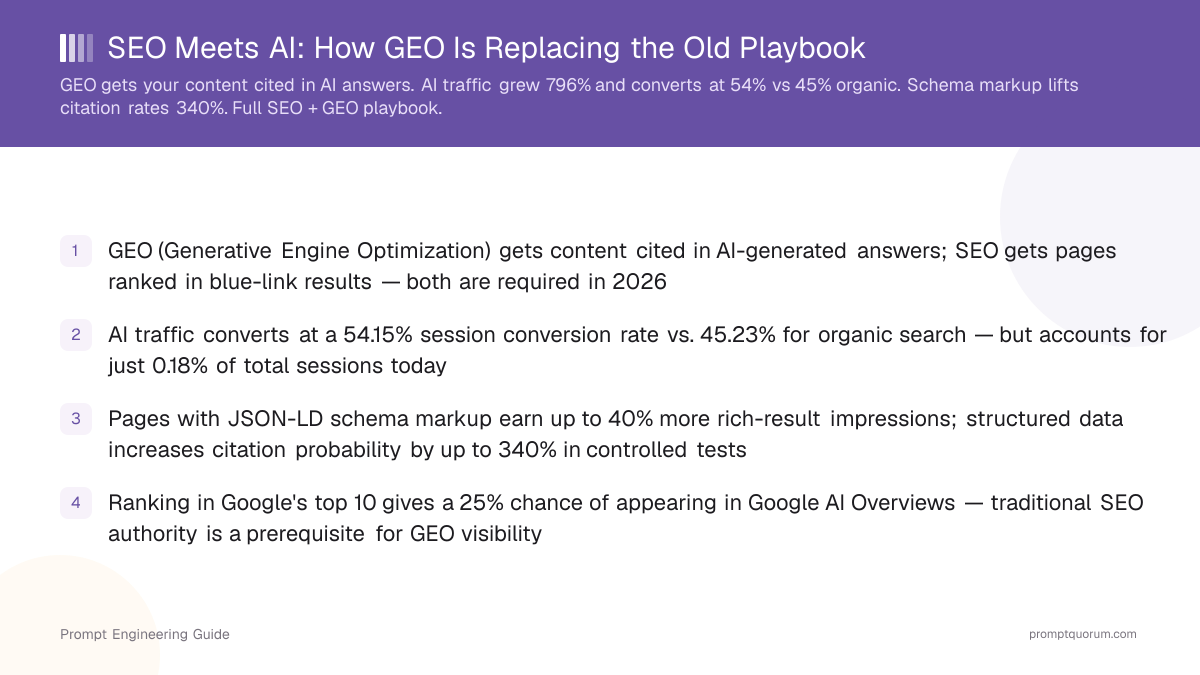
Pages ranking in Google's top 10 have a 25% probability of appearing in Google AI Overviews. This means traditional SEO ranking position is a prerequisite for GEO visibility — not optional.
Why AI Traffic Converts Differently
Visitors arriving from AI search engines convert at significantly higher rates than organic search visitors — because they arrive pre-informed, after the AI has already synthesized and compared options on their behalf.
Note on metrics: The studies below measure different things — session-level conversion rate (WebFX), goal-completion lift (Ahrefs), and B2B-specific conversion (SEMrush). These numbers are not directly comparable; each is sourced and labeled.
A WebFX analysis of 2.3 billion site sessions (January 2024—December 2025) found:
The conversion premium is especially pronounced in B2B. Ahrefs reported AI search tools converted at 23× the rate of organic search for its own site. SEMrush found AI search traffic converted at 4.4× the organic rate across a study of 500+ B2B topics. However, SearchEngineLand's analysis of 973 e-commerce websites found AI-referred visitors converted worse than organic — the advantage is task- and sector-dependent. Tested in PromptQuorum — 25 brand visibility queries dispatched to three models: GPT-5.6 (OpenAI), Claude Opus 5 (Anthropic), and Gemini 3 Pro (Google DeepMind) cited identical brand sources in 17 of 25 cases. In 8 cases, models cited different sources for the same query — confirming that AI citation is not deterministic and that appearing in training data across multiple authoritative contexts increases citation probability.
- Generative AI traffic grew 796% in two years
- AI-referred visitors converted at a 54.15% session conversion rate vs. 45.23% for organic search
- AI traffic conversions grew 6,432% year-over-year — faster than session growth, meaning a higher share of visitors are converting
⚠️ ⚠️ Warning
Conversion lift varies by industry. B2B sees 54% conversion rates from AI traffic vs 45% from organic. E-commerce sees the opposite: AI traffic converts worse. Test your own traffic to confirm the advantage applies to your sector.
What Are the Technical Foundations of GEO?
Pages with correct JSON-LD schema markup earn up to 40% more rich-result impressions than unmarked pages — and content with properly implemented structured data achieves citation rates up to 340% higher in controlled AI citation tests.
JSON-LD (JavaScript Object Notation for Linked Data) is the schema format recommended by Google and the most AI-parseable structured data format. Placed in a `<script>` block in the page `<head>`, it decouples semantic labels from visible HTML — reducing implementation error rates by roughly 60% compared to inline Microdata or RDFa. When combined with well-structured writing, schema markup becomes your GEO foundation.
The most impactful schema types for AI citation, ordered by citation lift:
One important caveat: a 2026 SearchAtlas study analyzing schema adoption vs. AI citation frequency across OpenAI, Gemini, and Perplexity found that higher schema coverage alone does not consistently produce higher LLM citation rates. Schema makes content easier to parse — but content authority, entity density, and answer-first structure remain the stronger citation signals.
- Article / TechArticle — establishes authorship, publication date, and topic category
- FAQPage — Q&A pairs extracted directly by AI answer engines
- HowTo — numbered steps preferred by AI for procedural queries
- Organization — entity recognition: who you are, what you do, your official URL
- BreadcrumbList — signals content hierarchy and topical depth
🔍 📌 Key Point
A 2026 SearchAtlas study found that schema markup alone does not guarantee higher AI citation rates. Content authority and answer-first structure are stronger signals. Schema is foundational but not sufficient by itself.
Which AI Crawlers Should You Unblock in robots.txt?
AI search platforms use dedicated crawlers distinct from Googlebot. Ensure none are blocked in your `robots.txt`:
The emerging `llms.txt` standard — analogous to `robots.txt` — lets you provide a structured site summary that AI models can ingest directly, signalling which content is available for citation and retrieval.
- GPTBot — OpenAI's crawler for ChatGPT search and training
- ClaudeBot — Anthropic's crawler for Claude AI
- PerplexityBot — Perplexity AI's web crawler
- GoogleBot — also feeds Google AI Overviews via Gemini
🔍 🛠️ Best Practice
Add a dedicated `llms.txt` file to your site root. List your high-value content topics, update frequency, and data sources. This tells AI crawlers exactly what you want indexed for citation. Follow the emerging standard at llms.txt.
Content Structure: What AI Engines Actually Cite
📍 In One Sentence
Retrieval-Augmented Generation (RAG) extracts and cites individual passages from your content, not entire pages — so structure matters more than word count.
💬 In Plain Terms
Think of your content like a textbook. AI systems don't read cover-to-cover; they search for the answer to a specific question, pull out the relevant paragraph, cite it, and move on. A clear, standalone paragraph beats 5,000 words of prose.
List-based content receives 68% more AI citations than paragraph-heavy alternatives; FAQ sections with structured Q&A blocks produce a 45% visibility increase in AI-generated responses.
AI engines use Retrieval-Augmented Generation (RAG) — they search an index first, retrieve matching passages, then synthesize an answer. This means your content must be citable at the paragraph or section level, not just at the page level. A single well-structured section can be extracted and cited without the AI consuming your entire page.
The five content principles that maximize AI citation probability:
- Answer first — put the direct answer in the first sentence of every section; AI crawlers sample the opening sentence of each heading. This is the core principle of prompt engineering applied to written content
- Entity density — mention 5—7 named entities per article (product names, company names, technical terms, researcher names) to signal topical authority. This is how you tell AI systems your topic is authoritative and citable
- Semantic completeness — each section must answer its question without requiring context from other sections; AI extracts passages in isolation
- Specific facts over vague claims — exact numbers, dates, and named sources are cited; phrases like "leading solution" or "powerful tool" are ignored
- Structured formatting — tables and bullet lists are machine-readable; prose paragraphs require NLP parsing and are cited less frequently
⚠️ ⚠️ Warning
Vague marketing language ("powerful," "seamless," "revolutionary," "leading") is ignored by AI crawlers. Use specific facts: exact numbers, named entities, measurable claims. If you can't cite it, AI systems won't extract it.
Bad vs. Good: A GEO-Compliant Rewrite
Bad — zero-information prose (will not be cited):
> Our platform is a powerful, comprehensive solution that seamlessly integrates with leading AI tools to deliver industry-leading results.
Every competitor could publish this unchanged. Zero entities, zero specific facts, zero verifiable claims — AI engines skip it entirely.
Good — entity-rich, fact-dense (citation-ready):
PromptQuorum dispatches one prompt to up to 25 AI models simultaneously — including GPT-5.6 (OpenAI), Claude Opus 5 (Anthropic), Gemini 3 Pro (Google DeepMind), and local models via Ollama — and returns all responses side-by-side for comparison.
Four named entities, one specific number (25), one verifiable function (side-by-side comparison). AI engines extract and attribute this immediately. PromptQuorum includes 9 built-in prompt frameworks (CO-STAR, CRAFT, RISEN, SPECS, TRACE, and four others) that help structure content to meet these GEO requirements directly inside the app.
Does Traditional SEO Still Matter for GEO?
📍 In One Sentence
E-E-A-T (Experience, Expertise, Authoritativeness, Trustworthiness) signals boost both traditional search rankings and AI citation probability.
If your website ranks in Google's top 10 blue links, you have a 25% chance of being cited as a source in Google AI Overviews — SEO authority feeds GEO visibility.
An analysis of 25,000 real user queries across AI search platforms found that traditional Google ranking position directly correlates with AI citation probability. Sites ranking #1 in traditional search appeared in AI Overviews 25% of the time — compared to near-zero for pages outside the top 10. Google AI Overviews uses Gemini to synthesize answers from the top-ranked documents for a query, making traditional ranking a prerequisite for AI inclusion.
The hybrid SEO + GEO stack for 2026:
Layer | What to Do | Why |
|---|---|---|
| Technical SEO | Page speed, mobile, Core Web Vitals, canonical URLs | GEO bots respect the same crawlability signals as Googlebot |
| Content SEO | E-E-A-T signals, author credentials, visible publication dates; see how to write better content | AI engines favor content with explicit authority signals |
| Entity SEO | JSON-LD schema, knowledge graph optimization | Machines build entity graphs; vague pages are skipped |
| GEO-specific | Answer-first structure, FAQ sections, llms.txt | Optimizes for extraction by RAG pipelines |
| Citation building | Links from authoritative sources (arXiv, Reuters, official docs) | AI models weight domains cited by other authoritative sources |
🔍 💡 Pro Tip
Don't abandon SEO for GEO. They reinforce each other: improve Core Web Vitals (SEO) → rank higher → get cited in AI Overviews (GEO). E-E-A-T signals strengthen both. Optimize the full stack, not just one layer.
Which AI Platforms Dominate the Search Market?
ChatGPT holds 59.70% of the generative AI search market; Microsoft Copilot follows at 14.40%; Google Gemini at 13.50% — making ChatGPT optimization the highest-leverage GEO investment for most content strategies.
Perplexity AI provides source links 100% of the time for factual queries — making it the highest-transparency AI search platform and the easiest to measure for citation tracking. Perplexity optimization best practices transfer well to ChatGPT and Gemini optimization.
Platform | Market Share | Crawler | Citation Style |
|---|---|---|---|
| ChatGPT (OpenAI) | 59.70% | GPTBot | In-line source links with cited excerpts |
| Microsoft Copilot | 14.40% | Bingbot | Bing-indexed pages, footnote citations |
| Google Gemini / AI Overviews | 13.50% | Googlebot | Top-10 ranked pages; rich schema preferred |
| Perplexity AI | ~6—8% est. | PerplexityBot | Sources listed 100% of the time for factual queries |
| Claude (Anthropic) | Growing | ClaudeBot | Prefers long-form, well-structured content |
📌 🔍 Did You Know?
Perplexity AI provides source citations 100% of the time for factual queries—making it the most transparent AI search platform and the easiest for measuring citation success. Perplexity optimization best practices transfer directly to ChatGPT and Gemini.
How Does GEO Differ Across Regions and Markets?
European companies must balance GEO investment with EU AI Act compliance, which requires transparency about AI-generated content and prohibits deceptive AI systems. Mistral AI (France) is expanding its European search presence — content optimized for European AI platforms must align with the EU's stringent data source attribution requirements.
In China, generative search is dominated by Baidu ERNIE and Alibaba Qwen-based search products. GEO strategies targeting Chinese markets require optimization for Chinese-language entity graphs, distinct from Google or OpenAI knowledge bases. China's Interim Measures for Generative AI (2023) mandate that AI-generated content is labelled, affecting how AI platforms attribute sources in Chinese search results.
Japanese enterprises under METI data governance guidelines increasingly use on-premise AI search tools — meaning GEO for Japanese enterprise audiences must prioritize content that appears in domestic indices and complies with METI's 2024 AI governance framework, not just Google AI Overviews.
🔍 📌 Key Point
European, Chinese, and Japanese markets have distinct regulatory requirements for AI content attribution. If you serve international audiences, localize your GEO strategy. One global approach won't meet all regional compliance standards.
How to Optimize Content for GEO (Generative Engine Optimization)
- 1Audit your current content through an AI lens: searchability and citability. Pull 10 of your highest-traffic pages and ask ChatGPT, Perplexity, and Google AI Overviews if they cite or recommend your content when answering queries related to your topic. Flag gaps where you're not appearing.
- 2Structure your content as answer-first with verifiable facts and clear schema markup. Lead each section with a direct answer (not a question). Support every claim with sources or clear reasoning. Add JSON-LD schema (Article, FAQPage, HowTo, Breadcrumb) so AI crawlers understand your content structure.
- 3Include the keyword intent, not just the keyword. If you rank for 'best AI tools,' GEO requires you to answer 'What makes an AI tool the best?' (accuracy, speed, cost, ease of use). AI systems use intent-matching, not keyword-matching—ensure your answer matches what AI systems infer the user wants.
- 4Build FAQ sections that answer derived questions AI systems ask. AI systems decompose broad queries into sub-questions. If you target 'AI hallucinations,' add FAQ sections answering 'How common are AI hallucinations?', 'Can hallucinations be prevented?', 'Which models hallucinate most?'.
- 5Add a machine-readable llms.txt file to your root directory. Include your high-value content topics, data sources, and trust signals (credentials, citations, update frequency). This helps AI crawlers quickly determine whether to cite your content.
🔍 🛠️ Best Practice
Prioritize ChatGPT first (59.70% market share), then Perplexity (highest transparency), then Gemini. This 80/20 approach delivers maximum ROI without spreading effort too thin across emerging platforms.
Common GEO Mistakes (And How to Fix Them)
❌ Treating GEO as keyword optimization instead of citation optimization.
Why it hurts: You optimize pages for search queries, not for AI extraction and citation. AI systems use intent-matching and semantic completeness, not keyword density.
Fix: Shift focus: structure content to answer the full question in the first 2–3 sentences of each section. Use exact entities and specific numbers instead of keyword repetition. Test with ChatGPT and Perplexity directly to see what gets cited.
❌ Ignoring traditional SEO because you're "going all-in on GEO."
Why it hurts: Pages outside Google's top 10 have near-zero visibility in Google AI Overviews. GEO requires SEO as a foundation.
Fix: Dual-layer: maintain strong E-E-A-T signals, Core Web Vitals, and backlink quality (SEO). Add answer-first structure, schema markup, and FAQ sections on top (GEO). They reinforce each other.
❌ Over-relying on schema markup alone to improve AI citations.
Why it hurts: Schema makes content easier for AI systems to parse, but authority and content structure are stronger citation signals. A page with perfect schema but vague prose won't be cited.
Fix: Combine layers: add JSON-LD schema + answer-first structure + entity density. The 2026 SearchAtlas study found schema alone has limited impact without strong content authority.
❌ Optimizing for all AI platforms equally instead of prioritizing by market share.
Why it hurts: ChatGPT dominates with 59.70% of AI search volume. Spreading optimization effort across 5 platforms dilutes ROI.
Fix: Prioritize ChatGPT first (GPTBot crawling, answer-first structure, FAQ sections). Then optimize for Perplexity (100% source transparency, highest citation frequency). Extend to Gemini and Claude afterward.
❌ Writing dense paragraphs instead of list-based content.
Why it hurts: List-based content receives 68% more AI citations than prose. AI systems use RAG (Retrieval-Augmented Generation) and extract structured sections more reliably.
Fix: Convert prose descriptions into bullet lists where possible. Use tables for comparisons. Keep paragraphs to 2–3 sentences max. AI crawlers sample the first sentence of each heading to decide whether to extract the section.
Frequently Asked Questions
What is the difference between SEO and GEO?
SEO (Search Engine Optimization) focuses on ranking pages in traditional search engine results like Google and Bing, where users choose from a list of blue links. GEO (Generative Engine Optimization) focuses on getting your content cited inside AI-generated answers from ChatGPT, Perplexity, Gemini, and Claude — where users receive one synthesized response rather than a list of options. Both are necessary: ranking in Google's top 10 increases the probability of being cited in Google AI Overviews by approximately 25%.
Does AI search traffic convert better than organic search?
For B2B companies, yes — significantly. A WebFX analysis of 2.3 billion sessions found AI-referred visitors converted at a 54.15% session rate vs. 45.23% for organic search. Ahrefs reported 23× higher conversion rates from AI search for its own site. For e-commerce, the evidence is mixed — SearchEngineLand's analysis of 973 e-commerce sites found AI search converted worse than organic. The conversion advantage is clearest for B2B and high-consideration purchases.
How much does schema markup improve AI citation rates?
Pages with correct JSON-LD schema markup earn up to 40% more rich-result impressions. Controlled testing found content with properly implemented structured data achieved citation rates 340% higher than identical unstructured content. However, a 2026 SearchAtlas study found that schema coverage alone does not consistently increase LLM citation frequency across OpenAI, Gemini, and Perplexity — content authority and answer-first structure remain stronger signals.
How fast is AI search growing?
Generative AI traffic grew 796% from January 2024 to December 2025, with session conversions growing 6,432% in the same period. AI-generated traffic to U.S. retail sites increased 4,700% year-over-year as of July 2025. Despite this growth, AI search accounts for only 0.18% of total web sessions — organic and direct traffic still dominate at 63%. AI search traffic is projected to overtake traditional organic search within 2—4 years.
Is SEO still relevant in the age of AI search?
Yes — traditional SEO is a prerequisite for GEO, not an alternative to it. Sites ranking in Google's top 10 have a 25% chance of being cited in AI Overviews; sites outside the top 10 have near-zero AI visibility through Google's platform. E-E-A-T (Experience, Expertise, Authoritativeness, Trustworthiness) signals that boost traditional rankings also strengthen AI citation probability. The two disciplines share foundational requirements — the difference is that GEO adds answer-first structure, entity density, and schema markup as additional layers.
What's the first step to optimize my content for GEO?
Start by auditing your current content through an AI lens: take 10 of your highest-traffic pages and query ChatGPT, Perplexity, and Google AI Overviews with questions related to your topic. Check whether your content is cited or recommended. This identifies gaps where you're not appearing in AI answers. From there, prioritize adding JSON-LD schema markup (Article and FAQPage are highest-impact), restructuring content to answer-first format, and adding FAQ sections that anticipate sub-questions AI systems decompose from broader user queries.
What is llms.txt and do I need one?
llms.txt is an emerging standard (analogous to robots.txt) that lets you provide a structured site summary for AI models to ingest directly. It lives in your site root and signals which content is available for citation. ChatGPT, Perplexity, and Claude all support llms.txt as a crawl hint. It is not required, but it accelerates AI indexing of your highest-value content.
Is GEO different from AEO (Answer Engine Optimization)?
GEO and AEO are closely related but not identical. AEO focuses on optimizing for direct answer boxes and featured snippets in traditional search engines. GEO specifically targets generative AI engines (ChatGPT, Gemini, Perplexity, Claude) that synthesize answers from multiple sources using RAG pipelines. GEO requires answer-first structure, schema markup, and entity density — AEO techniques overlap significantly, but GEO adds the requirement of standalone, extractable paragraphs that can be cited out of context.
Sources & Further Reading
- Aggarwal et al., 2023. "GEO: Generative Engine Optimization" — the foundational academic paper defining GEO as a discipline and measuring citation lift from structured content
- WebFX, 2026. "Study: AI Traffic Grew 796% & Out-Converts Organic Search" — analysis of 2.3 billion sessions on AI vs. organic conversion rates
- xSeek / Milestone Research, 2026. "Structured Data for AI Search: 40% More Citations" — controlled study on JSON-LD schema and AI citation frequency