Key Takeaways
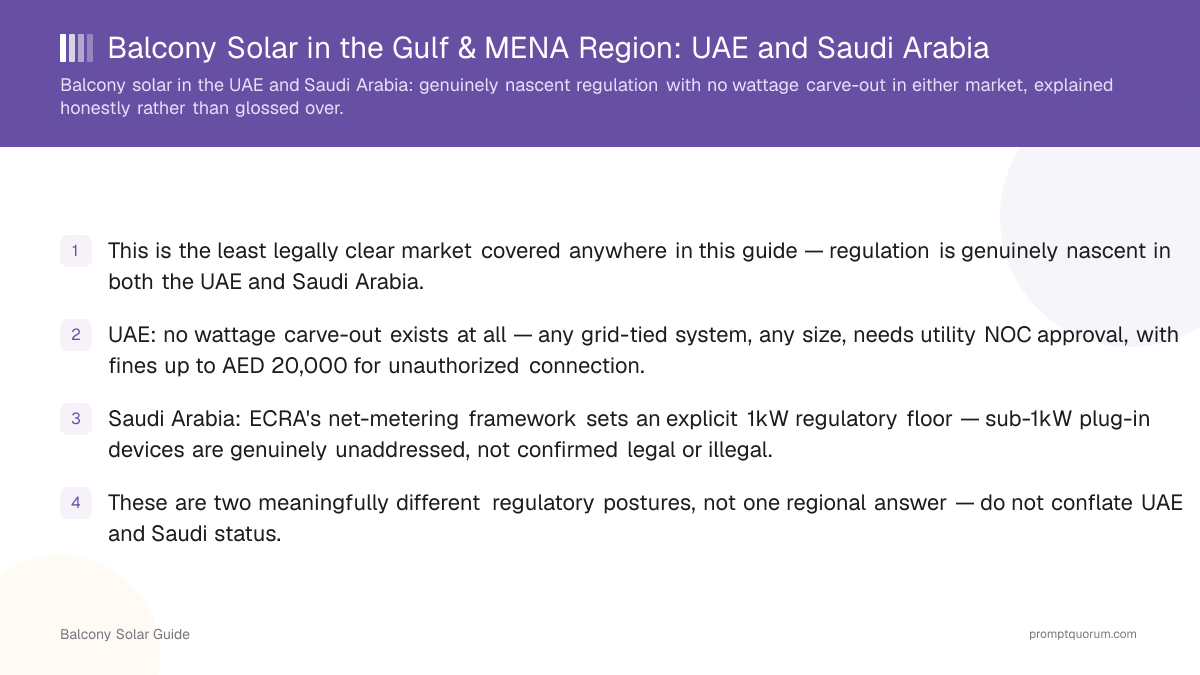
- This is the least legally clear market covered anywhere in this guide — regulation is genuinely nascent in both the UAE and Saudi Arabia.
- UAE: no wattage carve-out exists at all — any grid-tied system, any size, needs utility NOC approval, with fines up to AED 20,000 for unauthorized connection.
- Saudi Arabia: ECRA's net-metering framework sets an explicit 1kW regulatory floor — sub-1kW plug-in devices are genuinely unaddressed, not confirmed legal or illegal.
- These are two meaningfully different regulatory postures, not one regional answer — do not conflate UAE and Saudi status.
- No Gulf-specific plug-in solar product pricing was found in either market — this product category isn't commercially established here yet.
- Given the enforcement risk in the UAE specifically (real fines, cited explicitly), this is not a market where "probably fine" is good enough — confirm directly with your specific utility.
Why This Region Is Different
Neither the UAE nor Saudi Arabia has a dedicated plug-in-solar framework, and the two markets handle that gap differently rather than sharing one regional status. The UAE requires utility approval for any grid-tied connection regardless of size, with no wattage carve-out at all — a stricter default than most markets in this guide. Saudi Arabia's ECRA regulation instead sets an explicit 1kW regulatory floor, leaving sub-1kW plug-in devices in a genuine gap below the regulatory net — neither permitted nor banned, which is a meaningfully different situation from the UAE's blanket approval requirement.
United Arab Emirates
In the UAE, every grid-tied solar connection — regardless of size — requires utility approval, and there is no documented exemption for small plug-in units. Dubai's DEWA (Shams Dubai program), Abu Dhabi's ADDC and Al Ain's AADC, and Sharjah's SEWA each require a No Objection Certificate or equivalent approval before connection; Sharjah's framework is explicitly described as still under development. DEWA can fine up to AED 20,000 or disconnect supply for unauthorized or non-compliant solar installations — a real enforcement mechanism, not a theoretical risk.
⚠️Warning: Plugging in an unapproved solar device in the UAE carries real, cited enforcement risk (fines up to AED 20,000). This is not a market to treat casually based on the device being small.
Saudi Arabia
Saudi Arabia's ECRA (Electricity & Cogeneration Regulatory Authority) net-metering framework explicitly sets a 1kW minimum capacity for its regulated small-scale solar PV process — meaning a sub-1kW plug-in device technically falls outside the regulation's scope entirely, neither clearly permitted nor explicitly banned. Systems 1kW and above go through SEC's (Saudi Electricity Company) full registration process via the Shams platform. Whether a sub-1kW, non-exporting, self-use-only plug-in device is safe to operate without triggering any registration requirement is a genuine open question this guide cannot resolve — no source directly addresses that specific scenario.
What This Means for Buyers
If you're in the UAE, contact your specific utility (DEWA, ADDC, AADC, or SEWA depending on your emirate) before installing anything — there is no small-system exception to lean on, and enforcement is real. If you're in Saudi Arabia, a sub-1kW device sits in a genuine regulatory gap rather than confirmed legal territory — proceed cautiously and consider that "unaddressed" is not the same as "permitted."
Frequently Asked Questions
Is balcony solar legal in Dubai?
Not without utility approval — DEWA requires a No Objection Certificate or equivalent approval for any grid-tied solar connection, regardless of size. There is no documented exemption for small plug-in units.
Can I get fined for installing balcony solar in the UAE without approval?
Yes — DEWA can fine up to AED 20,000 or disconnect supply for unauthorized or non-compliant solar installations, a real and cited enforcement mechanism.
Is a small plug-in solar device legal in Saudi Arabia?
This is genuinely unclear. ECRA's regulation sets an explicit 1kW floor for its net-metering framework, meaning sub-1kW devices fall outside its scope entirely — neither confirmed legal nor explicitly banned.
Do UAE and Saudi Arabia have the same balcony solar rules?
No — they're meaningfully different. The UAE requires approval for any size with no exemption; Saudi Arabia's regulation has an explicit floor that leaves small devices unaddressed rather than requiring approval.
Which UAE utility do I need to contact?
It depends on your emirate: DEWA for Dubai, ADDC for Abu Dhabi city, AADC for Al Ain, or SEWA for Sharjah — each has its own approval process, and Sharjah's framework is still under development.
Is balcony solar hardware even sold in the Gulf region?
No dedicated Gulf-market plug-in solar kit pricing was found during research for this guide — this product category doesn't appear commercially established in either market yet.
Should I just install a small system in Saudi Arabia since it's under the 1kW threshold?
This guide isn't going to tell you that's safe — "unaddressed by regulation" is not the same as "confirmed legal," and no source directly addresses whether a sub-1kW self-use device triggers any requirement. Proceed with that uncertainty in mind.
Will this page get clearer as regulation develops?
Likely, given how nascent the current state is in both markets — this page is on the standard 6-month refresh cycle and will update as SEWA's framework or ECRA's scope develops further.