Balcony Solar: Kits, Rules, and No-Cloud Setups
Plug-in balcony solar (Balkonkraftwerk) lets you generate your own power from a railing, wall, or garden panel — no rooftop installer required. These 33 guides cover the stack: the best kits, batteries, and micro-inverters, legality by country, installation and registration, and running the whole setup on Home Assistant instead of a vendor cloud.
Most balcony solar brands push you toward their own app and cloud dashboard — Hoymiles, Deye, APsystems, EcoFlow, Anker, and Zendure all default to routing your production data through a vendor server. A local setup reads that same data directly from the inverter or battery and keeps it on hardware you own, so monitoring keeps working even if the manufacturer's app disappears.
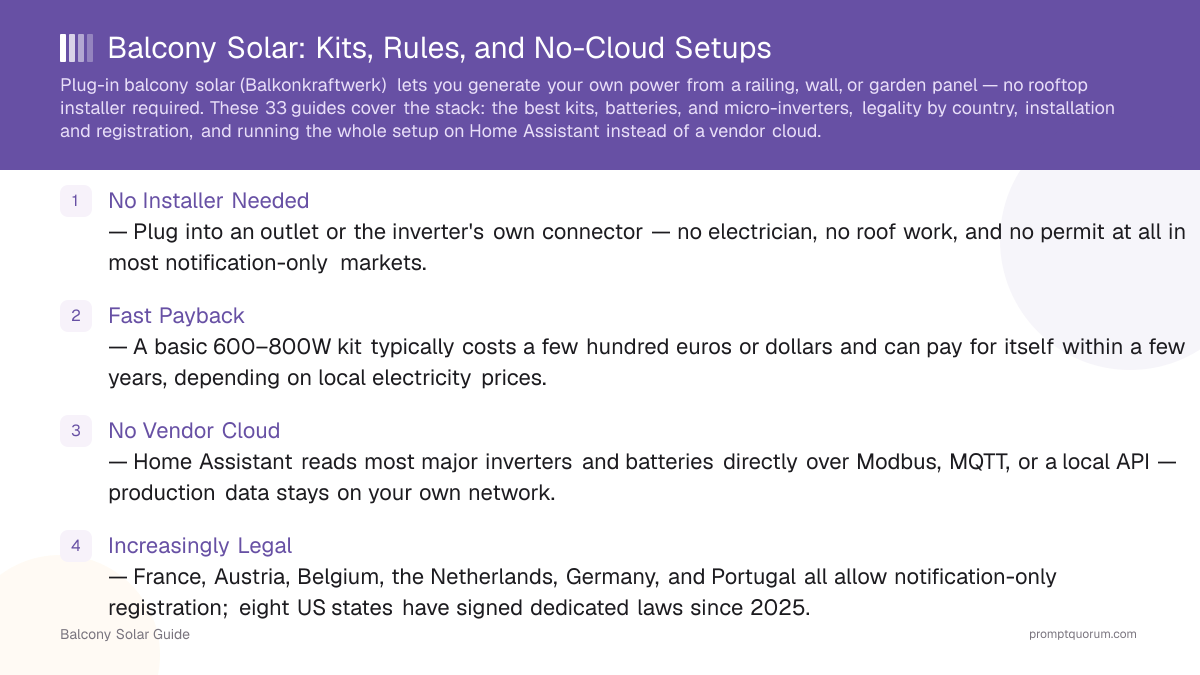
The slide deck below covers: why balcony solar beats rooftop installation for cost and speed (plug-and-play, no electrician, fast payback), the core stack (panel, micro-inverter, optional battery, and Home Assistant for cloud-free monitoring), the EU's converging 800W standard versus Greece's stricter zero-feed-in design, and a hardware buying matrix for kits, batteries, and micro-inverters by brand. Download the PDF as a balcony solar planning reference.
The basics and the main buying guides: what balcony solar is, the best kits, batteries, and micro-inverters, and running it all without the cloud.
Practical guides: balcony vs rooftop, installation, registration, sizing and payback, and mounting.
Per-country legal status: the global tracker plus dedicated pages for the US, Germany, Spain/LatAm, Portugal/Brazil, and the Gulf/MENA region.
Brand comparisons, whether you need a battery, whether the payback adds up, and fixes when your system stops producing.
What changes in 2027: EU battery/wattage standards, B2B housing-association adoption, the end of net metering in the Netherlands, and country-by-country status reports for Japan, China, Brazil, Greece, and the Gulf/MENA gap.
Frequently Asked Questions
A plug-in solar system — usually one or two panels feeding a small micro-inverter — that connects directly to a household outlet or dedicated connector, generating power for self-consumption without a rooftop installation or an electrician in most markets.
It depends on the country. France, Austria, Belgium, the Netherlands, Germany, and Portugal use simple notification-only registration for small systems; the US now has 8 states with dedicated laws; several other markets — the UAE, Saudi Arabia, Brazil, Japan — have no dedicated framework yet, so requirements vary.
Typical kits run from a few hundred to around a thousand dollars or euros depending on panel count, inverter brand, and whether a battery is included — payback commonly falls in the 2–5 year range depending on local electricity prices and how much of the output you self-consume.
Yes, for most major brands — Hoymiles, Deye, APsystems, EcoFlow, Anker, and Zendure inverters and batteries can be read locally via Modbus, MQTT, or a local API and pulled into Home Assistant, keeping your production data off the vendor's servers.
Check the country-by-country guide in this cluster — legal status ranges from fully codified (Germany, Portugal, France) to notification-only (Austria, Belgium, Netherlands) to nascent or unaddressed (the UAE, Saudi Arabia, Brazil, Japan, Bahrain, Taiwan) to state-by-state (the US).