Key Takeaways
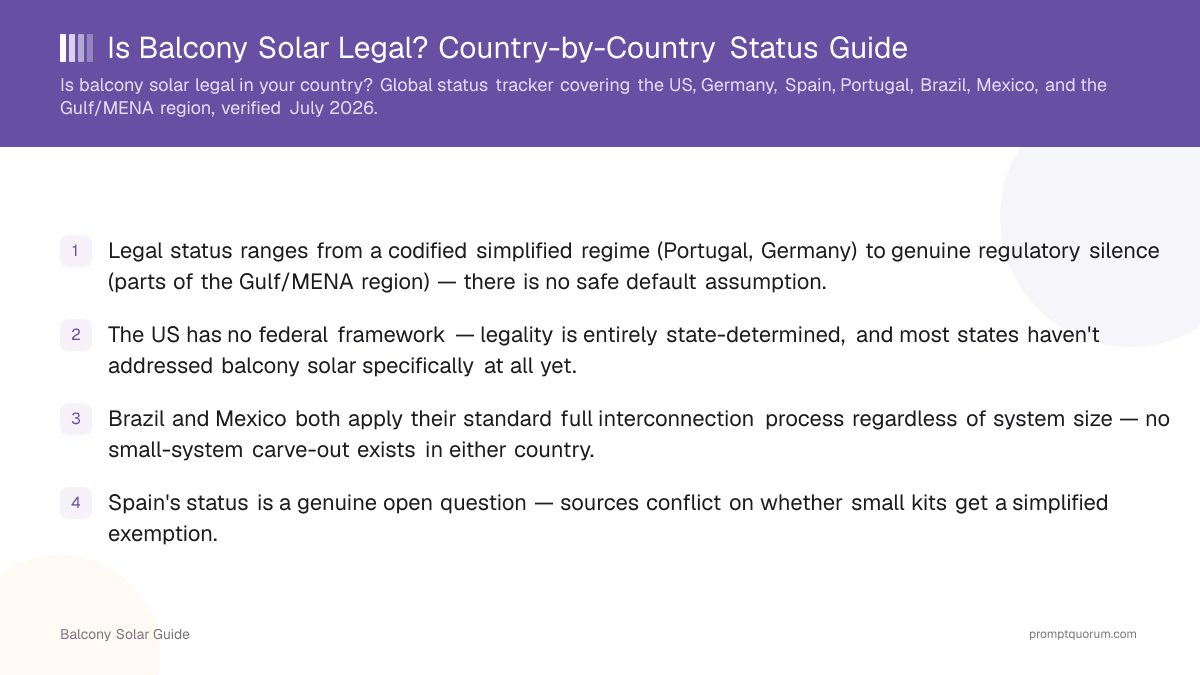
- Legal status ranges from a codified simplified regime (Portugal, Germany) to genuine regulatory silence (parts of the Gulf/MENA region) — there is no safe default assumption.
- The US has no federal framework — legality is entirely state-determined, and most states haven't addressed balcony solar specifically at all yet.
- Brazil and Mexico both apply their standard full interconnection process regardless of system size — no small-system carve-out exists in either country.
- Spain's status is a genuine open question — sources conflict on whether small kits get a simplified exemption.
- This tracker and every linked country page pull from a single shared data source, so a status change in one place updates everywhere consistently.
- Rules change fastest in the US, where new states are actively passing balcony solar legislation — check the dedicated US page for current month-to-month status.
Global Status Overview
This table summarizes current legal status and power limits across every market this site covers — click through to each country page for full detail, sourcing, and registration steps.
country | status | powerLimit |
|---|---|---|
| United States | Varies by state/emirate/region | No federal cap; varies by state where legislation exists (Colorado highest at 1920W). |
| Germany | Explicitly legal — dedicated simplified regime | 800W |
| Spain | Ambiguous / gray area | 800W |
| Portugal | Explicitly legal — dedicated simplified regime | 700W |
| Brazil | Legal — falls under general solar rules, no dedicated carve-out | No official ANEEL wattage exemption threshold found (e.g. no 500W/1kW carve-out). |
| Mexico | Legal — falls under general solar rules, no dedicated carve-out | No sub-kW exemption exists; 700kW is a permitting-complexity boundary, not a wattage cap relevant to balcony-scale systems. |
| Gulf / MENA (UAE + Saudi Arabia) | Unregulated / nascent — no explicit permission or prohibition | 1000W |
What Does "Legal" Actually Mean?
"Legal" for balcony solar usually means one of three distinct things, and conflating them is a common source of confusion: explicitly permitted under a dedicated simplified regime with a defined power limit, legal only in the sense that it falls under the same rules as any other grid-tied solar system with no lighter-touch path, or genuinely unaddressed by current regulation (neither permitted nor banned). The country pages below specify which of these three applies to your market, since the practical difference — self-install with a simple form vs. a full formal interconnection process — is significant.
One more thing worth knowing before you shop: most widely available balcony solar hardware reports production data to the manufacturer's cloud by default, regardless of which country's legal regime you're under — local-only monitoring is the exception you have to specifically look for, not the default you can assume. See running balcony solar without the cloud if that matters to you.
📍 In One Sentence
"Legal" balcony solar can mean anything from a codified simplified regime to genuine regulatory silence — check which applies to your specific country.
💬 In Plain Terms
Some countries have made a special, easy path just for small plug-in systems. Others just apply the same rules as a full rooftop install, no matter how small your system is. A few haven't addressed it at all.
Country Pages
Each market below has a dedicated page with full legal detail, registration steps, and sourcing.
How These Rules Are Changing
US state legislation is the fastest-moving part of this landscape — several states have signed dedicated balcony solar bills within the past year, and more are actively moving through state legislatures. Outside the US, changes are less frequent but not absent: Germany's DIN VDE V 0126-95 product standard took effect as recently as December 2025, showing that even established markets continue to refine their rules.
Frequently Asked Questions
Which countries have the clearest balcony solar laws?
Portugal and Germany both have well-established, codified simplified regimes with clear power limits and registration processes — the clearest status of any markets covered here.
Is balcony solar legal everywhere in the US?
No — there is no federal framework. Legality is determined entirely at the state level, and only a handful of states have passed dedicated legislation so far. See the state-by-state guide for current status.
Do any countries explicitly ban balcony solar?
None of the markets covered in this guide have an explicit ban — status ranges from clearly permitted to ambiguous to unaddressed, but not outright prohibited.
Why is Spain's status listed as ambiguous rather than a clear yes or no?
Sources genuinely conflict — vendor and press sources claim a simplified exemption for small kits, while a detailed legal-focused source says full formalities still apply. This guide reports that conflict rather than picking a side without confirmation.
Do Brazil and Mexico allow balcony solar?
It's not banned, but neither country has a small-system exemption — the same full interconnection registration process applies regardless of system size, which is a meaningfully different situation from a dedicated simplified regime.
How often does this legal status information change?
This page and its linked country pages are on a 6-month refresh cycle, though the US state page refreshes faster (60 days) given how quickly US state legislation is moving.
What should I do if my country isn't listed here?
Check your national or regional energy regulator directly — this guide covers the markets this site currently tracks, not every country worldwide.
Is unregulated the same as legal?
Not necessarily — genuinely unaddressed regulation (as in parts of the Gulf/MENA region) means neither explicit permission nor prohibition exists, which carries different practical risk than a market with a clear simplified legal framework.