Key Takeaways
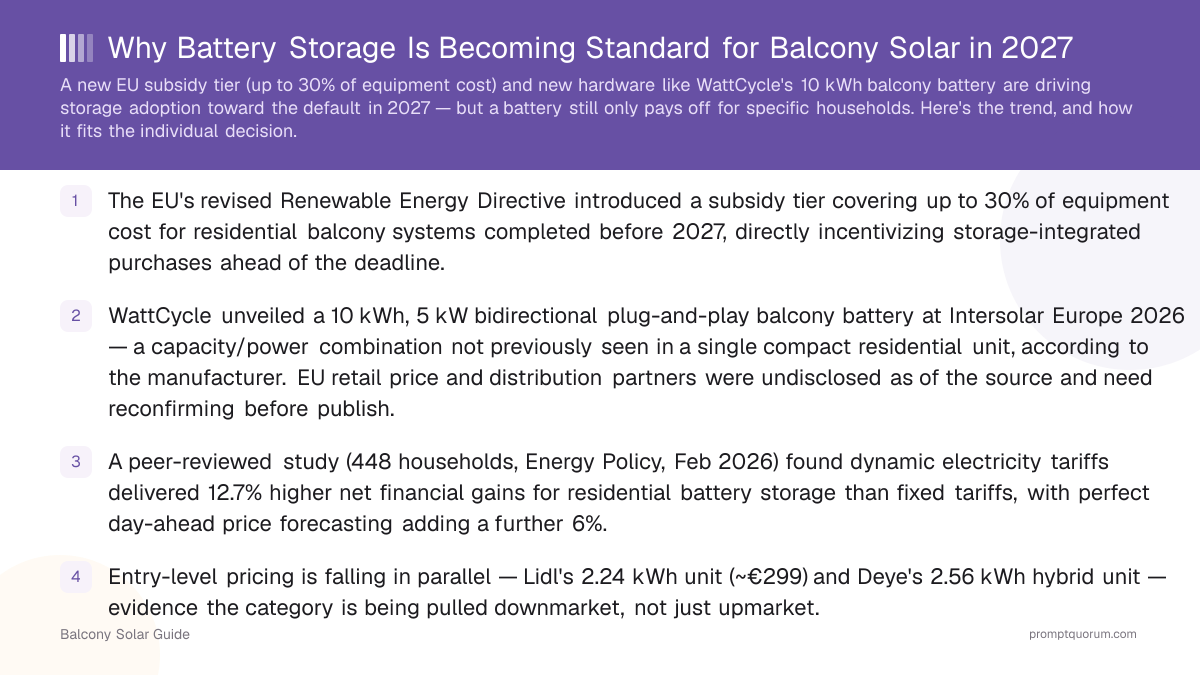
- The EU's revised Renewable Energy Directive introduced a subsidy tier covering up to 30% of equipment cost for residential balcony systems completed before 2027, directly incentivizing storage-integrated purchases ahead of the deadline.
- WattCycle unveiled a 10 kWh, 5 kW bidirectional plug-and-play balcony battery at Intersolar Europe 2026 — a capacity/power combination not previously seen in a single compact residential unit, according to the manufacturer. EU retail price and distribution partners were undisclosed as of the source and need reconfirming before publish.
- A peer-reviewed study (448 households, Energy Policy, Feb 2026) found dynamic electricity tariffs delivered 12.7% higher net financial gains for residential battery storage than fixed tariffs, with perfect day-ahead price forecasting adding a further 6%.
- Entry-level pricing is falling in parallel — Lidl's 2.24 kWh unit (~€299) and Deye's 2.56 kWh hybrid unit — evidence the category is being pulled downmarket, not just upmarket.
- This article describes a market-level trend toward wider storage adoption. It does not override the individual household economics covered in "Do You Need a Battery for Balcony Solar?" — that decision still comes down to your specific export-credit-vs-import-rate gap. In Germany specifically, battery-equipped systems remain excluded from the simplified DIN VDE V 0126-95 registration regime.
The EU Subsidy Tier
The EU's revised Renewable Energy Directive introduced a dedicated subsidy tier covering up to 30% of equipment cost for residential balcony systems completed before 2027, directly incentivizing storage-integrated purchases ahead of the deadline. This is a policy-level push toward storage adoption at the EU level, distinct from any individual household's payback calculation — the subsidy changes the upfront cost side of the equation, not whether ongoing self-consumption economics work for a specific home.
New Hardware: WattCycle and the Falling Entry Price
Manufacturers are responding with genuinely new hardware, not just larger batteries. At Intersolar Europe 2026 in Munich, Shenzhen-based WattCycle unveiled a 10 kWh, 5 kW bidirectional plug-and-play balcony-format battery — a capacity and power combination the company says had not previously appeared in a single compact residential unit. The AC-coupled design targets dynamic electricity tariff arbitrage, letting households store cheap off-peak power and discharge during high-price hours.
EU retail pricing and distribution partners for the WattCycle unit were undisclosed as of the source used for this page — this should be reconfirmed before the "buy now" framing of this article is treated as current.
Entry-level pricing is falling at the same time: Lidl introduced a 2.24 kWh residential battery in Germany at approximately €299, and Deye unveiled a 2.56 kWh hybrid unit designed specifically for balcony and residential PV installations — evidence the category is being pulled downmarket, not just upmarket.
The Tariff-Arbitrage Case
The arbitrage use case behind this hardware wave has research backing. A peer-reviewed study (Lorenz, Bayer, Pruckner, Staake & Hopf, *Energy Policy*, Feb 2026, DOI: 10.1016/j.enpol.2025.114952), based on 448 households, found dynamic tariffs delivered 12.7% higher net financial gains for residential battery storage versus fixed tariffs, with perfect day-ahead price forecasting adding a further 6% over rule-based charging strategies.
Trend vs. Individual Decision: What This Article Is Not Saying
This page describes a market-level trend — EU subsidy support, new hardware, and tariff-arbitrage economics pushing storage toward the default configuration. It is not a claim that battery storage is now required, or that it pays off for every household. The individual buying decision still comes down to the same one-number test covered in "Do You Need a Battery for Balcony Solar?": whether the gap between your utility's export credit and import rate is large enough to justify the added cost. That guide's "usually not required" framing remains the correct starting point for an individual household's decision — this article is about why more households are landing on "yes" as the underlying economics and subsidies shift, not a reversal of that guidance.
One specific friction is worth flagging: in Germany, battery-equipped balcony systems are explicitly excluded from the simplified DIN VDE V 0126-95 registration regime and require full grid-operator registration plus a licensed electrician — the EU-wide subsidy trend described here does not remove that specific German installation hurdle.
Frequently Asked Questions
Is battery storage now required for balcony solar?
No. This trend describes wider market adoption driven by EU subsidies and falling hardware prices, not a requirement. Whether a battery is worth it for your specific household still depends on your utility's export-credit-vs-import-rate gap — see "Do You Need a Battery for Balcony Solar?" for that decision framework.
What is the EU battery subsidy for balcony solar?
The EU's revised Renewable Energy Directive introduced a subsidy tier covering up to 30% of equipment cost for residential balcony systems completed before 2027.
What is the WattCycle balcony battery?
A 10 kWh, 5 kW bidirectional, AC-coupled, plug-and-play balcony-format battery from Shenzhen-based WattCycle, unveiled at Intersolar Europe 2026, targeting dynamic electricity tariff arbitrage. EU retail price and distribution details were undisclosed as of the source used here and should be reconfirmed before treating this as purchasable.
Do dynamic electricity tariffs actually make batteries more worthwhile?
Per a peer-reviewed 2026 study of 448 households, dynamic tariffs delivered 12.7% higher net financial gains for residential battery storage than fixed tariffs, with perfect day-ahead forecasting adding a further 6% over rule-based charging.
Does this mean Germany's simplified balcony solar registration now covers batteries?
No. Battery-equipped systems remain excluded from Germany's simplified DIN VDE V 0126-95 regime and still require full grid-operator registration and a licensed electrician, regardless of the EU-wide subsidy and hardware trend described here.