Key Takeaways
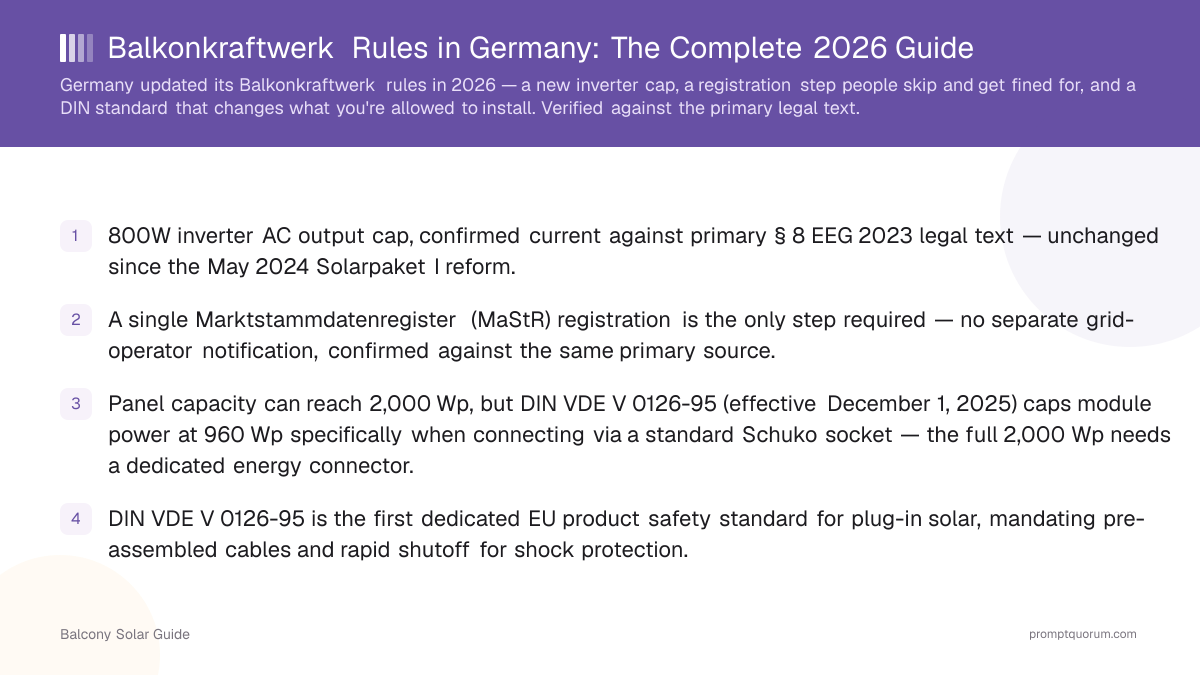
- 800W inverter AC output cap, confirmed current against primary § 8 EEG 2023 legal text — unchanged since the May 2024 Solarpaket I reform.
- A single Marktstammdatenregister (MaStR) registration is the only step required — no separate grid-operator notification, confirmed against the same primary source.
- Panel capacity can reach 2,000 Wp, but DIN VDE V 0126-95 (effective December 1, 2025) caps module power at 960 Wp specifically when connecting via a standard Schuko socket — the full 2,000 Wp needs a dedicated energy connector.
- DIN VDE V 0126-95 is the first dedicated EU product safety standard for plug-in solar, mandating pre-assembled cables and rapid shutoff for shock protection.
- Battery-equipped balcony systems are excluded from this entire simplified regime — full grid-operator registration and a licensed electrician are required for those specifically.
- The old Ferraris (backward-spinning) meter is still temporarily tolerated pending a swap by the Messstellenbetreiber — the exact statutory swap deadline is commonly cited as roughly 4 months but was not independently confirmed against primary statute text.
800W Inverter Limit
The inverter AC output cap is 800W, unchanged since the May 2024 Solarpaket I reform. It's now anchored in two sources: § 8 EEG 2023 sets the legal ceiling, and DIN VDE V 0126-95 — a technical/safety product standard effective December 1, 2025 — reinforces it as the first dedicated EU product standard for plug-in solar devices.
Registration: Marktstammdatenregister
A single Marktstammdatenregister (MaStR) entry is the only registration step required — no separate grid-operator notification is needed. § 8 EEG 2023 text states no additional Netzbetreiber notification can be demanded beyond MaStR; the grid operator is informed automatically via MaStR data-sharing.
Schuko vs. Wieland: Plug Types and Panel Capacity
Total panel (module) capacity can reach 2,000 Wp, independent of and separate from the 800W inverter/AC limit. DIN VDE V 0126-95 adds a plug-type-dependent sub-limit: module power is capped at 960 Wp when connected via a standard household Schuko socket, with the full 2,000 Wp requiring a dedicated energy connector such as Wieland.
In practice: if you're installing through a standard household Schuko outlet, plan around the 960 Wp module sub-limit. Reaching the full 2,000 Wp module capacity requires a dedicated energy connector (such as Wieland), which is a different — and more involved — installation than a simple Schuko plug-in.
The Meter Question
A digital or bidirectional meter is not mandatory to operate a Balkonkraftwerk — an old backward-spinning Ferraris meter is still tolerated temporarily, contingent on MaStR registration. The exact statutory window for the Messstellenbetreiber to install a two-way meter is commonly cited as roughly four months, but this specific figure was not independently confirmed against primary MessEG/MsbG statute text — treat it as a secondary-sourced estimate, not confirmed law.
💡Tip: You are not required to wait for a new meter before operating your system — the old meter is tolerated temporarily as long as your MaStR registration is complete.
Tenant Rights
Germany has moved toward treating balcony solar as a privileged home-improvement measure for tenants in recent reforms, similar in spirit to satellite dishes, though landlord/HOA approval processes and specifics can still vary by building. Confirm your specific building's rules, particularly for anything mounted visibly on a railing or exterior wall, since aesthetic and structural conditions can still apply even where the underlying right to install is protected.
Grants
Some German states and municipalities offer balcony solar subsidies (Förderprogramme), but availability, amount, and eligibility vary significantly by region and change over time — check your specific state or city's current program directly rather than assuming a subsidy applies nationally.
Frequently Asked Questions
What is the current wattage limit for Balkonkraftwerk in Germany?
800W inverter AC output, confirmed against primary § 8 EEG 2023 text — unchanged since the May 2024 Solarpaket I reform.
Do I need to register my Balkonkraftwerk with my grid operator?
No — a single Marktstammdatenregister (MaStR) entry is the only registration step required. No separate Netzbetreiber notification is needed; the grid operator is informed automatically via MaStR data-sharing.
What is DIN VDE V 0126-95?
The first dedicated EU product safety standard for plug-in solar devices, effective December 1, 2025. It mandates pre-assembled connection cables, clear installation instructions, and rapid voltage shutoff for shock protection, and explicitly excludes battery-equipped systems.
Can I install more than 800W of panels?
Yes — total panel (module) capacity can reach 2,000 Wp even though the inverter output stays capped at 800W. A standard Schuko socket connection caps module power at 960 Wp specifically; the full 2,000 Wp requires a dedicated energy connector.
Do I need a new digital meter to use a Balkonkraftwerk?
Not immediately — an old backward-spinning Ferraris meter is still tolerated temporarily, contingent on MaStR registration. The exact statutory swap deadline is commonly cited as roughly 4 months but wasn't independently confirmed against primary statute text.
Are battery-equipped balcony systems covered by the simplified regime?
No — storage-equipped balcony systems are explicitly excluded and still require full grid-operator registration and a licensed electrician, unlike standard plug-in units.
Can renters install a Balkonkraftwerk without landlord approval?
Germany has moved toward treating balcony solar as a privileged tenant right in recent reforms, but building-specific approval processes and conditions (particularly for visible exterior mounting) can still apply — confirm with your specific landlord or HOA.
Are there subsidies for Balkonkraftwerk in Germany?
Some states and municipalities offer subsidies, but availability and amount vary significantly by region — check your specific state or city's current program rather than assuming a nationwide subsidy applies.