Key Takeaways
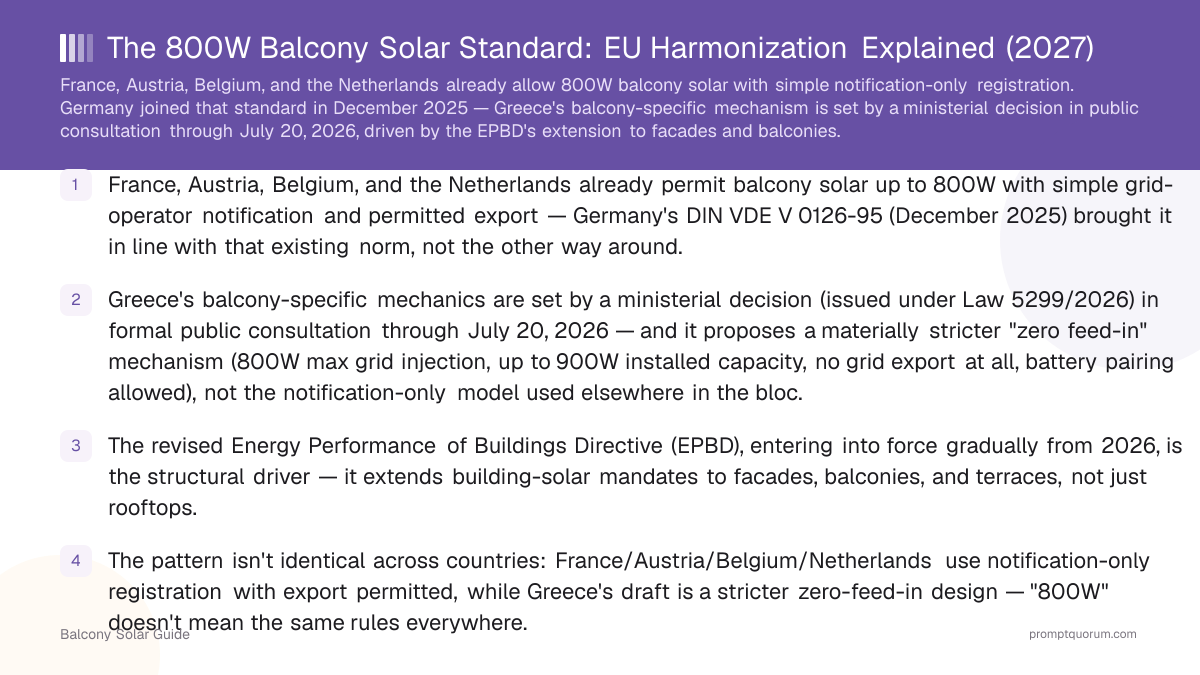
- France, Austria, Belgium, and the Netherlands already permit balcony solar up to 800W with simple grid-operator notification and permitted export — Germany's DIN VDE V 0126-95 (December 2025) brought it in line with that existing norm, not the other way around.
- Greece's balcony-specific mechanics are set by a ministerial decision (issued under Law 5299/2026) in formal public consultation through July 20, 2026 — and it proposes a materially stricter "zero feed-in" mechanism (800W max grid injection, up to 900W installed capacity, no grid export at all, battery pairing allowed), not the notification-only model used elsewhere in the bloc.
- The revised Energy Performance of Buildings Directive (EPBD), entering into force gradually from 2026, is the structural driver — it extends building-solar mandates to facades, balconies, and terraces, not just rooftops.
- The pattern isn't identical across countries: France/Austria/Belgium/Netherlands use notification-only registration with export permitted, while Greece's draft is a stricter zero-feed-in design — "800W" doesn't mean the same rules everywhere.
- Sweden and Hungary are the EU's clearest exceptions to the convergence trend — Sweden blocks standard grid connection for these systems and Hungary prohibits them outright.
- For Germany's specific mechanics — the 800W inverter cap, DIN VDE V 0126-95, the 960 Wp Schuko sub-cap, and § 8 EEG 2023 — see the dedicated Germany guide rather than this cross-border overview.
The EPBD Is Driving Convergence
The revised Energy Performance of Buildings Directive (EPBD), entering into force gradually from 2026, explicitly extends solar-installation mandates to facades, balconies, and terraces — not just rooftops. This reframes balcony solar from a consumer lifestyle choice into a compliance mechanism for member states' building-decarbonization obligations. Countries that previously treated plug-in solar as a regulatory afterthought now have a directive-level reason to formalize rules quickly, which is the immediate context for Greece's 2026 legislative push.
France, Austria, Belgium, and the Netherlands already permit balcony solar up to 800W with only a simple grid-operator notification requirement and permitted export, predating Germany's own finalization. Germany's DIN VDE V 0126-95, finalized in December 2025, brought it in line with that existing de facto standard rather than establishing a new one — the EPBD is now extending the same underlying logic to the rest of the bloc, though not every member state is adopting the same mechanism (see Greece, below) or converging at all (Sweden, Hungary).
Greece: The Newest Entrant
Greece is the newest entrant to this convergence, but with a materially stricter mechanism: a ministerial decision issued under Law 5299/2026 (itself already passed, May 5, 2026), following a RES bill submitted by YPEN on April 21, 2026, proposes a "zero feed-in" design — 800W maximum grid injection, up to 900W installed capacity, battery pairing allowed, but no grid export at all — unlike the notification-only, export-permitted model used elsewhere in this bloc. For the full timeline, the consultation process, and what happens once the decision finalizes, see the dedicated Greece guide rather than this brief summary.
⚠️Warning: Not yet finalized as of this page's last update — see the dedicated Greece guide for current status before treating any mechanism detail as settled.
What This Means Outside Germany
If your country doesn't yet have explicit balcony solar rules, the direction of travel is now predictable in shape if not in mechanism: expect an 800W cap and a timeline tied to your country's EPBD transposition deadline rather than open-ended uncertainty — but the exact rules can differ meaningfully by country, from notification-only with export (France, Austria, Belgium, Netherlands) to a stricter zero-feed-in design (Greece's draft). Greece is the clearest current example of a country moving from grey-zone to formalized rules, though its zero-feed-in approach shows that "800W" alone doesn't guarantee the same mechanism as elsewhere in the bloc — additional EU member states are likely to formalize rules as EPBD transposition deadlines approach, but not necessarily via the same model, and Sweden and Hungary show that convergence isn't guaranteed at all.
Frequently Asked Questions
Did Germany set the EU's 800W balcony solar standard?
No — France, Austria, Belgium, and the Netherlands already permitted balcony solar up to 800W with simple notification-only registration before Germany finalized its own DIN VDE V 0126-95 standard in December 2025. Germany joined an existing de facto EU norm rather than creating a new one.
What is Greece doing about balcony solar in 2026?
A ministerial decision issued under Law 5299/2026 (already passed, May 5, 2026) proposes a stricter "zero feed-in" design than the rest of the EU: 800W maximum grid injection, up to 900W of installed capacity, no export to the grid, and battery storage pairing allowed. See the dedicated Greece guide for the full timeline and current status.
What is the EPBD and why does it matter for balcony solar?
The revised Energy Performance of Buildings Directive (EPBD) enters into force gradually from 2026 and extends EU building-solar mandates to facades, balconies, and terraces, not just rooftops — turning balcony solar into a compliance mechanism for member states rather than a discretionary policy choice.
Is balcony solar legal everywhere in the EU?
No. While momentum is toward an 800W-style framework in many member states, Sweden blocks standard grid connection for these systems and Hungary prohibits them outright — convergence toward a common EU approach is real but not universal.
Where can I find Germany's specific balcony solar rules?
See the dedicated Germany guide, which covers the 800W inverter cap, DIN VDE V 0126-95, the 960 Wp Schuko-socket sub-cap, and the § 8 EEG 2023 legal text in full — this page focuses on cross-border harmonization rather than repeating those mechanics.