Key Takeaways
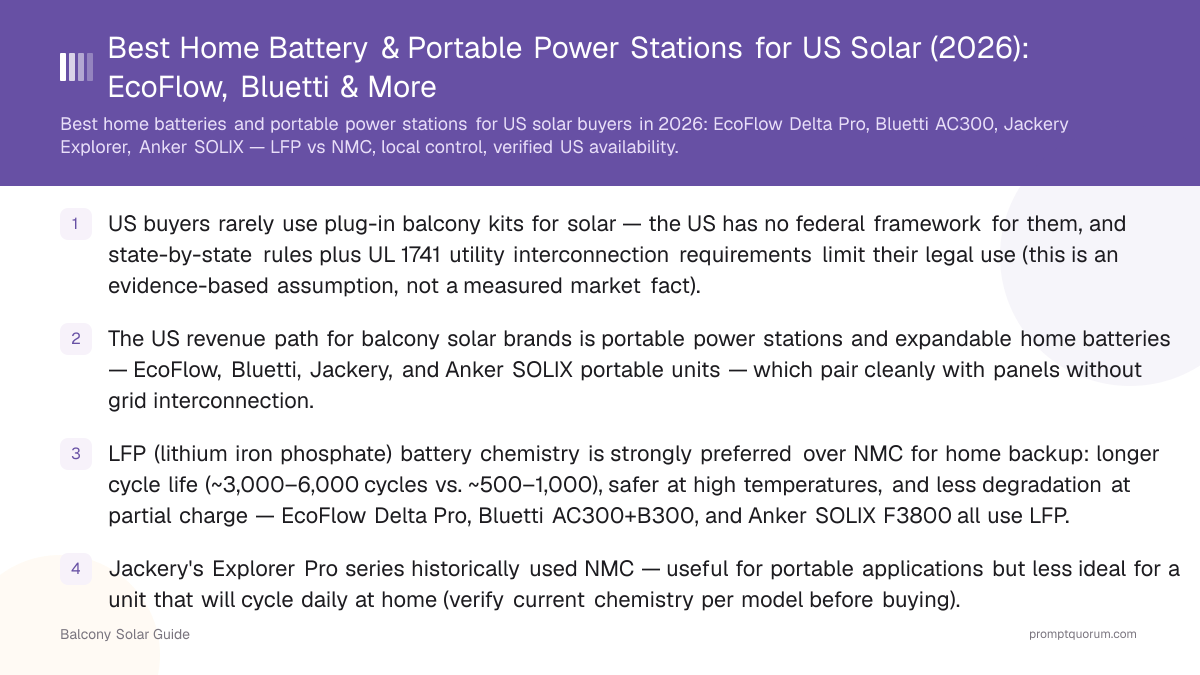
- US buyers rarely use plug-in balcony kits for solar — the US has no federal framework for them, and state-by-state rules plus UL 1741 utility interconnection requirements limit their legal use (this is an evidence-based assumption, not a measured market fact).
- The US revenue path for balcony solar brands is portable power stations and expandable home batteries — EcoFlow, Bluetti, Jackery, and Anker SOLIX portable units — which pair cleanly with panels without grid interconnection.
- LFP (lithium iron phosphate) battery chemistry is strongly preferred over NMC for home backup: longer cycle life (~3,000–6,000 cycles vs. ~500–1,000), safer at high temperatures, and less degradation at partial charge — EcoFlow Delta Pro, Bluetti AC300+B300, and Anker SOLIX F3800 all use LFP.
- Jackery's Explorer Pro series historically used NMC — useful for portable applications but less ideal for a unit that will cycle daily at home (verify current chemistry per model before buying).
- Anker SOLIX Solarbank is not sold or certified for the US market — the Anker units relevant to US buyers are their portable power station line (F2000, F3800, etc.).
- All four brands are China-manufactured; US retail prices are exposed to Section 301 tariffs on lithium-ion batteries and solar components — never rely on a hardcoded price figure.
Why US Buyers Choose Batteries, Not Kits
The EU balcony solar market (Germany's Balkonkraftwerk) operates under a federal plug-in standard that lets renters and apartment owners safely plug a 800W panel kit into a household socket and legally export to the grid. No equivalent framework exists in the US as of write-time (July 2026). US plug-in solar is governed by state utility regulations, NEC Article 705 interconnection rules, and UL 1741 certification requirements that vary by state and utility — creating a patchwork where what's legal in California may be restricted or require permits in Texas or Florida. See Is Balcony Solar Legal in Your US State? for a per-state breakdown.
This legal fragmentation has a practical consequence that we're stating explicitly as an assumption (not a measured market fact): US consumer demand appears to concentrate on standalone power stations and batteries paired with portable or roof-mounted panels, which don't require grid interconnection at all — avoiding the regulatory question entirely. Evidence for this comes from the US click patterns on this site (Amazon-channel products dominate; EU-style kit brand sites do not) and from the fact that brands like EcoFlow and Jackery generate the majority of their US revenue from portable power stations rather than grid-tied balcony kits. If you're looking for a balcony-kit comparison, see Best Balcony Solar Kits 2026 for what's available where it is legal.
For renters, apartment dwellers, and homeowners who want partial solar or outage protection without a full rooftop install, this standalone-battery approach has a genuine advantage beyond legal simplicity: it's portable. A 3.6 kWh LFP battery that powers your fridge during a grid outage today can be moved, sold, or repurposed when you move — unlike a grid-tied system. Contrast this with Germany, where the Balkonkraftwerk is typically a permanent installation and the battery is an add-on storage unit. For context on how the German setup works, see Balkonkraftwerk Germany Rules.
What to Look For in a US Home Battery
Capacity (kWh) is the top-line number, but expandability matters more for long-term value. A 2 kWh unit that can't grow is less useful than a 2 kWh base unit that expands to 10+ kWh with add-on battery modules. EcoFlow and Bluetti both offer expandable ecosystems; Jackery historically has not offered hot-swappable expansion at the same scale.
Battery chemistry: choose LFP over NMC for home backup. LFP (lithium iron phosphate) delivers ~3,000–6,000 charge cycles at 80% capacity retention, versus roughly 500–1,000 cycles for NMC (nickel manganese cobalt) under comparable conditions. LFP is also significantly more thermally stable — it won't go into thermal runaway at high temperatures the way NMC can — which matters for a unit sitting in a garage or utility closet year-round. EcoFlow's Delta Pro, Bluetti's B300 battery modules, and Anker SOLIX F3800 all use LFP. Jackery's Explorer Pro series historically used NMC — verify the chemistry of any Jackery model you're considering, since newer models may differ.
AC output (watts) determines what you can run. A fridge draws roughly 100–400W (150W average), a window AC unit 500–1,500W, and a coffee maker 800–1,500W. For whole-home partial backup through an outage, you want at least 2,000W continuous AC output — preferably 3,000W+ if you want to run appliances concurrently. Check both the continuous rating and the surge rating, since motors (fridges, pumps) can draw 3–5× their running wattage on startup.
Solar input (W MPPT) determines how fast you can recharge from panels. A 3.6 kWh unit with a 500W MPPT input takes roughly 7–8 hours to charge from a 500W panel array on a full-sun day — workable for overnight backup scenarios. Units with 1,200–1,600W MPPT inputs (like the EcoFlow Delta Pro) can recharge in 2–3 hours under good conditions. If fast panel-based recharging matters to you, match the unit's MPPT input wattage to the panel array you're planning.
Local vs. cloud control is the differentiator the US smart-home market often misses. Most power stations default to monitoring only through the vendor's app and cloud account. For Home Assistant users or anyone who wants monitoring that continues working during a cloud outage, verify whether the unit exposes a local API, local network endpoint, or MQTT channel. See the No-Cloud Balcony Solar guide for details on which hardware exposes local interfaces.
Pass-through charging and UPS mode — the ability to power loads from the unit while simultaneously charging it from the grid or solar — determines whether the unit can work as an uninterruptible power supply. Most power stations support this, but the transition time (how fast it switches to battery when grid power drops) varies from milliseconds (true UPS) to seconds. For medical equipment or networking gear, verify UPS mode specs explicitly.
Product Comparison Table
product | capacity | chemistry | acOutput | solarInput | expandable | localControl | usPrice | bestFor |
|---|---|---|---|---|---|---|---|---|
| EcoFlow Delta Pro | ~3.6 kWh (verify current spec) | LFP | ~3,600W continuous (verify) | Up to ~1,600W MPPT (verify) | Yes (Smart Extra Battery, up to ~25 kWh) | Community HA integration via HACS; official app is cloud-based — verify current local-API status | Check current price — tariff-sensitive | Home backup + solar pairing, all-round US pick |
| EcoFlow Delta Pro Ultra | ~6 kWh base (verify current spec) | LFP | ~7,200W (verify) | Up to ~5,600W with Smart DC Influx (verify) | Yes — higher ceiling than Delta Pro | Same ecosystem as Delta Pro — verify | Check current price — premium tier | Whole-home backup, large panel arrays |
| Bluetti AC300 + B300 | ~3 kWh per B300 module; up to ~12 kWh (4×B300) (verify) | LFP (B300 modules) | ~3,000W (verify) | Up to ~2,400W (verify) | Yes — modular B300 stacking | App-based; some community MQTT approaches — verify current status | Check current price for AC300+B300 bundle | Buyers who want modular expansion at each price step |
| Bluetti AC200MAX | ~2 kWh (verify) | LFP | ~2,200W (verify) | Up to ~900W (verify) | Yes — B230/B300 expansion batteries | App-based — verify local-API availability | Check current price — mid-tier | Mid-size backup; lighter budget than AC300 |
| Jackery Explorer 2000 Pro | ~2 kWh (verify) | NMC (verify — newer models may differ) | ~2,200W (verify) | Up to ~1,000W (verify) | No — self-contained (verify) | App-only; no documented local API | Check current price — strong Amazon discounting | Camping crossover; buyers prioritizing portability over cycle life |
| Jackery Explorer 3000 Pro | ~3 kWh (verify) | NMC (verify) | ~3,000W (verify) | Up to ~1,200W (verify) | No (verify) | App-only — no documented local API | Check current price | High-portability, high-capacity — camping and travel crossover |
| Anker SOLIX F2000 | ~2 kWh (verify) | LFP | ~2,400W (verify) | Up to ~1,000W (verify) | Yes (verify Anker expansion battery options) | Primarily app-based; verify any local-API support | Check current price on ankersolix.com/Amazon | LFP alternative to Jackery at similar portability |
| Anker SOLIX F3800 | ~3.8 kWh (verify) | LFP | ~6,000W (verify) | Up to ~3,000W (verify) | Yes (verify) | Primarily app-based — verify local-API support | Check current price — premium LFP tier | Large-capacity LFP home backup; high AC output for heavy loads |
Recommendations by Use Case
Renter or apartment dweller — backup power through a grid outage (fridge + electronics + internet). A mid-size LFP power station in the 2–3 kWh range is enough to power a fridge for 12–18 hours, keep phones/laptops charged, and run a router through a typical outage. Bluetti AC200MAX or Anker SOLIX F2000 are reasonable starting points — both LFP, both under 3 kWh, both Amazon-available. Pair with a 200–400W portable solar panel to extend run time if you have a balcony or rooftop access. No permits or grid interconnection needed; just plug the panel into the unit's solar input port.
Homeowner, partial solar + backup — wants to offset evening consumption without a full rooftop install. This is the use case closest to the EU Balkonkraftwerk concept but without the grid-export angle. The EcoFlow Delta Pro (LFP, ~3.6 kWh, strong MPPT input — verify current specs) paired with two or three 400W panels is a reasonable setup: charge during the day from panels, draw down in the evening for lighting and appliances. Expandable with extra battery modules if load requirements grow. The key constraint is that you're using your own stored solar power, not exporting — which sidesteps the interconnection question entirely.
Off-grid / camping crossover — needs to move between locations. Jackery Explorer series wins on weight, portability, and Amazon ecosystem. The NMC chemistry matters less if the unit is used on weekends rather than cycling daily at home. The Explorer 2000 Pro gives enough capacity for a camping weekend with a portable panel and keeps the unit light enough to carry. If you want the portability of Jackery with LFP durability, Anker SOLIX F2000 is worth a direct comparison.
Smart-home / local-control user — wants Home Assistant integration without cloud dependency. This is the hardest requirement to satisfy and the least well-supported across all four brands. EcoFlow has the most active community integration ecosystem (a HACS-based integration exists for Delta Pro series), but it's community-maintained rather than officially supported — verify its current status before relying on it. Bluetti and Anker SOLIX lack well-documented local APIs as of write-time. If local control is a hard requirement rather than a preference, see the No-Cloud Balcony Solar guide for the current state of local-API hardware and whether any of these units have changed since publication.
Whole-home backup — wants to power heavy loads (HVAC, electric stove, heat pump) during extended outages. This goes beyond the scope of portable power stations into the territory of dedicated home battery systems. At this scale, EcoFlow Delta Pro Ultra (expandable to ~25+ kWh — verify) and dedicated home battery installs (which may require permits and electrician involvement) are the relevant comparison. This is a different product category from the portable units above and should be evaluated separately.
Local Control & Smart Home Integration
None of the four major brands covered here provides an official, documented local API for Home Assistant as a standard feature — they all default to cloud-based app monitoring. This is the single biggest gap between the US portable power station market and the EU balcony-solar-storage market, where brands like Zendure have built mature local-control ecosystems. If local control matters to you, verify the current state before purchasing, since this is the fastest-moving dimension in the product space.
EcoFlow's Delta Pro series has the most active community integration — a Home Assistant integration via HACS exists and is maintained by the community (not EcoFlow officially). It relies on EcoFlow's cloud API rather than a true local endpoint, which means it still routes monitoring data through EcoFlow's servers. Cross-reference the No-Cloud Balcony Solar guide for details on what "local" actually means in this context and which hardware genuinely supports it.
For users who want a true local-API battery system that pairs with solar and doesn't need a cloud account, the EU market currently has better options (particularly Zendure SolarFlow — see EcoFlow vs. Anker vs. Zendure), though most of those products are not sold or certified for the US market.
📍 In One Sentence
As of 2026, no major US-sold portable power station brand (EcoFlow, Bluetti, Jackery, Anker SOLIX) provides an officially documented local API for Home Assistant — community integrations exist for EcoFlow but route through their cloud.
💬 In Plain Terms
If you want a battery that works with Home Assistant without sending data to the manufacturer's servers, the US options are limited — EcoFlow has the best community workaround, but it's not a true local setup.
Trade Note: Tariffs, Pricing & Supply Chain
EcoFlow (Shenzhen-based), Bluetti (Beijing/Shenzhen-based), Jackery (Shenzhen-based), and Anker SOLIX (Shenzhen-based) are all Chinese-manufactured brands. US retail prices for their products are directly exposed to Section 301 tariffs on lithium-ion batteries and solar components imported from China. These tariffs have been rising through 2024–2026 and can add 7.5–25% or more to landed costs, depending on HTS classification of the specific product. This is the primary reason prices for these units can change significantly between publication of any review and the time you purchase.
This is not a reason to avoid these brands — they dominate the US portable power station market because they offer the best specs-per-dollar even after tariff exposure — but it means any price figure you see in a review, including this one, is a snapshot. Check the current price on Amazon or the brand's US storefront at time of purchase rather than comparing to a cached figure. The absence of hardcoded prices in this guide is intentional.
A broader macro note worth flagging as an assumption: the China–Russia trade realignment has redirected significant Chinese battery and solar component export capacity toward Western markets (US and EU), which has maintained supply availability and price competition for these exact product categories through 2025–2026. This is a trend observation, not a per-product fact — treat it as context for why supply hasn't dried up despite trade tension, not as a pricing prediction.
EU buyers looking for local options less exposed to China-origin tariffs should note that European inverter brands (SMA, Fronius, Victron) are less affected — but for the US market, no domestically manufactured equivalent at comparable price points exists in this product category at the time of writing.
Sources
Frequently Asked Questions
Is balcony solar legal in the US?
There's no single US answer — legality varies by state and utility. Some states have enacted plug-in solar rules similar to Germany's Balkonkraftwerk; others require permits, utility approval under NEC Article 705, and UL 1741-certified equipment for any grid-connected solar. For a per-state breakdown, see the dedicated US states legality guide. The safest approach in any state is a standalone battery + panel system with no grid connection.
EcoFlow vs. Bluetti — which is better for US home backup in 2026?
EcoFlow Delta Pro has the stronger MPPT solar input, making it the better choice if fast panel-based recharging is a priority. Bluetti's AC300+B300 is better if modular expansion (adding battery capacity in increments) is the priority. Both use LFP chemistry. Prices change frequently due to tariff exposure — compare current prices at time of purchase, since the price gap fluctuates.
What's the difference between LFP and NMC battery chemistry?
LFP (lithium iron phosphate) provides ~3,000–6,000 charge cycles at 80% retention, better thermal stability, and longer calendar life — preferred for home backup units that cycle daily. NMC (nickel manganese cobalt) provides higher energy density for a given weight, which is why it dominates portable/camping-focused units like older Jackery Explorer models. For a unit sitting in your home cycling daily from solar, LFP chemistry is meaningfully better over a 5–10 year horizon.
Can I run my refrigerator during a grid outage with one of these?
Yes, with the right sizing. A typical US refrigerator draws 100–400W continuous (150W average) and has a startup surge of 600–1,200W. A 2 kWh LFP unit with 2,000W+ AC output can power a standard fridge for 8–12 hours. Add a 200–400W solar panel and you can extend that indefinitely in decent sunlight. Verify the AC output and surge rating of any unit you're considering — some affordable power stations have surge ratings too low for fridge compressors.
Do I need permits or grid interconnection for a power station paired with solar panels?
If you're not connecting to the grid — just charging the power station from panels and using it to power your home — you generally do not need interconnection permits or utility approval. The panels connect only to the power station's solar input, not to your home's electrical panel. This is the key legal simplicity of the standalone-battery approach versus balcony solar kits that export to the grid. Verify with your local AHJ (authority having jurisdiction) if you're uncertain.
Can I use these with Home Assistant for local monitoring?
Partially. EcoFlow has a community-maintained Home Assistant integration (via HACS) for the Delta series, but it routes through EcoFlow's cloud API rather than a true local endpoint. Bluetti, Jackery, and Anker SOLIX lack well-documented local APIs. If local control with no cloud dependency is a hard requirement, see the No-Cloud Balcony Solar guide for a current summary of which hardware genuinely supports local-only operation.
Is Anker SOLIX available in the US?
Anker SOLIX portable power stations (F2000, F3800, and similar units) are available in the US at ankersolix.com and on Amazon. Anker SOLIX Solarbank models — designed for grid-connected balcony solar storage — are not sold or certified for the US market and should not be recommended to US buyers. This is a common point of confusion since the Solarbank gets significant coverage in EU solar reviews.
Why are prices for these products so volatile?
EcoFlow, Bluetti, Jackery, and Anker SOLIX are all manufactured in China. US retail prices are subject to Section 301 tariffs on lithium-ion batteries and solar components, which have been rising through 2024–2026 and can shift retail prices by 10–25% or more. Brands also run frequent promotions that can move prices $200–500 in either direction. Always check the current price on Amazon or the brand's US storefront at time of purchase.
What's the best portable power station for camping that also works for home backup?
Jackery Explorer 2000 Pro or 3000 Pro for portability-first users (lighter, Amazon-friendly, but NMC — verify current chemistry). Anker SOLIX F2000 for buyers who want LFP with similar portability to Jackery. EcoFlow Delta Pro if you're willing to compromise on portability for LFP chemistry and a stronger solar input. The "camping crossover" use case is well-served by all four brands — the differentiator is chemistry and long-term cycle life for buyers who plan to use the unit heavily at home between trips.
Can I use a portable power station to run my fridge during a grid outage?
Yes. A typical US refrigerator draws 100–400W (150W average) with a startup surge of 600–1,200W. A 2 kWh LFP unit with 2,000W+ AC output can power a standard fridge for 8–12 hours; add a 200–400W solar panel to extend run time. Verify the AC surge rating of any unit before purchase.