Key Takeaways
- 9 states have signed balcony solar legislation as of write-time (2026-09-02): Utah, Maine, Virginia, Maryland, Colorado, New Hampshire, Vermont, Connecticut, and New Jersey. Colorado and New Hampshire (both Jan 1, 2027), New Jersey (Mar 1, 2027), and Connecticut (Oct 1, 2026) are signed but not yet in effect.
- 2 more states — New York and California — have passed their legislatures and await a governor's signature; neither is yet law.
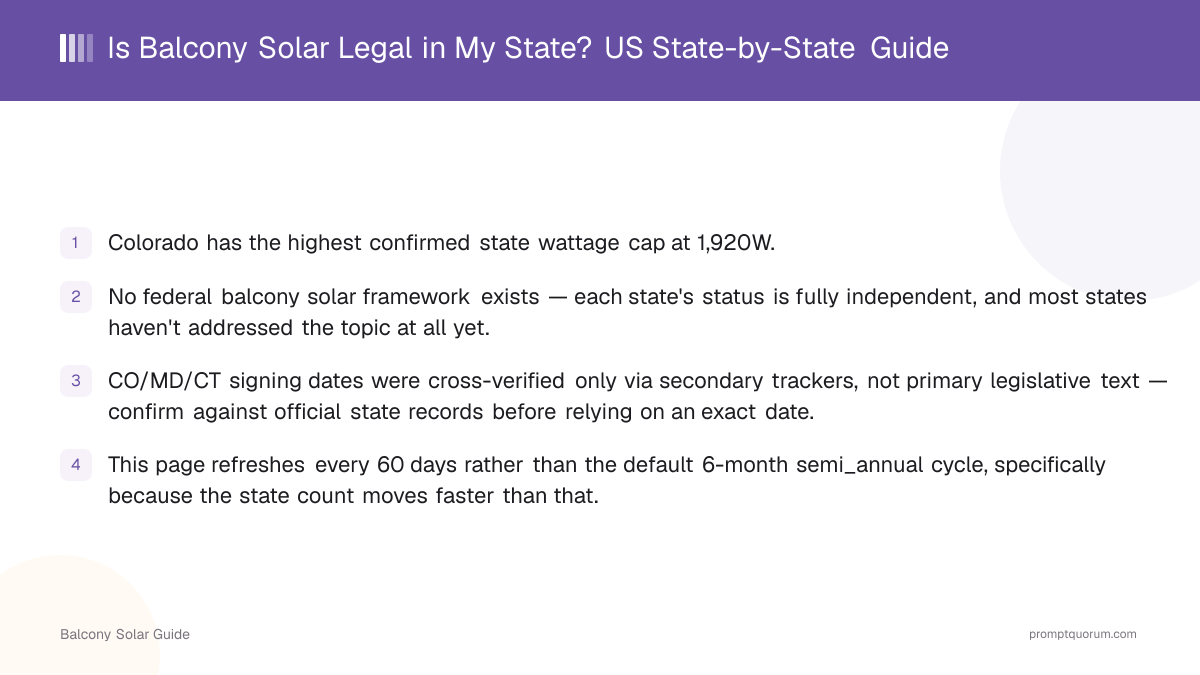
- Colorado has the highest confirmed state wattage cap at 1,920W.
- No federal balcony solar framework exists — each state's status is fully independent, and most states haven't addressed the topic at all yet.
- CO/MD/CT signing dates were cross-verified only via secondary trackers, not primary legislative text — confirm against official state records before relying on an exact date.
- This page refreshes every 60 days rather than the default 6-month semi_annual cycle, specifically because the state count moves faster than that.
Federal Picture
There is no federal balcony solar law — legality is determined entirely at the state level. The one federal-level development relevant to balcony solar is UL 3700, a safety certification standard (not a legalization framework) launched January 2026.
UL 3700 Certification Status
UL 3700, the federal safety certification standard for plug-in solar devices, launched its testing and certification program on January 8, 2026 — but no complete balcony solar system has yet earned certification. Testing takes months, and no product from any brand has completed the process as of write-time. Don't assume a product marketed as "UL 3700 compliant" or similar has actually completed certification — verify the specific claim before relying on it.
State-by-State Table
This state count moves monthly, faster than most facts tracked in this guide — that's why this page refreshes every 60 days instead of the standard 6-month cycle. Signing dates for Colorado, Maryland, and Connecticut were cross-verified via secondary trackers, not primary legislative text — confirm exact dates against official state records before relying on them for anything time-sensitive.
For the full rules, savings estimates, and product options for a specific state, see the dedicated guide: Utah · Maine · Virginia · Maryland · Colorado · New Hampshire · Vermont · Connecticut · New Jersey · New York · California
state | status | bill | signed | effective |
|---|---|---|---|---|
| Utah | Signed | HB 340 | 2025-03 | 2025-05-07 |
| Maine | Signed | LD 1730 | 2026-04-06 | 2026-07 |
| Virginia | Signed | HB 395 / SB 250 | 2026-04-22 | 2026-07-01 |
| Maryland | Signed | HB 1532 (Utility RELIEF Act) | 2026 | Immediate on signing |
| Colorado | Signed | HB 26-1007 | 2026-05-07 | — |
| Connecticut | Signed | HB 5340 | 2026 | 2026-10-01 |
| New York | Passed legislature, awaiting governor signature | SUNNY Act (A.9111C/S.8512C) | — | — |
| California | Passed legislature, awaiting governor signature | SB 868 (Plug and Play Solar Act) | — | — |
| New Hampshire | Signed | SB 540 | 2026-07-02 | 2027-01-01 |
| Vermont | Signed | S.202 / H.598 | 2026 | 2026-07-01 |
| New Jersey | Signed | Garden State Balcony Solar Act (S2368/A4836) | 2026-09-01 | 2027-03-01 |
Utah
Utah was the first US state to sign dedicated balcony solar legislation, HB 340, in March 2025, effective May 7, 2025. It remains the state with the most established balcony solar market as a result — several hardware vendors reference Utah-specific compliance directly on their product pages.
Maine
Maine signed LD 1730 on April 6, 2026, with an effective date of July 2026.
Virginia
Virginia signed HB 395/SB 250 on April 22, 2026, with an effective date of July 1, 2026 — the law is signed and already in effect as of write-time; localities cannot ban balcony solar within the state's 1,200W cap.
States to Watch
New York's SUNNY Act and California's SB 868 have both passed their state legislatures and await a governor's signature — both are pending, not yet law, and could still change before signing. California's deadline is sooner: Governor Newsom has until September 30, 2026 to sign or veto SB 868, while New York Governor Hochul has until the end of 2026. New Jersey, which was pending in an earlier version of this page, is now confirmed signed — see the state table above for its not-yet-in-effect status.
For the full story of how this wave of legislation started — including why Utah moved first and why Florida and Texas are still stuck — see how balcony solar became legal state by state.
How to Check Your Utility
If your state isn't on the signed or pending list, your best next step is contacting your local utility directly, since utility-level interconnection policy can sometimes matter even in the absence of state legislation. Do not assume balcony solar is either legal or illegal in an unlisted state without checking — the honest answer for most US states right now is "undetermined," not a clear yes or no.
⚠️Warning: Buying hardware before confirming your state's status can leave you with an unusable system — several kits are explicitly restricted to specific states by the manufacturer, not just by law.
Frequently Asked Questions
Which US states have legalized balcony solar?
Nine states have signed legislation as of write-time: Utah, Maine, Virginia, Maryland, Colorado, New Hampshire, Vermont, Connecticut, and New Jersey. Two more — New York and California — have passed their legislatures and await a governor's signature. Four of the 9 signed states (Colorado, New Hampshire, New Jersey, Connecticut) are not yet in effect.
Is balcony solar illegal in states not on this list?
Not necessarily illegal — most unlisted states simply haven't addressed balcony solar specifically. Status is undetermined rather than clearly legal or illegal; check with your local utility.
Which state has the highest wattage limit?
Colorado, at 1,920W — the highest confirmed cap of any US state balcony solar law found.
Is there a federal balcony solar law?
No. There is no federal legalization framework — only UL 3700, a federal-level safety certification standard, which is separate from state legalization and does not itself make balcony solar legal anywhere.
How often does this state count change?
Frequently enough that this page refreshes every 60 days rather than the standard 6-month cycle used elsewhere in this guide — US state legislation on this topic is moving faster than most other tracked facts.
Are the signing dates for Colorado, Maryland, and Connecticut fully confirmed?
They were cross-verified via secondary trackers (industry trackers and press coverage) but not independently checked against primary state legislative text this pass — confirm exact dates against official state records before relying on them for anything time-sensitive.
Can I buy balcony solar hardware before my state signs legislation?
Some hardware is nationally available regardless of state legislation status, but several storage-inclusive kits are explicitly restricted by the manufacturer to specific states — check product availability, not just legal status, before buying.
What happens to pending legislation if the governor doesn't sign it?
This varies by state's specific legislative process and timeline rules — a bill that isn't signed within its state's applicable window may need to be reintroduced in a future session, though the exact mechanics differ by state.
Do Virginia, New Hampshire, and Vermont share the same wattage cap?
Yes — all three cap balcony solar at 1,200W AC output, independently set by each state's own legislation. Colorado's 1,920W remains the highest cap of any signed state.
Do Maryland or Connecticut have a published wattage cap?
No wattage cap has been independently re-verified for Maryland (HB 1532) or Connecticut (HB 5340) as of write-time. If a specific wattage limit is decision-critical for hardware you're considering, check the bill text directly rather than assuming a cap similar to neighboring states.
Does Vermont require anything beyond the wattage cap?
Yes — Vermont's S.202/H.598 explicitly requires UL 3700 (or equivalent) certification by statute and explicitly excludes net metering. That combination is stricter than most other signed states, which don't mandate a specific certification standard in the bill text itself.