Key Takeaways
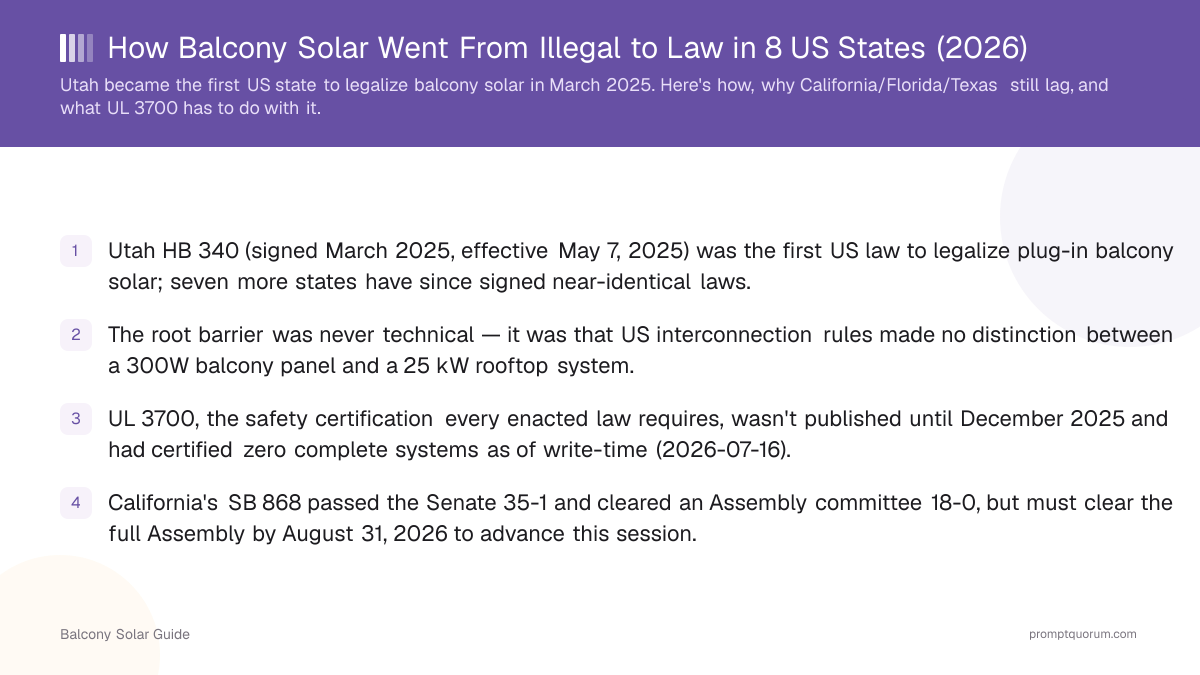
- Utah HB 340 (signed March 2025, effective May 7, 2025) was the first US law to legalize plug-in balcony solar; seven more states have since signed near-identical laws.
- The root barrier was never technical — it was that US interconnection rules made no distinction between a 300W balcony panel and a 25 kW rooftop system.
- UL 3700, the safety certification every enacted law requires, wasn't published until December 2025 and had certified zero complete systems as of write-time (2026-07-16).
- California's SB 868 passed the Senate 35-1 and cleared an Assembly committee 18-0, but must clear the full Assembly by August 31, 2026 to advance this session.
- Florida has no bill at all — and a 2011-era carve-out in its solar-rights statute explicitly excludes condo and apartment patio railings, the exact use case balcony solar targets.
- Texas has no bill and no ban — legality there depends on which of hundreds of retail electric providers serves your address.
Why Was Balcony Solar Illegal in the US Until 2025?
US residential electrical infrastructure was built entirely around consuming power, not generating it, and no rule distinguished a tiny plug-in panel from a full rooftop system. A plug-in solar device pushes power upstream through a standard NEMA 5-15 outlet into the home's wiring — the opposite of what that outlet was designed for.
Any grid-tied generation device, however small, technically fell under interconnection rules written for 5–25 kW rooftop systems: utility agreements, fees, inspections, and equipment that could double the cost of a $500 balcony system. That made balcony solar illegal or impractical across all 50 states through 2024.
Germany had already solved this. Its roughly 800W Balkonkraftwerk category grew from about 40,000 registered systems in 2017 to over 700,000 by late 2024, governed by the VDE-AR-N 4105 technical standard and simple grid-operator notification — with zero safety incidents reported for correctly used systems. Utah Representative Raymond Ward read a New York Times article about German balcony solar and introduced HB 340, citing Germany explicitly: "The electricity is the same over there as it is here. All the same rules of physics work and have proved to be safe."
What Is UL 3700 and Why Does It Matter?
UL 3700 is the US safety certification standard for plug-in solar equipment, published by UL Solutions in December 2025 — before it existed, there was no US standard a manufacturer could certify a balcony solar system against. Utah's HB 340 required certification to a standard that didn't yet exist when the law passed, effectively creating the demand that led UL to publish it.
UL 3700 tests three specific hazards: overcurrent conditions that could overwhelm a circuit breaker, GFCI incompatibility that could cause ground-fault protection to fail silently, and touch safety on the plug's exposed prongs when disconnected. It also requires anti-islanding protection — automatic shutdown within milliseconds of a grid outage, to protect utility line workers.
Certification testing opened in January 2026. As of write-time (2026-07-16), no complete plug-in solar system had yet earned full UL 3700 certification, though multiple manufacturers — EcoFlow among them — were in active certification discussions. UL VP of Engineering Kenneth Boyce said in April 2026 that he expected certified products within "months, maybe even weeks."
Use this to check a product claim: a device marketed as "UL 3700 compliant" or "UL 3700 ready" has not necessarily completed certification — verify the specific claim with the manufacturer or UL's own certification database before buying on the strength of it.
⚠️Warning: Every enacted state law conditions legal use on UL 3700 (or equivalent) certification. A state law being in effect does not mean a certified product is yet available to legally plug in there.
What Do All State Balcony Solar Laws Have in Common?
Every enacted or pending state balcony solar bill in the US follows the same template, modeled directly on Utah's HB 340. The seven common elements below appear, in some form, in all eight signed state laws.
The net metering exclusion is a deliberate political shortcut: utilities cannot object to being forced to compensate for microgeneration, and regulators don't need to redesign tariff structures — which is part of why these bills have passed with near-unanimous committee votes in every state so far.
| element | provision |
|---|---|
| Device definition | Movable PV device connected via a standard AC outlet — classified as an appliance, not "solar electric generating equipment" |
| Wattage cap | Most states: 1,200W AC. Colorado: 1,920W (highest confirmed). Maine: 420W self-install tier, 1,200W with an electrician |
| Safety certification | UL 3700 or an equivalent nationally recognized testing laboratory standard |
| Interconnection | Exempt from utility interconnection agreements, fees, and approval requirements |
| Anti-islanding | Required — automatic shutdown within milliseconds of a grid outage, to protect utility line workers |
| Net metering | Excluded — no compensation for excess generation fed back to the grid |
| Utility liability | Utilities are shielded from liability for damage caused by a compliant device |
How Did Utah Become the First State to Legalize Balcony Solar?
Utah HB 340, the Solar Power Amendments, passed both legislative chambers unanimously and was signed by Governor Spencer Cox in March 2025, taking effect May 7, 2025. Republican Representative Raymond Ward introduced it after reading about German Balkonkraftwerk systems in the New York Times; Republican Senator Wayne Harper carried it in the Senate.
Ward framed the bill entirely around consumer freedom and cost savings, not climate policy — "It's great for anyone who wants a little solar power but does not want to pay $30,000 for a roof install" — a framing that proved replicable in both conservative and liberal states alike. He worked directly with Rocky Mountain Power, Utah's largest utility, on safety language; the utility took no formal position but flagged concern about uncertified products.
The law creates a "small portable solar generation device" category: 1,200W maximum output, connects via a standard 120V AC outlet, meets National Electrical Code standards, and is certified by a nationally recognized testing laboratory. Qualifying devices are exempt from interconnection agreements, additional mandates, approval requirements, and utility fees — no notification to the utility is required.
If you live in Utah: the law has been in effect since May 2025, but the products legally allowed to use it are still catching up — confirm a specific product's UL 3700 status before buying, since the certification gap (see above) applies here too.
Why Can't California Residents Legally Plug In Balcony Solar Yet?
As of write-time, connecting balcony solar in California without a utility interconnection agreement violates CPUC rules — California treats a 300W balcony panel the same as a 25 kW rooftop system for interconnection purposes. Senate Bill 868, the Plug Into the Sun Act introduced by Senator Scott Wiener on January 5, 2026, would fix this by classifying portable solar devices as appliances rather than power plants.
SB 868 has moved through committee with unusual unanimity: it passed the full Senate 35-1 on May 19, 2026, and cleared the Assembly Utilities and Energy Committee 18-0 on June 10, 2026. It is now in Assembly Appropriations, where a CPUC estimate of $200,000–$500,000 in annual administrative costs triggered the suspense file and pushed its hearing to August 2026.
California's stakes are the highest of any state: roughly 44% of households rent, and statewide average residential electricity rates run around 31.4¢/kWh — nearly triple Utah's. NEM 3.0, which cut rooftop solar export compensation by roughly 75% in 2023, actually strengthens the case for balcony solar's self-consumption model, since it never relied on export credits in the first place.
If you live in California: the Assembly must pass SB 868 by August 31, 2026 for it to advance this session. Connecting a balcony panel to your home's wiring before that — or before Governor signature and a January 1, 2027 effective date, if it passes — is not currently legal under CPUC rules.
Why Does Florida Have No Balcony Solar Law Despite Strong Solar Rights?
Florida has no balcony solar bill, enacted or introduced, as of write-time — and its existing solar-rights law makes the gap worse, not better, for the exact renters balcony solar is designed for. Florida Statute 163.04 broadly prohibits HOAs and deed restrictions from blocking solar installations, with the prevailing party in disputes entitled to attorney fees.
But §163.04(4) contains a carve-out inserted as a late concession to utility and multi-family building lobbying: "This section shall not apply to patio railings in condominiums, cooperatives, or apartments." That clause excludes exactly the mounting location balcony solar uses — a detached homeowner has strong solar rights in Florida; a condo or apartment resident hanging a panel on a railing has none.
The gap persists despite strong underlying market fundamentals: a large condo-dense renter population in South Florida, rising electricity costs (~$210/year estimated savings from an 800W kit), and a legislature that already streamlined rooftop solar permitting via HB 683 in June 2025. Florida advocates have called the elimination of the patio-railing exception a prerequisite for any real balcony solar access.
If you live in Florida: check your specific HOA or condo association rules before buying — §163.04 provides no legal backing for a railing-mounted panel, and associations can and do prohibit them outright with no recourse available under current law.
Is Balcony Solar Legal in Texas?
There is no statewide ban and no statewide exemption in Texas — legality depends on which of hundreds of retail electric providers (REPs) serves your specific address. Standard interconnection rules written for 5 kW+ systems technically apply to any grid-tied device, but enforcement against small plug-in panels varies by utility and REP.
Texas's ERCOT grid covers roughly 90% of the state and lets residential customers choose their REP from a competitive market — each with its own tariff rules on behind-the-meter generation. Municipal utilities like Austin Energy and CPS Energy operate outside ERCOT retail competition with their own separate rules, and roughly 70 rural electric cooperatives add another layer of independent policy.
The 89th Legislature (2025 session) passed three solar-related laws — SB 1202 (permitting streamlining), SB 1697 (consumer guide), and SB 1036 (sales-practice consumer protection) — but none addresses plug-in devices specifically. SB 1036's requirement that sales agreements include utility interconnection approval language could actually complicate the picture for commercially sold plug-in systems.
If you live in Texas: there is no single answer — check your specific REP's tariff (or your municipal utility's rules, if you're served by one) before connecting anything to your home's wiring. "It depends on your utility" is the accurate answer, not a evasion of one.
What Does New York's SUNNY Act Do?
New York's SUNNY Act (A.9111C/S.8512C) passed the full legislature 59-1 on May 28–29, 2026 and needs only Governor Kathy Hochul's signature to become the 9th enacted state law — it would take effect 90 days after signing. The bill amends Public Service Law §66-j to create a "portable solar generation device" category, explicitly separate from utility-scale "solar electric generating equipment."
Sponsored by Assembly Member Gallagher and Senator Krueger, the bill requires accredited testing-lab certification, anti-islanding protection, and compliance with the state Fire Prevention and Building Code — and exempts qualifying devices from NYSERDA interconnection and net metering requirements. It explicitly modeled itself on Utah's HB 340 and cited Germany's roughly four million installed systems with no reported safety incidents as its safety benchmark.
New York's case may be the strongest in the country: Con Edison customers in New York City frequently pay over 30¢/kWh — about 59% above the national average — while roughly 68% of NYC residents rent, with no roof access and no path to any NYSERDA solar incentive built around owned rooftop systems. An 800W system is estimated to save $203–236/year at New York rates.
If you live in New York: the law is not yet in effect — it needs Governor Hochul's signature first, then a 90-day waiting period. Track the signature status before assuming the SUNNY Act already applies to you.
How Do Utah, California, Florida, Texas, and New York Compare?
Utah is the only one of these five states where balcony solar is both legal and in effect today — the other four are either pending, absent, or ambiguous, each for a different reason. Use this table to see where your state sits and what specifically is blocking or enabling it.
| state | status | wattageCap | avgRate | estSavings | keyBarrier |
|---|---|---|---|---|---|
| Utah | Enacted (signed Mar. 2025, effective May 7, 2025) | 1,200W | ~11.6¢/kWh | ~$175/yr (800W kit) | UL 3700 certification gap — no fully certified system yet available |
| California | Bill pending (SB 868, in Assembly Appropriations) | 1,200W if passed | ~31.4¢/kWh | ~$350/yr (800W kit) | Assembly must pass by Aug. 31, 2026; CPUC flagged $200k–$500k in admin costs |
| Florida | No bill introduced | N/A | ~14.2¢/kWh | ~$206/yr (800W kit) | F.S. 163.04(4) explicitly excludes condo/apartment patio railings from solar-access protection |
| Texas | No bill; legal status undetermined | N/A | ~15¢/kWh | ~$154/yr (800W kit) | ERCOT deregulation means each retail electric provider sets its own interconnection tariff |
| New York | Passed legislature 59-1; awaiting Gov. Hochul's signature | 1,200W if signed | ~27–30¢/kWh | ~$203–236/yr (800W kit) | Governor's signature is the only remaining step |
Who Is Driving US Balcony Solar Legislation Forward?
Three actors account for most of the US balcony solar legislative wave: Bright Saver, a nonprofit that provides model legislation and lobbying toolkits state by state; Utah Representative Raymond Ward, who has personally consulted with lawmakers in Hawaii, Washington, Minnesota, and Colorado; and UL Solutions, which was effectively deputized by Utah's law to create the UL 3700 standard the whole category now depends on.
Bright Saver was founded January 2025 with $500,000 in initial grant funding, led by Executive Director Kevin Chou and Co-founder Cora Stryker. Its central argument: roughly 70% of US households can't access rooftop solar due to renter status, unsuitable roofs, or upfront cost, making plug-in solar the only scalable path to solar access for that group.
On the manufacturing side, EcoFlow is the most visible brand actively pursuing UL 3700 certification for the US market; Anker's SOLIX Solarbank line, widely sold in Europe, is not certified or sold in the US at all. In California specifically, the Environmental Working Group sponsors SB 868, alongside the California Solar and Storage Association, Solar Rights Alliance, and Environment California.
What Should You Do Right Now, Based on Your State?
Your next step depends entirely on which of three groups your state falls into — enacted, pending, or unaddressed — not on a single national answer.
•Info: Enacted (Utah, Maine, Virginia, Maryland, Colorado, New Hampshire, Vermont, Connecticut): check your specific product's UL 3700 certification status before buying — the law being in effect does not guarantee a legally compliant product is on the market yet.
•Info: Pending (New York, California, and 30+ other states with bills introduced): track the bill's status directly rather than assuming it has passed — a unanimous committee vote is not the same as a signed law.
⚠️Warning: Unaddressed (Florida, Texas, and most other states): do not assume legality either way. In Florida, check your HOA/condo association rules directly against §163.04(4)'s patio-railing exception. In Texas, check your specific retail electric provider's or municipal utility's tariff. Elsewhere, contact your utility before connecting anything.
Frequently Asked Questions
Which US state legalized balcony solar first?
Utah, with HB 340, signed March 2025 and effective May 7, 2025. It remains the only one of the eight signed states where the law has been in effect for more than a year.
Why did the US lag Germany by roughly a decade on balcony solar?
US interconnection rules never created an exception for small plug-in devices — every grid-tied system, regardless of size, technically fell under rules written for 5–25 kW rooftop installations. Germany's VDE-AR-N 4105 standard and 800W cap solved this structurally starting in the early 2010s; the US had no equivalent framework or safety standard until Utah's 2025 law forced UL Solutions to create one.
Has any product actually been UL 3700 certified yet?
Not as of write-time (2026-07-16). UL 3700 was published December 2025 and certification testing opened January 2026; UL's VP of Engineering expected the first certified products within months as of April 2026, but none had completed the process at time of writing.
Is balcony solar legal in California?
Not yet. Connecting one without a utility interconnection agreement currently violates CPUC rules. SB 868 would fix this, but must pass the full Assembly by August 31, 2026 to advance, then requires the Governor's signature — it would take effect January 1, 2027 if signed.
Why is Florida different from other states with strong solar rights?
Florida's F.S. 163.04 broadly protects solar installations from HOA restrictions, but subsection (4) explicitly excludes patio railings in condominiums, cooperatives, and apartments — the exact mounting location balcony solar depends on. No plug-in solar bill has been introduced to close that gap.
Is balcony solar legal in Texas?
There's no single answer. Texas has no statewide law addressing plug-in solar either way; whether your specific setup is compliant depends on your retail electric provider's tariff, or your municipal utility's rules if you're outside ERCOT retail competition.
What happens if New York's Governor doesn't sign the SUNNY Act?
The bill would need to be reintroduced in a future legislative session — a 59-1 vote does not make a bill law without the Governor's signature. As of write-time it was still awaiting that signature.
Who is behind the push for US balcony solar legislation?
Bright Saver, a nonprofit founded January 2025, provides model legislation and lobbying support state by state. Utah Representative Raymond Ward has personally consulted with lawmakers in multiple other states. UL Solutions developed the UL 3700 safety standard that every enacted law requires.
Does a state balcony solar law mean I can buy and use a system immediately?
Not necessarily. Every enacted law conditions legal use on UL 3700 (or equivalent) certification, and as of write-time no complete system has earned that certification — check a specific product's actual certification status, not just its marketing claims, before assuming it's legal to plug in.