Is Balcony Solar Legal in Connecticut?
By Hans Kuepper · Founder of PromptQuorum · Discovery engine for open-weight & open-source AI
Key Takeaways
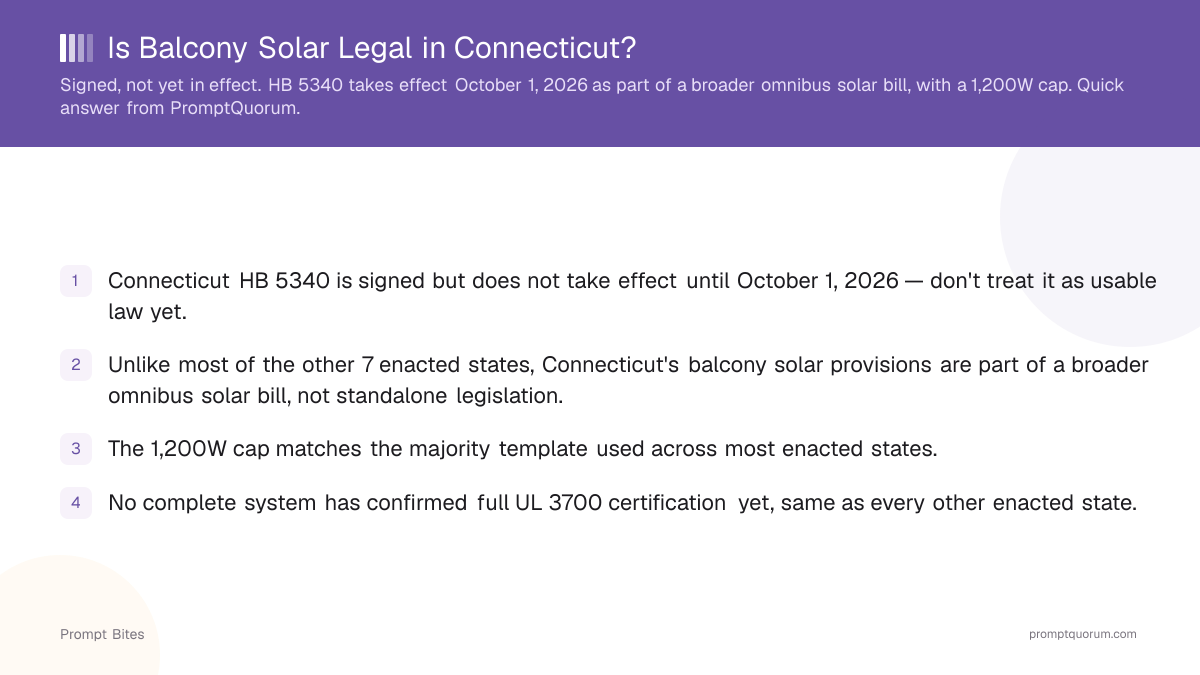
- ✓Connecticut HB 5340 has been in effect since October 1, 2026 — the legal gate is cleared, but product certification is still open.
- ✓Unlike most of the other 9 enacted states, Connecticut's balcony solar provisions are part of a broader omnibus solar bill, not standalone legislation.
- ✓The 1,200W cap matches the majority template used across most enacted states.
- ✓No complete system has confirmed full UL 3700 certification yet, same as every other enacted state.
This page contains links to third-party products for reference. PromptQuorum is not enrolled in any affiliate program — these are plain links that earn no commission. Clicking links and your next steps are entirely your own responsibility. Any recommendation on this page reflects our own reading of the vendors' public pages, not a vendor endorsement or a test.
Quick Answer
In effect. Connecticut HB 5340 was signed June 4, 2026 and has been in effect since October 1, 2026. It's part of a broader omnibus solar bill rather than a standalone balcony solar law, with a standard 1,200W cap.
- ▸HB 5340 signed June 4, 2026 — in effect since October 1, 2026
- ▸Part of a broader omnibus solar bill, not a standalone balcony solar law
- ▸1,200W cap, matching the majority template used by most enacted states
What Does HB 5340 Require in Connecticut?
Connecticut HB 5340 folds balcony solar provisions into a broader omnibus solar bill, rather than passing standalone legislation the way most of the other 9 enacted states did. It sets a 1,200W cap matching the majority template, and the law has been in effect since October 1, 2026. Expect the standard exemption structure: no utility interconnection agreement or fee, with net metering excluded.
No HOA or landlord preemption language for Connecticut was confirmed in this pass — check your lease or HOA covenant separately.
| Field | Connecticut HB 5340 |
|---|---|
| Signed / Effective | Jun 4, 2026 / Oct 1, 2026 (in effect) |
| Wattage cap | 1,200W |
| Bill structure | Omnibus solar bill, not standalone |
| Net metering | Not available |
Should I Buy Hardware Now for Connecticut?
Not yet — the legal gate is cleared (HB 5340 has been in effect since October 1, 2026), but no complete plug-in solar system has confirmed full UL 3700 certification as of write-time. The certification gate is still open. EcoFlow's STREAM Ultra is the closest product to market but is currently listed for sale specifically in Utah, not Connecticut.
Connecticut wasn't in the source tracker's state-by-state savings table used for this series, so a Connecticut-specific dollar figure isn't available here. Across the states that were tracked, an 800W kit saves roughly $150–$350 per year depending on local electricity rates — treat that as a national range, not a Connecticut estimate.
Once certified hardware exists, you'll want real options to compare. See the current US home-battery picks for balcony solar or the EcoFlow vs. Anker vs. Zendure ecosystem comparison for context now — but neither page claims any kit is certified or ready for Connecticut's law today.
Quick Answers About Connecticut Balcony Solar
Is balcony solar legal in Connecticut right now?▾
Why is Connecticut's balcony solar provision part of a bigger bill?▾
Can my HOA in Connecticut ban balcony solar?▾
Will I be able to sell excess power back to the grid in Connecticut?▾
Want the full breakdown?
Read the complete guide →Related Prompt Bites
- ▸Is Balcony Solar Legal in Utah?
- ▸Is Balcony Solar Legal in Maine?
- ▸Is Balcony Solar Legal in Virginia?
- ▸Is Balcony Solar Legal in Maryland?
- ▸Is Balcony Solar Legal in Colorado?
- ▸Is Balcony Solar Legal in New Hampshire?
- ▸Is Balcony Solar Legal in Vermont?
- ▸Is Balcony Solar Legal in New Jersey?
- ▸Is Balcony Solar Legal in California?
- ▸Is Balcony Solar Legal in New York?