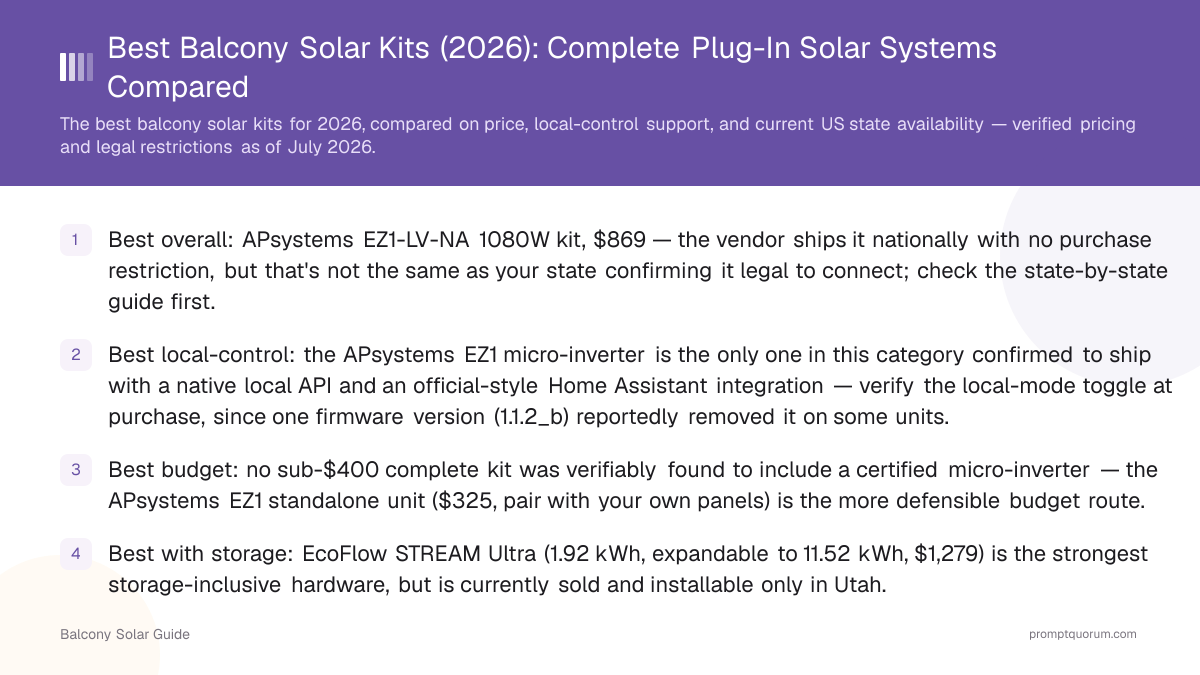
How We Chose
We prioritized current US availability and verifiable pricing over spec-sheet comparisons alone, since a well-specced kit that can't legally ship to your state isn't actually a usable pick. Local-control support was weighted heavily given this cluster's focus on no-cloud, self-hosted setups — see the full local-control thesis for why that matters.
Best Overall: APsystems EZ1-LV-NA 1080W Kit
The APsystems EZ1-LV-NA kit pairs two 540W Talesun bifacial panels with the EZ1-LV micro-inverter for $869 (down from $1,199 MSRP), sold and shipped from a US warehouse. Because it uses the standalone microinverter route rather than a battery-storage unit, it isn't subject to the state-by-state storage restrictions that limit EcoFlow's comparable kit — a meaningful practical advantage while state legislation is still catching up across the country. The $869 price was checked on 2026-07-02 and could not be re-verified on 2026-11-20 because the retailer page was unreachable.
Best No-Cloud / Local-Control Pick
The APsystems EZ1 micro-inverter — sold both in the kit above and standalone — has one of the few confirmed native local APIs in this category, with an official-style open-source Home Assistant integration that needs no cloud account. One caveat worth verifying before you buy: a reported firmware version (1.1.2_b) removed local-API functionality on some units, so confirm the local-mode toggle is present on the unit you receive rather than assuming it from the spec sheet alone.
Hoymiles hardware can also reach a genuinely no-cloud setup, but only via third-party OpenDTU firmware on separate ESP32-based hardware (roughly €55) plus a community Python integration — a real DIY project, not an out-of-box feature. See the dedicated micro-inverter comparison for the full breakdown.
Best Budget
We could not verify any complete kit under $400 that includes a certified micro-inverter — multiple current buying guides explicitly warn that sub-$400 listings "may not include a certified microinverter." The more defensible budget route is the APsystems EZ1 standalone micro-inverter at $325 (with free lower-48 shipping direct from APsystems), which you pair with your own compatible panels.
EcoFlow also sells a standalone STREAM Microinverter at $369 on sale, but its own product page states it is sold "only... within the state of Utah" under that state's specific legislation — not a nationally viable budget pick despite the attractive price. That price and restriction were checked on 2026-07-02 and have not been re-verified.
Best With Storage
EcoFlow's STREAM Ultra is the strongest storage-inclusive balcony solar hardware: 1.92 kWh base capacity (expandable to 11.52 kWh), a built-in grid-tied micro-inverter, 1,200W AC output, and a 10-year warranty on LFP cells rated for 6,000 cycles at 70% capacity retention. The significant limitation is availability: EcoFlow's US product page (checked 2026-11-20) lists it at $1,399, shows it as out of stock with a restock date of March 2027, and states the plug-in installation states inconsistently — one note names Utah, Maryland, Connecticut and Colorado, while a footnote says sale and plug-and-play installation are Utah only.
BigBlue's POWAFREE H1 (2,560 Wh battery, 800W solar input and an integrated micro-inverter, IP67 per retailer listings) is another storage option, but we could not verify its current US price or the states where it can be installed on a BigBlue-owned page — treat both as unverified and confirm with the vendor and your state's law before buying.
⚠️Warning: State legality for storage-inclusive balcony solar kits is currently far more restrictive than for panel-plus-microinverter-only kits. Confirm your state's status before buying a storage kit specifically.
Comparison Table
kit | price | storage | control | availability |
|---|---|---|---|---|
| APsystems EZ1-LV-NA 1080W | $869 | None | Native local API | Ships nationally |
| APsystems EZ1 (standalone) | $325 | None | Native local API | Ships nationally |
| EcoFlow STREAM Ultra | $1,399 | 1.92–11.52 kWh | Cloud app (no verified local API) | Out of stock (restock March 2027) |
| BigBlue POWAFREE H1 | Unverified | 2,560 Wh | Unverified | Unverified |
What to Look For
Check state legality first, then certification, then wattage limit and monitoring approach — in that order, since a great kit that can't legally ship or connect where you live isn't a usable option. See the state-by-state legal guide before you shop by price alone.
- State legality and any state-specific wattage cap — confirm before comparing kits
- Certification status (UL 1741/IEEE 1547 today; UL 3700: APsystems states CSA certification for its EZ1, other brands unconfirmed)
- Local vs. cloud monitoring, if that matters to you
- Whether storage is included, and whether that specific storage hardware is legal in your state
•Info: This guide is general information, not legal, tax or electrical advice. Plug-in solar rules and product safety requirements differ by state, utility and landlord or HOA; confirm them with your state regulator, your utility and, where needed, a licensed electrician before you buy or connect anything.
China Hardware & Price Note
Nearly all balcony solar hardware — panels and micro-inverters alike — is China-manufactured. China removed its PV-component export VAT rebate on April 1, 2026 and module prices jumped beforehand, but wholesale prices have since eased: the OPIS benchmark for Chinese TOPCon modules fell from about $0.119/W on April 7 to $0.108/W on September 22. These are wholesale module prices only — retail kit prices were not verified market by market, so we no longer forecast a retail price rise for the second half of 2026.
Frequently Asked Questions
What is the best balcony solar kit overall?
The APsystems EZ1-LV-NA 1080W kit ($869) is the strongest overall pick for most US buyers — it ships nationally without the state-storage restrictions that limit battery-inclusive kits, and its micro-inverter has native local-control support.
Is there a balcony solar kit with battery storage that ships nationwide?
Not currently verified. EcoFlow's STREAM Ultra, the strongest storage-inclusive option, was listed as out of stock (restock March 2027) on EcoFlow's US page on 2026-11-20, and that page names either Utah only or Utah, Maryland, Connecticut and Colorado for plug-in installation, depending on the note. We could not verify BigBlue's POWAFREE H1 availability.
Do any balcony solar kits have UL 3700 certification?
Not conclusively. APsystems states on its US page that its EZ1 is "CSA Certified to UL3700 standards" — a vendor claim we could not check against a certification database. Hoymiles' HiFlow Pro, announced in July 2026, is marketed as UL 3700-compliant, but press reports say UL Solutions has not certified it. The standard itself was published in December 2025.
What is the cheapest reliable balcony solar option?
The APsystems EZ1 standalone micro-inverter at $325 (paired with your own compatible panels) is the most defensible budget route we could verify — no complete kit under $400 was confirmed to include a certified micro-inverter.
Which balcony solar kit works best with Home Assistant?
Kits built around the APsystems EZ1 micro-inverter, which has a native local API and an official-style open-source Home Assistant integration requiring no cloud account.
Are balcony solar kit prices rising?
Not clearly. China removed a PV-component export VAT rebate effective April 1, 2026 and wholesale module prices jumped beforehand, but the OPIS benchmark for Chinese TOPCon modules eased from about $0.119/W to $0.108/W between April 7 and September 22. Retail kit prices were not verified market by market.
Can I add a battery to a panel-only kit later?
This depends on your micro-inverter and battery compatibility — check the specific product's expansion options before assuming a panel-only kit can be upgraded with storage later.
Are these kits legal in every US state?
No — legality and wattage limits vary by state. As of our 2026-10-19 tracker check, 10 states had signed plug-in solar laws (Utah, Maine, Maryland, Colorado, Vermont and Connecticut in effect; Virginia, California, New Hampshire and New Jersey signed but taking effect in 2027) and New York's bill was awaiting the governor. Confirm your state's current status before purchasing; see the state-by-state legal guide.