Key Takeaways
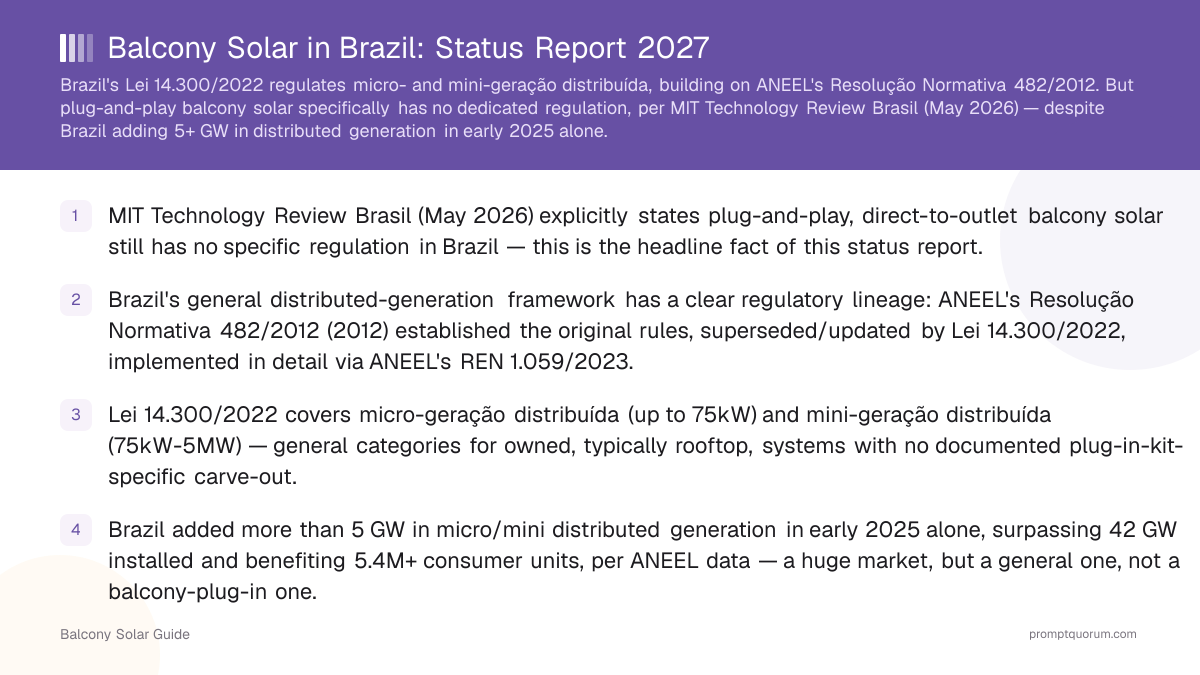
- MIT Technology Review Brasil (May 2026) explicitly states plug-and-play, direct-to-outlet balcony solar still has no specific regulation in Brazil — this is the headline fact of this status report.
- Brazil's general distributed-generation framework has a clear regulatory lineage: ANEEL's Resolução Normativa 482/2012 (2012) established the original rules, superseded/updated by Lei 14.300/2022, implemented in detail via ANEEL's REN 1.059/2023.
- Lei 14.300/2022 covers micro-geração distribuída (up to 75kW) and mini-geração distribuída (75kW-5MW) — general categories for owned, typically rooftop, systems with no documented plug-in-kit-specific carve-out.
- Brazil added more than 5 GW in micro/mini distributed generation in early 2025 alone, surpassing 42 GW installed and benefiting 5.4M+ consumer units, per ANEEL data — a huge market, but a general one, not a balcony-plug-in one.
- The correct framing: Brazil has the infrastructure and market culture for distributed solar broadly, but the plug-in-balcony product category specifically has no dedicated regulation yet — do not conflate Brazil's large general DG market with a balcony-solar subsidy program, because no such program exists.
The Regulatory Gap: Plug-In Solar Specifically
A Brazilian source — MIT Technology Review Brasil, May 2026 — explicitly states that the plug-and-play, direct-to-outlet balcony solar model still has no specific regulation in Brazil, making its adoption "more incipient" compared to international markets that have dedicated frameworks. This is the central finding of this status report: Brazil is not short on distributed solar policy in general (see below), but the specific plug-in-balcony product category — small, consumer-installed, direct-to-outlet kits, as distinct from professionally installed rooftop systems — has not been separately addressed by regulators.
This is a similar shape to the gap findings for Japan and other emerging markets covered elsewhere in this cluster: a country with substantial solar infrastructure and policy, where the specific balcony/plug-in product category simply has not been separately legislated yet.
The Framework It Would Fall Under
Brazil's general distributed-generation solar regulation has a clear lineage. ANEEL's Resolução Normativa (RN) 482/2012 first established Brazil's net-metering-style compensation system for distributed generation. That framework was substantially updated and given statutory backing by Lei 14.300/2022, Brazil's Distributed Generation Legal Framework law, which formally defines micro-geração distribuída (systems up to 75kW) and mini-geração distribuída (75kW to 5MW). ANEEL's REN 1.059/2023 is the regulator's implementing resolution that operationalizes Lei 14.300/2022's provisions in technical detail — connection requests, technical study requirements, bidirectional metering, and INMETRO-certified inverter documentation, applied uniformly regardless of system size.
None of these three instruments — RN 482/2012, Lei 14.300/2022, or REN 1.059/2023 — carve out a separate, lighter-touch process for small plug-in kits. A balcony solar system in Brazil technically falls under the same micro-geração process as a full rooftop installation, which is the structural reason the category remains, per MIT Technology Review Brasil, more incipient than in markets with a dedicated small-system exemption.
Brazil's Distributed Generation Market Is Not the Same Thing
Brazil added more than 5 GW in micro- and mini-geração distribuída in early 2025 alone, surpassing 42 GW of installed distributed-generation capacity and benefiting more than 5.4 million consumer units, according to ANEEL data cited in Brazilian press. This is one of the largest distributed-generation solar markets in the world by these measures.
That scale reflects owned, typically rooftop-installed systems operating under Lei 14.300/2022's net-metering-style credit system — it is general distributed-generation market growth, not evidence of a balcony-plug-in-specific market or program. It is easy to read Brazil's large DG numbers and assume a dedicated balcony solar subsidy or adoption program exists; that would be a conflation this page deliberately avoids. Brazil has the underlying infrastructure, grid-interconnection process, and market familiarity with distributed solar that could support balcony solar adoption — but the specific product category has not yet been addressed with dedicated rules.
⚠️Warning: Do not read Brazil's 5+ GW / 42 GW / 5.4M-consumer-unit distributed-generation figures as balcony-solar-specific statistics. They describe the general DG market under Lei 14.300/2022, which balcony solar would technically fall under but which has no dedicated small-plug-in-kit carve-out or separate reporting category.
Frequently Asked Questions
Is balcony solar legal in Brazil?
It's not banned, but plug-and-play balcony solar specifically has no dedicated regulation — per MIT Technology Review Brasil (May 2026), this makes its adoption more incipient than in markets with dedicated frameworks. It would technically fall under Brazil's general micro-geração distribuída process (Lei 14.300/2022), which has no small-kit carve-out.
What is Lei 14.300/2022?
Brazil's Distributed Generation Legal Framework law, which formally defines micro-geração distribuída (up to 75kW) and mini-geração distribuída (75kW-5MW), building on ANEEL's earlier Resolução Normativa 482/2012 and implemented in technical detail via ANEEL's REN 1.059/2023.
Does Brazil have a balcony solar subsidy program?
No. Brazil has a large general distributed-generation solar market — 5+ GW added in early 2025 alone, 42 GW+ installed, 5.4M+ consumer units — but this reflects owned/rooftop systems under Lei 14.300/2022's net-metering-style framework, not a balcony-plug-in-specific program. No dedicated balcony solar subsidy or adoption program exists.
Why is balcony solar adoption slower in Brazil than in some other markets?
Per MIT Technology Review Brasil (May 2026), the structural reason is the lack of a dedicated regulatory carve-out — plug-in kits fall under the same formal micro-geração process as full rooftop installations, with no lighter-touch registration path for small systems, unlike markets with an explicit small-system exemption.
How does this relate to the Portugal/Brazil legal comparison on this site?
The Portugal/Brazil comparison article covers Brazil's legal-status gray zone alongside Portugal's codified exemption. This page goes deeper on Brazil specifically: the regulatory lineage (RN 482/2012 to Lei 14.300/2022 to REN 1.059/2023) and the contrast between Brazil's large general distributed-generation market and the still-unaddressed balcony-plug-in category.