Key Takeaways
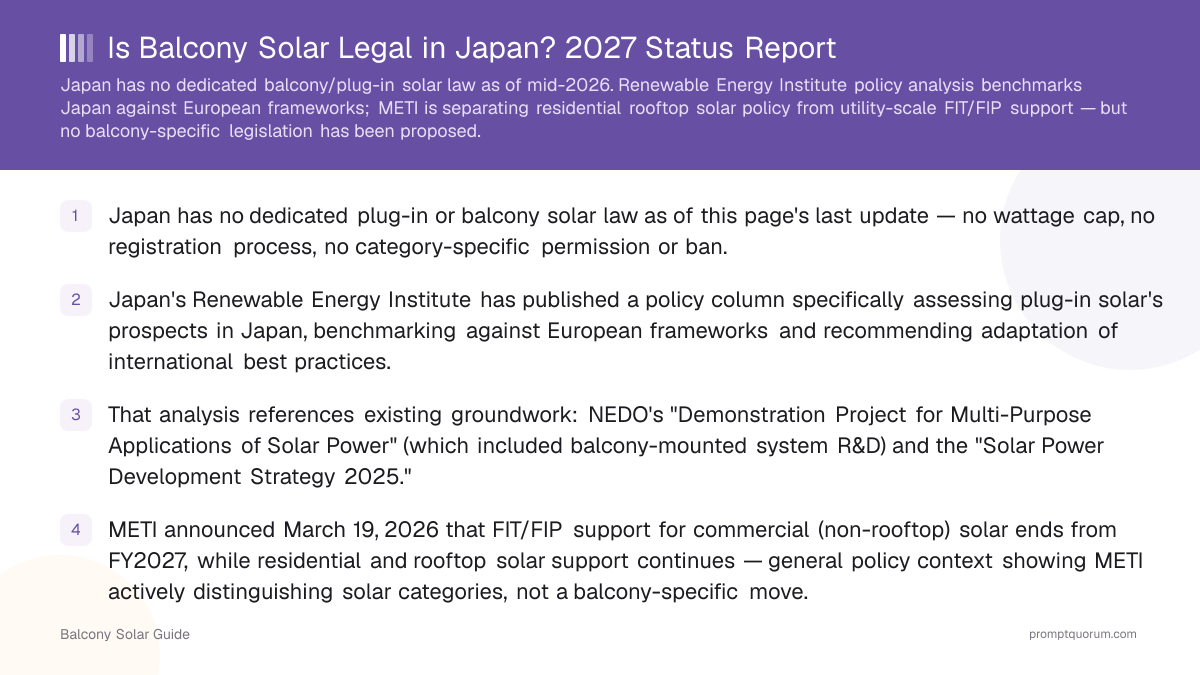
- Japan has no dedicated plug-in or balcony solar law as of this page's last update — no wattage cap, no registration process, no category-specific permission or ban.
- Japan's Renewable Energy Institute has published a policy column specifically assessing plug-in solar's prospects in Japan, benchmarking against European frameworks and recommending adaptation of international best practices.
- That analysis references existing groundwork: NEDO's "Demonstration Project for Multi-Purpose Applications of Solar Power" (which included balcony-mounted system R&D) and the "Solar Power Development Strategy 2025."
- METI announced March 19, 2026 that FIT/FIP support for commercial (non-rooftop) solar ends from FY2027, while residential and rooftop solar support continues — general policy context showing METI actively distinguishing solar categories, not a balcony-specific move.
- [VERIFY] No timeline for dedicated balcony-solar legislation has been announced — treat any near-term prediction as speculation, not fact.
No Dedicated Law Yet
As of this page's last update, Japan has no plug-in or balcony solar legislation — the product category exists in a genuine regulatory vacuum, not a gray zone shaped by an ill-fitting general rule. This differs from markets like Brazil, where a general distributed-generation framework technically applies to any grid-tied system regardless of size; in Japan, no comparable "this is the rule that happens to cover balcony solar too" framework has been identified in research for this page. There is no wattage cap analogous to Germany's 800W or Portugal's 700W exemption, and no registration process specific to small plug-in systems.
This page is deliberately a status report rather than a rules guide — because there are, at this point, no dedicated rules to report.
The Policy Conversation So Far
Japan's Renewable Energy Institute (自然エネルギー財団) has published a policy column specifically assessing plug-in solar's status in Japan, explicitly benchmarking the country against European regulatory frameworks and recommending Japan adapt international best practices to its own technical and legal context. This is advocacy and analysis from a renewable-energy policy institute, not a government proposal or draft bill — it signals that the topic has entered Japan's policy discourse, not that legislation is forthcoming.
The column references relevant existing foundations rather than starting from zero: NEDO's (New Energy and Industrial Technology Development Organization) "Demonstration Project for Multi-Purpose Applications of Solar Power," which included R&D specifically on balcony-mounted systems, and Japan's "Solar Power Development Strategy 2025." These represent prior technical/strategic groundwork the policy conversation can build on, not enacted rules for consumer plug-in systems.
Separately, and not balcony-specific: METI announced on March 19, 2026 that it will discontinue FIT/FIP (Feed-in Tariff / Feed-in Premium) support for commercial, non-rooftop solar from fiscal year 2027, while continuing FIT/FIP support for residential and commercial rooftop solar. This shows METI actively drawing a policy line between rooftop/residential solar and utility-scale solar — relevant background for where balcony solar could eventually be categorized, since it would presumably fall closer to the residential/rooftop side of that line, but it is general solar policy, not a balcony-solar announcement.
⚠️Warning: [VERIFY] This page reports the policy conversation as it stands at the time of research (mid-2026). No announced timeline for dedicated balcony-specific legislation exists — do not treat the Renewable Energy Institute's recommendations or METI's FIT/FIP distinction as evidence that formal rules are imminent.
Where This Might Be Headed
The two data points available — a renewable-energy policy institute actively recommending European-style frameworks, and METI already distinguishing residential/rooftop solar from utility-scale support in its FIT/FIP policy — suggest the pieces exist for Japan to eventually formalize balcony solar rules, in the way the EU's EPBD-driven push has done for several member states. That said, this is this page's own reasonable inference from available context, not a sourced prediction: no draft bill, consultation process, or ministry timeline for balcony-specific legislation has been found.
Frequently Asked Questions
Is balcony solar legal in Japan?
There is no dedicated law either permitting or banning it — the category has not been legislated yet. It exists in a genuine regulatory vacuum rather than a legal gray zone shaped by an existing general rule.
Is Japan planning to regulate balcony solar?
No formal government proposal has been identified. Japan's Renewable Energy Institute has published policy analysis recommending Japan adapt European-style frameworks, and METI has separated residential/rooftop solar policy from utility-scale FIT/FIP support in a March 2026 announcement — but neither is dedicated balcony-solar legislation, and no timeline for one has been announced.
What is NEDO's role in Japan's balcony solar policy discussion?
NEDO (New Energy and Industrial Technology Development Organization) ran a "Demonstration Project for Multi-Purpose Applications of Solar Power" that included R&D on balcony-mounted systems specifically — referenced groundwork in the current policy conversation, not enacted regulation.
Does METI's March 2026 FIT/FIP announcement affect balcony solar?
Not directly. METI announced it will discontinue FIT/FIP support for commercial, non-rooftop solar from FY2027 while continuing support for residential and rooftop solar. This is general solar policy showing a category distinction relevant to where balcony solar might eventually fit, not a balcony-specific rule.
When will Japan have balcony solar rules?
[VERIFY] No timeline has been announced. Treat any specific date as speculation rather than confirmed fact until a ministry proposal or draft bill is published.