Key Takeaways
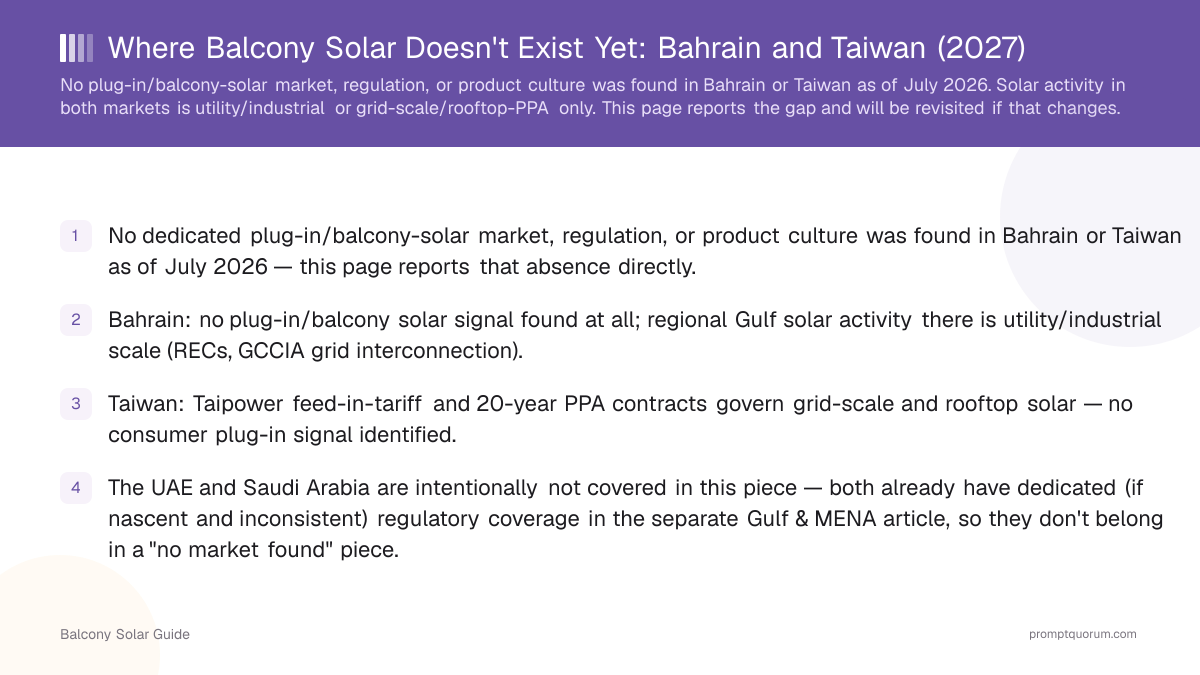
- No dedicated plug-in/balcony-solar market, regulation, or product culture was found in Bahrain or Taiwan — this page reports that absence directly.
- Bahrain: no plug-in/balcony solar signal found at all; regional Gulf solar activity there is utility/industrial scale (RECs, GCCIA grid interconnection).
- Taiwan: Taipower feed-in-tariff and 20-year PPA contracts govern grid-scale and rooftop solar — no consumer plug-in signal identified.
- The UAE and Saudi Arabia are intentionally not covered in this piece — both already have dedicated (if nascent and inconsistent) regulatory coverage in the separate Gulf & MENA article, so they don't belong in a "no market found" piece.
- No speculation on timing — this page states plainly that no legislative or market activity was found as of the research date and will be revisited if that changes.
Bahrain: No Signal Found
Research found no plug-in/balcony solar signal at all in Bahrain — not a regulation, not a market, not even passing consumer-product coverage. Regional Gulf solar activity that does involve Bahrain is utility/industrial in scale: renewable energy certificate (REC) mechanisms and GCCIA (Gulf Cooperation Council Interconnection Authority) grid-interconnection activity, both of which concern grid-level and industrial solar infrastructure rather than a consumer product category.
Taiwan: Grid-Scale Policy, No Consumer Plug-In Signal
Taiwan's solar policy centers on Taipower (Taiwan Power Company) feed-in tariffs and 20-year power purchase agreements (PPAs) for grid-scale and rooftop solar systems — no consumer plug-in/balcony-solar signal was found. These mechanisms are built around long-term grid-connected contracts for larger, professionally installed systems, structurally different from the direct-to-outlet plug-in category covered elsewhere in this cluster.
Why Might This Be? (Inference, Not Fact)
As a reasonable inference (not a sourced fact): housing stock with centralized utility management, and — in the Gulf case — extreme climate, differ structurally from the German/US rental-apartment pattern that has driven balcony solar adoption elsewhere. Renters in small apartment units with individual utility metering, the demographic driving adoption in Germany and the US, are less structurally common in both Bahrain and Taiwan's housing markets. This is this page's own reasoning for the gap, offered as a plausible explanation, not a cited market-research finding.
📌Note: This page states plainly that no legislative or market activity was found in Bahrain or Taiwan as of the research date (July 2026). It does not speculate on whether or when that might change, and will be revisited if new activity emerges.
Frequently Asked Questions
Can I buy and use balcony solar in Bahrain or Taiwan?
No dedicated plug-in/balcony-solar regulation, market, or product category was found in either country. Solar activity in both markets is utility/industrial or grid-scale/rooftop-PPA based, not a consumer plug-in category.
Why isn't the UAE or Saudi Arabia covered on this page?
Both already have their own dedicated regulatory coverage — the UAE requires utility approval (NOC) for any grid-tied system with real enforcement (fines up to AED 20,000), and Saudi Arabia's ECRA sets an explicit 1kW regulatory floor. See the separate Gulf & MENA article; this "no market found" page only covers countries where no regulatory signal exists at all.
Does Bahrain have any balcony solar rules?
None were found. Bahrain's solar activity is utility/industrial scale (renewable energy certificates, GCCIA grid interconnection) — no plug-in/balcony-specific signal was identified.
Does Taiwan have plug-in solar rules?
No consumer plug-in signal was found. Taiwan's solar policy (Taipower feed-in tariffs, 20-year PPAs) governs grid-scale and rooftop systems, not a plug-in balcony category.
Will this page be updated if Bahrain or Taiwan develop balcony solar rules?
Yes — this page will be revisited if legislative or market activity emerges in either country. As of the research date, none was found.