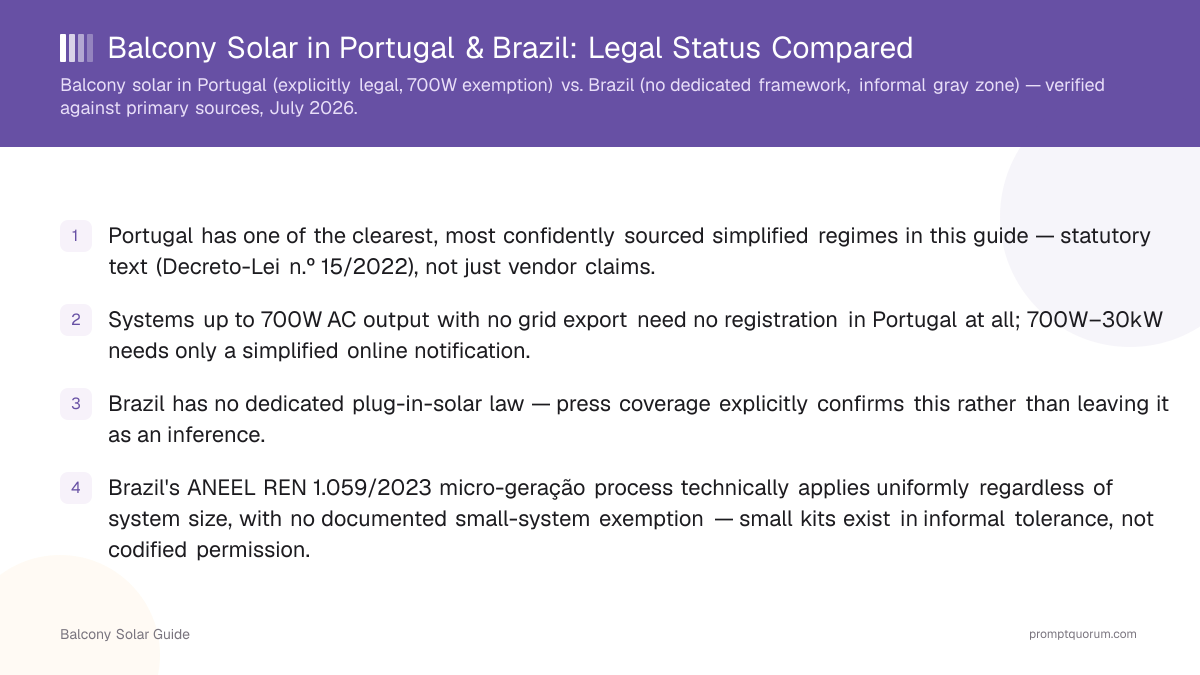
Key Takeaways
- Portugal has one of the clearest, most confidently sourced simplified regimes in this guide — statutory text (Decreto-Lei n.º 15/2022), not just vendor claims.
- Systems up to 700W AC output with no grid export need no registration in Portugal at all; 700W–30kW needs only a simplified online notification.
- Brazil has no dedicated plug-in-solar law — press coverage explicitly confirms this rather than leaving it as an inference.
- Brazil's ANEEL REN 1.059/2023 micro-geração process technically applies uniformly regardless of system size, with no documented small-system exemption — small kits exist in informal tolerance, not codified permission.
- This is a genuinely different risk profile than Portugal's codified exemption, even though neither country bans balcony solar outright.
- Any future pt-BR (Brazilian Portuguese) content for this cluster must use Brazilian Portuguese specifically, not European Portuguese, per this site's translation standard.
Portugal: A Codified Simplified Regime
Portugal has one of the most clearly codified simplified regimes of any country in this guide: systems up to 700W AC output with no grid export need no registration at all, per Decreto-Lei n.º 15/2022. Plug-in kits are treated as UPAC (self-consumption units) under this law, but the lowest power tier functions as a genuine simplified regime specifically for them — this is primary statutory text, not a vendor claim.
Systems between 700W and 30kW require only a simplified online notification ("Mera Comunicação Prévia") through DGEG rather than full registration — a meaningfully lighter process than what most other countries in this guide require.
Brazil: No Dedicated Framework
Brazil has no dedicated plug-in-solar law — press coverage explicitly confirms this rather than leaving it as an inference. Everything falls under ANEEL's general micro-geração framework (REN 1.059/2023), which technically applies the same formal interconnection process — connection request, technical study, bidirectional meter, INMETRO-certified inverter documentation — uniformly up to 75kW, with no documented wattage carve-out for small plug-in kits.
⚠️Warning: Do not describe Brazil's situation as "legal" in the same sense as Portugal's codified exemption — informal tolerance under an unaddressed regulatory gap carries meaningfully different risk than a statutory carve-out.
Side-by-Side Comparison
factor | portugal | brazil |
|---|---|---|
| Legal framework | Codified statute (Decreto-Lei n.º 15/2022) | No dedicated law — general ANEEL micro-geração rules apply |
| Small-system exemption | Yes — ≤700W AC, no export, zero registration | No documented exemption — full process technically applies to any size |
| Registration | None below 700W; simplified notification 700W–30kW | Standard micro-geração connection request via local utility |
| Practical reality for small kits | Clear legal certainty | Informally tolerated gray zone, not codified permission |
Frequently Asked Questions
Do I need to register balcony solar in Portugal?
Not if your system is 700W AC output or less with no grid export — that tier is exempt from prior control entirely under Decreto-Lei n.º 15/2022. Systems between 700W and 30kW need only a simplified online notification.
Is balcony solar illegal in Brazil?
No, it's not banned — but there's also no dedicated law permitting it with a simplified process. Small kits currently exist in an informally tolerated gray zone under ANEEL's general rules, which is a different situation from Portugal's codified exemption.
What certification do I need in Brazil for a balcony solar system?
INMETRO certification for the inverter and ABNT technical compliance, per the general ANEEL framework — the same requirements that apply to any grid-tied solar system regardless of size.
Which is safer to buy into: Portugal or Brazil?
Portugal offers clearer legal certainty due to its codified exemption. Brazil's situation carries more regulatory ambiguity since no dedicated small-system framework exists, even though enforcement against tiny plug-in kits is not currently reported as active.
Is there a wattage carve-out for small systems in Brazil?
No documented one — ANEEL's formal micro-geração process technically applies uniformly up to 75kW, with no confirmed exemption threshold for very small plug-in kits specifically.
What does "zero-export" mean in Portugal's exemption?
It refers to systems configured not to export surplus power to the grid — a common configuration for small plug-in kits generally, and specifically required to qualify for Portugal's no-registration tier under 700W. Portugal's regulatory text does not use Spain's "vertido cero" terminology; this is simply the zero-export configuration requirement.
Will pt-BR content on this site use European or Brazilian Portuguese?
Brazilian Portuguese specifically (você form, BR vocabulary, LGPD/ANPD references) — this is a firm standard for this site's translation process, not a stylistic preference.
How confident is the sourcing for Portugal vs. Brazil in this article?
Portugal's figures are sourced directly from primary statutory text (the Decreto-Lei itself) — high confidence. Brazil's "no dedicated framework" finding is also well-sourced, including a direct press confirmation, but pricing and enforcement-in-practice details for Brazil carry lower confidence.