Key Takeaways
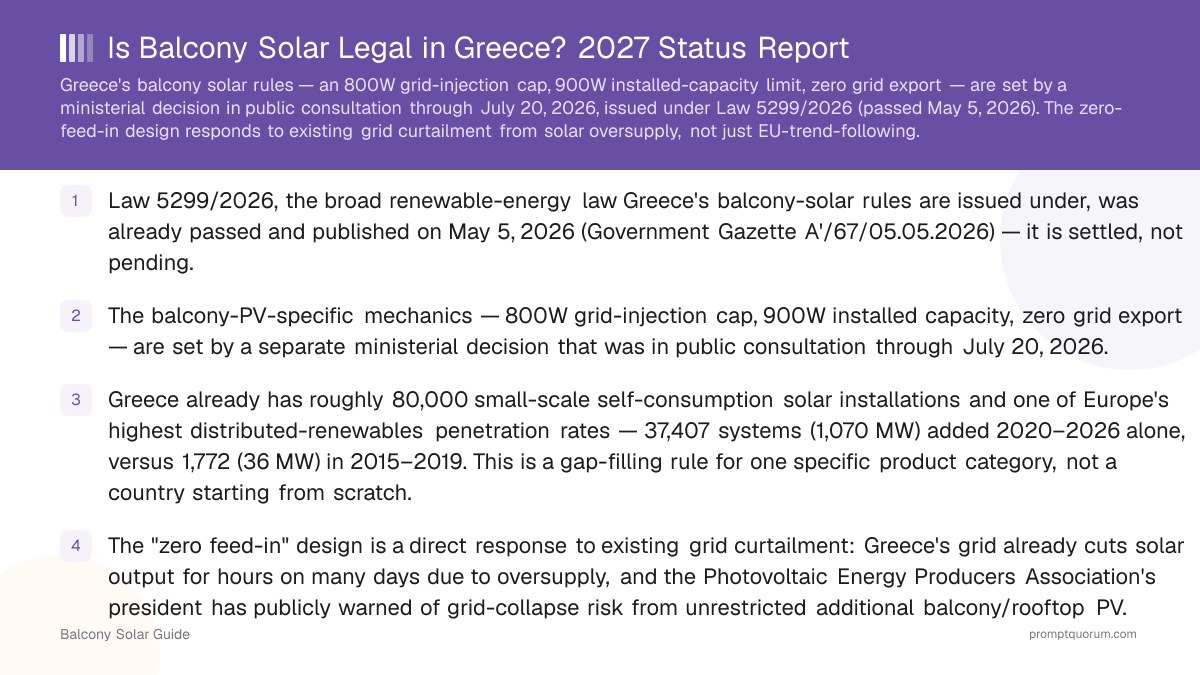
- Law 5299/2026, the broad renewable-energy law Greece's balcony-solar rules are issued under, was already passed and published on May 5, 2026 (Government Gazette Α'/67/05.05.2026) — it is settled, not pending.
- The balcony-PV-specific mechanics — 800W grid-injection cap, 900W installed capacity, zero grid export — are set by a separate ministerial decision that was in public consultation through July 20, 2026.
- Greece already has roughly 80,000 small-scale self-consumption solar installations and one of Europe's highest distributed-renewables penetration rates — 37,407 systems (1,070 MW) added 2020–2026 alone, versus 1,772 (36 MW) in 2015–2019. This is a gap-filling rule for one specific product category, not a country starting from scratch.
- The "zero feed-in" design is a direct response to existing grid curtailment: Greece's grid already cuts solar output for hours on many days due to oversupply, and the Photovoltaic Energy Producers Association's president has publicly warned of grid-collapse risk from unrestricted additional balcony/rooftop PV.
- Registration will be notification-only via a new DEDDIE/HEDNO digital platform — no permit, no license, no connection fee — with mandatory anti-islanding protection to keep balcony PV output from reaching the grid at all.
- Standalone battery storage for self-consumption is being institutionalized as a second, related category alongside balcony PV — also restricted to no grid injection.
The Law Is Settled — the Balcony-Specific Rules Aren't, Yet
Law 5299/2026 is a broad renewable-energy transition law — it transposes EU RED III provisions, accelerates permitting, and designates Renewable Energy Acceleration Areas — and it was passed and published in the Government Gazette (Α'/67/05.05.2026) on May 5, 2026. It is not itself in draft or pending; it is enacted law. It does not, on its own, spell out balcony-solar-specific wattage caps or registration steps.
Those balcony-specific mechanics — the 800W grid-injection cap, the 900W installed-capacity limit, and the zero-feed-in design — are set out in a separate ministerial decision issued under Law 5299/2026's authority, and that ministerial decision was the part still in public consultation, through July 20, 2026. This is a meaningful distinction: describing the whole framework as "not yet law" would be inaccurate, since the enabling statute already passed; describing the balcony-PV rules as fully settled would also be inaccurate, since the decision fixing their exact mechanics had not yet been finalized as of this page's publish date.
⚠️Warning: [VERIFY] This page reports the ministerial decision as drafted for public consultation, closing July 20, 2026 — one day after this page's publish date. Confirm the finalized decision text and effective date directly before treating the 800W/900W caps or the zero-feed-in mechanism as settled in final form.
Greece Isn't Starting From Zero
Greece already has roughly 80,000 small-scale self-consumption solar installations, one of the highest per-capita penetration rates for distributed renewables in Europe — this is not a market with no existing solar culture. Growth in this segment has been sharp: 37,407 systems, totaling 1,070 MW, were added between 2020 and 2026, compared with just 1,772 systems (36 MW) across 2015–2019.
What was genuinely missing, before this ministerial decision, was a dedicated rule for the specific plug-in/balcony product category — small, consumer-installed, direct-to-outlet kits, as distinct from the larger self-consumption rooftop systems that make up most of that existing installed base. Before this decision, balcony-specific plug-in kits existed in a regulatory grey zone with no explicit legal framework permitting or prohibiting the category. [VERIFY: single-source, a personal blog account, not corroborated by news/legal sources] That grey zone reportedly meant hardware was sold in Greek shops despite the regulatory void, leaving buyers without clear insurance coverage or legal standing in the event of an electrical incident.
Why Zero Feed-In — and Why Now
Greece's grid already curtails existing solar generation — utility-scale and rooftop combined — for several hours on many days, because oversupply already exceeds what the grid can absorb at peak solar hours. This is the direct context for why the balcony-PV decision is drafted as "zero feed-in" (no grid export permitted at all) rather than the notification-only, export-permitted model used in France, Austria, Belgium, and the Netherlands: adding more export-capable capacity to a grid that is already curtailing existing solar would make an active problem worse, not solve a new one.
Industry experts have pushed back publicly on the broader rooftop-and-balcony solar expansion this decision is part of. The president of Greece's Photovoltaic Energy Producers Association has warned that allowing photovoltaics on every house and balcony without restriction risks pushing the grid toward collapse, and industry voices have argued that what the moment actually calls for is more battery storage on balconies, not more grid-feeding panels — a tension this page notes as a real, current disagreement rather than a settled consensus.
The Ministry of Environment and Energy has framed the broader push in terms of energy access — describing the goal as giving "more consumers to gain greater control over their energy consumption, reduce electricity bills, and strengthen their energy independence," and one minister described the aim as extending "energy democracy" to every citizen. This is the ministry's own framing of the policy goal, presented here as a stated rationale, not as this page's independent assessment of whether the framework achieves it.
Registration: What the Draft Requires
As drafted, registration is notification-only, not a permit or licensing process: no formal connection agreement with DEDDIE/HEDNO, no additional approvals, and no connection fee. The process runs through a new DEDDIE/HEDNO digital platform (still under construction as of this page's publish date): the supplier notifies DEDDIE/HEDNO at the point of purchase, and the buyer separately notifies via a Digital Gateway — using TAXISnet credentials — up to five days before installation. Installers must submit a Declaration of Responsibility, renewed every two years.
Every system must include anti-islanding protection, which automatically disconnects the installation during blackouts or local grid faults — the core mechanism ensuring compliance with the zero-feed-in design by keeping output from reaching the grid at all, rather than just discouraging it. Alongside balcony PV, the same policy push is institutionalizing standalone battery storage as a separate, related self-consumption category — also restricted to no grid injection, for households that want storage without a panel-based system.
Frequently Asked Questions
Is balcony solar legal in Greece?
The enabling law (Law 5299/2026) is already passed and published (May 5, 2026). The balcony-PV-specific rules — 800W grid-injection cap, 900W installed capacity, zero grid export — are set by a separate ministerial decision that was in public consultation through July 20, 2026, and had not been finalized as of this page's publish date.
Why is Greece designing balcony solar as "zero feed-in" instead of allowing export like Germany or France?
Because Greece's grid already curtails existing solar output for hours on many days due to oversupply. Adding export-capable balcony PV to an already-curtailing grid would worsen a real, current problem — the Photovoltaic Energy Producers Association's president has publicly warned of grid-collapse risk from unrestricted additional PV, and regulators are steering households toward batteries and self-consumption instead.
Hasn't Greece had plenty of sun and solar for years — why regulate balcony solar only now?
Greece already has ~80,000 small-scale self-consumption solar installations and one of Europe's highest distributed-renewables penetration rates — it isn't new to solar. What was missing was a rule for the specific plug-in/balcony consumer category, which existed in a legal grey zone before this decision. The timing also reflects the grid-curtailment problem the existing solar base has already created, which shaped the zero-feed-in design.
How will I register a balcony solar system in Greece?
As drafted: notification-only via a new DEDDIE/HEDNO digital platform, no permit or connection fee. The supplier notifies DEDDIE/HEDNO at purchase; the buyer separately notifies via a Digital Gateway (TAXISnet credentials) up to five days before installation, and the installer files a Declaration of Responsibility, renewed every two years.
Can I export excess balcony solar power to the grid in Greece?
No — the draft ministerial decision caps grid injection at 800W and permits no export to the grid at all. Every system requires anti-islanding protection to enforce this. Standalone battery storage, a related self-consumption category also being institutionalized, follows the same no-export rule.
When will Greece's balcony solar rules be finalized?
[VERIFY] The public consultation on the ministerial decision closed July 20, 2026. No confirmed finalization date for the decision itself was available as of this page's publish date — check DEDDIE/HEDNO or YPEN directly for current status.