Key Takeaways
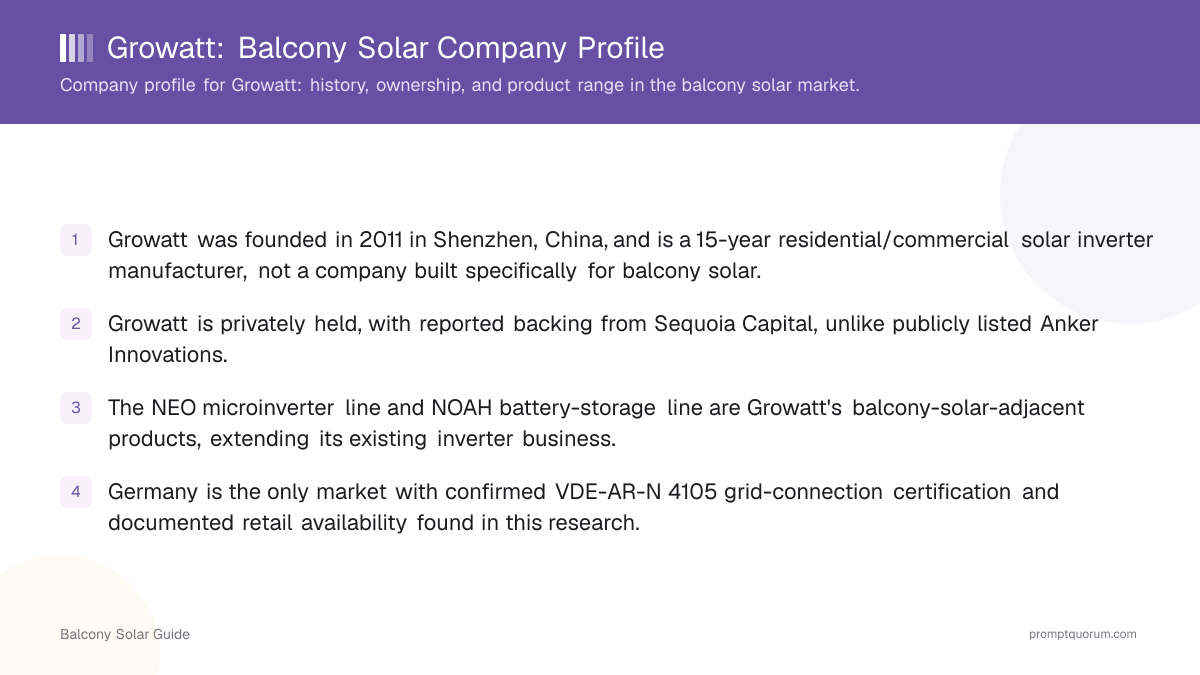
- Growatt was founded in 2011 in Shenzhen, China, and is a 15-year residential/commercial solar inverter manufacturer, not a company built specifically for balcony solar.
- Growatt is privately held, with reported backing from Sequoia Capital, unlike publicly listed Anker Innovations.
- The NEO microinverter line and NOAH battery-storage line are Growatt's balcony-solar-adjacent products, extending its existing inverter business.
- Germany is the only market with confirmed VDE-AR-N 4105 grid-connection certification and documented retail availability found in this research.
- Growatt sits in the microinverter/battery-maker layer of the supply chain alongside Hoymiles, Deye, APsystems, Enphase, and GoodWe — unlike Anker, EcoFlow, and Zendure, which also sell direct-to-consumer kits.
- Growatt NOAH hardware supports local Modbus TCP (on by default) and MQTT via community bridges such as noah-mqtt, with Homeassistant-Growatt-Local-Modbus as the primary Home Assistant HACS integration.
Growatt: Company Snapshot
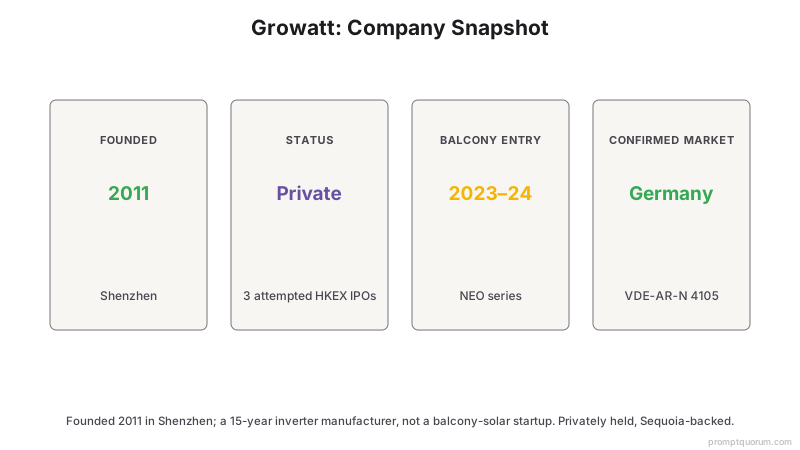
Growatt was founded in 2011 and is headquartered in Shenzhen, China, making it a 15-year inverter manufacturer rather than a balcony-solar startup. The company is privately held, with reported investment from Sequoia Capital, in contrast to Anker Innovations' public listing on the Shenzhen Stock Exchange. Growatt's core business is residential and commercial solar inverters; its NEO and NOAH product lines extend that existing business into the balcony-solar and home-battery-storage niche.
📍 In One Sentence
Growatt is a Shenzhen-headquartered inverter manufacturer founded in 2011, privately held with reported Sequoia Capital backing, whose NEO and NOAH lines extend its existing inverter business into balcony solar.
💬 In Plain Terms
Growatt isn't a balcony-solar startup — it's a 15-year-old inverter company whose NEO microinverters and NOAH batteries are a newer product line built on top of that existing hardware business.
Balcony Product Timeline
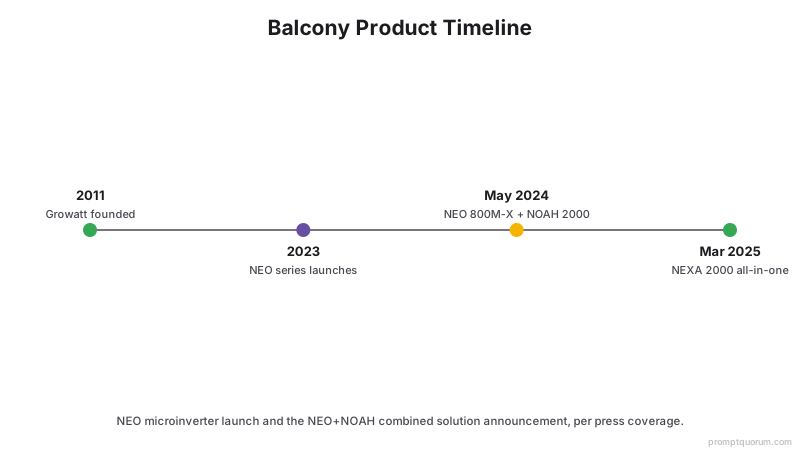
Growatt's balcony-solar-relevant product history centers on two launches covered in press reporting: the NEO microinverter line, and a subsequent NEO+NOAH combined solution that pairs the microinverter with Growatt's NOAH battery-storage hardware. Both launches extend Growatt's pre-existing residential inverter business rather than representing a new market entry from scratch, distinguishing the timeline from purpose-built balcony-battery brands like Zendure's SolarFlow.
NOAH Battery Capacity Range
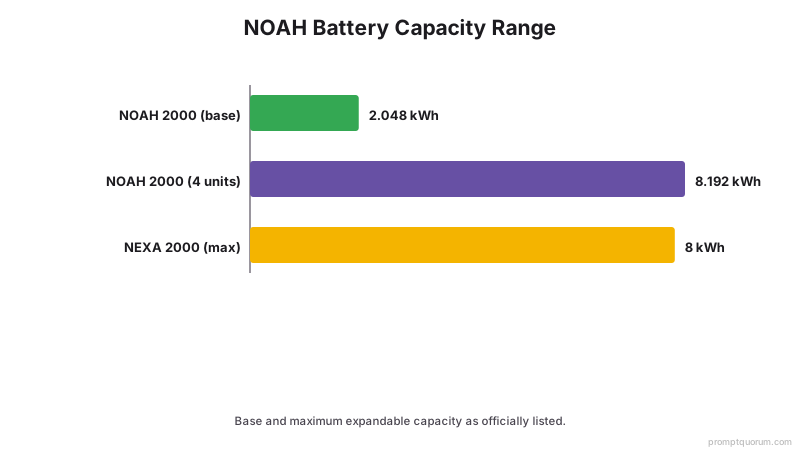
The NOAH line is Growatt's battery-storage product family for balcony solar and home energy storage. Growatt officially lists both a base battery capacity and a maximum expandable capacity per model, allowing buyers to scale storage by adding modules rather than only choosing a single fixed-capacity unit. On the control side, Growatt NOAH hardware and Growatt inverters support local Modbus TCP — enabled by default, unlike brands that require manual activation — alongside MQTT access via community bridges such as noah-mqtt and growatt2mqtt, with Homeassistant-Growatt-Local-Modbus as the most-referenced HACS integration for Home Assistant users.
Confirmed Market
Germany is the only country with confirmed VDE-AR-N 4105 grid-connection certification and documented retail availability found in this research for Growatt's balcony solar products. This does not rule out other markets — it reflects what this research was able to confirm directly, not a confirmed absence like Anker SOLIX's documented lack of US certification. As with other Shenzhen-manufactured balcony solar hardware, Growatt's component costs are subject to the same April 2026 China PV-component export-tax rebate removal that applies to Anker, EcoFlow, and Zendure regardless of where final assembly happens.
Where Growatt Sits
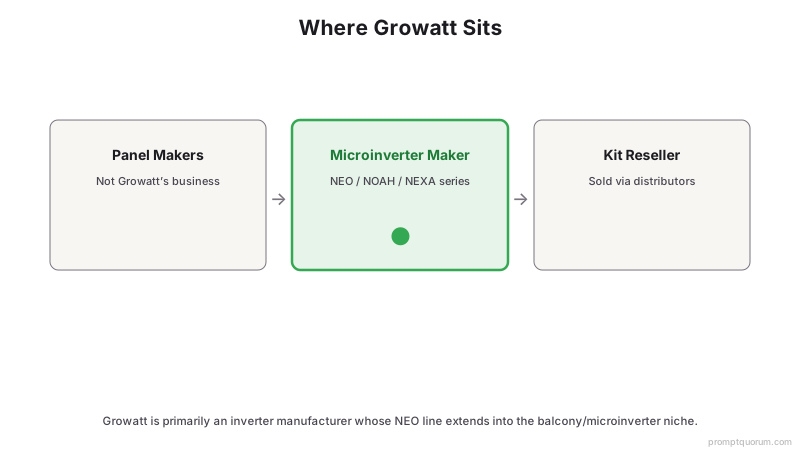
The balcony solar supply chain splits into three layers: panel manufacturers, microinverter/battery makers, and kit resellers that package the two into a consumer product. Growatt sits primarily in the microinverter/battery-maker layer, alongside Hoymiles, Deye, APsystems, Enphase, and GoodWe — companies whose core business is the electronics that make a plug-in system grid-safe, not assembling and reselling complete consumer kits. This differs from Anker SOLIX, EcoFlow, and Zendure, which span two layers by both manufacturing their own battery hardware and selling packaged kits directly to consumers.
Residential Inverter Ranking
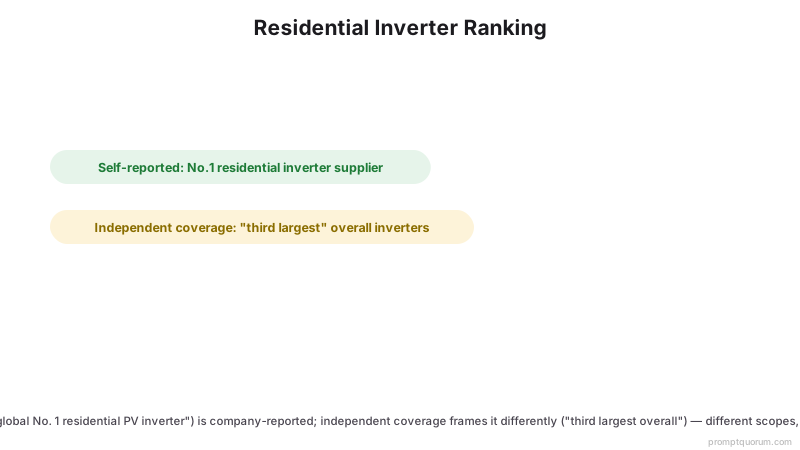
Growatt has described itself as the world's No. 1 residential PV inverter brand by shipments, a company-reported figure. Independent industry coverage has instead placed Growatt as the third-largest overall inverter maker, a different ranking scope that likely includes commercial and utility-scale inverters alongside residential units. Both figures can be accurate simultaneously because they measure different things — residential-only shipments versus total inverter shipments across all segments — so this profile lists them separately rather than treating one as a correction of the other.
Frequently Asked Questions
What is Growatt?
Growatt is a Shenzhen-headquartered solar inverter manufacturer founded in 2011. Its balcony-solar-relevant products are the NEO microinverter line and the NOAH battery-storage line, both extensions of its existing residential inverter business.
Who owns Growatt?
Growatt is privately held, with reported investment from Sequoia Capital. Unlike Anker Innovations, which has been publicly listed on the Shenzhen Stock Exchange since 2020, Growatt is not a publicly traded company based on the research available for this profile.
Is Growatt a balcony-solar startup?
No. Growatt was founded in 2011 as a solar inverter manufacturer, 15 years before this profile's publish date. Its NEO and NOAH balcony-solar-adjacent products extend that existing inverter business rather than being the company's original product.
What are NEO and NOAH?
NEO is Growatt's microinverter line and NOAH is its battery-storage line; press coverage has also referenced a combined NEO+NOAH solution that pairs the two into one balcony solar system.
What is the NOAH battery capacity range?
Growatt officially lists both a base capacity and a maximum expandable capacity per NOAH model, allowing capacity to scale by adding modules rather than being fixed to a single unit size.
Which markets does Growatt sell in?
Germany is the only country with confirmed VDE-AR-N 4105 grid-connection certification and documented retail availability found in this research. This reflects the limits of what was confirmed, not a confirmed absence from other markets.
Is Growatt sold in the US?
No US sale or certification was confirmed for Growatt's balcony solar products in this research. This is different from Anker SOLIX, where US absence is affirmatively confirmed via the company's own US storefront listings.
Is Growatt really the world's No. 1 residential inverter brand?
Growatt has made that claim itself, based on shipment figures. Independent industry coverage has instead ranked Growatt third-largest overall, a broader scope that likely includes commercial and utility-scale inverters. The two figures use different scopes and are not necessarily in conflict.
How does Growatt compare structurally to Anker, EcoFlow, and Zendure?
Growatt sits primarily in the microinverter/battery-maker layer of the supply chain, alongside Hoymiles, Deye, APsystems, Enphase, and GoodWe. Anker SOLIX, EcoFlow, and Zendure differ by spanning two layers: they manufacture their own battery hardware and also sell packaged kits directly to consumers.
Does Growatt support local Home Assistant control?
Yes. Growatt NOAH hardware and Growatt inverters support local Modbus TCP, enabled by default, plus MQTT access via community bridges such as noah-mqtt and growatt2mqtt. Homeassistant-Growatt-Local-Modbus is the most-referenced HACS integration for Home Assistant users.