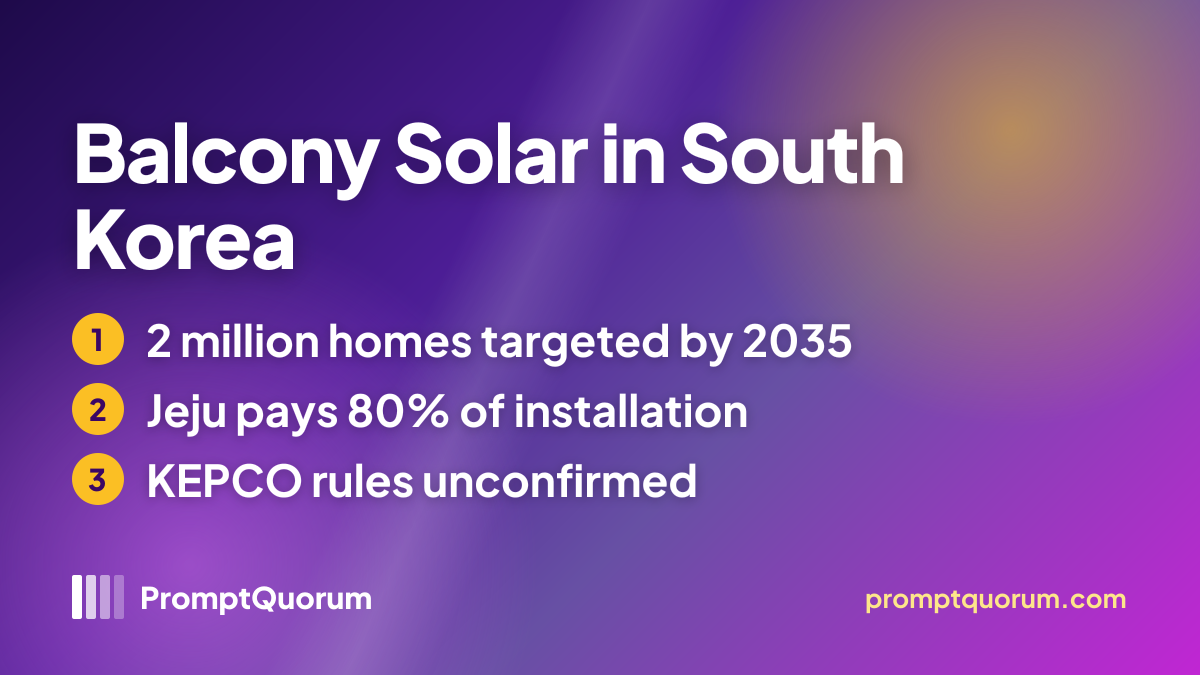
The 2026 National Plan: 100,000 Households Now, 2 Million by 2035
On 19 May 2026 the Ministry of Climate, Energy and Environment announced the first Basic Renewable Energy Plan, and reporting on it says balcony solar for apartments starts with about 100,000 households this year and targets 2 million apartment households by 2035. The same reporting mentions a goal of 100 GW of cumulative renewable capacity by 2030. One other outlet gave 2030 rather than 2035 as the 2-million-household target year, so read the original plan text before quoting either.
The modules discussed are in the 300–500 W class, mounted on balcony railings or balconies, and estimated to generate roughly 30–60 kWh a month, which the report values at about 10,000 won a month on a household electricity bill. The report does not state a total power limit per household.
Safety is the other pillar of the plan. The government intends to strengthen standards for structural fastening and wind pressure and to make a defect warranty of at least five years and a dedicated after-sales system mandatory.
📍 In One Sentence
On 19 May 2026 South Korea announced a plan to put balcony solar on about 100,000 apartments in 2026 and 2 million by 2035.
💬 In Plain Terms
The government wants ordinary apartment households to hang small solar panels on their balconies, and it plans stricter safety and warranty rules to make that work.
📌Note: Plan details come from press reporting of the announcement, not from the ministry's own document. Check the original plan text for exact targets and dates.
Local Subsidies: What Jeju Pays
Local governments run the actual subsidy programmes, and the clearest 2026 example is Jeju: an Asia Economy report of 14 October 2026 says it covers 80% of the installation cost of a 500 W system, 800,000 of 1,000,000 won, so the household pays 200,000 won. The programme covers 400 households in detached homes and apartments, with applications accepted until 4 December and a budget of 320 million won in national and provincial funds.
Households that already received a mini-solar subsidy from an earlier national or local programme are excluded. Applicants must sign with the designated partner company, and warranties run three to five years depending on the component, with at least one follow-up inspection a year. A Jeju official warned residents to confirm a company is officially designated before applying, because of false advertising.
Balcony solar subsidies in Korea are not new. A Seoul programme from 2014 offered 50% of installation cost up to 300,000 won for 200–260 W railing-mounted modules that connect to household power through a plug, with five years of free after-sales service. Other cities and provinces run their own schemes, so the amount depends on where you live.
The Grid Rules We Could Not Confirm: KEPCO, Meter and Inspection
None of the sources we reviewed says whether a balcony unit must be notified to the utility KEPCO, whether the meter must be changed, or whether an electrical safety inspection applies. The national plan reporting, the Jeju programme and the 2014 Seoul programme page all describe subsidy, size and warranty, and none mentions KEPCO notification, net metering or an inspection by the electrical safety body.
That silence is not an answer. The subsidy programmes are run through designated installers who may handle the paperwork, but we could not verify that, and we did not find a published national rule. Ask the programme operator or KEPCO in writing before you install, and keep the reply. If you buy outside a subsidy programme, the same question applies and you have no installer to rely on.
⚠️Warning: Do not assume that a subsidised unit is automatically registered with KEPCO, and do not assume it is not. Neither statement is supported by the sources we found.
After-Sales and Safety: Why Earlier Programmes Struggled
Earlier Korean balcony solar programmes ran into three recurring problems: poorly fastened structures and wind-pressure risk, inverter failures and weak maintenance, and installers that went out of business and ended after-sales service. The press reporting on the 2026 plan cites these as the reasons the government wants a mandatory minimum five-year defect warranty and a dedicated after-sales system.
Two further risks are named. Programmes in the past shrank once cost-effectiveness and management problems emerged, and panels installed in one wave all reach end of life 15–20 years later, creating a combined replacement and recycling burden. For a buyer, the practical checks are a written warranty of at least five years, a named after-sales contact, and a railing fixing that is rated for wind load at your floor height.
Frequently Asked Questions
Is balcony solar legal in South Korea?
Nothing we found restricts it, and the government and local authorities are promoting it. What we could not confirm is whether grid notification or an inspection applies to a balcony unit.
What is the national plan for balcony solar?
On 19 May 2026 the Ministry of Climate, Energy and Environment announced the first Basic Renewable Energy Plan. Reporting says it starts with about 100,000 apartment households in 2026 and targets 2 million by 2035, with one outlet giving 2030.
How much does Jeju pay?
According to an Asia Economy report of 14 October 2026, Jeju covers 80% of installation cost: 800,000 of 1,000,000 won for a 500 W unit, leaving the household 200,000 won. It covers 400 households and applications run until 4 December.
Do I need to notify KEPCO?
We could not confirm it. None of the sources we reviewed mentions KEPCO notification, a meter change or an inspection for balcony units. Ask your programme operator or KEPCO in writing.
How big are the panels?
The plan reporting discusses modules in the 300–500 W class, estimated at roughly 30–60 kWh a month. Jeju's programme funds 500 W per household. The reporting states no total power limit per household.
What warranty should I expect?
The government plans a mandatory minimum five-year defect warranty with dedicated after-sales service. Jeju's programme lists three to five years depending on the component and at least one inspection a year.
Why did earlier programmes struggle?
Reporting cites poor structural fastening and wind-pressure risk, inverter failures, weak maintenance and installers that went out of business, which ended after-sales service.
Can I install outside a subsidy programme?
We found no source that addresses it. The same grid and safety questions apply, and you would have no designated installer to handle them, so confirm the rules with KEPCO and your apartment management first.