Key Takeaways
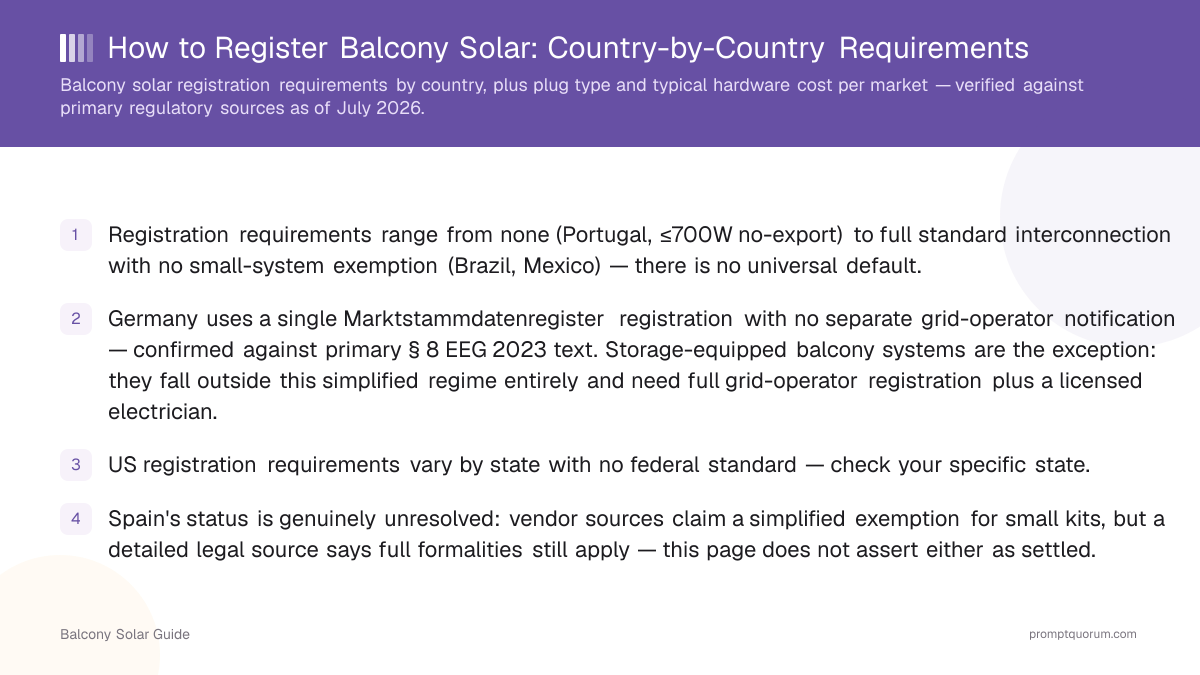
- Registration requirements range from none (Portugal, ≤700W no-export) to full standard interconnection with no small-system exemption (Brazil, Mexico) — there is no universal default.
- Germany uses a single Marktstammdatenregister registration with no separate grid-operator notification — confirmed against primary § 8 EEG 2023 text. Storage-equipped balcony systems are the exception: they fall outside this simplified regime entirely and need full grid-operator registration plus a licensed electrician.
- US registration requirements vary by state with no federal standard — check your specific state.
- Spain's status is genuinely unresolved: vendor sources claim a simplified exemption for small kits, but a detailed legal source says full formalities still apply — this page does not assert either as settled.
- Plug type and typical hardware price both vary meaningfully by country — see the dedicated table below rather than assuming your home market's numbers apply elsewhere.
- This data traces back to a single shared source-of-truth module — if a figure here looks outdated, the underlying data file is what needs updating, not this article's prose independently.
Do You Need to Register?
Whether you need to register depends entirely on your country's regulatory approach — some have a dedicated lightweight tier for small systems, others apply the same registration process regardless of size. The table below summarizes current registration requirements by country; see each market's dedicated section for detail.
Great Britain is the newest entry and works differently from every market below: notification happens *after* connection, not before. See the plug-in balcony solar UK rules and G98 notification steps for the 28-day window and the one-device-per-household limit.
country | registration | powerLimit |
|---|---|---|
| United States | Varies by state and utility — no uniform federal registration. | No federal cap; varies by state where legislation exists (Colorado highest at 1920W). |
| Germany | Marktstammdatenregister (MaStR) entry only — confirmed still the sole registration step. § 8 EEG 2023 text states no additional Netzbetreiber (grid operator) notification can be demanded beyond MaStR; the grid operator is informed automatically via MaStR data-sharing. Re-confirmed unchanged since the May 2024 reform. | 800W |
| Spain | UNCERTAIN — conflicting sources; treat as "may require full RD 244/2019 formalities" until confirmed otherwise per installation. | 800W |
| Portugal | None for ≤700W with no grid injection. Simplified online notification (Mera Comunicação Prévia) via DGEG portal for 700W–30kW. | 700W |
| Brazil | Standard micro-geração connection request with the local distribution utility (concessionária) — same process as any rooftop system, no lighter tier for small plug-in kits. | No official ANEEL wattage exemption threshold found (e.g. no 500W/1kW carve-out). |
| Mexico | CFE interconnection contract (Contrato de Interconexión) via a CRE-certified installer — required for any grid-tied system regardless of size. | No sub-kW exemption exists; 700kW is a permitting-complexity boundary, not a wattage cap relevant to balcony-scale systems. |
| Gulf / MENA (UAE + Saudi Arabia) | UAE: utility NOC (DEWA/ADDC/AADC/SEWA) before any connection, no exemption tier. Saudi: SEC via Shams platform for ≥1kW only; sub-1kW has no stated registration path either way. | 1000W |
Germany: Marktstammdatenregister
Germany requires a single Marktstammdatenregister (MaStR) entry for standard plug-in balcony solar — no separate grid-operator notification is required, since the grid operator is informed automatically via MaStR data-sharing. The inverter AC output cap is 800W, reinforced by DIN VDE V 0126-95, a dedicated EU product safety standard for plug-in solar that took effect December 1, 2025.
Total panel (module) capacity can reach 2,000 Wp even though the inverter output is capped at 800W — but DIN VDE V 0126-95 caps module power at 960 Wp specifically when connecting through a standard household Schuko socket, with the full 2,000 Wp requiring a dedicated energy connector instead. Any storage-equipped balcony system falls outside this simplified regime — battery-equipped kits still require full grid-operator registration and a licensed electrician in Germany, unlike standard plug-in units.
United States: Varies by State
There is no federal balcony solar registration requirement in the US — legality and any registration process is determined entirely at the state level, and most states have no framework addressing balcony solar specifically at all. See the state-by-state legal guide for current per-state status, since this changes month to month as legislatures act.
Spain
Spain's registration status for small balcony solar kits is genuinely unresolved — vendor and press sources claim systems under roughly 800W need no project, installer certificate, or registration, while a detailed legal-focused source states Spain has not adopted a dedicated balcony-solar regime and full RD 244/2019 formalities (CIE certificate, REBT compliance, regional registry, distributor notification) still apply. Treat this as an open question requiring direct confirmation for your specific region, not a settled fact in either direction.
Portugal
Portugal has the clearest, most confidently sourced simplified regime of any country covered here: systems up to 700W AC output with no grid export are exempt from prior control entirely, per Decreto-Lei n.º 15/2022. Systems between 700W and 30kW require only a simplified online notification ("Mera Comunicação Prévia") through DGEG rather than full registration.
Step-by-Step Per Market
The general pattern across markets with a registration requirement: confirm your system falls within any applicable power limit, gather the documentation your specific market requires (which varies from none to a full technical application), and submit through the designated authority — a utility, a national energy regulator, or both. Because the exact steps differ so much by country, always follow your market's official process directly rather than assuming another country's steps transfer over.
Plug Type & Hardware Cost by Country
Typical hardware pricing varies substantially by market — treat the figures below as a starting reference, not a quote, and note that several are flagged unverified where no reliable local-currency price was found.
country | typicalPrice | verified |
|---|---|---|
| United States | $1,500–$2,000 for a typical 800W kit (budget kits from ~$900–$1,200) | Verified |
| Germany | €250–€500 for a standard 800W kit; €600–€1,500 with battery storage | Verified |
| Spain | €589–€999 for a 600–800W kit | Verified |
| Portugal | €290–€900 for a 600–800W plug & play kit | Verified |
| Brazil | UNCERTAIN — no clean 400–600W plug-in kit BRL price found. Larger complete grid-tied kits with batteries: R$10,000–20,000. One ~600W portable option cited around R$5,000 (payback 4–6yr) but source quality uncertain. | Unverified — treat as approximate |
| Mexico | UNCERTAIN for small (300–800W) plug-in kits in MXN — only larger CFE-interconnection kits found (~$60,000–$132,490 MXN for 1.75–10kW systems). | Unverified — treat as approximate |
| Gulf / MENA (UAE + Saudi Arabia) | UNCERTAIN — no dedicated small plug-in-kit AED/SAR pricing found in either market. General panel-only pricing: AED 2.50–4.00/watt (UAE); SAR 20,000–60,000 general residential system (Saudi). This segment does not yet appear commercially established with published Gulf-market pricing. | Unverified — treat as approximate |
Frequently Asked Questions
Which country has the simplest balcony solar registration?
Portugal — systems up to 700W AC output with no grid export require no registration at all, per Decreto-Lei n.º 15/2022, one of the most clearly codified exemptions found across the markets covered here.
Do I need to register balcony solar in Germany?
Yes, via a single Marktstammdatenregister (MaStR) entry — no separate grid-operator notification is required for standard plug-in units. Storage-equipped balcony systems are an exception and still require full grid-operator registration plus a licensed electrician.
Is there a federal registration requirement in the US?
No — registration requirements, where they exist at all, are determined entirely at the state level. Most states have no dedicated balcony solar framework yet.
Do Brazil and Mexico have a simplified registration path for small systems?
No — both countries apply their standard full interconnection/registration process regardless of system size, with no documented small-system exemption found.
Is Spain's 800W exemption confirmed?
No — this is genuinely unresolved. Some sources claim an exemption for systems under roughly 800W; a detailed legal source disputes this and says full formalities still apply. Treat it as an open question.
What plug type do I need for my country?
This varies by country — check the table above for your specific market rather than assuming a single global standard applies.
Why does hardware pricing vary so much by country?
Local retail markups, import costs, and market maturity all vary — several figures in the table above are flagged unverified precisely because reliable local pricing wasn't consistently found.
How often does this registration information change?
Frequently enough that this page is on a 6-month refresh cycle — legislatures and regulators actively amend these rules, particularly in the US where new states are adding balcony solar legislation regularly.