Key Takeaways
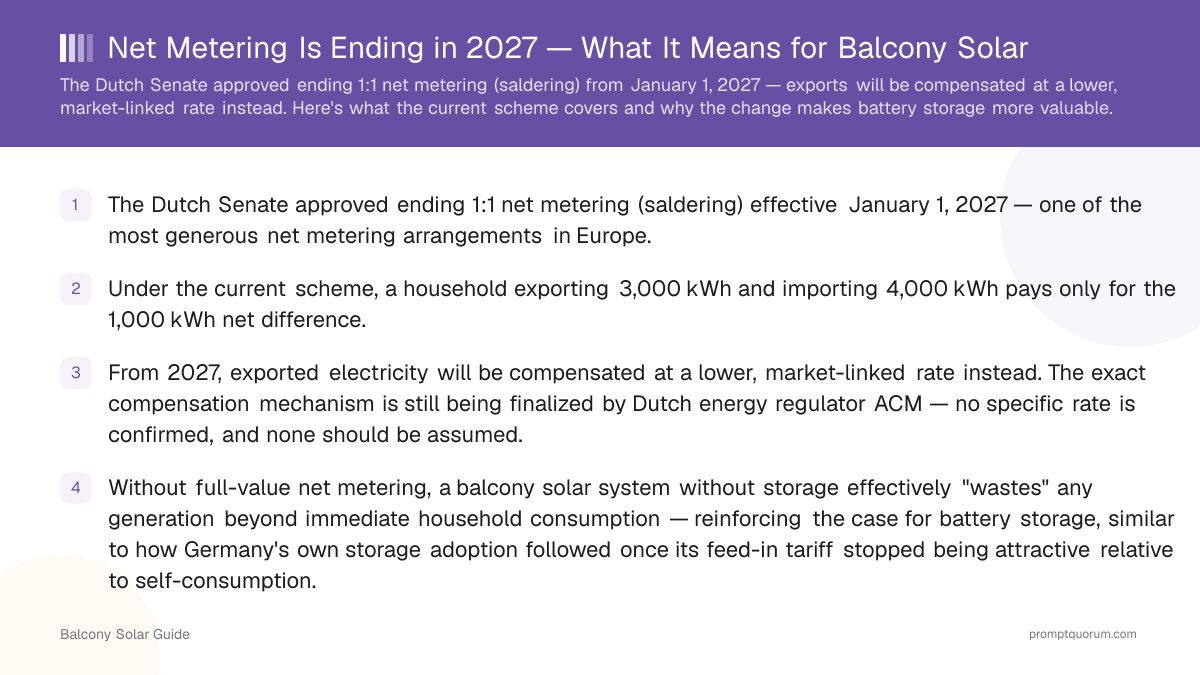
- The Dutch Senate approved ending 1:1 net metering (saldering) effective January 1, 2027 — one of the most generous net metering arrangements in Europe.
- Under the current scheme, a household exporting 3,000 kWh and importing 4,000 kWh pays only for the 1,000 kWh net difference.
- From 2027, exported electricity will be compensated at a lower, market-linked rate instead. The exact compensation mechanism is still being finalized by Dutch energy regulator ACM — no specific rate is confirmed, and none should be assumed.
- Without full-value net metering, a balcony solar system without storage effectively "wastes" any generation beyond immediate household consumption — reinforcing the case for battery storage, similar to how Germany's own storage adoption followed once its feed-in tariff stopped being attractive relative to self-consumption.
- This page covers the specific Netherlands saldering rollback — it is a narrower, differentiated topic from a general net-metering/grid-export explainer previously scoped for this cluster and held pending demand data; that broader piece is not covered here.
The Current Scheme, and What Changes
Under the Netherlands' current saldering scheme, exported and imported electricity are netted 1:1 — a household exporting 3,000 kWh and importing 4,000 kWh over a billing period pays only for the 1,000 kWh net difference. This is one of the most generous net metering arrangements in Europe, effectively letting solar owners use the grid as a free battery.
From January 1, 2027, that changes: exported electricity will instead be compensated at a lower, market-linked rate rather than netted 1:1 against consumption. The exact compensation mechanism is still being finalized by Dutch energy regulator ACM — no specific rate has been published, and this page will not state one until ACM confirms it. Multiple independent sources informally converge on a roughly €0.04–0.10/kWh expected range (against current retail electricity rates of roughly €0.28–0.35/kWh), but treat this strictly as an unofficial estimate, not a confirmed figure, until ACM publishes. The direction is unambiguous even though the exact number is not: self-consumption becomes significantly more valuable than it was under saldering.
Why This Makes Battery Storage More Valuable
Without full-value net metering, a balcony solar system without storage effectively "wastes" any generation beyond immediate household consumption. Once exports are compensated at a market-linked rate below the 1:1 saldering rate, storing surplus power for later self-consumption becomes more economically attractive than exporting it.
This mirrors a pattern already seen in Germany, where storage adoption accelerated once the feed-in tariff stopped being attractive relative to self-consumption. As context for scale, the Netherlands has an estimated ~26 GW of installed solar capacity — existing system owners retain the current saldering arrangement only until the January 1, 2027 cutover, after which the new, lower-value export economics apply to all exports going forward.
Frequently Asked Questions
When does net metering end in the Netherlands?
The Dutch Senate approved ending 1:1 net metering (saldering) effective January 1, 2027. Until then, the current 1:1 netting scheme remains in effect.
How does the current Dutch net metering scheme work?
Exported and imported electricity are netted 1:1 over a billing period — for example, a household exporting 3,000 kWh and importing 4,000 kWh pays only for the 1,000 kWh net difference.
What replaces net metering after January 1, 2027?
Exported electricity will be compensated at a lower, market-linked rate instead of being netted 1:1 against consumption. Dutch regulator ACM has not yet finalized the exact compensation mechanism, so no specific rate can be confirmed at this time. Multiple independent sources informally converge on a roughly €0.04–0.10/kWh expected range (against current retail rates of roughly €0.28–0.35/kWh), but treat this as an unofficial estimate, not an ACM-confirmed figure.
Does this rollback apply outside the Netherlands?
No — this is specific to the Netherlands' saldering scheme. It is not a general EU-wide net-metering explainer; a broader piece on net metering and grid export across multiple countries has been scoped separately for this cluster but is not covered on this page.
Should I get a battery because of this change?
The economics move in that direction — once exports are compensated below the current 1:1 rate, storing surplus power for self-consumption becomes relatively more valuable. See the dedicated battery storage guide for the general decision framework.