Key Takeaways
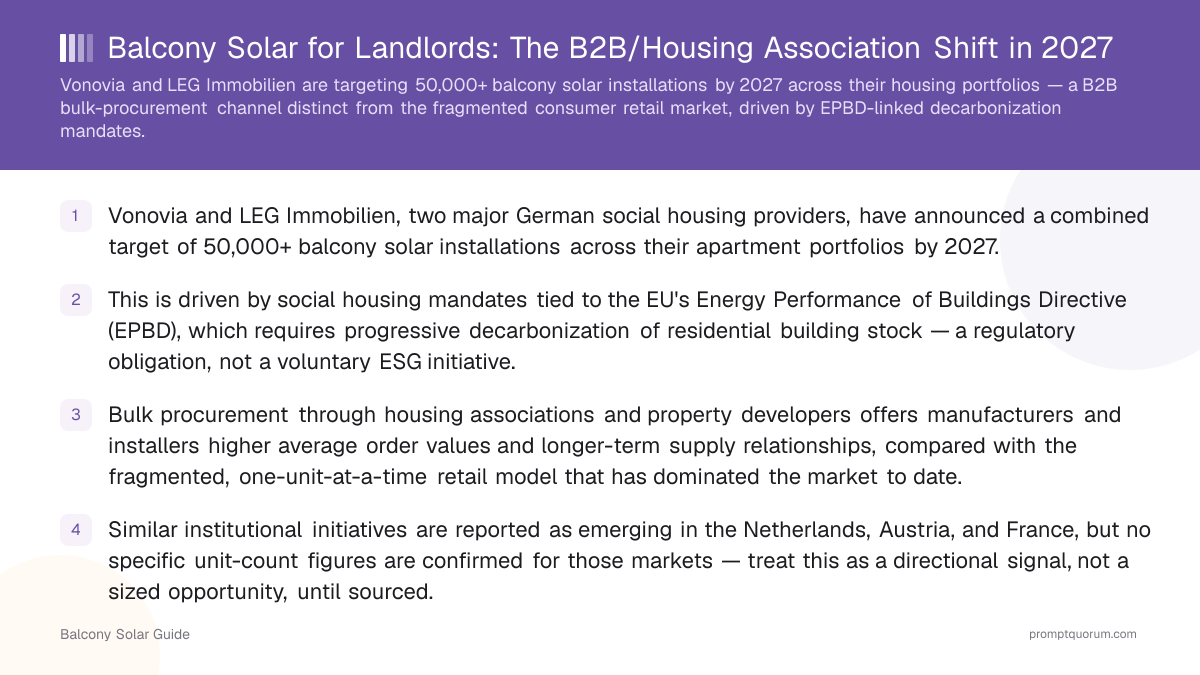
- Vonovia and LEG Immobilien, two major German social housing providers, have announced a combined target of 50,000+ balcony solar installations across their apartment portfolios by 2027.
- This is driven by social housing mandates tied to the EU's Energy Performance of Buildings Directive (EPBD), which requires progressive decarbonization of residential building stock — a regulatory obligation, not a voluntary ESG initiative.
- Bulk procurement through housing associations and property developers offers manufacturers and installers higher average order values and longer-term supply relationships, compared with the fragmented, one-unit-at-a-time retail model that has dominated the market to date.
- Similar institutional initiatives are reported as emerging in the Netherlands, Austria, and France, but no specific unit-count figures are confirmed for those markets — treat this as a directional signal, not a sized opportunity, until sourced.
- In buildings covered by these programs, balcony solar shifts from a tenant-initiated purchase to a landlord-installed amenity — potentially removing the permission friction that has slowed individual adoption in rental housing.
The Vonovia and LEG Immobilien Programs
German social housing providers Vonovia and LEG Immobilien have announced programs to install balcony solar systems across their apartment portfolios as part of broader building-decarbonization strategies, with combined installation targets exceeding 50,000 units by 2027. Both are among Germany's largest residential landlords, meaning a program at this scale reaches a substantial share of Germany's rental housing stock rather than a niche pilot.
Why This Is Regulatory, Not Voluntary
This is a direct response to regulatory pressure, not voluntary ESG branding. Social housing mandates tied to the EU's Energy Performance of Buildings Directive require progressive decarbonization of residential building stock, and similar institutional initiatives are emerging in the Netherlands, Austria, and France — though specific unit-count figures for those three markets have not been sourced and should not be cited as fact until confirmed.
The B2B Channel Shift
For manufacturers and installers, institutional housing programs represent a structurally different sales channel than direct-to-consumer retail. Bulk procurement through housing associations and property developers offers higher average order values and longer-term supply relationships, compared with the fragmented, one-unit-at-a-time retail model that has dominated the balcony solar market to date.
What This Means for Renters
In buildings covered by these programs, balcony solar shifts from a tenant-initiated purchase to a landlord-installed amenity. For renters, this potentially removes the permission friction that has slowed individual adoption in rental housing — where getting explicit landlord or HOA sign-off has historically been a common barrier to installing a personal unit.
Frequently Asked Questions
Which housing associations are installing balcony solar at scale?
German social housing providers Vonovia and LEG Immobilien have announced a combined target of over 50,000 balcony solar installations across their apartment portfolios by 2027.
Why are housing associations installing balcony solar now?
It's driven by social housing mandates tied to the EU's Energy Performance of Buildings Directive (EPBD), which requires progressive decarbonization of residential building stock — a regulatory obligation rather than a voluntary sustainability initiative.
Is this happening outside Germany too?
Similar institutional initiatives are reported as emerging in the Netherlands, Austria, and France, but no specific unit-count figures are confirmed for those markets yet — treat this as a directional trend, not a sized program, until sourced.
Does this help renters who want balcony solar but need landlord approval?
Potentially, in buildings covered by these programs — balcony solar becomes a landlord-installed amenity rather than something the tenant has to negotiate individually. Outside these specific programs, individual landlord/HOA permission questions are unaffected; see the general FAQ on that topic.