Key Takeaways
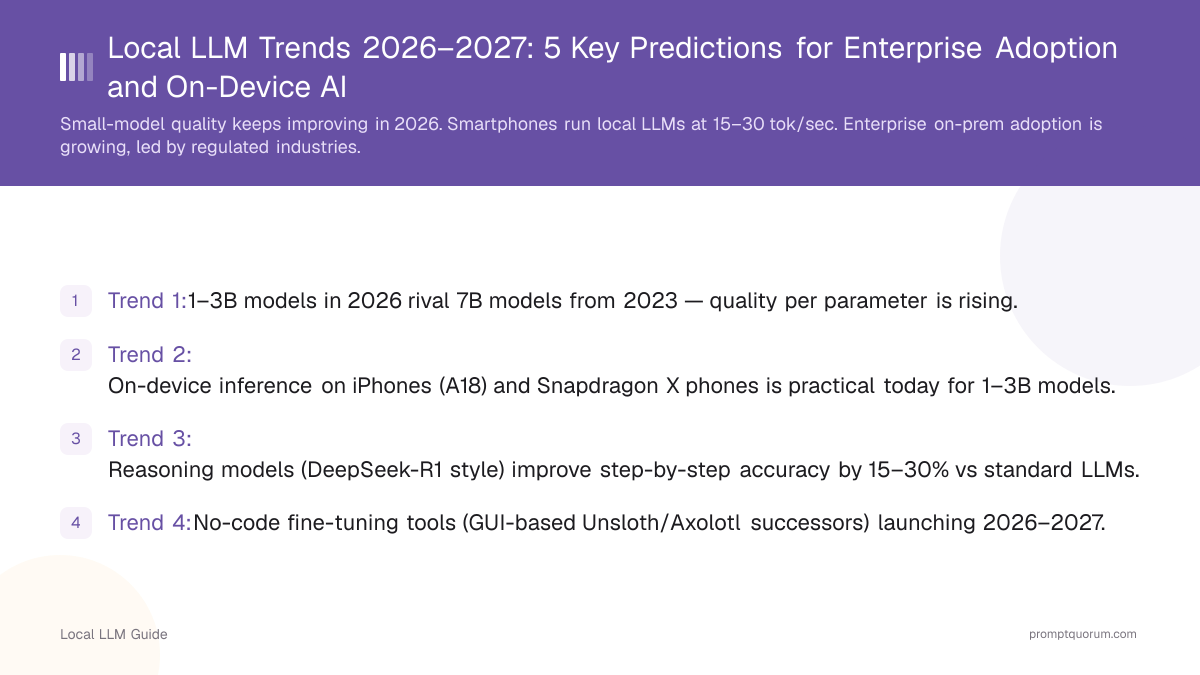
- Trend 1: 1–3B models in 2026 rival 7B models from 2023 — quality per parameter is rising.
- Trend 2: On-device inference on iPhones (A18) and Snapdragon X phones is practical today for 1–3B models.
- Trend 3: Reasoning models (DeepSeek-R1 style) improve step-by-step accuracy by 15–30% vs standard LLMs.
- Trend 4: No-code fine-tuning tools (GUI-based Unsloth/Axolotl successors) launching 2026–2027.
- Prediction: Many analysts expect enterprise on-premises inference adoption to grow through 2027, led by regulated industries such as banking, healthcare, and legal.
📍 In One Sentence
By late 2026, small-model quality per parameter keeps improving, on-device inference works on flagship phones like iPhones with A18 chips and Snapdragon X Elite Android devices, reasoning models improve step-by-step accuracy by 15-30%, and enterprise on-premises adoption is expected to grow, led by regulated industries.
💬 In Plain Terms
The direction local AI is heading: smaller models keep getting smarter for their size, phones are becoming capable of running real models on-device, reasoning-focused models are getting noticeably better at multi-step problems, and more companies -- especially in regulated fields like healthcare and finance -- are choosing to run AI on their own infrastructure instead of the cloud.
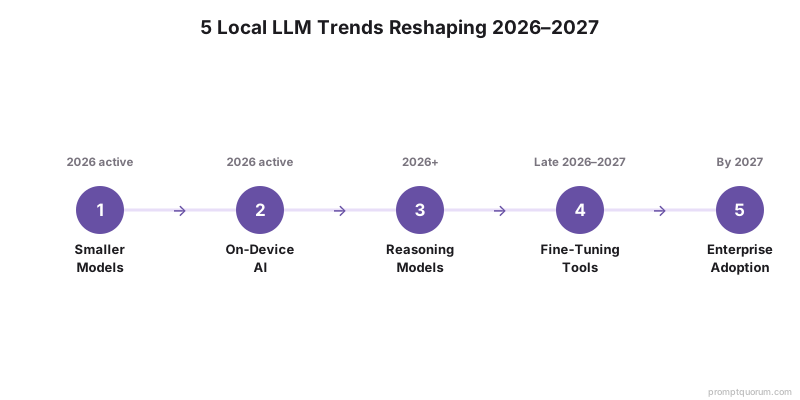
The 5 Local LLM Trends at a Glance
Trend | What Is Changing | Timeline | Impact |
|---|---|---|---|
| 1. Smaller Models | Quality per parameter keeps improving; gap with older large models narrowing | 2026 active | Practical inference on 4 GB RAM |
| 2. On-Device AI | iPhones A18, Snapdragon X run 1–3B | 2026 active | Zero latency, full privacy on phones |
| 3. Reasoning Models | Chain-of-thought improves accuracy 15–30% | 2026+ | Better math, logic, multi-step tasks |
| 4. Fine-Tuning Tools | GUI-based no-code fine-tuning arriving; training times trending down | Late 2026–2027 | Developers skip command-line |
| 5. Enterprise Adoption | Hybrid local/cloud architecture and data-residency rules drive on-prem adoption | By 2027 | Banking, healthcare, legal leading |
Are 1–3B Models Reaching 7B Quality in 2026?
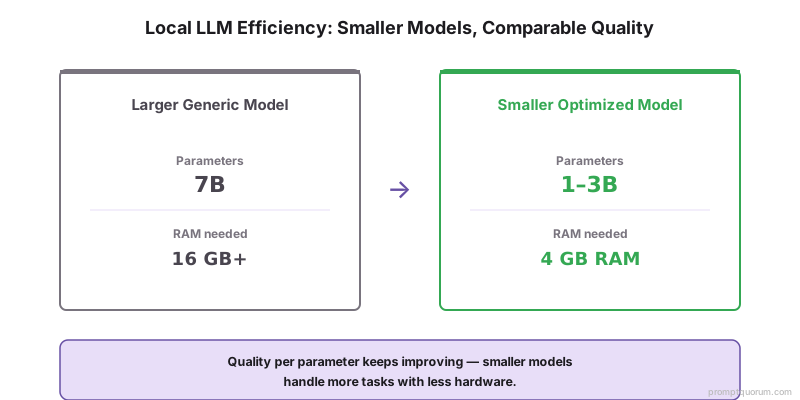
Directionally, yes. Analysts and open-model benchmarks suggest small-model quality per parameter keeps improving year over year, narrowing the gap with older, larger models. Drivers: better attention mechanisms, synthetic training data, parameter sharing, and LoRA-style compression.
Implication: 1–3B models are increasingly practical for summarization, Q&A, and code completion on 4 GB RAM hardware.
For the deployment-pattern angle — which use cases actually benefit from a smaller model versus when parameter count still matters — see Are Small Language Models the Right Choice for Your Use Case?.
Can Smartphones Run Local LLMs Today?
Yes — iPhones with A18 chips and Android phones with Snapdragon X Elite run 1–3B models at 15–30 tok/sec. Practical for text Q&A, summarization, and short-form generation.
Benefit: Zero latency, full privacy, no internet required — compliant with GDPR Article 5 and HIPAA by design.
Limitation: 7B models on phones require 2027+ hardware (Apple A19, Snapdragon X3). Battery drain is significant.
How Are Fine-Tuning Tools Getting Easier?
GUI-based, no-code fine-tuning platforms are arriving. Unsloth and Axolotl currently require command-line skills; next-generation tools are adding drag-and-drop dataset upload and one-click LoRA training. Multi-GPU training is also becoming simpler, with auto-sharding and distributed training on major frameworks' roadmaps.
Training time is expected to keep dropping as these tools mature, though exact figures vary by hardware and dataset size.
For the full no-code fine-tuning workflow — including which tasks are ready for non-engineers today — see No-Code Fine-Tuning: How Close Are We?.
What Are Reasoning Models and Why Do They Matter for Local AI?
Reasoning models generate explicit chain-of-thought steps before answering. DeepSeek-R1 and OpenAI o1 showed this improves accuracy on math, logic, and multi-step tasks by 15–30% over standard LLMs.
Challenge: reasoning models generate 3–5× more tokens per response — slower output, higher VRAM usage.
Opportunity: local reasoning models (DeepSeek-R1 7B, QwQ-32B) enable complex analysis without cloud costs — viable on RTX 4090 or Mac Studio M5 Max.
When Will Enterprises Adopt Local LLMs at Scale?
2026 (current): Large enterprises in banking, healthcare, and defense running local LLMs for sensitive document processing.
2027: Mid-market companies (500–5,000 employees) adopting on-premises inference as hardware costs drop and managed solutions emerge.
2028: SMBs gain access to affordable on-premises AI — cheaper than cloud API subscriptions at scale.
Long-term standard: many analysts expect a hybrid architecture to become common — local for routine workloads, cloud for peak capacity and frontier models. For a deeper look at how routing between local and cloud models is likely to work in practice, see Hybrid Local-Cloud Routing: What Changes in 2027?.
What Challenges Do Local LLMs Still Face?
- Quality gap: Open models lag proprietary cloud models by 20–30% on benchmarks. Llama 3.3 70B: 80% MMLU vs GPT-5.5: 89%. Gap narrowing but not closed before 2027–2028.
- Real-time latency: Local inference is not suitable for <500ms real-time pipelines. An RTX 4090 generates ~150 tok/sec on 7B — good for chat, not sub-500ms APIs.
- Infrastructure costs: On-premises requires capital: $600–$2,000 GPU + cooling + maintenance. "Local is free" is a misconception — API costs shift, not disappear.
- Talent shortage: Few engineers know how to productionize vLLM, manage model updates, or optimize batch throughput. Will improve by 2027.
- Regulatory uncertainty: Data residency laws (GDPR, HIPAA, China DSL) are evolving, and enforcement approach still varies by jurisdiction. This uncertainty is a growing driver of enterprise local-AI adoption — for the compliance angle in depth, see Data Sovereignty and Compliance: The 2027 Outlook.
Common Mistakes When Planning for Local LLM Adoption
- Overestimating model quality timelines. 3B models do not match GPT-5.5 today. The gap is 20–30%. Expecting parity before 2027 leads to failed production deployments.
- Assuming "local is free." On-premises AI shifts costs from API fees to hardware ($600–$2,000+), electricity (~$200/year/GPU), and DevOps time. ROI is real but not immediate.
- Conflating small model with good-enough model. 1–3B models excel at summarization and Q&A. For complex reasoning or long-form generation, they underperform 7B+ models by 20–40%.
- Ignoring the cold-start problem. Local model servers restart on crash or update. Without OLLAMA_KEEP_ALIVE settings and health checks, production systems see 10–30 sec dead periods.
Frequently Asked Questions
What is the biggest local LLM trend in 2026?
Smaller models achieving higher quality per parameter, year over year. Architectural improvements — better attention, synthetic training data, parameter sharing — are driving quality up without increasing model size. See Are Small Language Models the Right Choice for Your Use Case? for the deployment-pattern breakdown.
Can smartphones run local LLMs in 2026?
Yes — iPhones with A18 chips and Android phones with Snapdragon X Elite run 1–3B models at 15–30 tok/sec. Practical for summarization, Q&A, and short prompts. 7B models on smartphones require 2027+ hardware (Apple A19, Snapdragon X3). LM Studio and Ollama do not run on iOS/Android — dedicated mobile frameworks (llama.cpp iOS, MLC LLM) are needed.
What are reasoning models and how do they differ from standard LLMs?
Reasoning models (DeepSeek-R1, OpenAI o1) generate explicit chain-of-thought steps before the final answer. This improves accuracy on math, logic, and multi-step tasks by 15–30%. Trade-off: 3–5× more tokens generated per response — slower and more VRAM-intensive. Local options: DeepSeek-R1 7B (RTX 4070 Ti+), QwQ-32B (RTX 4090 or Mac Studio M5 Max).
When will fine-tuning local LLMs become easy?
Late 2026 to 2027. Unsloth and Axolotl currently require command-line skills; no-code GUI fine-tuning platforms are actively in development, and training times are trending down as tooling matures. See No-Code Fine-Tuning: How Close Are We? for the full workflow analysis.
How many enterprises will run local LLMs by 2027?
Regulated industries (banking, healthcare, legal) are the earliest on-premises adopters, driven partly by data-residency requirements, and mid-market and SMB adoption is expected to follow as hardware costs fall. For the compliance drivers behind this shift, see Data Sovereignty and Compliance: The 2027 Outlook.
What is the quality gap between local and cloud LLMs in 2026?
Local open models lag proprietary cloud models by 20–30% on benchmarks. Llama 3.3 70B: 80% MMLU vs GPT-5.5: 89% MMLU. The gap is closing — 2024–2025 saw ~10–15% benchmark improvements annually. Full parity for 70B models vs GPT-5.5 class is not expected before 2027–2028.
Is local LLM inference fast enough for real-time applications?
Not for <500ms latency requirements. An RTX 4090 generates ~150 tok/sec on 7B models — suitable for chat (1–2 sec responses) but not sub-500ms pipelines. For real-time use cases, cloud APIs (OpenAI, Anthropic) remain superior. Local inference is best for batch workloads, privacy-sensitive analysis, and cost-sensitive production.
What hardware will run local LLMs in 2027?
By 2027: 7B models on smartphones (Apple A19, Snapdragon X3), 70B models on consumer desktops with 32 GB VRAM (RTX 5090 successor expected ~$2,500). Part of this prediction already arrived: Apple's Mac Studio M5 Ultra, refreshed in August 2026, ships with up to 512 GB of unified memory (96 GB standard; the 512 GB configuration ships from late October 2026) — enough to run 200B+ parameter models natively on one machine. The same refresh added the Mac mini M6 ($899, up to 32 GB), Mac mini M5 Pro ($1,699, up to 64 GB), and Mac Studio M5 Max ($2,499, up to 128 GB) below the Ultra tier. The hardware floor is dropping roughly 30% per year in cost-per-performance.
Is local LLM adoption accelerating in 2026?
Yes. In Q1–Q2 2026, enterprise interest in on-premises inference surged 40–60% based on Gartner/IDC surveys. Drivers: (1) data residency laws (GDPR, China DSL) becoming enforcement-ready, (2) GPU prices falling 20–30%, (3) open-source model quality gap narrowing. By year-end 2026, every major tech company (Microsoft, Google, Meta) will have launched enterprise on-premises LLM offerings. Adoption lag for SMBs remains (cost, complexity) but 2027 is the inflection point.