Key Takeaways
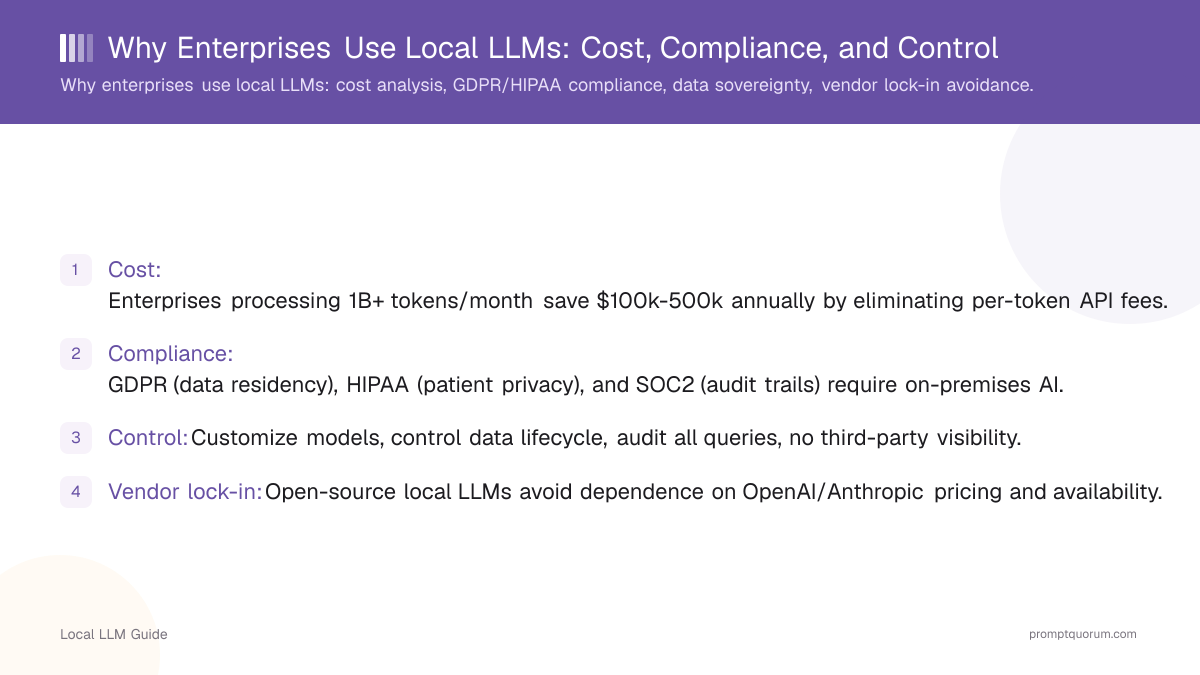
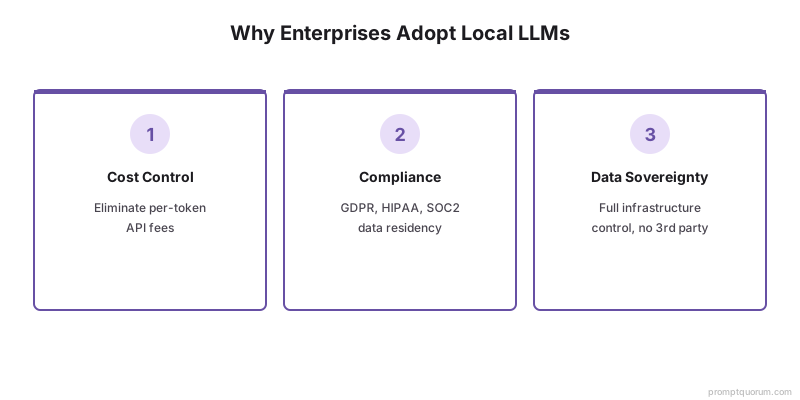
- Cost: Enterprises processing 1B+ tokens/month save $100k-500k annually by eliminating per-token API fees.
- Compliance: GDPR (data residency), HIPAA (patient privacy), and SOC2 (audit trails) require on-premises AI.
- Control: Customize models, control data lifecycle, audit all queries, no third-party visibility.
- Vendor lock-in: Open-source local LLMs avoid dependence on OpenAI/Anthropic pricing and availability.
- Security: Keep proprietary data and algorithms completely on-premises, reducing breach risk and regulatory exposure.
- Scalability: Deploy across multiple GPUs and Kubernetes clusters for millions of concurrent tokens/month.
- Break-even point is typically 200M-500M tokens/month, depending on data residency costs.
- Major industries adopting: finance, healthcare, government, legal, energy, and manufacturing.
📍 In One Sentence
Enterprises deploy local LLMs for three reasons -- cost savings on high-volume token usage, regulatory compliance (GDPR, HIPAA, SOC2) that requires data residency, and control over customization, audit trails, and vendor independence.
💬 In Plain Terms
Instead of paying a cloud AI company per request, a company can run the AI model on its own servers. This saves money once usage is high enough, keeps sensitive data from ever leaving company infrastructure (important for healthcare, finance, and government), and lets the company customize the model and audit exactly how it is used -- without depending on an outside vendor.
How Much Do Enterprises Save With Local LLMs?
Per-token pricing for cloud APIs accumulates quickly. Local LLMs have one-time hardware investment and ongoing operational costs.
Annual Token Volume | Cloud API Cost | Local AI (amortized) | Annual Savings |
|---|---|---|---|
| 100M tokens | $1,000 | $500 | $500 |
| 1B tokens | $10,000 | $5,000 | $5,000 |
| 10B tokens | $100,000 | $50,000 | $50,000 |
| 100B tokens | $1,000,000 | $500,000 | $500,000 |
What Compliance Requirements Drive Local AI?
GDPR (EU): Article 32 requires data processing within the EU. Cloud APIs to US servers violate GDPR. EU options include Hetzner Cloud GPU, Scaleway, and OVHcloud.
HIPAA (Healthcare): 164.306 requires patient data stored and processed on secure, audited infrastructure. No third-party API access.
SOC2 Type II (Enterprise): Type II audit requires 6+ months of audit logs, encryption, access controls. On-premises provides full control.
Data Residency Laws (China, Russia, India, Brazil): Many countries mandate data stay within borders. Local AI ensures compliance.
Violating these regulations incurs fines: GDPR up to €20M or 4% revenue, HIPAA up to $1.5M per violation.
Why Do Enterprises Need Data Sovereignty?
Data sovereignty means data stays under the organization's physical and legal control. No third-party access, no government subpoena risk.
Sensitive use cases: Financial models, drug formulations, trade secrets, customer personal information.
Competitive risk: If data goes to cloud, competitors (or cloud provider employees) could access it.
Historical incidents: Multiple cloud provider breaches (AWS, Azure, Google Cloud) have exposed enterprise data. Local storage eliminates that risk.
How Do Local LLMs Avoid Vendor Lock-In?
Cloud APIs lock you into vendor pricing and availability. If OpenAI increases prices 10×, you cannot switch without rewriting integrations.
Open-source local LLMs (Meta Llama, Qwen, Mistral) let you:
What Are Real Enterprise Use Cases?
How enterprises use local LLMs:
Industry | Use Case | Annual Volume | Annual Savings |
|---|---|---|---|
| Healthcare | Medical document analysis (HIPAA-compliant) | 500M tokens/year | $8k/year |
| Finance | Compliance analysis, regulatory filing | 2B tokens/year | $35k/year |
| Legal | Contract review, due diligence | 1B tokens/year | $18k/year |
| Manufacturing | Quality control, predictive maintenance | 100M tokens/year | $1.5k/year |
| Government | Classified document processing | 500M tokens/year | $8k/year + compliance |
What Are Common Objections to Local LLMs?
Objection 1: "Local models are less capable than GPT-4"
- True, but: Llama 3.3 70B matches GPT-4 (2023) on most benchmarks. For enterprises needing 80% GPT-4 quality at 1/10 cost, local is viable.
- Objection 2: "We need the latest models for competitive advantage"
- Counter: Most enterprise use cases (document analysis, Q&A, summarization) do not require frontier model quality. Fine-tuning open models beats cloud APIs on domain-specific tasks.
- Objection 3: "Infrastructure costs are too high"
- Counter: Hardware costs amortized over 5 years are 20-30% of API costs. Beyond 500M tokens/year, local is cheaper.
What Are Common Enterprise Deployment Mistakes?
- Underestimating infrastructure costs. Hardware is $20k-100k, but cooling, networking, and maintenance cost 3-5× that over 5 years.
- Not planning for scaling. Start with single-GPU setup, but production needs redundancy, failover, monitoring.
- Poor security posture. Open ports, weak authentication, no encryption = breach risk worse than cloud.
- Using outdated models. Deploy 2023 model, forget to retrain when new base models release. Plan for ongoing updates.
- Not measuring ROI. Calculate savings only on API costs, ignoring operational costs (salaries, infrastructure). Be honest about break-even timeline.
What Are Common Questions From Enterprise Leaders?
What is the minimum token volume to justify local LLMs?
Break-even is approximately 200M-500M tokens per year (depends on infrastructure, salaries in your region). Below that, cloud APIs are cheaper.
How do we ensure data never touches cloud?
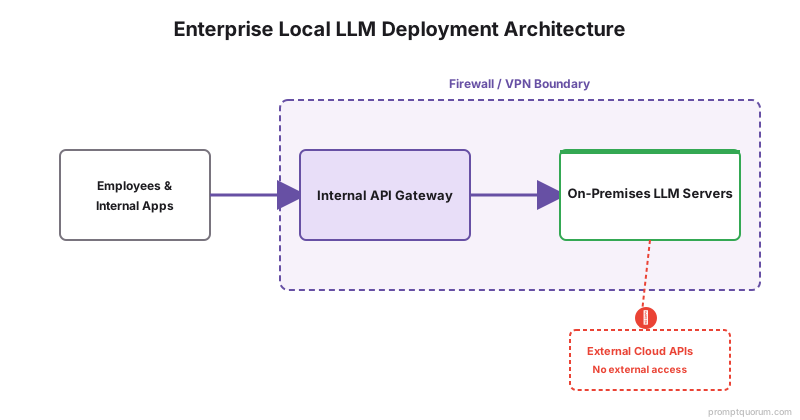
Deploy models entirely on-premises (not even inference goes to cloud). Use network monitoring and firewall rules to block external connections.
What compliance certifications do we need?
Depends on industry: SOC2 Type II (general enterprise), HIPAA (healthcare), GDPR compliance (EU operations), ISO 27001 (security best practice).
What if we need cloud scale but GDPR compliance?
When cloud is necessary, EU GDPR-compliant providers → remain an option: Hetzner, Scaleway, OVHcloud, Nebius offer full GDPR compliance with EU data residency.
Can we use cloud embeddings with local LLMs?
Technically yes, but violates data sovereignty. If data is sensitive, use local embeddings (nomic-embed-text) instead.
How do we migrate from cloud APIs to local?
Most tools (Ollama, vLLM) expose the same OpenAI API interface. Swap base_url in your code from api.openai.com to localhost:11434.
Sources
- GDPR Official Text -- gdpr-info.eu
- HIPAA Security Rule -- hhs.gov/hipaa/164-306
- SOC2 Trust Service Criteria -- aicpa.org/soc2
- McKinsey AI in Enterprise 2026 -- mckinsey.com